Bhagavad Gita 11.14: meaning and translation
Chapter 11: Vishvarupa Darshana Yoga. Sanjaya says
Sanjaya: Then Arjuna (Dhanañjaya) was filled with wonder, and the hair on his body stood up.
Click or tap a word for its meaning and its dictionary page.
Text and layers
Text and layers
These choices stay in this browser.
Bhagavad Gita 11.14
ततः स विस्मयाविष्टो हृष्टरोमा धनञ्जयः ।प्रणम्य शिरसा देवं कृताञ्जलिरभाषत ॥
Tatah sa vismayavishto hrishtaroma dhananjayahPranamya shirasa devam kritanjalirabhashata
tataḥ sa vismayāviṣṭo hṛṣṭaromā dhanañjayaḥ |praṇamya śirasā devaṃ kṛtāñjalirabhāṣata ||
Our explanation Then Arjuna (Dhanañjaya) was filled with wonder, and the hair on his body stood up. He bent his head low before the God, joined his palms and spoke.
हिंदी अर्थ तब आश्चर्य से भरे, रोमांचित अर्जुन (धनंजय) ने सिर झुकाकर देव को प्रणाम किया और हाथ जोड़कर बोले।
Word by word
Every word, with its dictionary page
Word by word
- ततः tataḥ · then (indeclinable) Dictionary: tatas, Monier-Williams 1899, p. 432, col. 2 “thereupon, then, after that”
- सः saḥ · he (pronoun (masculine), nominative singular) Dictionary: tad, Monier-Williams 1899, p. 434, col. 1 “m. he, f. she, n. it, that, this”
- विस्मयाविष्टः vismayāviṣṭaḥ · filled with wonder (compound (masculine), nominative singular) Dictionary: vi-smayāviṣṭa, Monier-Williams 1899, p. 1002, col. 2 “filled with astonishment or wonder”
- हृष्टरोमा hṛṣṭaromā · with hair standing on end (compound (masculine), nominative singular) Dictionary: hṛṣṭa-roman, Monier-Williams 1899, p. 1303, col. 2 “having the hair of the body bristling or thrilling (with delight or rapture)”
- धनञ्जयः dhanañjayaḥ · Dhananjaya (Arjuna) (noun (masculine), nominative singular) Dictionary: dhanaṃ-jaya, Monier-Williams 1899, p. 508, col. 2 “N. of Arjuna”
- प्रणम्य praṇamya · having bowed (absolutive (having done)) Dictionary: pra-ṇam, Monier-Williams 1899, p. 659, col. 3 “to bend or bow down before”
- शिरसा śirasā · with the head (noun (neuter), instrumental singular) Dictionary: śiras, Monier-Williams 1899, p. 1072, col. 2 “the head, skull”
- देवम् devam · to the God (noun (masculine), accusative singular) Dictionary: deva, Monier-Williams 1899, p. 492, col. 2 “a deity, god”
- कृताञ्जलिः kṛtāñjaliḥ · with joined palms (compound (masculine), nominative singular) Dictionary: kṛtāñjali, Monier-Williams 1899, p. 303, col. 1 “one who joins the hollowed palms in reverence or to solicit favour”
- अभाषत abhāṣata · spoke (imperfect, 3rd person singular) Dictionary: 1. bhāṣ, Monier-Williams 1899, p. 755, col. 2 “to speak, talk, say, tell”
Old translations
Kashinath Trimbak Telang, 1882. Public domain. Page 93.
Then Dhanañgaya filled with amazement, and with hair standing on end, bowed his head before the god, and spoke with joined hands.
Compare 3 translations
Kashinath Trimbak Telang, 1882. Public domain. Page 93.
Then Dhanañgaya filled with amazement, and with hair standing on end, bowed his head before the god, and spoke with joined hands.
You are reading this one
Annie Besant, 1895. Public domain. Page 105.
Then he, Dhananjaya, overwhelmed with astonishment, his hair upstanding with delight, bowed down his head, and with joined palms spake to the God.
You are reading this one
Swami Swarupananda, 1909 (first printed 1907). Public domain. Page 218.
Then Dhananjaya, filled with wonder, with his hair standing on end, bending down his head to the Deva in adoration, spoke with joined palms.
You are reading this one
Cite this verse
The translation: K. T. Telang, The Bhagavadgîtâ (The Sacred Books of the East, vol. VIII, Oxford: Clarendon Press, 1882), p. 93. Bhagavad Gita 11.14.
The translation: Annie Besant, The Bhagavad Gîtâ, or The Lord's Song (London: Theosophical Publishing Society, 1895), p. 105. Bhagavad Gita 11.14.
The translation: Swami Swarupananda, Srimad-Bhagavad-Gita (Mayavati: Prabuddha Bharata Press, 1909; first printed in Prabuddha Bharata, 1907–1909), p. 218. Bhagavad Gita 11.14.
Our explanation: “Bhagavad Gita 11.14: meaning and translation.” Pujadeep. Updated October 27, 2026. https://pujadeep.com/bhagavad-gita/11/14/
Pujadeep’s explanations are free to quote with credit: name Pujadeep and link to the page. How to credit
Classical readings, by school
No readings by school on this verse yet.
Share
Show the ways to share
Send one picture or the text to one chat. The picture names its source and the address of this page.
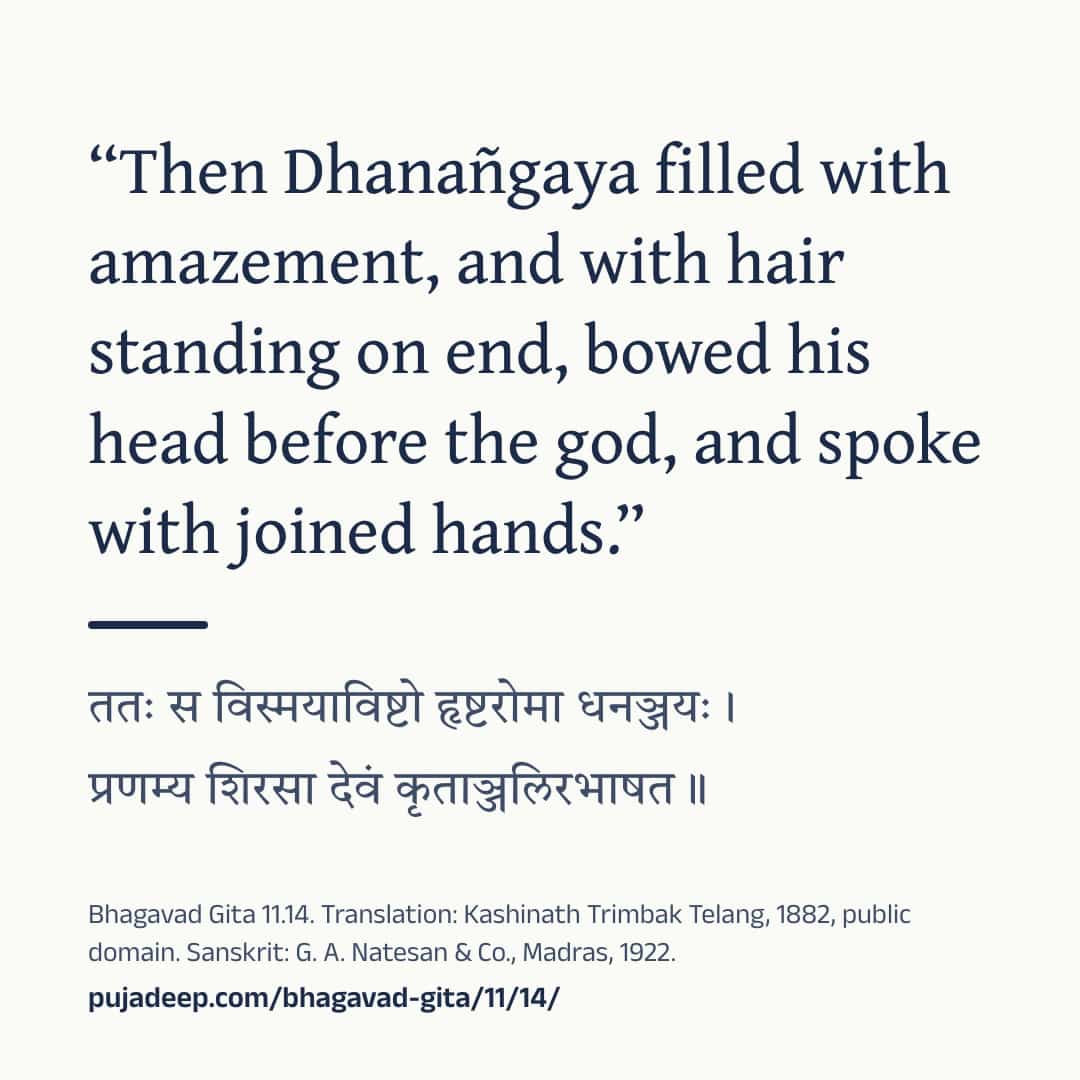
Drawing the picture
See the words
Bhagavad Gita 11.14

ततः स विस्मयाविष्टो हृष्टरोमा धनञ्जयः ।
प्रणम्य शिरसा देवं कृताञ्जलिरभाषत ॥

“Then Dhanañgaya filled with amazement, and with hair standing on end, bowed his head before the god, and spoke with joined hands.”
(K. T. Telang, The Bhagavadgîtâ (The Sacred Books of the East, vol. VIII, Oxford: Clarendon Press, 1882), p. 93, public domain)

“Then he, Dhananjaya, overwhelmed with astonishment, his hair upstanding with delight, bowed down his head, and with joined palms spake to the God.”
(Annie Besant, The Bhagavad Gîtâ, or The Lord's Song (London: Theosophical Publishing Society, 1895), p. 105, public domain)

“Then Dhananjaya, filled with wonder, with his hair standing on end, bending down his head to the Deva in adoration, spoke with joined palms.”
(Swami Swarupananda, Srimad-Bhagavad-Gita (Mayavati: Prabuddha Bharata Press, 1909; first printed in Prabuddha Bharata, 1907–1909), p. 218, public domain)

Sanskrit: G. A. Natesan & Co., Madras, 1922.
https://pujadeep.com/bhagavad-gita/11/14/ Nothing is sent from this site. Your own app sends it, to the chat you choose. The picture quotes the translation you chose on this page, with its name and year.
Sanskrit text: The Bhagavad-Gita, or The Lord's Song, with the text in Devanagari and an English translation, 1922. Meanings: written for Pujadeep and checked against the cited edition. Source and changes
Questions families ask
Who speaks Bhagavad Gita 11.14?
Sanjaya speaks this verse, in chapter 11 (Vishvarupa Darshana Yoga).
Where does the Sanskrit text come from?
Sanskrit text: The Bhagavad-Gita, or The Lord's Song, with the text in Devanagari and an English translation, 1922. Meanings: written for Pujadeep and checked against the cited edition. See the source
Is the meaning on this page a translation?
Explanation written for this site from the sources listed here, and checked against the cited edition. It is not a translation and not the only way to read the text. Free to quote with credit.
Source and licence
- Sanskrit text
- The Bhagavad-Gita, or The Lord's Song, with the text in Devanagari and an English translation (Annie Besant, G. A. Natesan & Co., Madras, 1922). Public domain. The Sanskrit on these pages was read from this printing’s page images.
- Translation
- The Bhagavadgîtâ with the Sanatsugâtîya and the Anugîtâ, translated by Kâshinâth Trimbak Telang (The Sacred Books of the East, vol. VIII, ed. F. Max Müller) (Kashinath Trimbak Telang, F. Max Müller, Clarendon Press, Oxford, 1882). Public domain. Shown verbatim, as printed.
- Translation
- The Bhagavad Gîtâ, or The Lord's Song, translated by Annie Besant (Annie Besant, Theosophical Publishing Society, London, 1895). Public domain. Shown verbatim, as printed.
- Translation
- Srimad-Bhagavad-Gita, with Sanskrit Text; Paraphrase with Word-by-word Literal Translation; English Rendering and Comments, Index, &c., by the Swami Swarupananda (Himalayan Series, No. XX) (Swami Swarupananda, The Editors and Publishers, Advaita Ashrama, Mayavati, Prabuddha Bharata Press, Mayavati, Almora, Himalayas, 1909). Public domain. Shown verbatim, as printed.
- Common wording
- In this text, 32 words follow today's common wording, checked against sanskritdocuments.org; Sanskrit Wikisource; Gita Press, Gorakhpur; GRETIL, Göttingen and Bhaktivedanta Book Trust.
- Our explanation
- Explanation written for this site from the sources listed here, and checked against the cited edition. It is not a translation and not the only way to read the text. Free to quote with credit.
- Checked
- Checked against the cited edition, October 27, 2026.