Bhagavad Gita 11.6: meaning and translation
Chapter 11: Vishvarupa Darshana Yoga. Krishna says
Krishna tells Arjuna to see the Ādityas, the Vasus, the Rudras, the two Aśvins and the Maruts (groups of gods named in the Vedas), and many wonders never seen before.
Click or tap a word for its meaning and its dictionary page.
Text and layers
Text and layers
These choices stay in this browser.
Bhagavad Gita 11.6
पश्यादित्यान्वसून्रुद्रानश्विनौ मरुतस्तथा ।बहून्यदृष्टपूर्वाणि पश्याश्चर्याणि भारत ॥
Pashyadityanvasunrudranashvinau marutastathaBahunyadrishtapurvani pashyashcharyani bharata
paśyādityānvasūnrudrānaśvinau marutastathā |bahūnyadṛṣṭapūrvāṇi paśyāścaryāṇi bhārata ||
Our explanation Krishna tells Arjuna to see the Ādityas, the Vasus, the Rudras, the two Aśvins and the Maruts (groups of gods named in the Vedas), and many wonders never seen before.
हिंदी अर्थ कृष्ण कहते हैं कि अर्जुन आदित्यों, वसुओं, रुद्रों, दोनों अश्विनीकुमारों और मरुतों (वेदों में बताए देवताओं के समूहों) को देखें, और बहुत से ऐसे आश्चर्य भी जो पहले कभी नहीं देखे गए।
Word by word
Every word, with its dictionary page
Word by word
- पश्य paśya · see (imperative, 2nd person singular) Dictionary: 1. paś, Monier-Williams 1899, p. 611, col. 2 “to see, behold, look at, observe, perceive, notice”
- आदित्यान् ādityān · the Adityas (noun (masculine), accusative plural) Dictionary: 1. āditya, Monier-Williams 1899, p. 137, col. 2 “N. of seven deities of the heavenly sphere”
- वसून् vasūn · the Vasus (noun (masculine), accusative plural) Dictionary: 1. vasu, Monier-Williams 1899, p. 930, col. 3 “a partic. class of gods”
- रुद्रान् rudrān · the Rudras (noun (masculine), accusative plural) Dictionary: rudra, Monier-Williams 1899, p. 883, col. 1 “‘Roarer or Howler,’ N. of the god of tempests”
- अश्विनौ aśvinau · the two Ashvins (noun (masculine), accusative dual) Dictionary: aśvin, Monier-Williams 1899, p. 116, col. 1 “‘the two charioteers,’ N. of two divinities”
- मरुतः marutaḥ · the Maruts (noun (masculine), accusative plural) Dictionary: marut, Monier-Williams 1899, p. 790, col. 2 “the storm-gods”
- तथा tathā · also, likewise (indeclinable) Dictionary: tathā, Monier-Williams 1899, p. 433, col. 3 “in that manner, so, thus”
- बहूनि bahūni · many (adjective (neuter), accusative plural) Dictionary: bahu, Monier-Williams 1899, p. 724, col. 2 “much, many, frequent, abundant, numerous”
- अदृष्टपूर्वाणि adṛṣṭapūrvāṇi · never seen before (compound (neuter), accusative plural) Dictionary: a-dṛṣṭa-pūrva, Monier-Williams 1899, p. 18, col. 3 “never seen before”
- पश्य paśya · see (imperative, 2nd person singular) Dictionary: 1. paś, Monier-Williams 1899, p. 611, col. 2 “to see, behold, look at, observe, perceive, notice”
- आश्चर्याणि āścaryāṇi · wonders (noun (neuter), accusative plural) Dictionary: 1. āścarya, Monier-Williams 1899, p. 158, col. 1 “a wonder, miracle, marvel, prodigy”
- भारत bhārata · O Bharata (Arjuna) (noun (masculine), vocative singular) Dictionary: bhārata, Monier-Williams 1899, p. 753, col. 1 “a descendant of Bharata”
Old translations
Kashinath Trimbak Telang, 1882. Public domain. Page 92.
See the Âdityas, Vasus, Rudras, the two Asvins, and Maruts likewise. And O descendant of Bharata! see wonders, in numbers, unseen before.
Compare 3 translations
Kashinath Trimbak Telang, 1882. Public domain. Page 92.
See the Âdityas, Vasus, Rudras, the two Asvins, and Maruts likewise. And O descendant of Bharata! see wonders, in numbers, unseen before.
You are reading this one
Annie Besant, 1895. Public domain. Page 104.
Behold the Âdityas, the Vasus, the Rudras, the two Ashvins and also the Maruts; behold many marvels never seen ere this, O Bhârata.
You are reading this one
Swami Swarupananda, 1909 (first printed 1907). Public domain. Page 214.
Behold the Adityas, the Vasus, the Rudras, the twin Ashvins; and the Winds; behold, O descendant of Bharata, many wonders that were not seen before.
You are reading this one
Cite this verse
The translation: K. T. Telang, The Bhagavadgîtâ (The Sacred Books of the East, vol. VIII, Oxford: Clarendon Press, 1882), p. 92. Bhagavad Gita 11.6.
The translation: Annie Besant, The Bhagavad Gîtâ, or The Lord's Song (London: Theosophical Publishing Society, 1895), p. 104. Bhagavad Gita 11.6.
The translation: Swami Swarupananda, Srimad-Bhagavad-Gita (Mayavati: Prabuddha Bharata Press, 1909; first printed in Prabuddha Bharata, 1907–1909), p. 214. Bhagavad Gita 11.6.
Our explanation: “Bhagavad Gita 11.6: meaning and translation.” Pujadeep. Updated October 27, 2026. https://pujadeep.com/bhagavad-gita/11/6/
Pujadeep’s explanations are free to quote with credit: name Pujadeep and link to the page. How to credit
Classical readings, by school
No readings by school on this verse yet.
Share
Show the ways to share
Send one picture or the text to one chat. The picture names its source and the address of this page.
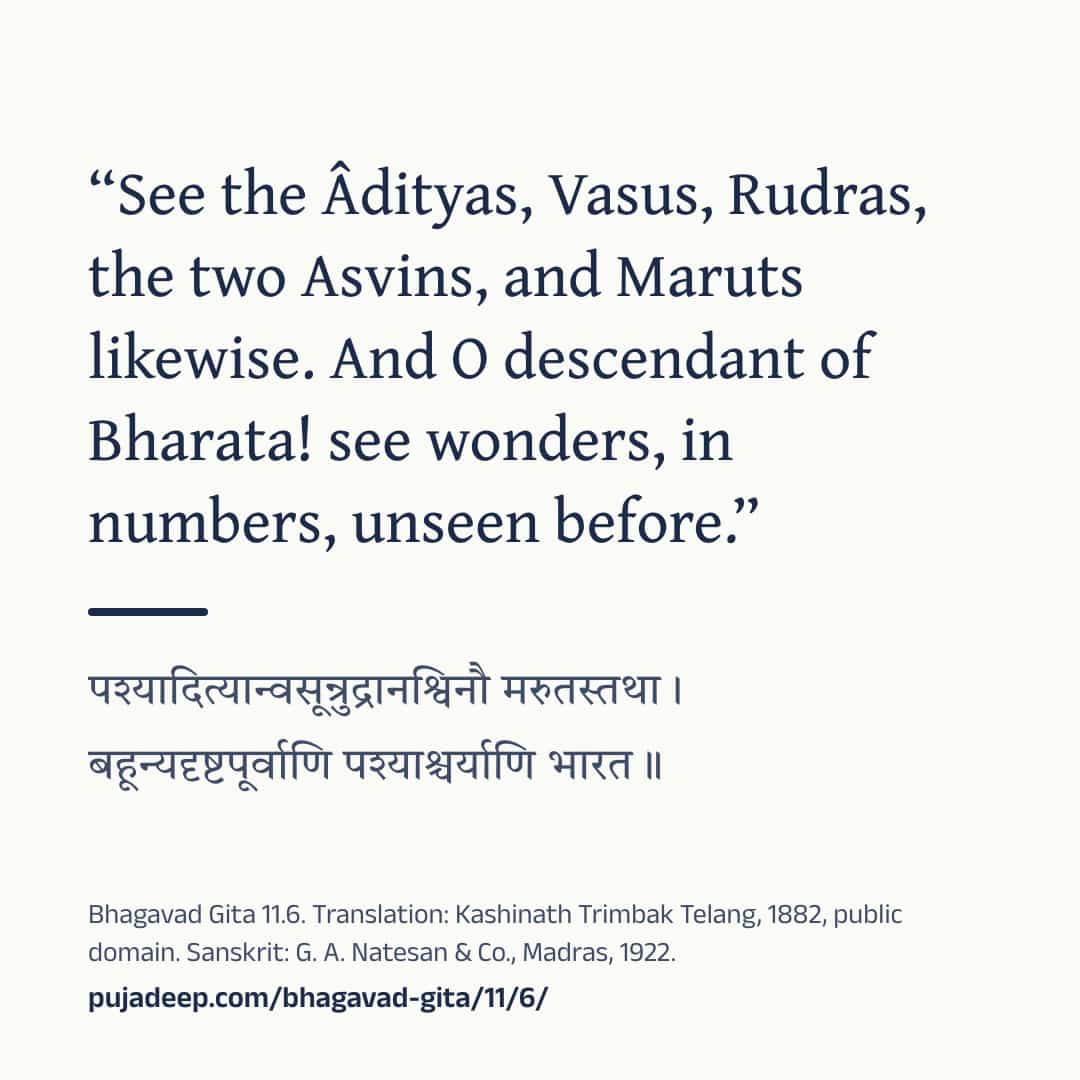
Drawing the picture
See the words
Bhagavad Gita 11.6

पश्यादित्यान्वसून्रुद्रानश्विनौ मरुतस्तथा ।
बहून्यदृष्टपूर्वाणि पश्याश्चर्याणि भारत ॥

“See the Âdityas, Vasus, Rudras, the two Asvins, and Maruts likewise. And O descendant of Bharata! see wonders, in numbers, unseen before.”
(K. T. Telang, The Bhagavadgîtâ (The Sacred Books of the East, vol. VIII, Oxford: Clarendon Press, 1882), p. 92, public domain)

“Behold the Âdityas, the Vasus, the Rudras, the two Ashvins and also the Maruts; behold many marvels never seen ere this, O Bhârata.”
(Annie Besant, The Bhagavad Gîtâ, or The Lord's Song (London: Theosophical Publishing Society, 1895), p. 104, public domain)

“Behold the Adityas, the Vasus, the Rudras, the twin Ashvins; and the Winds; behold, O descendant of Bharata, many wonders that were not seen before.”
(Swami Swarupananda, Srimad-Bhagavad-Gita (Mayavati: Prabuddha Bharata Press, 1909; first printed in Prabuddha Bharata, 1907–1909), p. 214, public domain)

Sanskrit: G. A. Natesan & Co., Madras, 1922.
https://pujadeep.com/bhagavad-gita/11/6/ Nothing is sent from this site. Your own app sends it, to the chat you choose. The picture quotes the translation you chose on this page, with its name and year.
Sanskrit text: The Bhagavad-Gita, or The Lord's Song, with the text in Devanagari and an English translation, 1922. Meanings: written for Pujadeep and checked against the cited edition. Source and changes
Questions families ask
Who speaks Bhagavad Gita 11.6?
Krishna speaks this verse, in chapter 11 (Vishvarupa Darshana Yoga).
Where does the Sanskrit text come from?
Sanskrit text: The Bhagavad-Gita, or The Lord's Song, with the text in Devanagari and an English translation, 1922. Meanings: written for Pujadeep and checked against the cited edition. See the source
Is the meaning on this page a translation?
Explanation written for this site from the sources listed here, and checked against the cited edition. It is not a translation and not the only way to read the text. Free to quote with credit.
Source and licence
- Sanskrit text
- The Bhagavad-Gita, or The Lord's Song, with the text in Devanagari and an English translation (Annie Besant, G. A. Natesan & Co., Madras, 1922). Public domain. The Sanskrit on these pages was read from this printing’s page images.
- Translation
- The Bhagavadgîtâ with the Sanatsugâtîya and the Anugîtâ, translated by Kâshinâth Trimbak Telang (The Sacred Books of the East, vol. VIII, ed. F. Max Müller) (Kashinath Trimbak Telang, F. Max Müller, Clarendon Press, Oxford, 1882). Public domain. Shown verbatim, as printed.
- Translation
- The Bhagavad Gîtâ, or The Lord's Song, translated by Annie Besant (Annie Besant, Theosophical Publishing Society, London, 1895). Public domain. Shown verbatim, as printed.
- Translation
- Srimad-Bhagavad-Gita, with Sanskrit Text; Paraphrase with Word-by-word Literal Translation; English Rendering and Comments, Index, &c., by the Swami Swarupananda (Himalayan Series, No. XX) (Swami Swarupananda, The Editors and Publishers, Advaita Ashrama, Mayavati, Prabuddha Bharata Press, Mayavati, Almora, Himalayas, 1909). Public domain. Shown verbatim, as printed.
- Common wording
- In this text, 32 words follow today's common wording, checked against sanskritdocuments.org; Sanskrit Wikisource; Gita Press, Gorakhpur; GRETIL, Göttingen and Bhaktivedanta Book Trust.
- Our explanation
- Explanation written for this site from the sources listed here, and checked against the cited edition. It is not a translation and not the only way to read the text. Free to quote with credit.
- Checked
- Checked against the cited edition, October 27, 2026.