Bhagavad Gita 11.20: meaning and translation
Chapter 11: Vishvarupa Darshana Yoga. Arjuna says
Arjuna says the space between heaven and earth, and all the directions, are filled by Krishna alone.
Click or tap a word for its meaning and its dictionary page.
Text and layers
Text and layers
These choices stay in this browser.
Bhagavad Gita 11.20
द्यावापृथिव्योरिदमन्तरं हि व्याप्तं त्वयैकेन दिशश्च सर्वाः ।दृष्ट्वाऽद्भुतं रूपमुग्रं तवेदम् लोकत्रयं प्रव्यथितं महात्मन् ॥
Dyavaprithivyoridamantaram hi vyaptam tvayaikena dishashcha sarvahDrishtvadbhutam rupamugram tavedam lokatrayam pravyathitam mahatman
dyāvāpṛthivyoridamantaraṃ hi vyāptaṃ tvayaikena diśaśca sarvāḥ |dṛṣṭvā’dbhutaṃ rūpamugraṃ tavedam lokatrayaṃ pravyathitaṃ mahātman ||
Our explanation Arjuna says the space between heaven and earth, and all the directions, are filled by Krishna alone. Seeing this wonderful and fierce (ugra) form, he says, the three worlds tremble: Telang has 'are affrighted', Besant 'sink down'. The schools explain who the three worlds are here (see the views).
हिंदी अर्थ अर्जुन कहते हैं कि धरती और आकाश के बीच का सारा स्थान और सब दिशाएँ अकेले कृष्ण से भरी हैं। वे कहते हैं कि इस अद्भुत और उग्र रूप को देखकर तीनों लोक व्यथित हैं। यहाँ “तीनों लोक” कौन हैं, इसे परंपराएँ अलग-अलग ढंग से समझाती हैं।
Word by word
Every word, with its dictionary page
Word by word
- द्यावापृथिव्योः dyāvāpṛthivyoḥ · of heaven and earth (compound (feminine), genitive dual) Dictionary: dyāvā-pṛthivī, Monier-Williams 1899, p. 500, col. 1
- इदम् idam · this (pronoun (neuter), nominative singular) Dictionary: 1. idam, Monier-Williams 1899, p. 165, col. 2 “this, this here”
- अन्तरम् antaram · space between (noun (neuter), nominative singular) Dictionary: antara, Monier-Williams 1899, p. 43, col. 3 “interval, intermediate space or time”
- हि hi · for, indeed (indeclinable) Dictionary: 2. hi, Monier-Williams 1899, p. 1297, col. 3 “for, because, on account of”
- व्याप्तम् vyāptam · filled, pervaded (past participle (neuter), nominative singular) Dictionary: vy-āpta, Monier-Williams 1899, p. 1037, col. 2 “spread through, pervaded, extended, covered or filled with”
- त्वया tvayā · by you (pronoun, instrumental singular) Dictionary: yuṣmad, Monier-Williams 1899, p. 855, col. 3 “the base of the 2nd pers. pron. as used in comp.”
- एकेन ekena · alone (adjective (masculine), instrumental singular) Dictionary: eka, Monier-Williams 1899, p. 227, col. 3 “alone, solitary, single”
- दिशः diśaḥ · the directions (noun (feminine), nominative plural) Dictionary: 2. diś, Monier-Williams 1899, p. 480, col. 1 “quarter or region pointed at, direction, cardinal point”
- च ca · and (indeclinable) Dictionary: 2. ca, Monier-Williams 1899, p. 380, col. 1 “and, both, also, moreover, as well as”
- सर्वाः sarvāḥ · all (pronoun (feminine), nominative plural) Dictionary: sarva, Monier-Williams 1899, p. 1184, col. 3 “whole, entire, all, every”
- दृष्ट्वा dṛṣṭvā · having seen (absolutive (having done)) Dictionary: 1. dṛś, Monier-Williams 1899, p. 491, col. 2 “to see, behold, look at, regard, consider”
- अद्भुतम् adbhutam · wondrous (adjective (neuter), accusative singular) Dictionary: adbhuta, Monier-Williams 1899, p. 19, col. 1 “supernatural, wonderful, marvellous”
- रूपम् rūpam · form (noun (neuter), accusative singular) Dictionary: rūpa, Monier-Williams 1899, p. 885, col. 3 “form, shape, figure”
- उग्रम् ugram · fierce (adjective (neuter), accusative singular) Dictionary: ugra, Monier-Williams 1899, p. 172, col. 2 “powerful, violent, mighty, impetuous, strong”
- तव tava · your (pronoun, genitive singular) Dictionary: yuṣmad, Monier-Williams 1899, p. 855, col. 3 “the base of the 2nd pers. pron. as used in comp.”
- इदम् idam · this (pronoun (neuter), accusative singular) Dictionary: 1. idam, Monier-Williams 1899, p. 165, col. 2 “this, this here”
- लोकत्रयम् lokatrayam · the three worlds (compound (neuter), nominative singular) Dictionary: loka-traya, Monier-Williams 1899, p. 906, col. 2 “'world-triad,' the three w°s (heaven, earth and atmosphere, or h°, earth and lower regions)”
- प्रव्यथितम् pravyathitam · is shaken (past participle (neuter), nominative singular) Dictionary: pra-vyathita, Monier-Williams 1899, p. 694, col. 2 “affrighted, distressed, pained”
- महात्मन् mahātman · O great being (compound (masculine), vocative singular) Dictionary: mahātman, Monier-Williams 1899, p. 796, col. 1 “‘high-souled,’ magnanimous, having gr° or noble nature, high-minded, noble”
1 printing differs
Edition differences. Another printing or text reads this place differently.
- Spelling A digital text reads Same words. The 1922 edition marks the merged vowel with an avagraha (दृष्ट्वाऽद्भुतं) and writes तवेदम् at the printed line end; the e-text writes दृष्ट्वाद्भुतं and तवेदं.
Old translations
Kashinath Trimbak Telang, 1882. Public domain. Page 94.
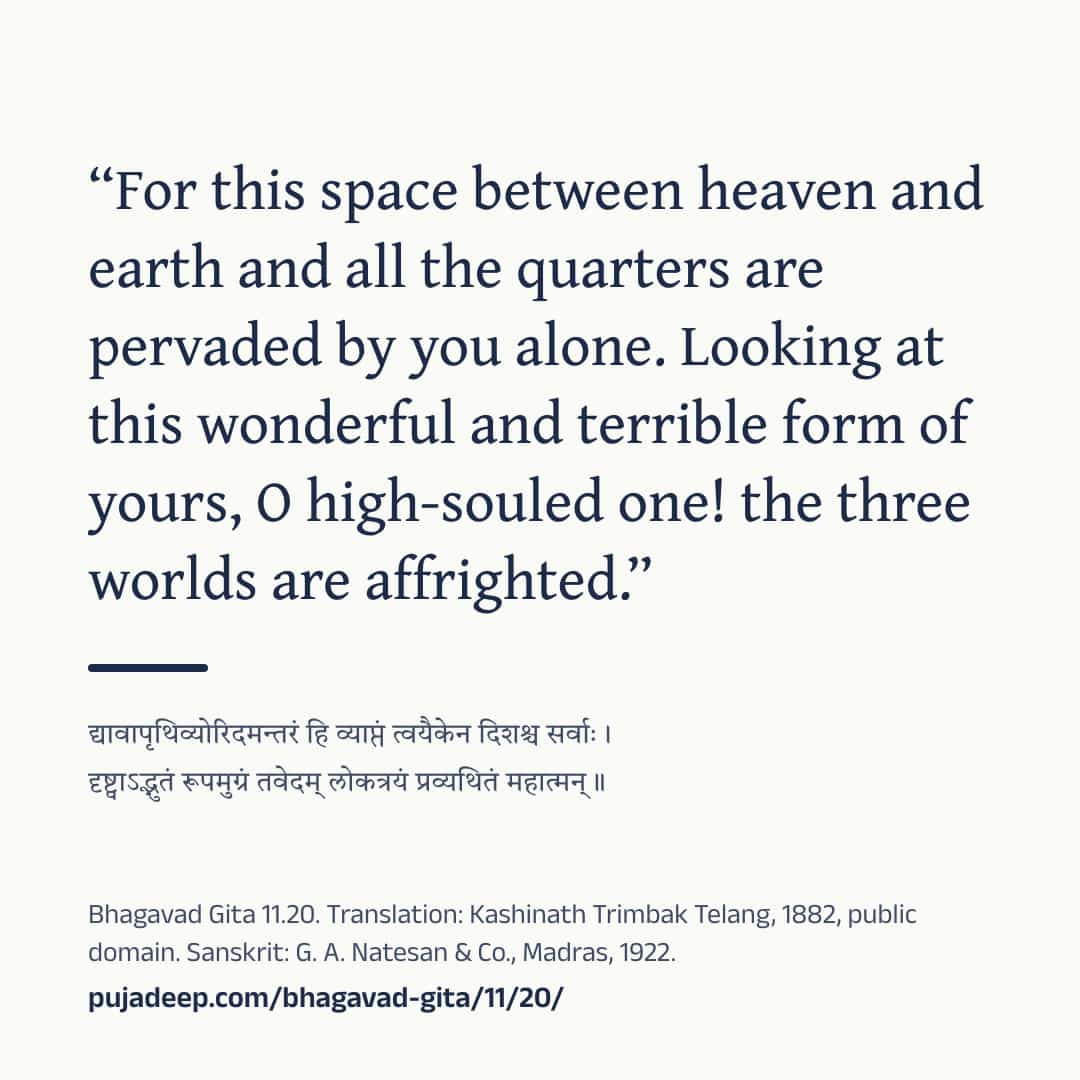
For this space between heaven and earth and all the quarters are pervaded by you alone. Looking at this wonderful and terrible form of yours, O high-souled one! the three worlds are affrighted.
Compare 3 translations
Kashinath Trimbak Telang, 1882. Public domain. Page 94.
For this space between heaven and earth and all the quarters are pervaded by you alone. Looking at this wonderful and terrible form of yours, O high-souled one! the three worlds are affrighted.
You are reading this one
Annie Besant, 1895. Public domain. Page 107.
By Thee alone are filled the earth, the heavens,
And all the regions that are stretched between;
The triple worlds sink down, O mighty One,
Before Thine awful manifested Form
You are reading this one
Swami Swarupananda, 1909 (first printed 1907). Public domain. Page 221.
The space betwixt heaven and earth and all the quarters are filled by Thee alone; having seen this, Thy marvellous and awful form, the three worlds are trembling with fear, O Great-souled One.
You are reading this one
Cite this verse
The translation: K. T. Telang, The Bhagavadgîtâ (The Sacred Books of the East, vol. VIII, Oxford: Clarendon Press, 1882), p. 94. Bhagavad Gita 11.20.
The translation: Annie Besant, The Bhagavad Gîtâ, or The Lord's Song (London: Theosophical Publishing Society, 1895), p. 107. Bhagavad Gita 11.20.
The translation: Swami Swarupananda, Srimad-Bhagavad-Gita (Mayavati: Prabuddha Bharata Press, 1909; first printed in Prabuddha Bharata, 1907–1909), p. 221. Bhagavad Gita 11.20.
Our explanation: “Bhagavad Gita 11.20: meaning and translation.” Pujadeep. Updated October 27, 2026. https://pujadeep.com/bhagavad-gita/11/20/
Pujadeep’s explanations are free to quote with credit: name Pujadeep and link to the page. How to credit
Classical readings, by school
Each reading is named by its school. None is presented as the only meaning.
What Advaita, Vishishtadvaita and Dvaita teach, in short
Ramanuja Vishishtadvaita
Ramanuja says the three worlds are the beings of every kind who had gathered to watch the battle, friendly, hostile and neutral. Like Arjuna, they were all given divine sight, so that Arjuna would see how far the Lord's power reaches. The form fills them with awe because it pervades everything without limit.
Source: Sri Bhagavad-Gita with Sri Ramanujacharya's Visishtadvaita commentary, translated by A. Govindacharya (Madras, 1898), commentary on 11.20, p. 358. Summarised in our own words; none of its text is reproduced.
Madhva Dvaita
Madhva says a single form spans the space between earth and sky, while further forms cover the directions. In his reading the form is not dreadful by nature. It looks dreadful here because of the task at hand, the end of some warriors, and because no one is used to such a sight; for those who know it, it brings joy. He gives two readings of 'the three worlds': the devotees in them, or Arjuna seeing his own fear in all beings.
Source: The Bhagavad-Gita: translation and commentaries in English according to Sri Madhwacharya's Bhashyas, by S. Subba Rau (Madras, 1906), commentary on 11.20, p. 226 (leaf n224). Summarised in our own words; none of its text is reproduced.
Share
Show the ways to share
Send one picture or the text to one chat. The picture names its source and the address of this page.
Drawing the picture
See the words
Bhagavad Gita 11.20

द्यावापृथिव्योरिदमन्तरं हि व्याप्तं त्वयैकेन दिशश्च सर्वाः ।
दृष्ट्वाऽद्भुतं रूपमुग्रं तवेदम् लोकत्रयं प्रव्यथितं महात्मन् ॥

“For this space between heaven and earth and all the quarters are pervaded by you alone. Looking at this wonderful and terrible form of yours, O high-souled one! the three worlds are affrighted.”
(K. T. Telang, The Bhagavadgîtâ (The Sacred Books of the East, vol. VIII, Oxford: Clarendon Press, 1882), p. 94, public domain)

“By Thee alone are filled the earth, the heavens, And all the regions that are stretched between; The triple worlds sink down, O mighty One, Before Thine awful manifested Form”
(Annie Besant, The Bhagavad Gîtâ, or The Lord's Song (London: Theosophical Publishing Society, 1895), p. 107, public domain)

“The space betwixt heaven and earth and all the quarters are filled by Thee alone; having seen this, Thy marvellous and awful form, the three worlds are trembling with fear, O Great-souled One.”
(Swami Swarupananda, Srimad-Bhagavad-Gita (Mayavati: Prabuddha Bharata Press, 1909; first printed in Prabuddha Bharata, 1907–1909), p. 221, public domain)

Sanskrit: G. A. Natesan & Co., Madras, 1922.
https://pujadeep.com/bhagavad-gita/11/20/ Nothing is sent from this site. Your own app sends it, to the chat you choose. The picture quotes the translation you chose on this page, with its name and year.
Sanskrit text: The Bhagavad-Gita, or The Lord's Song, with the text in Devanagari and an English translation, 1922. Meanings: written for Pujadeep and checked against the cited edition. Source and changes
Questions families ask
Who speaks Bhagavad Gita 11.20?
Arjuna speaks this verse, in chapter 11 (Vishvarupa Darshana Yoga).
Where does the Sanskrit text come from?
Sanskrit text: The Bhagavad-Gita, or The Lord's Song, with the text in Devanagari and an English translation, 1922. Meanings: written for Pujadeep and checked against the cited edition. See the source
Is the meaning on this page a translation?
Explanation written for this site from the sources listed here, and checked against the cited edition. It is not a translation and not the only way to read the text. Free to quote with credit.
Source and licence
- Sanskrit text
- The Bhagavad-Gita, or The Lord's Song, with the text in Devanagari and an English translation (Annie Besant, G. A. Natesan & Co., Madras, 1922). Public domain. The Sanskrit on these pages was read from this printing’s page images.
- Translation
- The Bhagavadgîtâ with the Sanatsugâtîya and the Anugîtâ, translated by Kâshinâth Trimbak Telang (The Sacred Books of the East, vol. VIII, ed. F. Max Müller) (Kashinath Trimbak Telang, F. Max Müller, Clarendon Press, Oxford, 1882). Public domain. Shown verbatim, as printed.
- Translation
- The Bhagavad Gîtâ, or The Lord's Song, translated by Annie Besant (Annie Besant, Theosophical Publishing Society, London, 1895). Public domain. Shown verbatim, as printed.
- Translation
- Srimad-Bhagavad-Gita, with Sanskrit Text; Paraphrase with Word-by-word Literal Translation; English Rendering and Comments, Index, &c., by the Swami Swarupananda (Himalayan Series, No. XX) (Swami Swarupananda, The Editors and Publishers, Advaita Ashrama, Mayavati, Prabuddha Bharata Press, Mayavati, Almora, Himalayas, 1909). Public domain. Shown verbatim, as printed.
- Commentary
- Sri Bhagavad-Gita with Sri Ramanujacharya's Visishtadvaita commentary, translated by A. Govindacharya (Madras, 1898) (Scan uploaded to archive.org (folkscanomy collection)). Summarised in our own words; none of its text is reproduced.
- Commentary
- The Bhagavad-Gita: translation and commentaries in English according to Sri Madhwacharya's Bhashyas, by S. Subba Rau (Madras, 1906) (Scan uploaded to archive.org (folkscanomy collection)). Summarised in our own words; none of its text is reproduced.
- Common wording
- In this text, 32 words follow today's common wording, checked against sanskritdocuments.org; Sanskrit Wikisource; Gita Press, Gorakhpur; GRETIL, Göttingen and Bhaktivedanta Book Trust.
- Our explanation
- Explanation written for this site from the sources listed here, and checked against the cited edition. It is not a translation and not the only way to read the text. Free to quote with credit.
- Checked
- Checked against the cited edition, October 27, 2026.