Bhagavad Gita 11.25: meaning and translation
Chapter 11: Vishvarupa Darshana Yoga. Arjuna says
Seeing Krishna's mouths with their fearsome teeth, like the fire of time (kālānala; Shankara explains it as the fire that consumes the worlds at their dissolution), Arjuna says he loses his sense of direction and finds no comfort.
Click or tap a word for its meaning and its dictionary page.
Text and layers
Text and layers
These choices stay in this browser.
Bhagavad Gita 11.25
दंष्ट्राकरालानि च ते मुखानि दृष्ट्वैव कालानलसन्निभानि ।दिशो न जाने न लभे च शर्म प्रसीद देवेश जगन्निवास ॥
Danshtrakaralani cha te mukhani drishtvaiva kalanalasannibhaniDisho na jane na labhe cha sharma prasida devesha jagannivasa
daṃṣṭrākarālāni ca te mukhāni dṛṣṭvaiva kālānalasannibhāni |diśo na jāne na labhe ca śarma prasīda deveśa jagannivāsa ||
Our explanation Seeing Krishna's mouths with their fearsome teeth, like the fire of time (kālānala; Shankara explains it as the fire that consumes the worlds at their dissolution), Arjuna says he loses his sense of direction and finds no comfort. He prays: 'Be gracious, Lord of gods, home of the universe.'
हिंदी अर्थ अर्जुन कहते हैं कि विकराल दाढ़ों वाले, कालाग्नि जैसे मुखों को देखकर उन्हें दिशाएँ नहीं सूझतीं और चैन नहीं मिलता। (शंकराचार्य कालाग्नि का अर्थ वह आग बताते हैं जो प्रलय के समय लोकों को जलाती है।) वे प्रार्थना करते हैं: “हे देवेश, हे जगन्निवास, प्रसन्न होइए।”
Word by word
Every word, with its dictionary page
Word by word
- दंष्ट्राकरालानि daṃṣṭrākarālāni · fearsome with tusks (compound (neuter), accusative plural) Dictionary: daṃṣṭrā-karāla, Monier-Williams 1899, p. 464, col. 3 “having terrible tusks”
- च ca · and (indeclinable) Dictionary: 2. ca, Monier-Williams 1899, p. 380, col. 1 “and, both, also, moreover, as well as”
- ते te · your (pronoun, genitive singular) Dictionary: yuṣmad, Monier-Williams 1899, p. 855, col. 3 “the base of the 2nd pers. pron. as used in comp.”
- मुखानि mukhāni · mouths (noun (neuter), accusative plural) Dictionary: mukha, Monier-Williams 1899, p. 819, col. 3 “the mouth, face, countenance”
- दृष्ट्वा dṛṣṭvā · having seen (absolutive (having done)) Dictionary: 1. dṛś, Monier-Williams 1899, p. 491, col. 2 “to see, behold, look at, regard, consider”
- एव eva · just, merely (indeclinable) Dictionary: 1. eva, Monier-Williams 1899, p. 232, col. 2 “just, exactly, very, same, only, even, alone, merely”
- कालानलसन्निभानि kālānalasannibhāni · like the fire at the end of time (compound (neuter), accusative plural) Dictionary: kālānala, Monier-Williams 1899, p. 279, col. 1; saṃ-nibha, Monier-Williams 1899, p. 1147, col. 1 “like, similar, resembling”
- दिशः diśaḥ · the directions (noun (feminine), accusative plural) Dictionary: 2. diś, Monier-Williams 1899, p. 480, col. 1 “quarter or region pointed at, direction, cardinal point”
- न na · not (indeclinable) Dictionary: 2. na, Monier-Williams 1899, p. 523, col. 1 “not, no, nor, neither”
- जाने jāne · know (present, 1st person singular) Dictionary: 1. jñā, Monier-Williams 1899, p. 425, col. 3 “to know, have knowledge, become acquainted with”
- न na · not (indeclinable) Dictionary: 2. na, Monier-Williams 1899, p. 523, col. 1 “not, no, nor, neither”
- लभे labhe · find, get (present, 1st person singular) Dictionary: labh, Monier-Williams 1899, p. 896, col. 2 “to gain possession of, obtain, receive, conceive, get”
- च ca · and (indeclinable) Dictionary: 2. ca, Monier-Williams 1899, p. 380, col. 1 “and, both, also, moreover, as well as”
- शर्म śarma · shelter, peace (noun (neuter), accusative singular) Dictionary: śarman, Monier-Williams 1899, p. 1058, col. 2 “shelter, protection, refuge, safety ...; joy, bliss, comfort, delight, happiness”
- प्रसीद prasīda · be gracious (imperative, 2nd person singular) Dictionary: pra-sad, Monier-Williams 1899, p. 696, col. 3 “to become satisfied or pleased or glad, be gracious or kind”
- देवेश deveśa · O Lord of gods (compound (masculine), vocative singular) Dictionary: deveśa, Monier-Williams 1899, p. 495, col. 2 “‘chief of the g°,’ N. of Brahmā or Vishṇu or Śiva or Indra”
- जगन्निवास jagannivāsa · O refuge of the world (compound (masculine), vocative singular) Dictionary: jagan-nivāsa, Monier-Williams 1899, p. 408, col. 2 “‘world-abode,’ Vishṇu or Kṛishṇa”
Old translations
Kashinath Trimbak Telang, 1882. Public domain. Page 95.
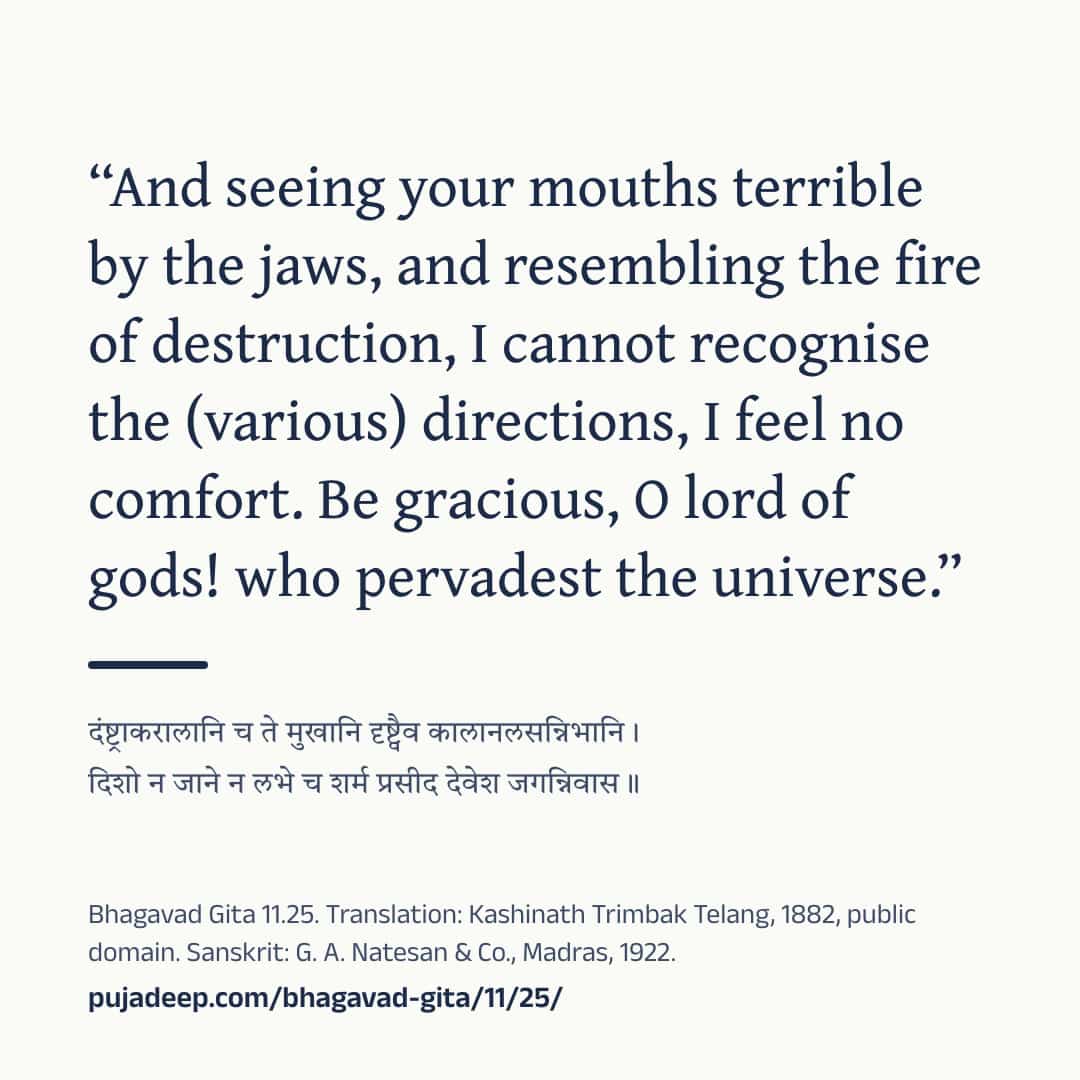
And seeing your mouths terrible by the jaws, and resembling the fire of destruction, I cannot recognise the (various) directions, I feel no comfort. Be gracious, O lord of gods! who pervadest the universe.
Compare 3 translations
Kashinath Trimbak Telang, 1882. Public domain. Page 95.
And seeing your mouths terrible by the jaws, and resembling the fire of destruction, I cannot recognise the (various) directions, I feel no comfort. Be gracious, O lord of gods! who pervadest the universe.
You are reading this one
Annie Besant, 1895. Public domain. Page 108–109.
Like Time's destroying flames I see Thy teeth,
Upstanding, spread within expanded jaws;
Nought know I anywhere, no shelter find,
Mercy, O God! Refuge of all the worlds!
You are reading this one
Swami Swarupananda, 1909 (first printed 1907). Public domain. Page 224.
Having seen Thy mouths fearful with tusks, (blazing) like Pralaya-Fires, I know not the four quarters, nor do I find peace; have mercy, O Lord of the Devas, O Abode of the Universe.
You are reading this one
Cite this verse
The translation: K. T. Telang, The Bhagavadgîtâ (The Sacred Books of the East, vol. VIII, Oxford: Clarendon Press, 1882), p. 95. Bhagavad Gita 11.25.
The translation: Annie Besant, The Bhagavad Gîtâ, or The Lord's Song (London: Theosophical Publishing Society, 1895), pp. 108–109. Bhagavad Gita 11.25.
The translation: Swami Swarupananda, Srimad-Bhagavad-Gita (Mayavati: Prabuddha Bharata Press, 1909; first printed in Prabuddha Bharata, 1907–1909), p. 224. Bhagavad Gita 11.25.
Our explanation: “Bhagavad Gita 11.25: meaning and translation.” Pujadeep. Updated October 27, 2026. https://pujadeep.com/bhagavad-gita/11/25/
Pujadeep’s explanations are free to quote with credit: name Pujadeep and link to the page. How to credit
Classical readings, by school
No readings by school on this verse yet.
Share
Show the ways to share
Send one picture or the text to one chat. The picture names its source and the address of this page.
Drawing the picture
See the words
Bhagavad Gita 11.25

दंष्ट्राकरालानि च ते मुखानि दृष्ट्वैव कालानलसन्निभानि ।
दिशो न जाने न लभे च शर्म प्रसीद देवेश जगन्निवास ॥

“And seeing your mouths terrible by the jaws, and resembling the fire of destruction, I cannot recognise the (various) directions, I feel no comfort. Be gracious, O lord of gods! who pervadest the universe.”
(K. T. Telang, The Bhagavadgîtâ (The Sacred Books of the East, vol. VIII, Oxford: Clarendon Press, 1882), p. 95, public domain)

“Like Time's destroying flames I see Thy teeth, Upstanding, spread within expanded jaws; Nought know I anywhere, no shelter find, Mercy, O God! Refuge of all the worlds!”
(Annie Besant, The Bhagavad Gîtâ, or The Lord's Song (London: Theosophical Publishing Society, 1895), pp. 108–109, public domain)

“Having seen Thy mouths fearful with tusks, (blazing) like Pralaya-Fires, I know not the four quarters, nor do I find peace; have mercy, O Lord of the Devas, O Abode of the Universe.”
(Swami Swarupananda, Srimad-Bhagavad-Gita (Mayavati: Prabuddha Bharata Press, 1909; first printed in Prabuddha Bharata, 1907–1909), p. 224, public domain)

Sanskrit: G. A. Natesan & Co., Madras, 1922.
https://pujadeep.com/bhagavad-gita/11/25/ Nothing is sent from this site. Your own app sends it, to the chat you choose. The picture quotes the translation you chose on this page, with its name and year.
Sanskrit text: The Bhagavad-Gita, or The Lord's Song, with the text in Devanagari and an English translation, 1922. Meanings: written for Pujadeep and checked against the cited edition. Source and changes
Questions families ask
Who speaks Bhagavad Gita 11.25?
Arjuna speaks this verse, in chapter 11 (Vishvarupa Darshana Yoga).
Where does the Sanskrit text come from?
Sanskrit text: The Bhagavad-Gita, or The Lord's Song, with the text in Devanagari and an English translation, 1922. Meanings: written for Pujadeep and checked against the cited edition. See the source
Is the meaning on this page a translation?
Explanation written for this site from the sources listed here, and checked against the cited edition. It is not a translation and not the only way to read the text. Free to quote with credit.
Source and licence
- Sanskrit text
- The Bhagavad-Gita, or The Lord's Song, with the text in Devanagari and an English translation (Annie Besant, G. A. Natesan & Co., Madras, 1922). Public domain. The Sanskrit on these pages was read from this printing’s page images.
- Translation
- The Bhagavadgîtâ with the Sanatsugâtîya and the Anugîtâ, translated by Kâshinâth Trimbak Telang (The Sacred Books of the East, vol. VIII, ed. F. Max Müller) (Kashinath Trimbak Telang, F. Max Müller, Clarendon Press, Oxford, 1882). Public domain. Shown verbatim, as printed.
- Translation
- The Bhagavad Gîtâ, or The Lord's Song, translated by Annie Besant (Annie Besant, Theosophical Publishing Society, London, 1895). Public domain. Shown verbatim, as printed.
- Translation
- Srimad-Bhagavad-Gita, with Sanskrit Text; Paraphrase with Word-by-word Literal Translation; English Rendering and Comments, Index, &c., by the Swami Swarupananda (Himalayan Series, No. XX) (Swami Swarupananda, The Editors and Publishers, Advaita Ashrama, Mayavati, Prabuddha Bharata Press, Mayavati, Almora, Himalayas, 1909). Public domain. Shown verbatim, as printed.
- Common wording
- In this text, 32 words follow today's common wording, checked against sanskritdocuments.org; Sanskrit Wikisource; Gita Press, Gorakhpur; GRETIL, Göttingen and Bhaktivedanta Book Trust.
- Our explanation
- Explanation written for this site from the sources listed here, and checked against the cited edition. It is not a translation and not the only way to read the text. Free to quote with credit.
- Checked
- Checked against the cited edition, October 27, 2026.