Bhagavad Gita 11.15: meaning and translation
Chapter 11: Vishvarupa Darshana Yoga. Arjuna says
Arjuna speaks.
Click or tap a word for its meaning and its dictionary page.
Text and layers
Text and layers
These choices stay in this browser.
Bhagavad Gita 11.15
अर्जुन उवाच ।
पश्यामि देवांस्तव देव देहे सर्वांस्तथा भूतविशेषसङ्घान् ।ब्रह्माणमीशं कमलासनस्थमृषींश्च सर्वानुरगांश्च दिव्यान् ॥
Pashyami devanstava deva dehe sarvanstatha bhutavisheshasanghanBrahmanamisham kamalasanasthamrishinshcha sarvanuraganshcha divyan
paśyāmi devāṃstava deva dehe sarvāṃstathā bhūtaviśeṣasaṅghān |brahmāṇamīśaṃ kamalāsanasthamṛṣīṃśca sarvānuragāṃśca divyān ||
Our explanation Arjuna speaks. He says he sees in the body of the God all the gods and the hosts of every kind of being; Brahmā, the Lord, seated on his lotus seat; all the sages (ṛṣis); and the divine serpents. From here to verse 50 the verses are in a longer metre (triṣṭubh). The schools read 'the Lord (īśa) seated on the lotus' differently (see the views).
हिंदी अर्थ अर्जुन बोलते हैं। वे कहते हैं कि वे देव के शरीर में सब देवताओं को और हर प्रकार के प्राणियों के समूहों को देख रहे हैं; कमल के आसन पर बैठे स्वामी ब्रह्मा को; सब ऋषियों को; और दिव्य नागों को। यहाँ से श्लोक 50 तक के श्लोक एक लंबे छंद (त्रिष्टुभ्) में हैं। “कमलासन पर बैठे ईश” को परंपराएँ अलग-अलग ढंग से पढ़ती हैं।
Word by word
Every word, with its dictionary page
Word by word
- पश्यामि paśyāmi · see (present, 1st person singular) Dictionary: 1. paś, Monier-Williams 1899, p. 611, col. 2 “to see, behold, look at, observe, perceive, notice”
- देवान् devān · the gods (noun (masculine), accusative plural) Dictionary: deva, Monier-Williams 1899, p. 492, col. 2 “a deity, god”
- तव tava · your (pronoun, genitive singular) Dictionary: yuṣmad, Monier-Williams 1899, p. 855, col. 3 “the base of the 2nd pers. pron. as used in comp.”
- देव deva · O God (noun (masculine), vocative singular) Dictionary: deva, Monier-Williams 1899, p. 492, col. 2 “a deity, god”
- देहे dehe · in the body (noun (masculine), locative singular) Dictionary: deha, Monier-Williams 1899, p. 496, col. 3 “the body”
- सर्वान् sarvān · all (pronoun (masculine), accusative plural) Dictionary: sarva, Monier-Williams 1899, p. 1184, col. 3 “whole, entire, all, every”
- तथा tathā · and also (indeclinable) Dictionary: tathā, Monier-Williams 1899, p. 433, col. 3 “in that manner, so, thus”
- भूतविशेषसङ्घान् bhūtaviśeṣasaṅghān · hosts of different kinds of beings (compound (masculine), accusative plural) Dictionary: bhūta, Monier-Williams 1899, p. 761, col. 3 “that which is or exists, any living being”; vi-śeṣa, Monier-Williams 1899, p. 990, col. 2 “a kind, species”; saṃ-gha, Monier-Williams 1899, p. 1129, col. 3 “multitude, quantity, crowd, host”
- ब्रह्माणम् brahmāṇam · Brahma (noun (masculine), accusative singular) Dictionary: brahman, Monier-Williams 1899, p. 738, col. 1 “Brahmā or the one impersonal universal Spirit manifested as a personal Creator”
- ईशम् īśam · the lord (noun (masculine), accusative singular) Dictionary: īśa, Monier-Williams 1899, p. 171, col. 1 “powerful, supreme; a ruler, master, lord”
- कमलासनस्थम् kamalāsanastham · seated on a lotus seat (compound (masculine), accusative singular) Dictionary: kamalāsana, Monier-Williams 1899, p. 252, col. 2 “‘having a lotus as seat,’ N. of Brahmā”; stha, Monier-Williams 1899, p. 1262, col. 3 “standing, staying, abiding, being situated in”
- ऋषीन् ṛṣīn · the sages (noun (masculine), accusative plural) Dictionary: ṛṣi, Monier-Williams 1899, p. 226, col. 3 “a singer of sacred hymns, an inspired poet or sage”
- च ca · and (indeclinable) Dictionary: 2. ca, Monier-Williams 1899, p. 380, col. 1 “and, both, also, moreover, as well as”
- सर्वान् sarvān · all (pronoun (masculine), accusative plural) Dictionary: sarva, Monier-Williams 1899, p. 1184, col. 3 “whole, entire, all, every”
- उरगान् uragān · serpents (noun (masculine), accusative plural) Dictionary: ura-ga, Monier-Williams 1899, p. 217, col. 2 “a serpent, snake”
- च ca · and (indeclinable) Dictionary: 2. ca, Monier-Williams 1899, p. 380, col. 1 “and, both, also, moreover, as well as”
- दिव्यान् divyān · divine (adjective (masculine), accusative plural) Dictionary: 2. divya, Monier-Williams 1899, p. 479, col. 2 “divine, heavenly, celestial”
Old translations
Kashinath Trimbak Telang, 1882. Public domain. Page 93.
Arguna said:
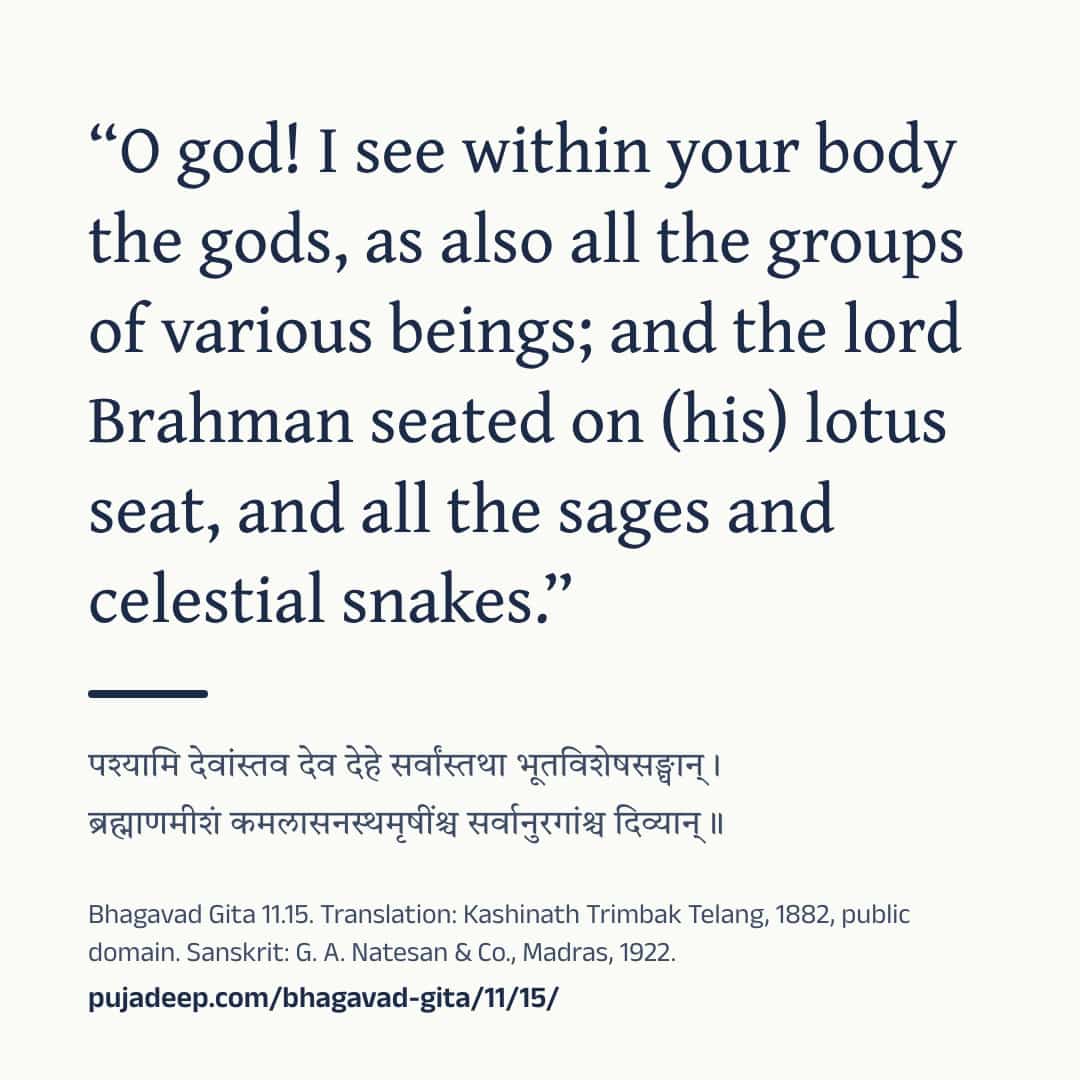
O god! I see within your body the gods, as also all the groups of various beings; and the lord Brahman seated on (his) lotus seat, and all the sages and celestial snakes.
Compare 3 translations
Kashinath Trimbak Telang, 1882. Public domain. Page 93.
Arguna said:
O god! I see within your body the gods, as also all the groups of various beings; and the lord Brahman seated on (his) lotus seat, and all the sages and celestial snakes.
You are reading this one
Annie Besant, 1895. Public domain. Page 105–106.
Arjuna said:
Within Thy Form, O God, the Gods I see,
All grades of beings with distinctive marks;
Brahmâ, the Lord, upon His lotus-throne,
The Rishis all and Serpents, the divine.
You are reading this one
Swami Swarupananda, 1909 (first printed 1907). Public domain. Page 218.
Arjuna said:
I see all the devas, O Deva, in Thy body, and hosts of all grades of beings; Brahmá, the Lord, seated on the lotus, and all the Rishis and celestial serpents.
You are reading this one
Cite this verse
The translation: K. T. Telang, The Bhagavadgîtâ (The Sacred Books of the East, vol. VIII, Oxford: Clarendon Press, 1882), p. 93. Bhagavad Gita 11.15.
The translation: Annie Besant, The Bhagavad Gîtâ, or The Lord's Song (London: Theosophical Publishing Society, 1895), pp. 105–106. Bhagavad Gita 11.15.
The translation: Swami Swarupananda, Srimad-Bhagavad-Gita (Mayavati: Prabuddha Bharata Press, 1909; first printed in Prabuddha Bharata, 1907–1909), p. 218. Bhagavad Gita 11.15.
Our explanation: “Bhagavad Gita 11.15: meaning and translation.” Pujadeep. Updated October 27, 2026. https://pujadeep.com/bhagavad-gita/11/15/
Pujadeep’s explanations are free to quote with credit: name Pujadeep and link to the page. How to credit
Classical readings, by school
Each reading is named by its school. None is presented as the only meaning.
What Advaita, Vishishtadvaita and Dvaita teach, in short
Shankara Advaita
Shankara takes 'Brahmā, the Lord' as one figure: Brahmā, the four-faced lord of creatures, seated on Mount Meru, which he places at the centre of the earth pictured as a lotus.
Source: The Bhagavad-Gita, with the commentary of Sri Sankaracharya, translated by A. Mahadeva Sastri (2nd ed., Mysore: G. T. A. Printing Works, 1901), commentary on 11.15, pp. 251–252. Summarised in our own words; none of its text is reproduced.
Ramanuja Vishishtadvaita
Ramanuja reads two figures: Brahmā, the four-faced ruler of the world-egg, and Īśa, that is Śiva, seated in Brahmā, who sits on the lotus. He takes this to mean that Śiva is under Brahmā's control.
Source: Sri Bhagavad-Gita with Sri Ramanujacharya's Visishtadvaita commentary, translated by A. Govindacharya (Madras, 1898), commentary on 11.15, pp. 354–355. Summarised in our own words; none of its text is reproduced.
Madhva Dvaita
Madhva also reads two figures: Brahmā, the lotus-seated one, and Rudra seen within him. He draws on the Padma Purāṇa for a layered picture of the universal form, with Brahmā upon Viṣṇu, Śiva (Hara) held by Brahmā, and the other gods placed on Śiva's body; Arjuna sees the gods within Viṣṇu in this nested order.
Source: The Bhagavad-Gita: translation and commentaries in English according to Sri Madhwacharya's Bhashyas, by S. Subba Rau (Madras, 1906), commentary on 11.15, p. 224 (leaf n222). Summarised in our own words; none of its text is reproduced.
Share
Show the ways to share
Send one picture or the text to one chat. The picture names its source and the address of this page.
Drawing the picture
See the words
Bhagavad Gita 11.15

पश्यामि देवांस्तव देव देहे सर्वांस्तथा भूतविशेषसङ्घान् ।
ब्रह्माणमीशं कमलासनस्थमृषींश्च सर्वानुरगांश्च दिव्यान् ॥

“O god! I see within your body the gods, as also all the groups of various beings; and the lord Brahman seated on (his) lotus seat, and all the sages and celestial snakes.”
(K. T. Telang, The Bhagavadgîtâ (The Sacred Books of the East, vol. VIII, Oxford: Clarendon Press, 1882), p. 93, public domain)

“Within Thy Form, O God, the Gods I see, All grades of beings with distinctive marks; Brahmâ, the Lord, upon His lotus-throne, The Rishis all and Serpents, the divine.”
(Annie Besant, The Bhagavad Gîtâ, or The Lord's Song (London: Theosophical Publishing Society, 1895), pp. 105–106, public domain)

“I see all the devas, O Deva, in Thy body, and hosts of all grades of beings; Brahmá, the Lord, seated on the lotus, and all the Rishis and celestial serpents.”
(Swami Swarupananda, Srimad-Bhagavad-Gita (Mayavati: Prabuddha Bharata Press, 1909; first printed in Prabuddha Bharata, 1907–1909), p. 218, public domain)

Sanskrit: G. A. Natesan & Co., Madras, 1922.
https://pujadeep.com/bhagavad-gita/11/15/ Nothing is sent from this site. Your own app sends it, to the chat you choose. The picture quotes the translation you chose on this page, with its name and year.
Sanskrit text: The Bhagavad-Gita, or The Lord's Song, with the text in Devanagari and an English translation, 1922. Meanings: written for Pujadeep and checked against the cited edition. Source and changes
Questions families ask
Who speaks Bhagavad Gita 11.15?
Arjuna speaks this verse, in chapter 11 (Vishvarupa Darshana Yoga).
Where does the Sanskrit text come from?
Sanskrit text: The Bhagavad-Gita, or The Lord's Song, with the text in Devanagari and an English translation, 1922. Meanings: written for Pujadeep and checked against the cited edition. See the source
Is the meaning on this page a translation?
Explanation written for this site from the sources listed here, and checked against the cited edition. It is not a translation and not the only way to read the text. Free to quote with credit.
Source and licence
- Sanskrit text
- The Bhagavad-Gita, or The Lord's Song, with the text in Devanagari and an English translation (Annie Besant, G. A. Natesan & Co., Madras, 1922). Public domain. The Sanskrit on these pages was read from this printing’s page images.
- Translation
- The Bhagavadgîtâ with the Sanatsugâtîya and the Anugîtâ, translated by Kâshinâth Trimbak Telang (The Sacred Books of the East, vol. VIII, ed. F. Max Müller) (Kashinath Trimbak Telang, F. Max Müller, Clarendon Press, Oxford, 1882). Public domain. Shown verbatim, as printed.
- Translation
- The Bhagavad Gîtâ, or The Lord's Song, translated by Annie Besant (Annie Besant, Theosophical Publishing Society, London, 1895). Public domain. Shown verbatim, as printed.
- Translation
- Srimad-Bhagavad-Gita, with Sanskrit Text; Paraphrase with Word-by-word Literal Translation; English Rendering and Comments, Index, &c., by the Swami Swarupananda (Himalayan Series, No. XX) (Swami Swarupananda, The Editors and Publishers, Advaita Ashrama, Mayavati, Prabuddha Bharata Press, Mayavati, Almora, Himalayas, 1909). Public domain. Shown verbatim, as printed.
- Commentary
- The Bhagavad-Gita, with the commentary of Sri Sankaracharya, translated by A. Mahadeva Sastri (2nd ed., Mysore: G. T. A. Printing Works, 1901) (Public-domain scan, University of California Libraries). Summarised in our own words; none of its text is reproduced.
- Commentary
- Sri Bhagavad-Gita with Sri Ramanujacharya's Visishtadvaita commentary, translated by A. Govindacharya (Madras, 1898) (Scan uploaded to archive.org (folkscanomy collection)). Summarised in our own words; none of its text is reproduced.
- Commentary
- The Bhagavad-Gita: translation and commentaries in English according to Sri Madhwacharya's Bhashyas, by S. Subba Rau (Madras, 1906) (Scan uploaded to archive.org (folkscanomy collection)). Summarised in our own words; none of its text is reproduced.
- Common wording
- In this text, 32 words follow today's common wording, checked against sanskritdocuments.org; Sanskrit Wikisource; Gita Press, Gorakhpur; GRETIL, Göttingen and Bhaktivedanta Book Trust.
- Our explanation
- Explanation written for this site from the sources listed here, and checked against the cited edition. It is not a translation and not the only way to read the text. Free to quote with credit.
- Checked
- Checked against the cited edition, October 27, 2026.