Bhagavad Gita 11.5: meaning and translation
Chapter 11: Vishvarupa Darshana Yoga. Krishna says
Krishna answers.
Click or tap a word for its meaning and its dictionary page.
Text and layers
Text and layers
These choices stay in this browser.
Bhagavad Gita 11.5
श्रीभगवानुवाच ।
पश्य मे पार्थ रूपाणि शतशोऽथ सहस्रशः ।नानाविधानि दिव्यानि नानावर्णाकृतीनि च ॥
Pashya me partha rupani shatashotha sahasrashahNanavidhani divyani nanavarnakritini cha
paśya me pārtha rūpāṇi śataśo’tha sahasraśaḥ |nānāvidhāni divyāni nānāvarṇākṛtīni ca ||
Our explanation Krishna answers. He tells Arjuna (Pārtha) to see his forms by the hundred and by the thousand: of many kinds, divine, and of many colours and shapes.
हिंदी अर्थ कृष्ण उत्तर देते हैं। वे अर्जुन (पार्थ) से कहते हैं कि वे उनके सैकड़ों और हज़ारों रूप देखें: अनेक प्रकार के, दिव्य, और अनेक रंगों और आकारों वाले।
Word by word
Every word, with its dictionary page
Word by word
- पश्य paśya · see (imperative, 2nd person singular) Dictionary: 1. paś, Monier-Williams 1899, p. 611, col. 2 “to see, behold, look at, observe, perceive, notice”
- मे me · "my" (Krishna's) (pronoun, genitive singular) Dictionary: 1. mad, Monier-Williams 1899, p. 777, col. 2 “base of the first pers. pron. in the sg. number (esp. in comp.)”
- पार्थ pārtha · O Partha (son of Pritha) (noun (masculine), vocative singular) Dictionary: 2. pārtha, Monier-Williams 1899, p. 621, col. 3 “metron. of Yudhi-shṭhira or Bhīma-sena or Arjuna”
- रूपाणि rūpāṇi · forms (noun (neuter), accusative plural) Dictionary: rūpa, Monier-Williams 1899, p. 885, col. 3 “form, shape, figure”
- शतशः śataśaḥ · by hundreds (indeclinable) Dictionary: śataśas, Monier-Williams 1899, p. 1050, col. 2 “by or in h°s, a h° times”
- अथ atha · and, then (indeclinable) Dictionary: atha, Monier-Williams 1899, p. 17, col. 3 “now; then; moreover”
- सहस्रशः sahasraśaḥ · by thousands (indeclinable) Dictionary: sahasraśas, Monier-Williams 1899, p. 1196, col. 2 “by thousands”
- नानाविधानि nānāvidhāni · of many kinds (compound (neuter), accusative plural) Dictionary: nānā-vidha, Monier-Williams 1899, p. 535, col. 2 “of various sorts, multiform, manifold”
- दिव्यानि divyāni · divine (adjective (neuter), accusative plural) Dictionary: 2. divya, Monier-Williams 1899, p. 479, col. 2 “divine, heavenly, celestial”
- नानावर्णाकृतीनि nānāvarṇākṛtīni · of many colours and shapes (compound (neuter), accusative plural) Dictionary: 1. nānā, Monier-Williams 1899, p. 535, col. 1 “differently, variously, distinctly, separately”; varṇa, Monier-Williams 1899, p. 924, col. 2 “colour, tint, dye, pigment”; ā-kṛti, Monier-Williams 1899, p. 127, col. 2 “form, figure, shape, appearance”
- च ca · and (indeclinable) Dictionary: 2. ca, Monier-Williams 1899, p. 380, col. 1 “and, both, also, moreover, as well as”
Old translations
Kashinath Trimbak Telang, 1882. Public domain. Page 92.
The Deity said:
In hundreds and in thousands see my forms, O son of Prithâ! various, divine, and of various colours and shapes.
Compare 3 translations
Kashinath Trimbak Telang, 1882. Public domain. Page 92.
The Deity said:
In hundreds and in thousands see my forms, O son of Prithâ! various, divine, and of various colours and shapes.
You are reading this one
Annie Besant, 1895. Public domain. Page 104.
The Blessed Lord said:
Behold, O Pârtha, the forms of Me, by hundreds and by thousands, various in kind, divine, various in colour and shape.
You are reading this one
Swami Swarupananda, 1909 (first printed 1907). Public domain. Page 214.
The Blessed Lord said:
Behold, O son of Prithá, by the hundred and by the thousand, My different forms celestial, of various colours and shapes.
You are reading this one
Cite this verse
The translation: K. T. Telang, The Bhagavadgîtâ (The Sacred Books of the East, vol. VIII, Oxford: Clarendon Press, 1882), p. 92. Bhagavad Gita 11.5.
The translation: Annie Besant, The Bhagavad Gîtâ, or The Lord's Song (London: Theosophical Publishing Society, 1895), p. 104. Bhagavad Gita 11.5.
The translation: Swami Swarupananda, Srimad-Bhagavad-Gita (Mayavati: Prabuddha Bharata Press, 1909; first printed in Prabuddha Bharata, 1907–1909), p. 214. Bhagavad Gita 11.5.
Our explanation: “Bhagavad Gita 11.5: meaning and translation.” Pujadeep. Updated October 27, 2026. https://pujadeep.com/bhagavad-gita/11/5/
Pujadeep’s explanations are free to quote with credit: name Pujadeep and link to the page. How to credit
Classical readings, by school
No readings by school on this verse yet.
Share
Show the ways to share
Send one picture or the text to one chat. The picture names its source and the address of this page.
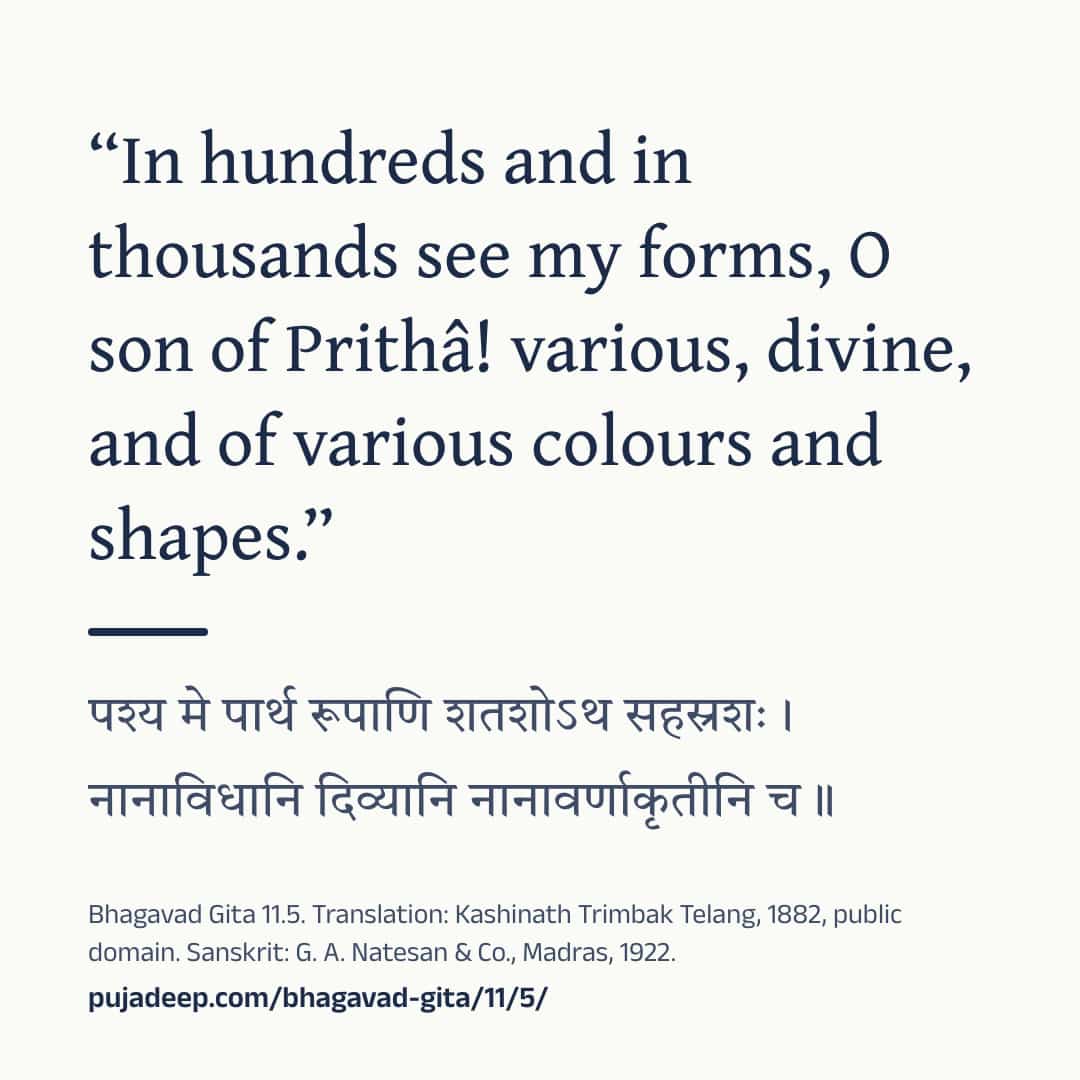
Drawing the picture
See the words
Bhagavad Gita 11.5

पश्य मे पार्थ रूपाणि शतशोऽथ सहस्रशः ।
नानाविधानि दिव्यानि नानावर्णाकृतीनि च ॥

“In hundreds and in thousands see my forms, O son of Prithâ! various, divine, and of various colours and shapes.”
(K. T. Telang, The Bhagavadgîtâ (The Sacred Books of the East, vol. VIII, Oxford: Clarendon Press, 1882), p. 92, public domain)

“Behold, O Pârtha, the forms of Me, by hundreds and by thousands, various in kind, divine, various in colour and shape.”
(Annie Besant, The Bhagavad Gîtâ, or The Lord's Song (London: Theosophical Publishing Society, 1895), p. 104, public domain)

“Behold, O son of Prithá, by the hundred and by the thousand, My different forms celestial, of various colours and shapes.”
(Swami Swarupananda, Srimad-Bhagavad-Gita (Mayavati: Prabuddha Bharata Press, 1909; first printed in Prabuddha Bharata, 1907–1909), p. 214, public domain)

Sanskrit: G. A. Natesan & Co., Madras, 1922.
https://pujadeep.com/bhagavad-gita/11/5/ Nothing is sent from this site. Your own app sends it, to the chat you choose. The picture quotes the translation you chose on this page, with its name and year.
Sanskrit text: The Bhagavad-Gita, or The Lord's Song, with the text in Devanagari and an English translation, 1922. Meanings: written for Pujadeep and checked against the cited edition. Source and changes
Questions families ask
Who speaks Bhagavad Gita 11.5?
Krishna speaks this verse, in chapter 11 (Vishvarupa Darshana Yoga).
Where does the Sanskrit text come from?
Sanskrit text: The Bhagavad-Gita, or The Lord's Song, with the text in Devanagari and an English translation, 1922. Meanings: written for Pujadeep and checked against the cited edition. See the source
Is the meaning on this page a translation?
Explanation written for this site from the sources listed here, and checked against the cited edition. It is not a translation and not the only way to read the text. Free to quote with credit.
Source and licence
- Sanskrit text
- The Bhagavad-Gita, or The Lord's Song, with the text in Devanagari and an English translation (Annie Besant, G. A. Natesan & Co., Madras, 1922). Public domain. The Sanskrit on these pages was read from this printing’s page images.
- Translation
- The Bhagavadgîtâ with the Sanatsugâtîya and the Anugîtâ, translated by Kâshinâth Trimbak Telang (The Sacred Books of the East, vol. VIII, ed. F. Max Müller) (Kashinath Trimbak Telang, F. Max Müller, Clarendon Press, Oxford, 1882). Public domain. Shown verbatim, as printed.
- Translation
- The Bhagavad Gîtâ, or The Lord's Song, translated by Annie Besant (Annie Besant, Theosophical Publishing Society, London, 1895). Public domain. Shown verbatim, as printed.
- Translation
- Srimad-Bhagavad-Gita, with Sanskrit Text; Paraphrase with Word-by-word Literal Translation; English Rendering and Comments, Index, &c., by the Swami Swarupananda (Himalayan Series, No. XX) (Swami Swarupananda, The Editors and Publishers, Advaita Ashrama, Mayavati, Prabuddha Bharata Press, Mayavati, Almora, Himalayas, 1909). Public domain. Shown verbatim, as printed.
- Common wording
- In this text, 32 words follow today's common wording, checked against sanskritdocuments.org; Sanskrit Wikisource; Gita Press, Gorakhpur; GRETIL, Göttingen and Bhaktivedanta Book Trust.
- Our explanation
- Explanation written for this site from the sources listed here, and checked against the cited edition. It is not a translation and not the only way to read the text. Free to quote with credit.
- Checked
- Checked against the cited edition, October 27, 2026.