Bhagavad Gita 11.16: meaning and translation
Chapter 11: Vishvarupa Darshana Yoga. Arjuna says
Arjuna says he sees Krishna everywhere, of endless form, with many arms, bellies, mouths and eyes.
Click or tap a word for its meaning and its dictionary page.
Text and layers
Text and layers
These choices stay in this browser.
Bhagavad Gita 11.16
अनेकबाहूदरवक्त्रनेत्रम् पश्यामि त्वां सर्वतोऽनन्तरूपम् ।नान्तं न मध्यं न पुनस्तवादिम् पश्यामि विश्वेश्वर विश्वरूप ॥
Anekabahudaravaktranetram pashyami tvam sarvatonantarupamNantam na madhyam na punastavadim pashyami vishveshvara vishvarupa
anekabāhūdaravaktranetram paśyāmi tvāṃ sarvato’nantarūpam |nāntaṃ na madhyaṃ na punastavādim paśyāmi viśveśvara viśvarūpa ||
Our explanation Arjuna says he sees Krishna everywhere, of endless form, with many arms, bellies, mouths and eyes. He calls him lord of the universe and universal form (viśvarūpa), and says he sees no end, no middle and no beginning of him.
हिंदी अर्थ अर्जुन कहते हैं कि वे कृष्ण को हर ओर अनंत रूप में देख रहे हैं, अनेक भुजाओं, उदरों, मुखों और नेत्रों के साथ। वे उन्हें विश्वेश्वर और विश्वरूप कहते हैं, और कहते हैं कि उन्हें उनका न अंत दिखता है, न मध्य, न आदि।
Word by word
Every word, with its dictionary page
Word by word
- अनेकबाहूदरवक्त्रनेत्रम् anekabāhūdaravaktranetram · with many arms, bellies, mouths and eyes (compound (masculine), accusative singular) Dictionary: an-eka, Monier-Williams 1899, p. 42, col. 2 “not one, many, much”; bāhu, Monier-Williams 1899, p. 730, col. 2 “the arm, (esp.) the fore-arm”; udara, Monier-Williams 1899, p. 184, col. 2 “the belly, abdomen, stomach, bowels”; vaktra, Monier-Williams 1899, p. 912, col. 2 “‘organ of speech,’ the mouth, face”; netra, Monier-Williams 1899, p. 568, col. 3 “the eye”
- पश्यामि paśyāmi · see (present, 1st person singular) Dictionary: 1. paś, Monier-Williams 1899, p. 611, col. 2 “to see, behold, look at, observe, perceive, notice”
- त्वाम् tvām · you (pronoun, accusative singular) Dictionary: yuṣmad, Monier-Williams 1899, p. 855, col. 3 “the base of the 2nd pers. pron. as used in comp.”
- सर्वतः sarvataḥ · on every side (indeclinable) Dictionary: sarvatas, Monier-Williams 1899, p. 1189, col. 1 “from all sides, in every direction, everywhere”
- अनन्तरूपम् anantarūpam · of endless forms (compound (masculine), accusative singular) Dictionary: an-anta-rūpa, Monier-Williams 1899, p. 25, col. 1 “having innumerable forms or shapes”
- न na · not (indeclinable) Dictionary: 2. na, Monier-Williams 1899, p. 523, col. 1 “not, no, nor, neither”
- अन्तम् antam · end (noun (masculine), accusative singular) Dictionary: anta, Monier-Williams 1899, p. 42, col. 3 “end, limit, boundary, term”
- न na · nor (indeclinable) Dictionary: 2. na, Monier-Williams 1899, p. 523, col. 1 “not, no, nor, neither”
- मध्यम् madhyam · middle (noun (neuter), accusative singular) Dictionary: madhya, Monier-Williams 1899, p. 781, col. 3 “the middle, midst, centre, inside, interior”
- न na · nor (indeclinable) Dictionary: 2. na, Monier-Williams 1899, p. 523, col. 1 “not, no, nor, neither”
- पुनः punaḥ · again, also (indeclinable) Dictionary: punar, Monier-Williams 1899, p. 633, col. 2 “again, once more”
- तव tava · your (pronoun, genitive singular) Dictionary: yuṣmad, Monier-Williams 1899, p. 855, col. 3 “the base of the 2nd pers. pron. as used in comp.”
- आदिम् ādim · beginning (noun (masculine), accusative singular) Dictionary: 1. ādi, Monier-Williams 1899, p. 136, col. 3 “beginning, commencement”
- पश्यामि paśyāmi · see (present, 1st person singular) Dictionary: 1. paś, Monier-Williams 1899, p. 611, col. 2 “to see, behold, look at, observe, perceive, notice”
- विश्वेश्वर viśveśvara · O Lord of all (compound (masculine), vocative singular) Dictionary: viśveśvara, Monier-Williams 1899, p. 994, col. 2
- विश्वरूप viśvarūpa · O you of every form (compound (masculine), vocative singular) Dictionary: viśva-rūpa, Monier-Williams 1899, p. 993, col. 3 “wearing all forms, manifold, various”
1 printing differs
Edition differences. Another printing or text reads this place differently.
- Spelling A digital text reads Same words. At the printed line ends of this long-metre verse the 1922 edition writes नेत्रम् and आदिम् (with virama, not anusvara); the e-text writes नेत्रं and आदिं.
Old translations
Kashinath Trimbak Telang, 1882. Public domain. Page 93.
I see you, who are of countless forms, possessed of many arms, stomachs, mouths, and eyes on all sides. And, O lord of the universe! O you of all forms! I do not see your end or middle or beginning.
Compare 3 translations
Kashinath Trimbak Telang, 1882. Public domain. Page 93.
I see you, who are of countless forms, possessed of many arms, stomachs, mouths, and eyes on all sides. And, O lord of the universe! O you of all forms! I do not see your end or middle or beginning.
You are reading this one
Annie Besant, 1895. Public domain. Page 106.
With mouths, eyes, arms, breasts,1 multitudinous,
I see Thee everywhere, unbounded Form.
Beginning, middle, end, nor source of Thee,
Infinite Lord, infinite Form, I find;
This sentence goes on in 11.17.
Footnotes (the translator’s own) - Literally, stomach. ↩
You are reading this one
Swami Swarupananda, 1909 (first printed 1907). Public domain. Page 219.
I see Thee of boundless form on every side with manifold arms, stomachs, mouths and eyes; neither the end nor the middle, nor also the beginning of Thee do I see, O Lord of the Universe, O Universal Form.
You are reading this one
Cite this verse
The translation: K. T. Telang, The Bhagavadgîtâ (The Sacred Books of the East, vol. VIII, Oxford: Clarendon Press, 1882), p. 93. Bhagavad Gita 11.16.
The translation: Annie Besant, The Bhagavad Gîtâ, or The Lord's Song (London: Theosophical Publishing Society, 1895), p. 106. Bhagavad Gita 11.16.
The translation: Swami Swarupananda, Srimad-Bhagavad-Gita (Mayavati: Prabuddha Bharata Press, 1909; first printed in Prabuddha Bharata, 1907–1909), p. 219. Bhagavad Gita 11.16.
Our explanation: “Bhagavad Gita 11.16: meaning and translation.” Pujadeep. Updated October 27, 2026. https://pujadeep.com/bhagavad-gita/11/16/
Pujadeep’s explanations are free to quote with credit: name Pujadeep and link to the page. How to credit
Classical readings, by school
No readings by school on this verse yet.
Share
Show the ways to share
Send one picture or the text to one chat. The picture names its source and the address of this page.
Drawing the picture
See the words
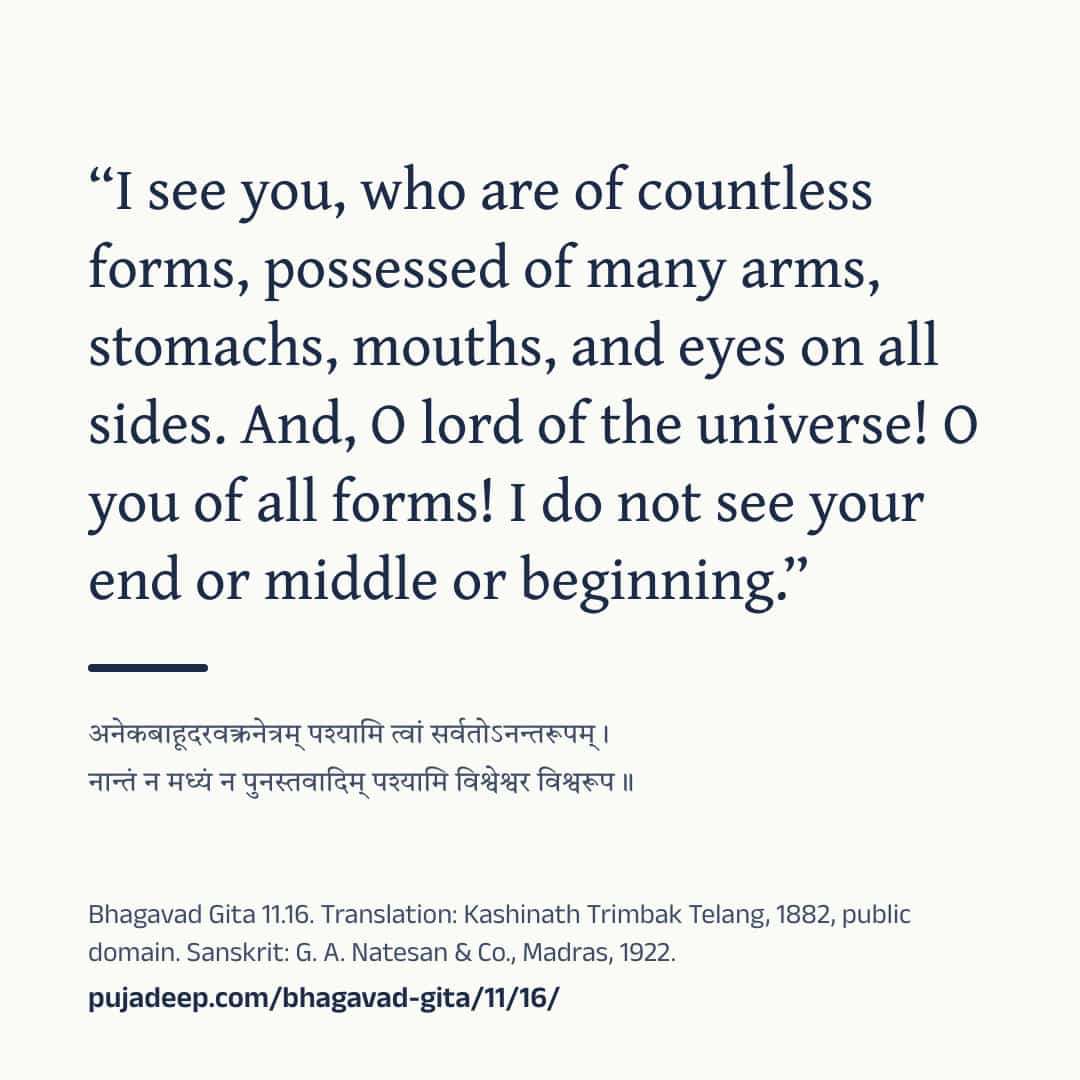
Bhagavad Gita 11.16

अनेकबाहूदरवक्त्रनेत्रम् पश्यामि त्वां सर्वतोऽनन्तरूपम् ।
नान्तं न मध्यं न पुनस्तवादिम् पश्यामि विश्वेश्वर विश्वरूप ॥

“I see you, who are of countless forms, possessed of many arms, stomachs, mouths, and eyes on all sides. And, O lord of the universe! O you of all forms! I do not see your end or middle or beginning.”
(K. T. Telang, The Bhagavadgîtâ (The Sacred Books of the East, vol. VIII, Oxford: Clarendon Press, 1882), p. 93, public domain)

“With mouths, eyes, arms, breasts, multitudinous, I see Thee everywhere, unbounded Form. Beginning, middle, end, nor source of Thee, Infinite Lord, infinite Form, I find;”
(Annie Besant, The Bhagavad Gîtâ, or The Lord's Song (London: Theosophical Publishing Society, 1895), p. 106, public domain)
This sentence goes on in 11.17.

“I see Thee of boundless form on every side with manifold arms, stomachs, mouths and eyes; neither the end nor the middle, nor also the beginning of Thee do I see, O Lord of the Universe, O Universal Form.”
(Swami Swarupananda, Srimad-Bhagavad-Gita (Mayavati: Prabuddha Bharata Press, 1909; first printed in Prabuddha Bharata, 1907–1909), p. 219, public domain)

Sanskrit: G. A. Natesan & Co., Madras, 1922.
https://pujadeep.com/bhagavad-gita/11/16/ Nothing is sent from this site. Your own app sends it, to the chat you choose. The picture quotes the translation you chose on this page, with its name and year.
Sanskrit text: The Bhagavad-Gita, or The Lord's Song, with the text in Devanagari and an English translation, 1922. Meanings: written for Pujadeep and checked against the cited edition. Source and changes
Questions families ask
Who speaks Bhagavad Gita 11.16?
Arjuna speaks this verse, in chapter 11 (Vishvarupa Darshana Yoga).
Where does the Sanskrit text come from?
Sanskrit text: The Bhagavad-Gita, or The Lord's Song, with the text in Devanagari and an English translation, 1922. Meanings: written for Pujadeep and checked against the cited edition. See the source
Is the meaning on this page a translation?
Explanation written for this site from the sources listed here, and checked against the cited edition. It is not a translation and not the only way to read the text. Free to quote with credit.
Source and licence
- Sanskrit text
- The Bhagavad-Gita, or The Lord's Song, with the text in Devanagari and an English translation (Annie Besant, G. A. Natesan & Co., Madras, 1922). Public domain. The Sanskrit on these pages was read from this printing’s page images.
- Translation
- The Bhagavadgîtâ with the Sanatsugâtîya and the Anugîtâ, translated by Kâshinâth Trimbak Telang (The Sacred Books of the East, vol. VIII, ed. F. Max Müller) (Kashinath Trimbak Telang, F. Max Müller, Clarendon Press, Oxford, 1882). Public domain. Shown verbatim, as printed.
- Translation
- The Bhagavad Gîtâ, or The Lord's Song, translated by Annie Besant (Annie Besant, Theosophical Publishing Society, London, 1895). Public domain. Shown verbatim, as printed.
- Translation
- Srimad-Bhagavad-Gita, with Sanskrit Text; Paraphrase with Word-by-word Literal Translation; English Rendering and Comments, Index, &c., by the Swami Swarupananda (Himalayan Series, No. XX) (Swami Swarupananda, The Editors and Publishers, Advaita Ashrama, Mayavati, Prabuddha Bharata Press, Mayavati, Almora, Himalayas, 1909). Public domain. Shown verbatim, as printed.
- Common wording
- In this text, 32 words follow today's common wording, checked against sanskritdocuments.org; Sanskrit Wikisource; Gita Press, Gorakhpur; GRETIL, Göttingen and Bhaktivedanta Book Trust.
- Our explanation
- Explanation written for this site from the sources listed here, and checked against the cited edition. It is not a translation and not the only way to read the text. Free to quote with credit.
- Checked
- Checked against the cited edition, October 27, 2026.