Bhagavad Gita 11.27: meaning and translation
Chapter 11: Vishvarupa Darshana Yoga. Arjuna says
Arjuna: ... are rushing into Krishna's mouths, which are fearsome with teeth; some are seen caught between the teeth, their heads crushed to powder.
Click or tap a word for its meaning and its dictionary page.
Text and layers
Text and layers
These choices stay in this browser.
Bhagavad Gita 11.27
वक्त्राणि ते त्वरमाणा विशन्ति दंष्ट्राकरालानि भयानकानि ।केचिद्विलग्ना दशनान्तरेषु संदृश्यन्ते चूर्णितैरुत्तमाङ्गैः ॥
Vaktrani te tvaramana vishanti danshtrakaralani bhayanakaniKechidvilagna dashanantareshu sandrishyante churnitairuttamangaih
vaktrāṇi te tvaramāṇā viśanti daṃṣṭrākarālāni bhayānakāni |kecidvilagnā daśanāntareṣu saṃdṛśyante cūrṇitairuttamāṅgaiḥ ||
Our explanation ... are rushing into Krishna's mouths, which are fearsome with teeth; some are seen caught between the teeth, their heads crushed to powder. These are Arjuna's words for what he sees in the form.
हिंदी अर्थ … कृष्ण के विकराल दाढ़ों वाले भयानक मुखों में तेज़ी से प्रवेश कर रहे हैं; कुछ दाँतों के बीच फँसे दिखते हैं, उनके सिर चूर्ण हो गए हैं। ये शब्द अर्जुन के हैं, जो वे उस रूप में देख रहे हैं।
Word by word
Every word, with its dictionary page
Word by word
- वक्त्राणि vaktrāṇi · mouths (noun (neuter), accusative plural) Dictionary: vaktra, Monier-Williams 1899, p. 912, col. 2 “‘organ of speech,’ the mouth, face”
- ते te · your (pronoun, genitive singular) Dictionary: yuṣmad, Monier-Williams 1899, p. 855, col. 3 “the base of the 2nd pers. pron. as used in comp.”
- त्वरमाणाः tvaramāṇāḥ · hurrying (present participle (masculine), nominative plural) Dictionary: tvar, Monier-Williams 1899, p. 463, col. 3 “to hurry, make haste, move with speed”
- विशन्ति viśanti · enter (present, 3rd person plural) Dictionary: 1. viś, Monier-Williams 1899, p. 989, col. 2 “to enter, enter in or settle down on, go into”
- दंष्ट्राकरालानि daṃṣṭrākarālāni · fearsome with tusks (compound (neuter), accusative plural) Dictionary: daṃṣṭrā-karāla, Monier-Williams 1899, p. 464, col. 3 “having terrible tusks”
- भयानकानि bhayānakāni · terrible (adjective (neuter), accusative plural) Dictionary: bhayānaka, Monier-Williams 1899, p. 747, col. 2 “fearful, terrible, dreadful, formidable”
- केचित् kecit · some (pronoun (masculine), nominative plural) Dictionary: kim, Monier-Williams 1899, p. 282, col. 2 “what? how? whence? wherefore? why?”; 2. cid, Monier-Williams 1899, p. 398, col. 1 “even, indeed, also”
- विलग्नाः vilagnāḥ · caught, sticking (past participle (masculine), nominative plural) Dictionary: vi-lagna, Monier-Williams 1899, p. 984, col. 3 “fastened or attached to, resting or hanging on”
- दशनान्तरेषु daśanāntareṣu · in the gaps between the teeth (compound (neuter), locative plural) Dictionary: daśana, Monier-Williams 1899, p. 472, col. 3 “a tooth”; antara, Monier-Williams 1899, p. 43, col. 3 “interval, intermediate space or time”
- संदृश्यन्ते saṃdṛśyante · are seen (present passive, 3rd person plural) Dictionary: saṃ-dṛś, Monier-Williams 1899, p. 1144, col. 1 “to be observed, become visible, appear”
- चूर्णितैः cūrṇitaiḥ · crushed (past participle (neuter), instrumental plural) Dictionary: cūrṇita, Monier-Williams 1899, p. 401, col. 2
- उत्तमाङ्गैः uttamāṅgaiḥ · with heads (compound (neuter), instrumental plural) Dictionary: uttamāṅga, Monier-Williams 1899, p. 178, col. 1 “the highest or chief part of the body, the head”
1 printing differs
Edition differences. Another printing or text reads this place differently.
- Spelling A digital text reads Same word. The e-text writes the class nasal (सन्दृश्यन्ते); the 1922 edition writes anusvara (संदृश्यन्ते).
Old translations
Kashinath Trimbak Telang, 1882. Public domain. Page 95.
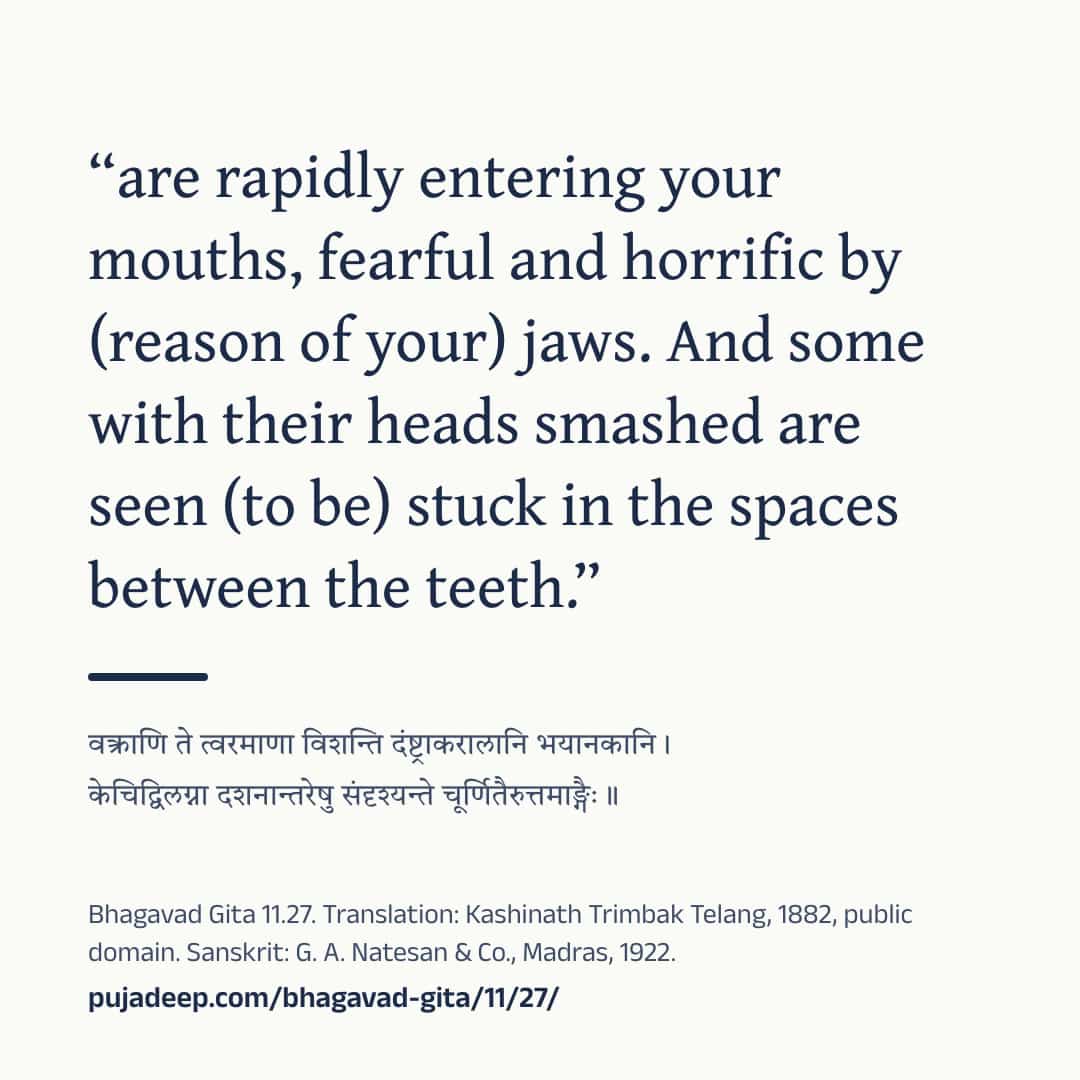
are rapidly entering your mouths, fearful and horrific1 by (reason of your) jaws. And some with their heads smashed are seen (to be) stuck in the spaces between the teeth.
This sentence begins in 11.26.
Footnotes (the translator’s own) - By reason of the ruggedness and distortion of face. ↩
Compare 3 translations
Kashinath Trimbak Telang, 1882. Public domain. Page 95.
are rapidly entering your mouths, fearful and horrific1 by (reason of your) jaws. And some with their heads smashed are seen (to be) stuck in the spaces between the teeth.
This sentence begins in 11.26.
Footnotes (the translator’s own) - By reason of the ruggedness and distortion of face. ↩
You are reading this one
Annie Besant, 1895. Public domain. Page 109.
Into Thy gaping mouths they hurrying rush,
Tremendous-toothed and terrible to see;
Some caught within the gaps between Thy teeth
Are seen, their heads to powder crushed and ground.
This sentence begins in 11.26.
You are reading this one
Swami Swarupananda, 1909 (first printed 1907). Public domain.
Swarupananda renders verses 26–27 together; see 11.26. Read it at 11.26
You are reading this one
Cite this verse
The translation: K. T. Telang, The Bhagavadgîtâ (The Sacred Books of the East, vol. VIII, Oxford: Clarendon Press, 1882), p. 95. Bhagavad Gita 11.27.
The translation: Annie Besant, The Bhagavad Gîtâ, or The Lord's Song (London: Theosophical Publishing Society, 1895), p. 109. Bhagavad Gita 11.27.
The translation: Swami Swarupananda, Srimad-Bhagavad-Gita (Mayavati: Prabuddha Bharata Press, 1909; first printed in Prabuddha Bharata, 1907–1909), pp. 224–225. Bhagavad Gita 11.26–27.
Our explanation: “Bhagavad Gita 11.27: meaning and translation.” Pujadeep. Updated October 27, 2026. https://pujadeep.com/bhagavad-gita/11/27/
Pujadeep’s explanations are free to quote with credit: name Pujadeep and link to the page. How to credit
Classical readings, by school
No readings by school on this verse yet.
Share
Show the ways to share
Send one picture or the text to one chat. The picture names its source and the address of this page.
Drawing the picture
See the words
Bhagavad Gita 11.27

वक्त्राणि ते त्वरमाणा विशन्ति दंष्ट्राकरालानि भयानकानि ।
केचिद्विलग्ना दशनान्तरेषु संदृश्यन्ते चूर्णितैरुत्तमाङ्गैः ॥

“are rapidly entering your mouths, fearful and horrific by (reason of your) jaws. And some with their heads smashed are seen (to be) stuck in the spaces between the teeth.”
(K. T. Telang, The Bhagavadgîtâ (The Sacred Books of the East, vol. VIII, Oxford: Clarendon Press, 1882), p. 95, public domain)
This sentence begins in 11.26.

“Into Thy gaping mouths they hurrying rush, Tremendous-toothed and terrible to see; Some caught within the gaps between Thy teeth Are seen, their heads to powder crushed and ground.”
(Annie Besant, The Bhagavad Gîtâ, or The Lord's Song (London: Theosophical Publishing Society, 1895), p. 109, public domain)
This sentence begins in 11.26.

Sanskrit: G. A. Natesan & Co., Madras, 1922.
https://pujadeep.com/bhagavad-gita/11/27/ Nothing is sent from this site. Your own app sends it, to the chat you choose. The picture quotes the translation you chose on this page, with its name and year.
Sanskrit text: The Bhagavad-Gita, or The Lord's Song, with the text in Devanagari and an English translation, 1922. Meanings: written for Pujadeep and checked against the cited edition. Source and changes
Questions families ask
Who speaks Bhagavad Gita 11.27?
Arjuna speaks this verse, in chapter 11 (Vishvarupa Darshana Yoga).
Where does the Sanskrit text come from?
Sanskrit text: The Bhagavad-Gita, or The Lord's Song, with the text in Devanagari and an English translation, 1922. Meanings: written for Pujadeep and checked against the cited edition. See the source
Is the meaning on this page a translation?
Explanation written for this site from the sources listed here, and checked against the cited edition. It is not a translation and not the only way to read the text. Free to quote with credit.
Source and licence
- Sanskrit text
- The Bhagavad-Gita, or The Lord's Song, with the text in Devanagari and an English translation (Annie Besant, G. A. Natesan & Co., Madras, 1922). Public domain. The Sanskrit on these pages was read from this printing’s page images.
- Translation
- The Bhagavadgîtâ with the Sanatsugâtîya and the Anugîtâ, translated by Kâshinâth Trimbak Telang (The Sacred Books of the East, vol. VIII, ed. F. Max Müller) (Kashinath Trimbak Telang, F. Max Müller, Clarendon Press, Oxford, 1882). Public domain. Shown verbatim, as printed.
- Translation
- The Bhagavad Gîtâ, or The Lord's Song, translated by Annie Besant (Annie Besant, Theosophical Publishing Society, London, 1895). Public domain. Shown verbatim, as printed.
- Translation
- Srimad-Bhagavad-Gita, with Sanskrit Text; Paraphrase with Word-by-word Literal Translation; English Rendering and Comments, Index, &c., by the Swami Swarupananda (Himalayan Series, No. XX) (Swami Swarupananda, The Editors and Publishers, Advaita Ashrama, Mayavati, Prabuddha Bharata Press, Mayavati, Almora, Himalayas, 1909). Public domain. Shown verbatim, as printed.
- Common wording
- In this text, 32 words follow today's common wording, checked against sanskritdocuments.org; Sanskrit Wikisource; Gita Press, Gorakhpur; GRETIL, Göttingen and Bhaktivedanta Book Trust.
- Our explanation
- Explanation written for this site from the sources listed here, and checked against the cited edition. It is not a translation and not the only way to read the text. Free to quote with credit.
- Checked
- Checked against the cited edition, October 27, 2026.