Bhagavad Gita 11.26: meaning and translation
Chapter 11: Vishvarupa Darshana Yoga. Arjuna says
Arjuna says that all the sons of Dhritarashtra, with the hosts of kings, Bhishma, Drona and Karna (Telang: 'this charioteer's son'; his note explains that Karna was brought up by a charioteer), together with the chief warriors of Arjuna's own side, ...
Click or tap a word for its meaning and its dictionary page.
Text and layers
Text and layers
These choices stay in this browser.
Bhagavad Gita 11.26
अमी च त्वां धृतराष्ट्रस्य पुत्राः सर्वे सहैवावनिपालसङ्घैः ।भीष्मो द्रोणः सूतपुत्रस्तथाऽसौ सहास्मदीयैरपि योधमुख्यैः ॥
Ami cha tvam dhritarashtrasya putrah sarve sahaivavanipalasanghaihBhishmo dronah sutaputrastathasau sahasmadiyairapi yodhamukhyaih
amī ca tvāṃ dhṛtarāṣṭrasya putrāḥ sarve sahaivāvanipālasaṅghaiḥ |bhīṣmo droṇaḥ sūtaputrastathā’sau sahāsmadīyairapi yodhamukhyaiḥ ||
Our explanation Arjuna says that all the sons of Dhritarashtra, with the hosts of kings, Bhishma, Drona and Karna (Telang: 'this charioteer's son'; his note explains that Karna was brought up by a charioteer), together with the chief warriors of Arjuna's own side, ... The sentence goes on in verse 27. The commentators explain what Arjuna sees here (see the views).
हिंदी अर्थ अर्जुन कहते हैं कि धृतराष्ट्र के सब पुत्र, राजाओं के समूहों के साथ, भीष्म, द्रोण और कर्ण (तेलंग: “सारथी का पुत्र”; उनकी टिप्पणी बताती है कि कर्ण को एक सारथी ने पाला था), और अर्जुन के अपने पक्ष के प्रमुख योद्धा भी … यह वाक्य श्लोक 27 में आगे चलता है। अर्जुन यहाँ क्या देख रहे हैं, इसे टीकाकार समझाते हैं।
Word by word
Every word, with its dictionary page
Word by word
- अमी amī · these (pronoun (masculine), nominative plural) Dictionary: adas, Monier-Williams 1899, p. 18, col. 1 “that; a certain”
- च ca · and (indeclinable) Dictionary: 2. ca, Monier-Williams 1899, p. 380, col. 1 “and, both, also, moreover, as well as”
- त्वाम् tvām · into you (pronoun, accusative singular) Dictionary: yuṣmad, Monier-Williams 1899, p. 855, col. 3 “the base of the 2nd pers. pron. as used in comp.”
- धृतराष्ट्रस्य dhṛtarāṣṭrasya · of Dhritarashtra (noun (masculine), genitive singular) Dictionary: dhṛta-rāṣṭra, Monier-Williams 1899, p. 519, col. 2 “the eldest son of Vyāsa by the widow of Vicitra-vīrya”
- पुत्राः putrāḥ · sons (noun (masculine), nominative plural) Dictionary: putra, Monier-Williams 1899, p. 632, col. 3 “a son, child”
- सर्वे sarve · all (pronoun (masculine), nominative plural) Dictionary: sarva, Monier-Williams 1899, p. 1184, col. 3 “whole, entire, all, every”
- सह saha · with (indeclinable) Dictionary: 2. saha, Monier-Williams 1899, p. 1193, col. 2 “together with, along with, with”
- एव eva · indeed (indeclinable) Dictionary: 1. eva, Monier-Williams 1899, p. 232, col. 2 “just, exactly, very, same, only, even, alone, merely”
- अवनिपालसङ्घैः avanipālasaṅghaiḥ · with hosts of kings (compound (masculine), instrumental plural) Dictionary: avani-pāla, Monier-Williams 1899, p. 100, col. 2 “‘protector of the earth,’ a king”; saṃ-gha, Monier-Williams 1899, p. 1129, col. 3 “multitude, quantity, crowd, host”
- भीष्मः bhīṣmaḥ · Bhishma (noun (masculine), nominative singular) Dictionary: bhīṣma, Monier-Williams 1899, p. 758, col. 3 “N. of a son of Śāṃtanu and Gaṅgā”
- द्रोणः droṇaḥ · Drona (noun (masculine), nominative singular) Dictionary: droṇa, Monier-Williams 1899, p. 503, col. 1 “the military preceptor of both the Kuru and Pāṇḍu princes”
- सूतपुत्रः sūtaputraḥ · the charioteer's son (Karna) (compound (masculine), nominative singular) Dictionary: sūta-putra, Monier-Williams 1899, p. 1241, col. 3 “N. of Karṇa”
- तथा tathā · likewise (indeclinable) Dictionary: tathā, Monier-Williams 1899, p. 433, col. 3 “in that manner, so, thus”
- असौ asau · that one (pronoun (masculine), nominative singular) Dictionary: adas, Monier-Williams 1899, p. 18, col. 1 “that; a certain”
- सह saha · together with (indeclinable) Dictionary: 2. saha, Monier-Williams 1899, p. 1193, col. 2 “together with, along with, with”
- अस्मदीयैः asmadīyaiḥ · ours (adjective (masculine), instrumental plural) Dictionary: asmadīya, Monier-Williams 1899, p. 123, col. 2 “our, ours”
- अपि api · also (indeclinable) Dictionary: api, Monier-Williams 1899, p. 55, col. 1 “even, also, very”
- योधमुख्यैः yodhamukhyaiḥ · chief warriors (compound (masculine), instrumental plural) Dictionary: yodha-mukhya, Monier-Williams 1899, p. 858, col. 2 “a chief warrior, leader”
1 printing differs
Edition differences. Another printing or text reads this place differently.
- Spelling A digital text reads Same words. The 1922 edition marks the merged vowel with an avagraha (तथाऽसौ); this e-text does not.
Old translations
Kashinath Trimbak Telang, 1882. Public domain. Page 95.
And all these sons of Dhritarâshtra, together with all the bands of kings, and Bhîshma and Drona, and this charioteer's son1 likewise, together with our principal warriors also,
This sentence goes on in 11.27.
Footnotes (the translator’s own) - I.e. Karna, who was really the eldest brother of the Pândavas, but having been immediately on birth abandoned by Kuntî, was brought up by a charioteer. Karna was told of his true origin by Bhîshma on his deathbed, and advised to join the Pândavas, but he declined. ↩
Compare 3 translations
Kashinath Trimbak Telang, 1882. Public domain. Page 95.
And all these sons of Dhritarâshtra, together with all the bands of kings, and Bhîshma and Drona, and this charioteer's son1 likewise, together with our principal warriors also,
This sentence goes on in 11.27.
Footnotes (the translator’s own) - I.e. Karna, who was really the eldest brother of the Pândavas, but having been immediately on birth abandoned by Kuntî, was brought up by a charioteer. Karna was told of his true origin by Bhîshma on his deathbed, and advised to join the Pândavas, but he declined. ↩
You are reading this one
Annie Besant, 1895. Public domain. Page 109.
The sons of Dhritarâshtra, and with them
The multitude of all these kings of earth,
Bhîshma, Drona, Sûta's royal son,
And all the noblest warriors of our hosts,
This sentence goes on in 11.27.
You are reading this one
Swami Swarupananda, 1909 (first printed 1907). Public domain. Page 224–225.
All these sons of Dhritaráshtra, with hosts of monarchs, Bhishma, Drona, and Sutaputra, with the warrior chiefs of ours, enter precipitately into Thy mouth, terrible with tusks and fearful to behold. Some are found sticking in the interstices of Thy teeth, with their heads crushed to powder.
This sentence covers verses 11.26 to 11.27.
You are reading this one
Cite this verse
The translation: K. T. Telang, The Bhagavadgîtâ (The Sacred Books of the East, vol. VIII, Oxford: Clarendon Press, 1882), p. 95. Bhagavad Gita 11.26.
The translation: Annie Besant, The Bhagavad Gîtâ, or The Lord's Song (London: Theosophical Publishing Society, 1895), p. 109. Bhagavad Gita 11.26.
The translation: Swami Swarupananda, Srimad-Bhagavad-Gita (Mayavati: Prabuddha Bharata Press, 1909; first printed in Prabuddha Bharata, 1907–1909), pp. 224–225. Bhagavad Gita 11.26–27.
Our explanation: “Bhagavad Gita 11.26: meaning and translation.” Pujadeep. Updated October 27, 2026. https://pujadeep.com/bhagavad-gita/11/26/
Pujadeep’s explanations are free to quote with credit: name Pujadeep and link to the page. How to credit
Classical readings, by school
Each reading is named by its school. None is presented as the only meaning.
What Advaita, Vishishtadvaita and Dvaita teach, in short
Shankara Advaita
Shankara says that here Arjuna sees the defeat of the enemy, so his fear of defeat (2.6) is gone.
Source: The Bhagavad-Gita, with the commentary of Sri Sankaracharya, translated by A. Mahadeva Sastri (2nd ed., Mysore: G. T. A. Printing Works, 1901), commentary on 11.26–27, p. 255. Summarised in our own words; none of its text is reproduced.
Ramanuja Vishishtadvaita
Ramanuja says that, with the divine sight he has been given, Arjuna now sees in the Lord how the hosts of Dhritarashtra's side meet their end, an event that has not yet happened.
Source: Sri Bhagavad-Gita with Sri Ramanujacharya's Visishtadvaita commentary, translated by A. Govindacharya (Madras, 1898), commentary on 11.25–27, pp. 361–362. Summarised in our own words; none of its text is reproduced.
Madhva Dvaita
Madhva says these warriors go into the mouths because the Lord has ordained their death. This is different from the way the freed souls and devotees enter the Lord (11.21).
Source: The Bhagavad-Gita: translation and commentaries in English according to Sri Madhwacharya's Bhashyas, by S. Subba Rau (Madras, 1906), commentary on 11.27, p. 227 (leaf n225). Summarised in our own words; none of its text is reproduced.
Share
Show the ways to share
Send one picture or the text to one chat. The picture names its source and the address of this page.
Drawing the picture
See the words
Bhagavad Gita 11.26

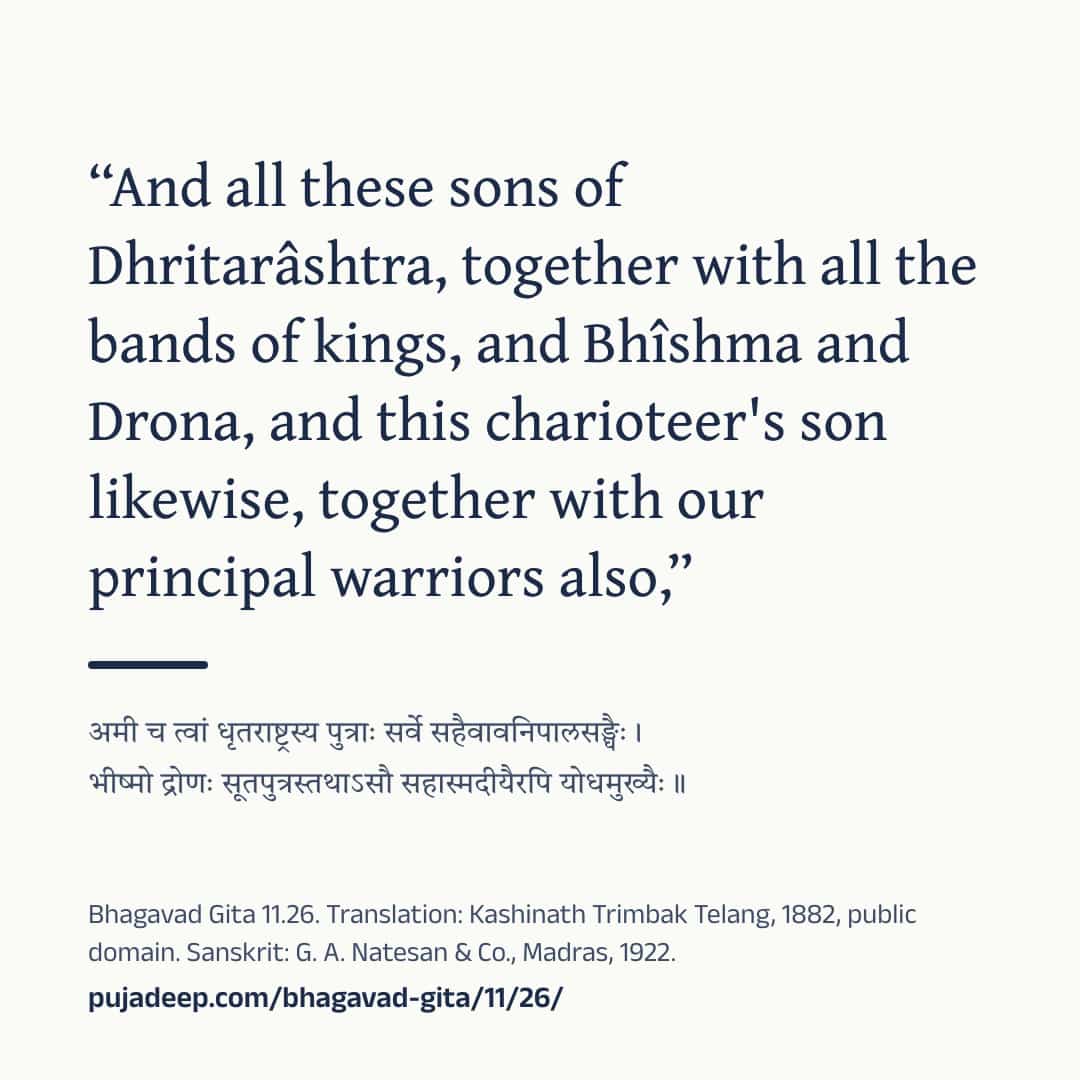
अमी च त्वां धृतराष्ट्रस्य पुत्राः सर्वे सहैवावनिपालसङ्घैः ।
भीष्मो द्रोणः सूतपुत्रस्तथाऽसौ सहास्मदीयैरपि योधमुख्यैः ॥

“And all these sons of Dhritarâshtra, together with all the bands of kings, and Bhîshma and Drona, and this charioteer's son likewise, together with our principal warriors also,”
(K. T. Telang, The Bhagavadgîtâ (The Sacred Books of the East, vol. VIII, Oxford: Clarendon Press, 1882), p. 95, public domain)
This sentence goes on in 11.27.

“The sons of Dhritarâshtra, and with them The multitude of all these kings of earth, Bhîshma, Drona, Sûta's royal son, And all the noblest warriors of our hosts,”
(Annie Besant, The Bhagavad Gîtâ, or The Lord's Song (London: Theosophical Publishing Society, 1895), p. 109, public domain)
This sentence goes on in 11.27.

“All these sons of Dhritaráshtra, with hosts of monarchs, Bhishma, Drona, and Sutaputra, with the warrior chiefs of ours, enter precipitately into Thy mouth, terrible with tusks and fearful to behold. Some are found sticking in the interstices of Thy teeth, with their heads crushed to powder.”
(Swami Swarupananda, Srimad-Bhagavad-Gita (Mayavati: Prabuddha Bharata Press, 1909; first printed in Prabuddha Bharata, 1907–1909), pp. 224–225, public domain)
This sentence covers verses 11.26 to 11.27.

Sanskrit: G. A. Natesan & Co., Madras, 1922.
https://pujadeep.com/bhagavad-gita/11/26/ Nothing is sent from this site. Your own app sends it, to the chat you choose. The picture quotes the translation you chose on this page, with its name and year.
Sanskrit text: The Bhagavad-Gita, or The Lord's Song, with the text in Devanagari and an English translation, 1922. Meanings: written for Pujadeep and checked against the cited edition. Source and changes
Questions families ask
Who speaks Bhagavad Gita 11.26?
Arjuna speaks this verse, in chapter 11 (Vishvarupa Darshana Yoga).
Where does the Sanskrit text come from?
Sanskrit text: The Bhagavad-Gita, or The Lord's Song, with the text in Devanagari and an English translation, 1922. Meanings: written for Pujadeep and checked against the cited edition. See the source
Is the meaning on this page a translation?
Explanation written for this site from the sources listed here, and checked against the cited edition. It is not a translation and not the only way to read the text. Free to quote with credit.
Source and licence
- Sanskrit text
- The Bhagavad-Gita, or The Lord's Song, with the text in Devanagari and an English translation (Annie Besant, G. A. Natesan & Co., Madras, 1922). Public domain. The Sanskrit on these pages was read from this printing’s page images.
- Translation
- The Bhagavadgîtâ with the Sanatsugâtîya and the Anugîtâ, translated by Kâshinâth Trimbak Telang (The Sacred Books of the East, vol. VIII, ed. F. Max Müller) (Kashinath Trimbak Telang, F. Max Müller, Clarendon Press, Oxford, 1882). Public domain. Shown verbatim, as printed.
- Translation
- The Bhagavad Gîtâ, or The Lord's Song, translated by Annie Besant (Annie Besant, Theosophical Publishing Society, London, 1895). Public domain. Shown verbatim, as printed.
- Translation
- Srimad-Bhagavad-Gita, with Sanskrit Text; Paraphrase with Word-by-word Literal Translation; English Rendering and Comments, Index, &c., by the Swami Swarupananda (Himalayan Series, No. XX) (Swami Swarupananda, The Editors and Publishers, Advaita Ashrama, Mayavati, Prabuddha Bharata Press, Mayavati, Almora, Himalayas, 1909). Public domain. Shown verbatim, as printed.
- Commentary
- The Bhagavad-Gita, with the commentary of Sri Sankaracharya, translated by A. Mahadeva Sastri (2nd ed., Mysore: G. T. A. Printing Works, 1901) (Public-domain scan, University of California Libraries). Summarised in our own words; none of its text is reproduced.
- Commentary
- Sri Bhagavad-Gita with Sri Ramanujacharya's Visishtadvaita commentary, translated by A. Govindacharya (Madras, 1898) (Scan uploaded to archive.org (folkscanomy collection)). Summarised in our own words; none of its text is reproduced.
- Commentary
- The Bhagavad-Gita: translation and commentaries in English according to Sri Madhwacharya's Bhashyas, by S. Subba Rau (Madras, 1906) (Scan uploaded to archive.org (folkscanomy collection)). Summarised in our own words; none of its text is reproduced.
- Common wording
- In this text, 32 words follow today's common wording, checked against sanskritdocuments.org; Sanskrit Wikisource; Gita Press, Gorakhpur; GRETIL, Göttingen and Bhaktivedanta Book Trust.
- Our explanation
- Explanation written for this site from the sources listed here, and checked against the cited edition. It is not a translation and not the only way to read the text. Free to quote with credit.
- Checked
- Checked against the cited edition, October 27, 2026.