Bhagavad Gita 11.31: meaning and translation
Chapter 11: Vishvarupa Darshana Yoga. Arjuna says
Arjuna asks Krishna to tell him who he is, in this fierce form.
Click or tap a word for its meaning and its dictionary page.
Text and layers
Text and layers
These choices stay in this browser.
Bhagavad Gita 11.31
आख्याहि मे को भवानुग्ररूपो नमोऽस्तु ते देववर प्रसीद ।विज्ञातुमिच्छामि भवन्तमाद्यम् न हि प्रजानामि तव प्रवृत्तिम् ॥
Akhyahi me ko bhavanugrarupo namostu te devavara prasidaVijnatumichchhami bhavantamadyam na hi prajanami tava pravrittim
ākhyāhi me ko bhavānugrarūpo namo’stu te devavara prasīda |vijñātumicchāmi bhavantamādyam na hi prajānāmi tava pravṛttim ||
Our explanation Arjuna asks Krishna to tell him who he is, in this fierce form. He bows to him and asks him to be gracious, calling him best of gods. He says he wishes to know Krishna, the first being, because he does not understand what Krishna is doing (pravṛtti).
हिंदी अर्थ अर्जुन कृष्ण से पूछते हैं कि इस उग्र रूप में वे कौन हैं। वे उन्हें प्रणाम करते हैं और उन्हें देवश्रेष्ठ कहकर प्रसन्न होने की विनती करते हैं। वे कहते हैं कि वे आदि पुरुष कृष्ण को जानना चाहते हैं, क्योंकि वे उनकी प्रवृत्ति (वे क्या कर रहे हैं) नहीं समझ पा रहे।
Word by word
Every word, with its dictionary page
Word by word
- आख्याहि ākhyāhi · tell (imperative, 2nd person singular) Dictionary: 1. ā-khyā, Monier-Williams 1899, p. 129, col. 1 “to tell, communicate, inform, declare”
- मे me · to "me" (Arjuna) (pronoun, dative singular) Dictionary: 1. mad, Monier-Williams 1899, p. 777, col. 2 “base of the first pers. pron. in the sg. number (esp. in comp.)”
- कः kaḥ · who (pronoun (masculine), nominative singular) Dictionary: kim, Monier-Williams 1899, p. 282, col. 2 “what? how? whence? wherefore? why?”
- भवान् bhavān · you (respectful) (pronoun (masculine), nominative singular) Dictionary: bhavat, Monier-Williams 1899, p. 749, col. 2 “your honour, your worship, your lordship or ladyship, you”
- उग्ररूपः ugrarūpaḥ · of fierce form (compound (masculine), nominative singular) Dictionary: ugra, Monier-Williams 1899, p. 172, col. 2 “powerful, violent, mighty, impetuous, strong”; rūpa, Monier-Williams 1899, p. 885, col. 3 “form, shape, figure”
- नमः namaḥ · salutation (noun (neuter), nominative singular) Dictionary: namas, Monier-Williams 1899, p. 528, col. 1 “bow, obeisance, reverential salutation”
- अस्तु astu · let there be (imperative, 3rd person singular) Dictionary: 1. as, Monier-Williams 1899, p. 117, col. 2 “to be, live, exist, be present”
- ते te · to you (pronoun, dative singular) Dictionary: yuṣmad, Monier-Williams 1899, p. 855, col. 3 “the base of the 2nd pers. pron. as used in comp.”
- देववर devavara · O best of gods (compound (masculine), vocative singular) Dictionary: deva-vara, Monier-Williams 1899, p. 494, col. 2 “a superior or supreme deity”
- प्रसीद prasīda · be gracious (imperative, 2nd person singular) Dictionary: pra-sad, Monier-Williams 1899, p. 696, col. 3 “to become satisfied or pleased or glad, be gracious or kind”
- विज्ञातुम् vijñātum · to know (infinitive (to do)) Dictionary: vi-jñā, Monier-Williams 1899, p. 961, col. 1 “to distinguish, discern, observe, investigate, recognize, ascertain, know, understand”
- इच्छामि icchāmi · wish, want (present, 1st person singular) Dictionary: 3. iṣ, Monier-Williams 1899, p. 169, col. 1 “to endeavour to obtain, strive, seek for”
- भवन्तम् bhavantam · you (respectful) (pronoun (masculine), accusative singular) Dictionary: bhavat, Monier-Williams 1899, p. 749, col. 2 “your honour, your worship, your lordship or ladyship, you”
- आद्यम् ādyam · the first one, the origin (adjective (masculine), accusative singular) Dictionary: 1. ādya, Monier-Williams 1899, p. 137, col. 1 “being at the beginning, first, primitive”
- न na · not (indeclinable) Dictionary: 2. na, Monier-Williams 1899, p. 523, col. 1 “not, no, nor, neither”
- हि hi · for (indeclinable) Dictionary: 2. hi, Monier-Williams 1899, p. 1297, col. 3 “for, because, on account of”
- प्रजानामि prajānāmi · understand (present, 1st person singular) Dictionary: pra-jñā, Monier-Williams 1899, p. 659, col. 1 “to know, understand”
- तव tava · your (pronoun, genitive singular) Dictionary: yuṣmad, Monier-Williams 1899, p. 855, col. 3 “the base of the 2nd pers. pron. as used in comp.”
- प्रवृत्तिम् pravṛttim · purpose, working (noun (feminine), accusative singular) Dictionary: pra-vṛtti, Monier-Williams 1899, p. 694, col. 1 “moving onwards, advance, progress; coming forth, appearance, manifestation”
1 printing differs
Edition differences. Another printing or text reads this place differently.
- Spelling A digital text reads Same words. At the printed line end the 1922 edition writes आद्यम्; the e-text writes आद्यं.
Old translations
Kashinath Trimbak Telang, 1882. Public domain. Page 95.
Tell me who you are in this fierce form. Salutations be to thee, O chief of the gods! Be gracious. I wish to know you, the primeval one, for I do not understand your actions.
Compare 3 translations
Kashinath Trimbak Telang, 1882. Public domain. Page 95.
Tell me who you are in this fierce form. Salutations be to thee, O chief of the gods! Be gracious. I wish to know you, the primeval one, for I do not understand your actions.
You are reading this one
Annie Besant, 1895. Public domain. Page 110.
Reveal Thy SELF; what awful form art Thou?
I worship Thee! Have mercy, God supreme!
Thine inner Being I am fain to know;
This Thy forthstreaming Life bewilders me.
You are reading this one
Swami Swarupananda, 1909 (first printed 1907). Public domain. Page 227.
Tell me who Thou art, fierce in form. Salutation to Thee, O Deva Supreme; have mercy. I desire to know Thee, O Primeval One. I know not indeed Thy purpose.
You are reading this one
Cite this verse
The translation: K. T. Telang, The Bhagavadgîtâ (The Sacred Books of the East, vol. VIII, Oxford: Clarendon Press, 1882), p. 95. Bhagavad Gita 11.31.
The translation: Annie Besant, The Bhagavad Gîtâ, or The Lord's Song (London: Theosophical Publishing Society, 1895), p. 110. Bhagavad Gita 11.31.
The translation: Swami Swarupananda, Srimad-Bhagavad-Gita (Mayavati: Prabuddha Bharata Press, 1909; first printed in Prabuddha Bharata, 1907–1909), p. 227. Bhagavad Gita 11.31.
Our explanation: “Bhagavad Gita 11.31: meaning and translation.” Pujadeep. Updated October 27, 2026. https://pujadeep.com/bhagavad-gita/11/31/
Pujadeep’s explanations are free to quote with credit: name Pujadeep and link to the page. How to credit
Classical readings, by school
No readings by school on this verse yet.
Share
Show the ways to share
Send one picture or the text to one chat. The picture names its source and the address of this page.
Drawing the picture
See the words
Bhagavad Gita 11.31

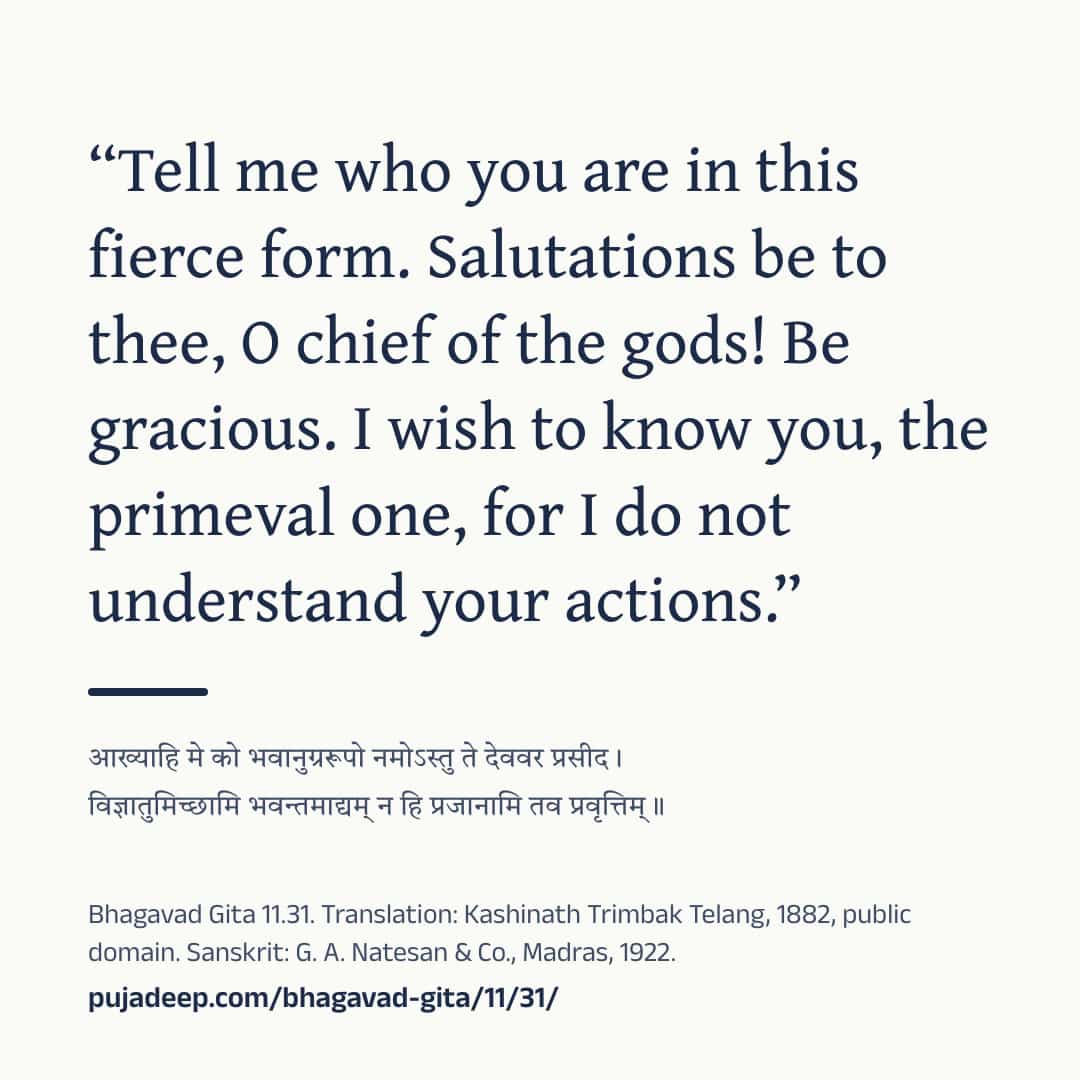
आख्याहि मे को भवानुग्ररूपो नमोऽस्तु ते देववर प्रसीद ।
विज्ञातुमिच्छामि भवन्तमाद्यम् न हि प्रजानामि तव प्रवृत्तिम् ॥

“Tell me who you are in this fierce form. Salutations be to thee, O chief of the gods! Be gracious. I wish to know you, the primeval one, for I do not understand your actions.”
(K. T. Telang, The Bhagavadgîtâ (The Sacred Books of the East, vol. VIII, Oxford: Clarendon Press, 1882), p. 95, public domain)

“Reveal Thy SELF; what awful form art Thou? I worship Thee! Have mercy, God supreme! Thine inner Being I am fain to know; This Thy forthstreaming Life bewilders me.”
(Annie Besant, The Bhagavad Gîtâ, or The Lord's Song (London: Theosophical Publishing Society, 1895), p. 110, public domain)

“Tell me who Thou art, fierce in form. Salutation to Thee, O Deva Supreme; have mercy. I desire to know Thee, O Primeval One. I know not indeed Thy purpose.”
(Swami Swarupananda, Srimad-Bhagavad-Gita (Mayavati: Prabuddha Bharata Press, 1909; first printed in Prabuddha Bharata, 1907–1909), p. 227, public domain)

Sanskrit: G. A. Natesan & Co., Madras, 1922.
https://pujadeep.com/bhagavad-gita/11/31/ Nothing is sent from this site. Your own app sends it, to the chat you choose. The picture quotes the translation you chose on this page, with its name and year.
Sanskrit text: The Bhagavad-Gita, or The Lord's Song, with the text in Devanagari and an English translation, 1922. Meanings: written for Pujadeep and checked against the cited edition. Source and changes
Questions families ask
Who speaks Bhagavad Gita 11.31?
Arjuna speaks this verse, in chapter 11 (Vishvarupa Darshana Yoga).
Where does the Sanskrit text come from?
Sanskrit text: The Bhagavad-Gita, or The Lord's Song, with the text in Devanagari and an English translation, 1922. Meanings: written for Pujadeep and checked against the cited edition. See the source
Is the meaning on this page a translation?
Explanation written for this site from the sources listed here, and checked against the cited edition. It is not a translation and not the only way to read the text. Free to quote with credit.
Source and licence
- Sanskrit text
- The Bhagavad-Gita, or The Lord's Song, with the text in Devanagari and an English translation (Annie Besant, G. A. Natesan & Co., Madras, 1922). Public domain. The Sanskrit on these pages was read from this printing’s page images.
- Translation
- The Bhagavadgîtâ with the Sanatsugâtîya and the Anugîtâ, translated by Kâshinâth Trimbak Telang (The Sacred Books of the East, vol. VIII, ed. F. Max Müller) (Kashinath Trimbak Telang, F. Max Müller, Clarendon Press, Oxford, 1882). Public domain. Shown verbatim, as printed.
- Translation
- The Bhagavad Gîtâ, or The Lord's Song, translated by Annie Besant (Annie Besant, Theosophical Publishing Society, London, 1895). Public domain. Shown verbatim, as printed.
- Translation
- Srimad-Bhagavad-Gita, with Sanskrit Text; Paraphrase with Word-by-word Literal Translation; English Rendering and Comments, Index, &c., by the Swami Swarupananda (Himalayan Series, No. XX) (Swami Swarupananda, The Editors and Publishers, Advaita Ashrama, Mayavati, Prabuddha Bharata Press, Mayavati, Almora, Himalayas, 1909). Public domain. Shown verbatim, as printed.
- Common wording
- In this text, 32 words follow today's common wording, checked against sanskritdocuments.org; Sanskrit Wikisource; Gita Press, Gorakhpur; GRETIL, Göttingen and Bhaktivedanta Book Trust.
- Our explanation
- Explanation written for this site from the sources listed here, and checked against the cited edition. It is not a translation and not the only way to read the text. Free to quote with credit.
- Checked
- Checked against the cited edition, October 27, 2026.