Bhagavad Gita 11.37: meaning and translation
Chapter 11: Vishvarupa Darshana Yoga. Arjuna says
And why should they not bow to him, Arjuna asks: the great one, greater even than Brahmā, the first creator?
Click or tap a word for its meaning and its dictionary page.
Text and layers
Text and layers
These choices stay in this browser.
Bhagavad Gita 11.37
कस्माच्च ते न नमेरन्महात्मन् गरीयसे ब्रह्मणोऽप्यादिकर्त्रे ।अनन्त देवेश जगन्निवास त्वमक्षरं सदसत्तत्परं यत् ॥
Kasmachcha te na nameranmahatman gariyase brahmanopyadikartreAnanta devesha jagannivasa tvamaksharam sadasattatparam yat
kasmācca te na nameranmahātman garīyase brahmaṇo’pyādikartre |ananta deveśa jagannivāsa tvamakṣaraṃ sadasattatparaṃ yat ||
Our explanation And why should they not bow to him, Arjuna asks: the great one, greater even than Brahmā, the first creator? He calls Krishna endless, lord of gods and home of the universe, and says he is the imperishable (akṣara): being (sat) and non-being (asat), and what is beyond them. Telang reads brahmaṇaḥ as 'Brahman'; Besant and the commentators, as Brahmā, the creator. The schools explain 'being and non-being' differently (see the views).
हिंदी अर्थ अर्जुन पूछते हैं कि वे उन्हें प्रणाम क्यों न करें: वे महात्मा हैं, ब्रह्मा से भी बड़े, आदि कर्ता। वे कृष्ण को अनंत, देवेश और जगन्निवास कहते हैं, और कहते हैं कि वे ही अक्षर हैं: सत् और असत्, और जो उनसे परे है। तेलंग “ब्रह्मणः” को Brahman (ब्रह्म) पढ़ते हैं; बेसेंट और टीकाकार इसे सृष्टिकर्ता ब्रह्मा पढ़ते हैं। “सत् और असत्” को परंपराएँ अलग-अलग ढंग से समझाती हैं।
Word by word
Every word, with its dictionary page
Word by word
- कस्मात् kasmāt · why (indeclinable) Dictionary: kim, Monier-Williams 1899, p. 282, col. 2 “what? how? whence? wherefore? why?”
- च ca · and (indeclinable) Dictionary: 2. ca, Monier-Williams 1899, p. 380, col. 1 “and, both, also, moreover, as well as”
- ते te · to you (pronoun, dative singular) Dictionary: yuṣmad, Monier-Williams 1899, p. 855, col. 3 “the base of the 2nd pers. pron. as used in comp.”
- न na · not (indeclinable) Dictionary: 2. na, Monier-Williams 1899, p. 523, col. 1 “not, no, nor, neither”
- नमेरन् nameran · should bow (optative, 3rd person plural) Dictionary: nam, Monier-Williams 1899, p. 528, col. 1 “to bend or bow … to bow to, subject or submit one's self”
- महात्मन् mahātman · O great being (compound (masculine), vocative singular) Dictionary: mahātman, Monier-Williams 1899, p. 796, col. 1 “‘high-souled,’ magnanimous, having gr° or noble nature, high-minded, noble”
- गरीयसे garīyase · to the greater one (adjective (masculine), dative singular) Dictionary: garīyas, Monier-Williams 1899, p. 348, col. 3 “greater than (abl.)”
- ब्रह्मणः brahmaṇaḥ · than Brahma (noun (masculine), ablative singular) Dictionary: brahman, Monier-Williams 1899, p. 738, col. 1 “Brahmā or the one impersonal universal Spirit manifested as a personal Creator”
- अपि api · even (indeclinable) Dictionary: api, Monier-Williams 1899, p. 55, col. 1 “even, also, very”
- आदिकर्त्रे ādikartre · to the first creator (compound (masculine), dative singular) Dictionary: ādi-kartṛ, Monier-Williams 1899, p. 136, col. 3 “the creator”
- अनन्त ananta · O endless one (noun (masculine), vocative singular) Dictionary: an-anta, Monier-Williams 1899, p. 25, col. 1 “endless, boundless, eternal, infinite”
- देवेश deveśa · O Lord of gods (compound (masculine), vocative singular) Dictionary: deveśa, Monier-Williams 1899, p. 495, col. 2 “‘chief of the g°,’ N. of Brahmā or Vishṇu or Śiva or Indra”
- जगन्निवास jagannivāsa · O refuge of the world (compound (masculine), vocative singular) Dictionary: jagan-nivāsa, Monier-Williams 1899, p. 408, col. 2 “‘world-abode,’ Vishṇu or Kṛishṇa”
- त्वम् tvam · you (pronoun, nominative singular) Dictionary: yuṣmad, Monier-Williams 1899, p. 855, col. 3 “the base of the 2nd pers. pron. as used in comp.”
- अक्षरम् akṣaram · the Imperishable (noun (neuter), nominative singular) Dictionary: a-kṣara, Monier-Williams 1899, p. 3, col. 2 “imperishable; unalterable”
- सदसत् sadasat · being and non-being (compound (neuter), nominative singular) Dictionary: sad-asat, Monier-Williams 1899, p. 1137, col. 1 “being and not being, real and unreal”
- तत् tat · that (pronoun (neuter), nominative singular) Dictionary: tad, Monier-Williams 1899, p. 434, col. 1 “m. he, f. she, n. it, that, this”
- परम् param · beyond, highest (adjective (neuter), nominative singular) Dictionary: 1. para, Monier-Williams 1899, p. 586, col. 1 “highest, supreme, chief”
- यत् yat · which (pronoun (neuter), nominative singular) Dictionary: yad, Monier-Williams 1899, p. 844, col. 2 “who, which, what, whichever, whatever, that”
Old translations
Kashinath Trimbak Telang, 1882. Public domain. Page 96.
And why, O high-souled one! should they not bow down to you (who are) greater than Brahman, and first cause? O infinite lord of gods! O you pervading the universe! you are the indestructible, that which is, that which is not, and what is beyond them1.
Footnotes (the translator’s own) - The commentators interpret this to mean the perceptible, the unperceived, and the higher principle. Cf. p. 84 supra, and also pp. 103, 113 infra and notes there. ↩
Compare 3 translations
Kashinath Trimbak Telang, 1882. Public domain. Page 96.
And why, O high-souled one! should they not bow down to you (who are) greater than Brahman, and first cause? O infinite lord of gods! O you pervading the universe! you are the indestructible, that which is, that which is not, and what is beyond them1.
Footnotes (the translator’s own) - The commentators interpret this to mean the perceptible, the unperceived, and the higher principle. Cf. p. 84 supra, and also pp. 103, 113 infra and notes there. ↩
You are reading this one
Annie Besant, 1895. Public domain. Page 112.
How should they otherwise, O loftiest SELF!
First Cause! Brahmâ Himself less great than Thou.
Infinite, God of Gods, Home of all worlds,
Unperishing, Sat Asat, THAT supreme!
You are reading this one
Swami Swarupananda, 1909 (first printed 1907). Public domain. Page 231.
And how should they not, O Great-souled One, bow to Thee, greater than, and the Primal Cause of, even Brahmá, O Infinite Being, O Lord of the Devas, O Abode of the Universe; Thou art the Imperishable, the Being and the non-Being, (as well as) That which is Beyond (them).
You are reading this one
Cite this verse
The translation: K. T. Telang, The Bhagavadgîtâ (The Sacred Books of the East, vol. VIII, Oxford: Clarendon Press, 1882), p. 96. Bhagavad Gita 11.37.
The translation: Annie Besant, The Bhagavad Gîtâ, or The Lord's Song (London: Theosophical Publishing Society, 1895), p. 112. Bhagavad Gita 11.37.
The translation: Swami Swarupananda, Srimad-Bhagavad-Gita (Mayavati: Prabuddha Bharata Press, 1909; first printed in Prabuddha Bharata, 1907–1909), p. 231. Bhagavad Gita 11.37.
Our explanation: “Bhagavad Gita 11.37: meaning and translation.” Pujadeep. Updated October 27, 2026. https://pujadeep.com/bhagavad-gita/11/37/
Pujadeep’s explanations are free to quote with credit: name Pujadeep and link to the page. How to credit
Classical readings, by school
Each reading is named by its school. None is presented as the only meaning.
What Advaita, Vishishtadvaita and Dvaita teach, in short
Shankara Advaita
Shankara says being and non-being are the limiting conditions (upādhis) through which the imperishable is spoken of as existent or non-existent. In truth the imperishable that the knowers of the Veda speak of is beyond both, and that is Krishna himself.
Source: The Bhagavad-Gita, with the commentary of Sri Sankaracharya, translated by A. Mahadeva Sastri (2nd ed., Mysore: G. T. A. Printing Works, 1901), commentary on 11.37, pp. 258–259. Summarised in our own words; none of its text is reproduced.
Ramanuja Vishishtadvaita
Ramanuja takes akṣara here as the class of individual souls; sat and asat as matter, in its manifest state as effect and its unmanifest state as cause; and 'what is beyond' as the freed souls. The Lord is all of these as their inner self.
Source: Sri Bhagavad-Gita with Sri Ramanujacharya's Visishtadvaita commentary, translated by A. Govindacharya (Madras, 1898), commentary on 11.37, pp. 366–367. Summarised in our own words; none of its text is reproduced.
Madhva Dvaita
Madhva reads the line as saying that the Lord is the imperishable (akṣara) and stands well above sat and asat. He takes sat as things that are present and asat as absences.
Source: The Bhagavad-Gita: translation and commentaries in English according to Sri Madhwacharya's Bhashyas, by S. Subba Rau (Madras, 1906), commentary on 11.37, p. 230 (leaf n228). Summarised in our own words; none of its text is reproduced.
Share
Show the ways to share
Send one picture or the text to one chat. The picture names its source and the address of this page.
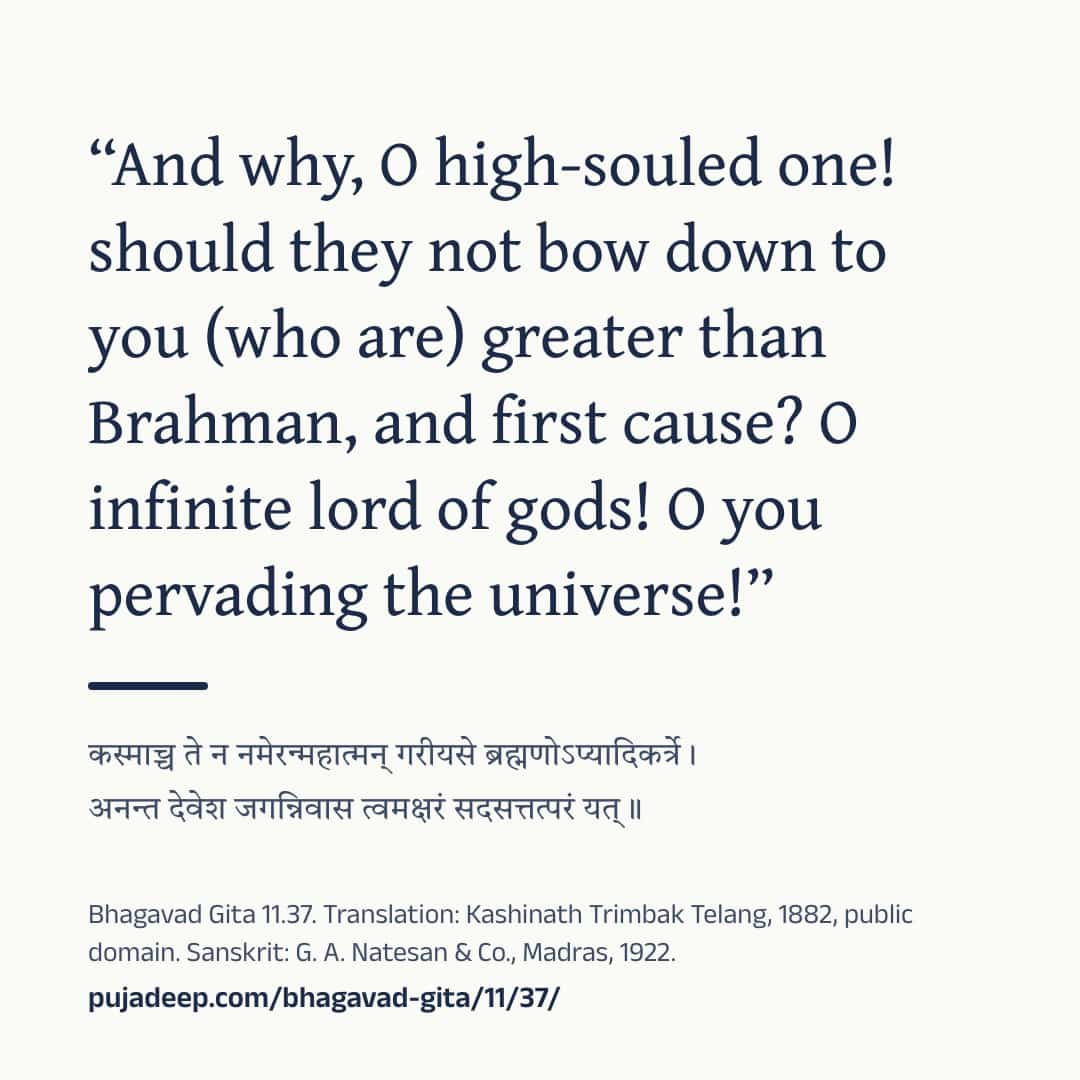
Drawing the picture
See the words
Bhagavad Gita 11.37

कस्माच्च ते न नमेरन्महात्मन् गरीयसे ब्रह्मणोऽप्यादिकर्त्रे ।
अनन्त देवेश जगन्निवास त्वमक्षरं सदसत्तत्परं यत् ॥

“And why, O high-souled one! should they not bow down to you (who are) greater than Brahman, and first cause? O infinite lord of gods! O you pervading the universe! you are the indestructible, that which is, that which is not, and what is beyond them.”
(K. T. Telang, The Bhagavadgîtâ (The Sacred Books of the East, vol. VIII, Oxford: Clarendon Press, 1882), p. 96, public domain)

“How should they otherwise, O loftiest SELF! First Cause! Brahmâ Himself less great than Thou. Infinite, God of Gods, Home of all worlds, Unperishing, Sat Asat, THAT supreme!”
(Annie Besant, The Bhagavad Gîtâ, or The Lord's Song (London: Theosophical Publishing Society, 1895), p. 112, public domain)

“And how should they not, O Great-souled One, bow to Thee, greater than, and the Primal Cause of, even Brahmá, O Infinite Being, O Lord of the Devas, O Abode of the Universe; Thou art the Imperishable, the Being and the non-Being, (as well as) That which is Beyond (them).”
(Swami Swarupananda, Srimad-Bhagavad-Gita (Mayavati: Prabuddha Bharata Press, 1909; first printed in Prabuddha Bharata, 1907–1909), p. 231, public domain)

Sanskrit: G. A. Natesan & Co., Madras, 1922.
https://pujadeep.com/bhagavad-gita/11/37/ Nothing is sent from this site. Your own app sends it, to the chat you choose. The picture quotes the translation you chose on this page, with its name and year.
Sanskrit text: The Bhagavad-Gita, or The Lord's Song, with the text in Devanagari and an English translation, 1922. Meanings: written for Pujadeep and checked against the cited edition. Source and changes
Questions families ask
Who speaks Bhagavad Gita 11.37?
Arjuna speaks this verse, in chapter 11 (Vishvarupa Darshana Yoga).
Where does the Sanskrit text come from?
Sanskrit text: The Bhagavad-Gita, or The Lord's Song, with the text in Devanagari and an English translation, 1922. Meanings: written for Pujadeep and checked against the cited edition. See the source
Is the meaning on this page a translation?
Explanation written for this site from the sources listed here, and checked against the cited edition. It is not a translation and not the only way to read the text. Free to quote with credit.
Source and licence
- Sanskrit text
- The Bhagavad-Gita, or The Lord's Song, with the text in Devanagari and an English translation (Annie Besant, G. A. Natesan & Co., Madras, 1922). Public domain. The Sanskrit on these pages was read from this printing’s page images.
- Translation
- The Bhagavadgîtâ with the Sanatsugâtîya and the Anugîtâ, translated by Kâshinâth Trimbak Telang (The Sacred Books of the East, vol. VIII, ed. F. Max Müller) (Kashinath Trimbak Telang, F. Max Müller, Clarendon Press, Oxford, 1882). Public domain. Shown verbatim, as printed.
- Translation
- The Bhagavad Gîtâ, or The Lord's Song, translated by Annie Besant (Annie Besant, Theosophical Publishing Society, London, 1895). Public domain. Shown verbatim, as printed.
- Translation
- Srimad-Bhagavad-Gita, with Sanskrit Text; Paraphrase with Word-by-word Literal Translation; English Rendering and Comments, Index, &c., by the Swami Swarupananda (Himalayan Series, No. XX) (Swami Swarupananda, The Editors and Publishers, Advaita Ashrama, Mayavati, Prabuddha Bharata Press, Mayavati, Almora, Himalayas, 1909). Public domain. Shown verbatim, as printed.
- Commentary
- The Bhagavad-Gita, with the commentary of Sri Sankaracharya, translated by A. Mahadeva Sastri (2nd ed., Mysore: G. T. A. Printing Works, 1901) (Public-domain scan, University of California Libraries). Summarised in our own words; none of its text is reproduced.
- Commentary
- Sri Bhagavad-Gita with Sri Ramanujacharya's Visishtadvaita commentary, translated by A. Govindacharya (Madras, 1898) (Scan uploaded to archive.org (folkscanomy collection)). Summarised in our own words; none of its text is reproduced.
- Commentary
- The Bhagavad-Gita: translation and commentaries in English according to Sri Madhwacharya's Bhashyas, by S. Subba Rau (Madras, 1906) (Scan uploaded to archive.org (folkscanomy collection)). Summarised in our own words; none of its text is reproduced.
- Common wording
- In this text, 32 words follow today's common wording, checked against sanskritdocuments.org; Sanskrit Wikisource; Gita Press, Gorakhpur; GRETIL, Göttingen and Bhaktivedanta Book Trust.
- Our explanation
- Explanation written for this site from the sources listed here, and checked against the cited edition. It is not a translation and not the only way to read the text. Free to quote with credit.
- Checked
- Checked against the cited edition, October 27, 2026.