Bhagavad Gita 11.46: meaning and translation
Chapter 11: Vishvarupa Darshana Yoga. Arjuna says
Arjuna says he wishes to see Krishna as before, with crown and mace and discus in hand.
Click or tap a word for its meaning and its dictionary page.
Text and layers
Text and layers
These choices stay in this browser.
Bhagavad Gita 11.46
किरीटिनं गदिनं चक्रहस्तमिच्छामि त्वां द्रष्टुमहं तथैव ।तेनैव रूपेण चतुर्भुजेन सहस्रबाहो भव विश्वमूर्ते ॥
Kiritinam gadinam chakrahastamichchhami tvam drashtumaham tathaivaTenaiva rupena chaturbhujena sahasrabaho bhava vishvamurte
kirīṭinaṃ gadinaṃ cakrahastamicchāmi tvāṃ draṣṭumahaṃ tathaiva |tenaiva rūpeṇa caturbhujena sahasrabāho bhava viśvamūrte ||
Our explanation Arjuna says he wishes to see Krishna as before, with crown and mace and discus in hand. He asks the thousand-armed one, the universal form (viśvamūrti), to take that same four-armed form. Telang's note: 'This is the ordinary form of Krishna.'
हिंदी अर्थ अर्जुन कहते हैं कि वे कृष्ण को पहले की तरह मुकुट, गदा और हाथ में चक्र के साथ देखना चाहते हैं। वे सहस्रबाहु, विश्वमूर्ति से विनती करते हैं कि वे वही चार भुजाओं वाला रूप धारण करें। तेलंग की टिप्पणी: यह कृष्ण का सामान्य रूप है।
Word by word
Every word, with its dictionary page
Word by word
- किरीटिनम् kirīṭinam · wearing a crown (adjective (masculine), accusative singular) Dictionary: kirīṭin, Monier-Williams 1899, p. 284, col. 1 “decorated with a diadem”
- गदिनम् gadinam · holding a mace (adjective (masculine), accusative singular) Dictionary: gadin, Monier-Williams 1899, p. 344, col. 3 “armed with a club (said of Kṛishṇa)”
- चक्रहस्तम् cakrahastam · discus in hand (compound (masculine), accusative singular) Dictionary: cakra, Monier-Williams 1899, p. 380, col. 3 “a discus or sharp circular missile weapon (esp. that of Vishṇu)”; hasta, Monier-Williams 1899, p. 1294, col. 3 “the hand”
- इच्छामि icchāmi · wish, want (present, 1st person singular) Dictionary: 3. iṣ, Monier-Williams 1899, p. 169, col. 1 “to endeavour to obtain, strive, seek for”
- त्वाम् tvām · you (pronoun, accusative singular) Dictionary: yuṣmad, Monier-Williams 1899, p. 855, col. 3 “the base of the 2nd pers. pron. as used in comp.”
- द्रष्टुम् draṣṭum · to see (infinitive (to do)) Dictionary: 1. dṛś, Monier-Williams 1899, p. 491, col. 2 “to see, behold, look at, regard, consider”
- अहम् aham · "I" (Arjuna) (pronoun, nominative singular) Dictionary: aham, Monier-Williams 1899, p. 124, col. 2 “nom. sg. ‘I,’”
- तथा tathā · so, as before (indeclinable) Dictionary: tathā, Monier-Williams 1899, p. 433, col. 3 “in that manner, so, thus”
- एव eva · just (indeclinable) Dictionary: 1. eva, Monier-Williams 1899, p. 232, col. 2 “just, exactly, very, same, only, even, alone, merely”
- तेन tena · with that (pronoun (neuter), instrumental singular) Dictionary: tad, Monier-Williams 1899, p. 434, col. 1 “m. he, f. she, n. it, that, this”
- एव eva · same (indeclinable) Dictionary: 1. eva, Monier-Williams 1899, p. 232, col. 2 “just, exactly, very, same, only, even, alone, merely”
- रूपेण rūpeṇa · with the form (noun (neuter), instrumental singular) Dictionary: rūpa, Monier-Williams 1899, p. 885, col. 3 “form, shape, figure”
- चतुर्भुजेन caturbhujena · four-armed (compound (neuter), instrumental singular) Dictionary: catur-bhuja, Monier-Williams 1899, p. 384, col. 3 “four-armed”
- सहस्रबाहो sahasrabāho · O thousand-armed one (compound (masculine), vocative singular) Dictionary: sahasra-bāhu, Monier-Williams 1899, p. 1196, col. 1 “having a th° arms, th°-armed”
- भव bhava · be, become (imperative, 2nd person singular) Dictionary: 1. bhū, Monier-Williams 1899, p. 760, col. 2 “to become, be”
- विश्वमूर्ते viśvamūrte · O you whose form is all (compound (masculine), vocative singular) Dictionary: viśva-mūrti, Monier-Williams 1899, p. 993, col. 2 “having all forms (or one 'whose body is the universe')”
1 printing differs
Edition differences. Another printing or text reads this place differently.
- Spelling A digital text reads Same words. The e-text writes चक्रहस्तं इच्छामि; the 1922 edition joins चक्रहस्तमिच्छामि, broken across the printed lines with a hyphen (चक्रहस्त-मिच्छामि).
Old translations
Kashinath Trimbak Telang, 1882. Public domain. Page 98.
I wish to see you bearing the coronet and the mace, with the discus in hand, just the same (as before)1. O you of thousand arms! O you of all forms! assume that same four-handed form.
Footnotes (the translator’s own) - This is the ordinary form of Krishna. ↩
Compare 3 translations
Kashinath Trimbak Telang, 1882. Public domain. Page 98.
I wish to see you bearing the coronet and the mace, with the discus in hand, just the same (as before)1. O you of thousand arms! O you of all forms! assume that same four-handed form.
Footnotes (the translator’s own) - This is the ordinary form of Krishna. ↩
You are reading this one
Annie Besant, 1895. Public domain. Page 114–115.
Diademed, mace and discus in Thy hand,
Again I fain would see Thee as before;
Put on again Thy four-armed Shape, O Lord,
O thousand-armed, of Forms innumerate.
You are reading this one
Swami Swarupananda, 1909 (first printed 1907). Public domain. Page 236–237.
Diademed, bearing a mace and a discus, Thee I desire to see as before. Assume that same four-armed Form, O Thou of thousand arms, of Universal Form.
You are reading this one
Cite this verse
The translation: K. T. Telang, The Bhagavadgîtâ (The Sacred Books of the East, vol. VIII, Oxford: Clarendon Press, 1882), p. 98. Bhagavad Gita 11.46.
The translation: Annie Besant, The Bhagavad Gîtâ, or The Lord's Song (London: Theosophical Publishing Society, 1895), pp. 114–115. Bhagavad Gita 11.46.
The translation: Swami Swarupananda, Srimad-Bhagavad-Gita (Mayavati: Prabuddha Bharata Press, 1909; first printed in Prabuddha Bharata, 1907–1909), pp. 236–237. Bhagavad Gita 11.46.
Our explanation: “Bhagavad Gita 11.46: meaning and translation.” Pujadeep. Updated October 27, 2026. https://pujadeep.com/bhagavad-gita/11/46/
Pujadeep’s explanations are free to quote with credit: name Pujadeep and link to the page. How to credit
Classical readings, by school
No readings by school on this verse yet.
Share
Show the ways to share
Send one picture or the text to one chat. The picture names its source and the address of this page.
Drawing the picture
See the words
Bhagavad Gita 11.46

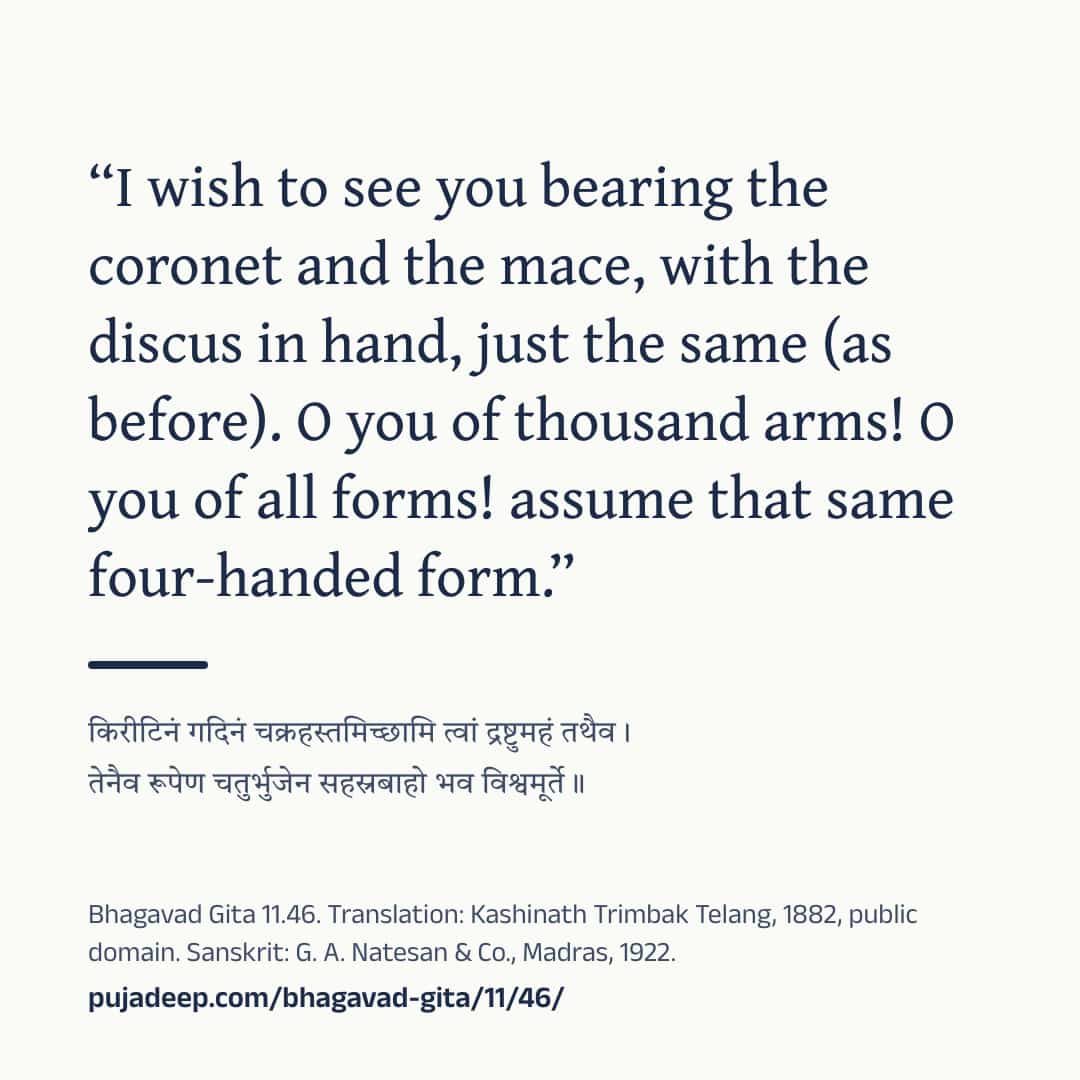
किरीटिनं गदिनं चक्रहस्तमिच्छामि त्वां द्रष्टुमहं तथैव ।
तेनैव रूपेण चतुर्भुजेन सहस्रबाहो भव विश्वमूर्ते ॥

“I wish to see you bearing the coronet and the mace, with the discus in hand, just the same (as before). O you of thousand arms! O you of all forms! assume that same four-handed form.”
(K. T. Telang, The Bhagavadgîtâ (The Sacred Books of the East, vol. VIII, Oxford: Clarendon Press, 1882), p. 98, public domain)

“Diademed, mace and discus in Thy hand, Again I fain would see Thee as before; Put on again Thy four-armed Shape, O Lord, O thousand-armed, of Forms innumerate.”
(Annie Besant, The Bhagavad Gîtâ, or The Lord's Song (London: Theosophical Publishing Society, 1895), pp. 114–115, public domain)

“Diademed, bearing a mace and a discus, Thee I desire to see as before. Assume that same four-armed Form, O Thou of thousand arms, of Universal Form.”
(Swami Swarupananda, Srimad-Bhagavad-Gita (Mayavati: Prabuddha Bharata Press, 1909; first printed in Prabuddha Bharata, 1907–1909), pp. 236–237, public domain)

Sanskrit: G. A. Natesan & Co., Madras, 1922.
https://pujadeep.com/bhagavad-gita/11/46/ Nothing is sent from this site. Your own app sends it, to the chat you choose. The picture quotes the translation you chose on this page, with its name and year.
Sanskrit text: The Bhagavad-Gita, or The Lord's Song, with the text in Devanagari and an English translation, 1922. Meanings: written for Pujadeep and checked against the cited edition. Source and changes
Questions families ask
Who speaks Bhagavad Gita 11.46?
Arjuna speaks this verse, in chapter 11 (Vishvarupa Darshana Yoga).
Where does the Sanskrit text come from?
Sanskrit text: The Bhagavad-Gita, or The Lord's Song, with the text in Devanagari and an English translation, 1922. Meanings: written for Pujadeep and checked against the cited edition. See the source
Is the meaning on this page a translation?
Explanation written for this site from the sources listed here, and checked against the cited edition. It is not a translation and not the only way to read the text. Free to quote with credit.
Source and licence
- Sanskrit text
- The Bhagavad-Gita, or The Lord's Song, with the text in Devanagari and an English translation (Annie Besant, G. A. Natesan & Co., Madras, 1922). Public domain. The Sanskrit on these pages was read from this printing’s page images.
- Translation
- The Bhagavadgîtâ with the Sanatsugâtîya and the Anugîtâ, translated by Kâshinâth Trimbak Telang (The Sacred Books of the East, vol. VIII, ed. F. Max Müller) (Kashinath Trimbak Telang, F. Max Müller, Clarendon Press, Oxford, 1882). Public domain. Shown verbatim, as printed.
- Translation
- The Bhagavad Gîtâ, or The Lord's Song, translated by Annie Besant (Annie Besant, Theosophical Publishing Society, London, 1895). Public domain. Shown verbatim, as printed.
- Translation
- Srimad-Bhagavad-Gita, with Sanskrit Text; Paraphrase with Word-by-word Literal Translation; English Rendering and Comments, Index, &c., by the Swami Swarupananda (Himalayan Series, No. XX) (Swami Swarupananda, The Editors and Publishers, Advaita Ashrama, Mayavati, Prabuddha Bharata Press, Mayavati, Almora, Himalayas, 1909). Public domain. Shown verbatim, as printed.
- Common wording
- In this text, 32 words follow today's common wording, checked against sanskritdocuments.org; Sanskrit Wikisource; Gita Press, Gorakhpur; GRETIL, Göttingen and Bhaktivedanta Book Trust.
- Our explanation
- Explanation written for this site from the sources listed here, and checked against the cited edition. It is not a translation and not the only way to read the text. Free to quote with credit.
- Checked
- Checked against the cited edition, October 27, 2026.