Bhagavad Gita 11.54: meaning and translation
Chapter 11: Vishvarupa Darshana Yoga. Krishna says
But, Krishna says, by devotion (bhakti) that turns to nothing else he can be known, seen and truly entered into in this way.
Click or tap a word for its meaning and its dictionary page.
Text and layers
Text and layers
These choices stay in this browser.
Bhagavad Gita 11.54
भक्त्या त्वनन्यया शक्य अहमेवंविधोऽर्जुन ।ज्ञातुं द्रष्टुं च तत्त्वेन प्रवेष्टुं च परन्तप ॥
Bhaktya tvananyaya shakya ahamevanvidhorjunaJnatum drashtum cha tattvena praveshtum cha parantapa
bhaktyā tvananyayā śakya ahamevaṃvidho’rjuna |jñātuṃ draṣṭuṃ ca tattvena praveṣṭuṃ ca parantapa ||
Our explanation But, Krishna says, by devotion (bhakti) that turns to nothing else he can be known, seen and truly entered into in this way. He calls Arjuna Parantapa. Telang's note: 'entered into' means final emancipation. The schools explain this 'entering' differently (see the views).
हिंदी अर्थ कृष्ण कहते हैं कि अनन्य भक्ति से, जो किसी और की ओर नहीं जाती, उन्हें इस प्रकार जाना जा सकता है, देखा जा सकता है, और तत्त्व से उनमें प्रवेश किया जा सकता है। वे अर्जुन को परंतप कहते हैं। तेलंग की टिप्पणी: “प्रवेश” का अर्थ अंतिम मुक्ति है। इस “प्रवेश” को परंपराएँ अलग-अलग ढंग से समझाती हैं।
Word by word
Every word, with its dictionary page
Word by word
- भक्त्या bhaktyā · by devotion (noun (feminine), instrumental singular) Dictionary: bhakti, Monier-Williams 1899, p. 743, col. 2 “attachment, devotion, fondness for, devotion to”
- तु tu · but (indeclinable) Dictionary: 2. tu, Monier-Williams 1899, p. 449, col. 3 “but”
- अनन्यया ananyayā · undivided, single (adjective (feminine), instrumental singular) Dictionary: an-anya, Monier-Williams 1899, p. 25, col. 2 “having no other (object), undistracted”
- शक्यः śakyaḥ · can be (gerundive (to be done) (masculine), nominative singular) Dictionary: śakya, Monier-Williams 1899, p. 1045, col. 1 “able, possible, practicable”
- अहम् aham · "I" (Krishna) (pronoun, nominative singular) Dictionary: aham, Monier-Williams 1899, p. 124, col. 2 “nom. sg. ‘I,’”
- एवंविधः evaṃvidhaḥ · of this kind (compound (masculine), nominative singular) Dictionary: evaṃ-vidha, Monier-Williams 1899, p. 232, col. 3 “of such a kind, in such a form or manner, such”
- अर्जुन arjuna · O Arjuna (noun (masculine), vocative singular) Dictionary: arjuna, Monier-Williams 1899, p. 90, col. 1
- ज्ञातुम् jñātum · to be known (infinitive (to do)) Dictionary: 1. jñā, Monier-Williams 1899, p. 425, col. 3 “to know, have knowledge, become acquainted with”
- द्रष्टुम् draṣṭum · to be seen (infinitive (to do)) Dictionary: 1. dṛś, Monier-Williams 1899, p. 491, col. 2 “to see, behold, look at, regard, consider”
- च ca · and (indeclinable) Dictionary: 2. ca, Monier-Williams 1899, p. 380, col. 1 “and, both, also, moreover, as well as”
- तत्त्वेन tattvena · in truth (noun (neuter), instrumental singular) Dictionary: tat-tva, Monier-Williams 1899, p. 432, col. 3
- प्रवेष्टुम् praveṣṭum · to be entered (infinitive (to do)) Dictionary: pra-viś, Monier-Williams 1899, p. 692, col. 3 “to enter, go into”
- च ca · and (indeclinable) Dictionary: 2. ca, Monier-Williams 1899, p. 380, col. 1 “and, both, also, moreover, as well as”
- परन्तप parantapa · O scorcher of foes (compound (masculine), vocative singular) Dictionary: paraṃ-tapa, Monier-Williams 1899, p. 586, col. 3 “destroying foes (said of heroes)”
Old translations
Kashinath Trimbak Telang, 1882. Public domain. Page 99.
But, O Arguna! by devotion to me exclusively, I can in this form be truly known, seen, and assimilated1 with, O terror of your foes!
Footnotes (the translator’s own) - Literally, 'entered into;' it means final emancipation. See p. 128. ↩
Compare 3 translations
Kashinath Trimbak Telang, 1882. Public domain. Page 99.
But, O Arguna! by devotion to me exclusively, I can in this form be truly known, seen, and assimilated1 with, O terror of your foes!
Footnotes (the translator’s own) - Literally, 'entered into;' it means final emancipation. See p. 128. ↩
You are reading this one
Annie Besant, 1895. Public domain. Page 116.
But by devotion to Me alone I may thus be perceived, Arjuna, and known and seen, and entered in essence, O Parantapa.
This sentence begins in 11.53.
You are reading this one
Swami Swarupananda, 1909 (first printed 1907). Public domain. Page 241.
But by single devotion I may in this Form be known, O Arjuna, and seen in reality, and also entered into, O scorcher of foes.
You are reading this one
Cite this verse
The translation: K. T. Telang, The Bhagavadgîtâ (The Sacred Books of the East, vol. VIII, Oxford: Clarendon Press, 1882), p. 99. Bhagavad Gita 11.54.
The translation: Annie Besant, The Bhagavad Gîtâ, or The Lord's Song (London: Theosophical Publishing Society, 1895), p. 116. Bhagavad Gita 11.54.
The translation: Swami Swarupananda, Srimad-Bhagavad-Gita (Mayavati: Prabuddha Bharata Press, 1909; first printed in Prabuddha Bharata, 1907–1909), p. 241. Bhagavad Gita 11.54.
Our explanation: “Bhagavad Gita 11.54: meaning and translation.” Pujadeep. Updated October 27, 2026. https://pujadeep.com/bhagavad-gita/11/54/
Pujadeep’s explanations are free to quote with credit: name Pujadeep and link to the page. How to credit
Classical readings, by school
Each reading is named by its school. None is presented as the only meaning.
What Advaita, Vishishtadvaita and Dvaita teach, in short
Shankara Advaita
Shankara says devotion that seeks nothing but the Lord lets one know him as the scriptures teach, realise him directly as he is, and enter into him, that is, gain liberation (mokṣa).
Source: The Bhagavad-Gita, with the commentary of Sri Sankaracharya, translated by A. Mahadeva Sastri (2nd ed., Mysore: G. T. A. Printing Works, 1901), commentary on 11.54, pp. 263–264. Summarised in our own words; none of its text is reproduced.
Ramanuja Vishishtadvaita
Ramanuja says that without bhakti none of the other means reveal the Lord. By exclusive bhakti he is known as the scriptures teach, seen as he is, and 'entered', which Ramanuja explains as the soul's actual experience of communion with God.
Source: Sri Bhagavad-Gita with Sri Ramanujacharya's Visishtadvaita commentary, translated by A. Govindacharya (Madras, 1898), commentary on 11.54, pp. 374–375. Summarised in our own words; none of its text is reproduced.
Madhva Dvaita
Madhva's reading of the devotion here is one that needs no other support and turns away from everything else. In Subba Rau's translation the third verb becomes reaching the Lord, where the translations of Shankara and Ramanuja have entering into him.
Source: The Bhagavad-Gita: translation and commentaries in English according to Sri Madhwacharya's Bhashyas, by S. Subba Rau (Madras, 1906), commentary on 11.54, p. 234 (leaf n232). Summarised in our own words; none of its text is reproduced.
Share
Show the ways to share
Send one picture or the text to one chat. The picture names its source and the address of this page.
Drawing the picture
See the words
Bhagavad Gita 11.54

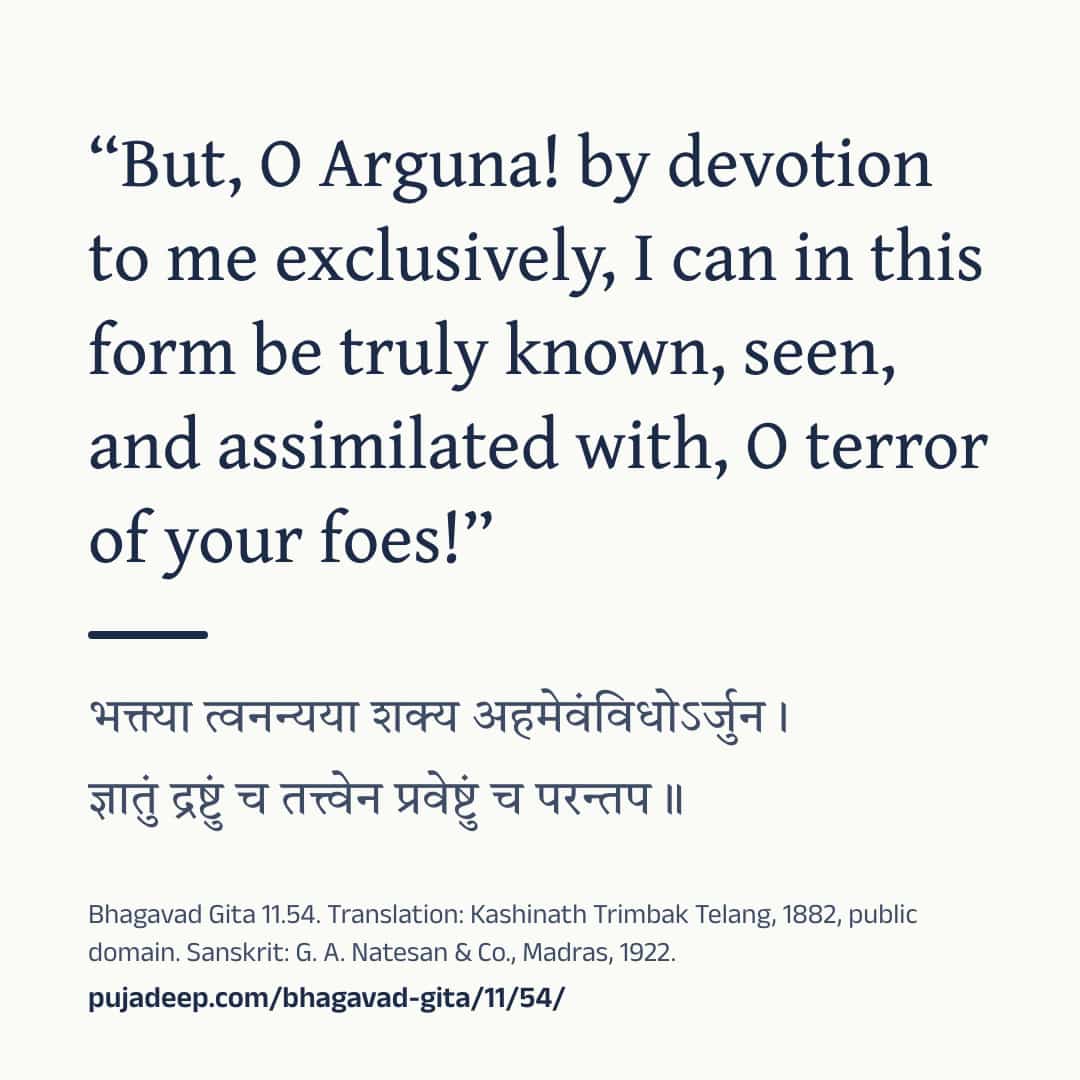
भक्त्या त्वनन्यया शक्य अहमेवंविधोऽर्जुन ।
ज्ञातुं द्रष्टुं च तत्त्वेन प्रवेष्टुं च परन्तप ॥

“But, O Arguna! by devotion to me exclusively, I can in this form be truly known, seen, and assimilated with, O terror of your foes!”
(K. T. Telang, The Bhagavadgîtâ (The Sacred Books of the East, vol. VIII, Oxford: Clarendon Press, 1882), p. 99, public domain)

“But by devotion to Me alone I may thus be perceived, Arjuna, and known and seen, and entered in essence, O Parantapa.”
(Annie Besant, The Bhagavad Gîtâ, or The Lord's Song (London: Theosophical Publishing Society, 1895), p. 116, public domain)
This sentence begins in 11.53.

“But by single devotion I may in this Form be known, O Arjuna, and seen in reality, and also entered into, O scorcher of foes.”
(Swami Swarupananda, Srimad-Bhagavad-Gita (Mayavati: Prabuddha Bharata Press, 1909; first printed in Prabuddha Bharata, 1907–1909), p. 241, public domain)

Sanskrit: G. A. Natesan & Co., Madras, 1922.
https://pujadeep.com/bhagavad-gita/11/54/ Nothing is sent from this site. Your own app sends it, to the chat you choose. The picture quotes the translation you chose on this page, with its name and year.
Sanskrit text: The Bhagavad-Gita, or The Lord's Song, with the text in Devanagari and an English translation, 1922. Meanings: written for Pujadeep and checked against the cited edition. Source and changes
Questions families ask
Who speaks Bhagavad Gita 11.54?
Krishna speaks this verse, in chapter 11 (Vishvarupa Darshana Yoga).
Where does the Sanskrit text come from?
Sanskrit text: The Bhagavad-Gita, or The Lord's Song, with the text in Devanagari and an English translation, 1922. Meanings: written for Pujadeep and checked against the cited edition. See the source
Is the meaning on this page a translation?
Explanation written for this site from the sources listed here, and checked against the cited edition. It is not a translation and not the only way to read the text. Free to quote with credit.
Source and licence
- Sanskrit text
- The Bhagavad-Gita, or The Lord's Song, with the text in Devanagari and an English translation (Annie Besant, G. A. Natesan & Co., Madras, 1922). Public domain. The Sanskrit on these pages was read from this printing’s page images.
- Translation
- The Bhagavadgîtâ with the Sanatsugâtîya and the Anugîtâ, translated by Kâshinâth Trimbak Telang (The Sacred Books of the East, vol. VIII, ed. F. Max Müller) (Kashinath Trimbak Telang, F. Max Müller, Clarendon Press, Oxford, 1882). Public domain. Shown verbatim, as printed.
- Translation
- The Bhagavad Gîtâ, or The Lord's Song, translated by Annie Besant (Annie Besant, Theosophical Publishing Society, London, 1895). Public domain. Shown verbatim, as printed.
- Translation
- Srimad-Bhagavad-Gita, with Sanskrit Text; Paraphrase with Word-by-word Literal Translation; English Rendering and Comments, Index, &c., by the Swami Swarupananda (Himalayan Series, No. XX) (Swami Swarupananda, The Editors and Publishers, Advaita Ashrama, Mayavati, Prabuddha Bharata Press, Mayavati, Almora, Himalayas, 1909). Public domain. Shown verbatim, as printed.
- Commentary
- The Bhagavad-Gita, with the commentary of Sri Sankaracharya, translated by A. Mahadeva Sastri (2nd ed., Mysore: G. T. A. Printing Works, 1901) (Public-domain scan, University of California Libraries). Summarised in our own words; none of its text is reproduced.
- Commentary
- Sri Bhagavad-Gita with Sri Ramanujacharya's Visishtadvaita commentary, translated by A. Govindacharya (Madras, 1898) (Scan uploaded to archive.org (folkscanomy collection)). Summarised in our own words; none of its text is reproduced.
- Commentary
- The Bhagavad-Gita: translation and commentaries in English according to Sri Madhwacharya's Bhashyas, by S. Subba Rau (Madras, 1906) (Scan uploaded to archive.org (folkscanomy collection)). Summarised in our own words; none of its text is reproduced.
- Common wording
- In this text, 32 words follow today's common wording, checked against sanskritdocuments.org; Sanskrit Wikisource; Gita Press, Gorakhpur; GRETIL, Göttingen and Bhaktivedanta Book Trust.
- Our explanation
- Explanation written for this site from the sources listed here, and checked against the cited edition. It is not a translation and not the only way to read the text. Free to quote with credit.
- Checked
- Checked against the cited edition, October 27, 2026.