Bhagavad Gita 11.44: meaning and translation
Chapter 11: Vishvarupa Darshana Yoga. Arjuna says
Therefore, Arjuna says, he bows down, laying his body before Krishna, and asks the Lord who is worthy of praise to be gracious.
Click or tap a word for its meaning and its dictionary page.
Text and layers
Text and layers
These choices stay in this browser.
Bhagavad Gita 11.44
तस्मात्प्रणम्य प्रणिधाय कायम् प्रसादये त्वामहमीशमीड्यम् ।पितेव पुत्रस्य सखेव सख्युः प्रियः प्रियायार्हसि देव सोढुम् ॥
Tasmatpranamya pranidhaya kayam prasadaye tvamahamishamidyamPiteva putrasya sakheva sakhyuh priyah priyayarhasi deva sodhum
tasmātpraṇamya praṇidhāya kāyam prasādaye tvāmahamīśamīḍyam |piteva putrasya sakheva sakhyuḥ priyaḥ priyāyārhasi deva soḍhum ||
Our explanation Therefore, Arjuna says, he bows down, laying his body before Krishna, and asks the Lord who is worthy of praise to be gracious. As a father bears with his son, a friend with a friend and a lover with the beloved, he asks Krishna to bear with him.
हिंदी अर्थ अर्जुन कहते हैं कि इसलिए वे अपना शरीर कृष्ण के आगे डालकर प्रणाम करते हैं, और स्तुति के योग्य ईश्वर से प्रसन्न होने की विनती करते हैं। जैसे पिता पुत्र को, मित्र मित्र को और प्रेमी प्रिय को सह लेता है, वैसे ही वे कृष्ण से विनती करते हैं कि वे उन्हें सह लें।
Word by word
Every word, with its dictionary page
Word by word
- तस्मात् tasmāt · therefore (indeclinable) Dictionary: tad, Monier-Williams 1899, p. 434, col. 1 “m. he, f. she, n. it, that, this”
- प्रणम्य praṇamya · having bowed (absolutive (having done)) Dictionary: pra-ṇam, Monier-Williams 1899, p. 659, col. 3 “to bend or bow down before”
- प्रणिधाय praṇidhāya · having laid down (absolutive (having done)) Dictionary: pra-ṇi-dhā, Monier-Williams 1899, p. 660, col. 1 “to put down, deposit”
- कायम् kāyam · the body (noun (masculine), accusative singular) Dictionary: 2. kāya, Monier-Williams 1899, p. 274, col. 1 “the body”
- प्रसादये prasādaye · seek grace, ask to be pleased (causative present, 1st person singular) Dictionary: pra-sad, Monier-Williams 1899, p. 696, col. 3 “to become satisfied or pleased or glad, be gracious or kind”
- त्वाम् tvām · you (pronoun, accusative singular) Dictionary: yuṣmad, Monier-Williams 1899, p. 855, col. 3 “the base of the 2nd pers. pron. as used in comp.”
- अहम् aham · "I" (Arjuna) (pronoun, nominative singular) Dictionary: aham, Monier-Williams 1899, p. 124, col. 2 “nom. sg. ‘I,’”
- ईशम् īśam · the Lord (noun (masculine), accusative singular) Dictionary: īśa, Monier-Williams 1899, p. 171, col. 1 “powerful, supreme; a ruler, master, lord”
- ईड्यम् īḍyam · worthy of praise (gerundive (to be done) (masculine), accusative singular) Dictionary: īḍya, Monier-Williams 1899, p. 170, col. 2 “to be praised or glorified, praiseworthy, laudable”
- पिता pitā · a father (noun (masculine), nominative singular) Dictionary: pitṛ, Monier-Williams 1899, p. 626, col. 2 “a father”
- इव iva · like (indeclinable) Dictionary: iva, Monier-Williams 1899, p. 168, col. 3 “like, in the same manner as”
- पुत्रस्य putrasya · of a son (noun (masculine), genitive singular) Dictionary: putra, Monier-Williams 1899, p. 632, col. 3 “a son, child”
- सखा sakhā · a friend (noun (masculine), nominative singular) Dictionary: sakhi, Monier-Williams 1899, p. 1130, col. 2 “a friend, assistant, companion”
- इव iva · like (indeclinable) Dictionary: iva, Monier-Williams 1899, p. 168, col. 3 “like, in the same manner as”
- सख्युः sakhyuḥ · of a friend (noun (masculine), genitive singular) Dictionary: sakhi, Monier-Williams 1899, p. 1130, col. 2 “a friend, assistant, companion”
- प्रियः priyaḥ · a lover (noun (masculine), nominative singular) Dictionary: priya, Monier-Williams 1899, p. 710, col. 1 “a lover, husband”
- प्रियायाः priyāyāḥ · of the beloved (noun (feminine), genitive singular) Dictionary: priya, Monier-Williams 1899, p. 710, col. 1 “beloved, dear to (gen., loc., dat. or comp.), liked, favourite”
- अर्हसि arhasi · you should, please (present, 2nd person singular) Dictionary: arh, Monier-Williams 1899, p. 93, col. 3 “is often used as a softened form of Imper.”
- देव deva · O God (noun (masculine), vocative singular) Dictionary: deva, Monier-Williams 1899, p. 492, col. 2 “a deity, god”
- सोढुम् soḍhum · to bear, to forgive (infinitive (to do)) Dictionary: 1. sah, Monier-Williams 1899, p. 1193, col. 1 “to bear, put up with, endure”
1 printing differs
Edition differences. Another printing or text reads this place differently.
- Spelling A digital text reads Same words. At the printed line end the 1922 edition writes कायम्; the e-text writes कायं.
Old translations
Kashinath Trimbak Telang, 1882. Public domain. Page 97–98.
Therefore I bow and prostrate myself, and would propitiate you, the praiseworthy lord. Be pleased, O god! to pardon (my guilt) as a father (that of his) son, a friend (that of his) friend, or a husband (that of his) beloved.
Compare 3 translations
Kashinath Trimbak Telang, 1882. Public domain. Page 97–98.
Therefore I bow and prostrate myself, and would propitiate you, the praiseworthy lord. Be pleased, O god! to pardon (my guilt) as a father (that of his) son, a friend (that of his) friend, or a husband (that of his) beloved.
You are reading this one
Annie Besant, 1895. Public domain. Page 114.
Therefore I fall before Thee; with my body
I worship as is fitting; bless Thou me.
As father with the son, as friend with friend,
With the beloved as lover, bear with me.
You are reading this one
Swami Swarupananda, 1909 (first printed 1907). Public domain. Page 235.
So prostrating my body in adoration, I crave Thy forgiveness, Lord adorable. As a father forgiveth his son, a friend a dear friend, a beloved one his love, even so shouldst Thou forgive me, O Deva.
You are reading this one
Cite this verse
The translation: K. T. Telang, The Bhagavadgîtâ (The Sacred Books of the East, vol. VIII, Oxford: Clarendon Press, 1882), pp. 97–98. Bhagavad Gita 11.44.
The translation: Annie Besant, The Bhagavad Gîtâ, or The Lord's Song (London: Theosophical Publishing Society, 1895), p. 114. Bhagavad Gita 11.44.
The translation: Swami Swarupananda, Srimad-Bhagavad-Gita (Mayavati: Prabuddha Bharata Press, 1909; first printed in Prabuddha Bharata, 1907–1909), p. 235. Bhagavad Gita 11.44.
Our explanation: “Bhagavad Gita 11.44: meaning and translation.” Pujadeep. Updated October 27, 2026. https://pujadeep.com/bhagavad-gita/11/44/
Pujadeep’s explanations are free to quote with credit: name Pujadeep and link to the page. How to credit
Classical readings, by school
No readings by school on this verse yet.
Share
Show the ways to share
Send one picture or the text to one chat. The picture names its source and the address of this page.
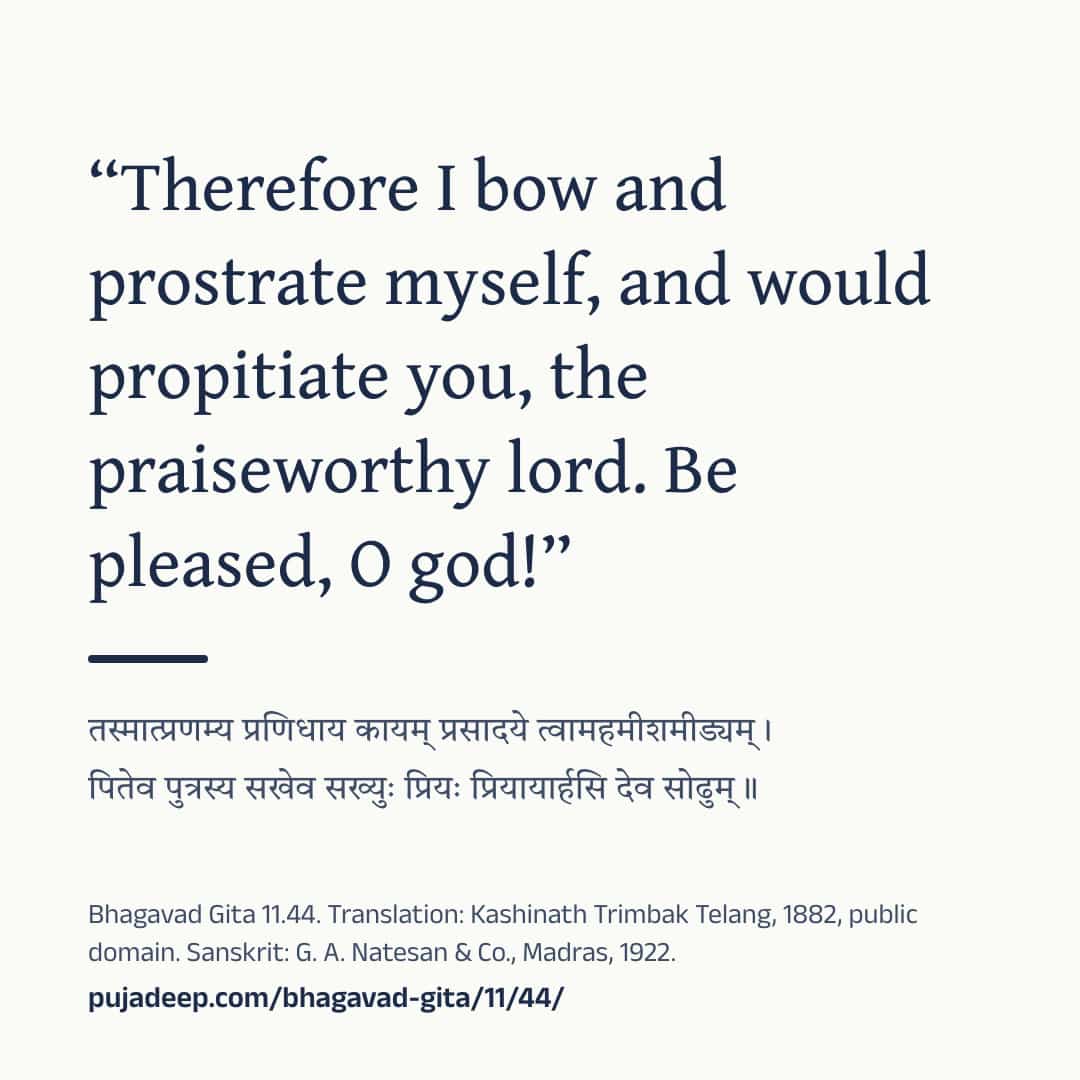
Drawing the picture
See the words
Bhagavad Gita 11.44

तस्मात्प्रणम्य प्रणिधाय कायम् प्रसादये त्वामहमीशमीड्यम् ।
पितेव पुत्रस्य सखेव सख्युः प्रियः प्रियायार्हसि देव सोढुम् ॥

“Therefore I bow and prostrate myself, and would propitiate you, the praiseworthy lord. Be pleased, O god! to pardon (my guilt) as a father (that of his) son, a friend (that of his) friend, or a husband (that of his) beloved.”
(K. T. Telang, The Bhagavadgîtâ (The Sacred Books of the East, vol. VIII, Oxford: Clarendon Press, 1882), pp. 97–98, public domain)

“Therefore I fall before Thee; with my body I worship as is fitting; bless Thou me. As father with the son, as friend with friend, With the beloved as lover, bear with me.”
(Annie Besant, The Bhagavad Gîtâ, or The Lord's Song (London: Theosophical Publishing Society, 1895), p. 114, public domain)

“So prostrating my body in adoration, I crave Thy forgiveness, Lord adorable. As a father forgiveth his son, a friend a dear friend, a beloved one his love, even so shouldst Thou forgive me, O Deva.”
(Swami Swarupananda, Srimad-Bhagavad-Gita (Mayavati: Prabuddha Bharata Press, 1909; first printed in Prabuddha Bharata, 1907–1909), p. 235, public domain)

Sanskrit: G. A. Natesan & Co., Madras, 1922.
https://pujadeep.com/bhagavad-gita/11/44/ Nothing is sent from this site. Your own app sends it, to the chat you choose. The picture quotes the translation you chose on this page, with its name and year.
Sanskrit text: The Bhagavad-Gita, or The Lord's Song, with the text in Devanagari and an English translation, 1922. Meanings: written for Pujadeep and checked against the cited edition. Source and changes
Questions families ask
Who speaks Bhagavad Gita 11.44?
Arjuna speaks this verse, in chapter 11 (Vishvarupa Darshana Yoga).
Where does the Sanskrit text come from?
Sanskrit text: The Bhagavad-Gita, or The Lord's Song, with the text in Devanagari and an English translation, 1922. Meanings: written for Pujadeep and checked against the cited edition. See the source
Is the meaning on this page a translation?
Explanation written for this site from the sources listed here, and checked against the cited edition. It is not a translation and not the only way to read the text. Free to quote with credit.
Source and licence
- Sanskrit text
- The Bhagavad-Gita, or The Lord's Song, with the text in Devanagari and an English translation (Annie Besant, G. A. Natesan & Co., Madras, 1922). Public domain. The Sanskrit on these pages was read from this printing’s page images.
- Translation
- The Bhagavadgîtâ with the Sanatsugâtîya and the Anugîtâ, translated by Kâshinâth Trimbak Telang (The Sacred Books of the East, vol. VIII, ed. F. Max Müller) (Kashinath Trimbak Telang, F. Max Müller, Clarendon Press, Oxford, 1882). Public domain. Shown verbatim, as printed.
- Translation
- The Bhagavad Gîtâ, or The Lord's Song, translated by Annie Besant (Annie Besant, Theosophical Publishing Society, London, 1895). Public domain. Shown verbatim, as printed.
- Translation
- Srimad-Bhagavad-Gita, with Sanskrit Text; Paraphrase with Word-by-word Literal Translation; English Rendering and Comments, Index, &c., by the Swami Swarupananda (Himalayan Series, No. XX) (Swami Swarupananda, The Editors and Publishers, Advaita Ashrama, Mayavati, Prabuddha Bharata Press, Mayavati, Almora, Himalayas, 1909). Public domain. Shown verbatim, as printed.
- Common wording
- In this text, 32 words follow today's common wording, checked against sanskritdocuments.org; Sanskrit Wikisource; Gita Press, Gorakhpur; GRETIL, Göttingen and Bhaktivedanta Book Trust.
- Our explanation
- Explanation written for this site from the sources listed here, and checked against the cited edition. It is not a translation and not the only way to read the text. Free to quote with credit.
- Checked
- Checked against the cited edition, October 27, 2026.