Bhagavad Gita 11.35: meaning and translation
Chapter 11: Vishvarupa Darshana Yoga. Sanjaya says
Sanjaya speaks.
Click or tap a word for its meaning and its dictionary page.
Text and layers
Text and layers
These choices stay in this browser.
Bhagavad Gita 11.35
सञ्जय उवाच ।
एतच्छ्रुत्वा वचनं केशवस्य कृताञ्जलिर्वेपमानः किरीटी ।नमस्कृत्वा भूय एवाह कृष्णम् सगद्गदं भीतभीतः प्रणम्य ॥
Etachchhrutva vachanam keshavasya kritanjalirvepamanah kiritiNamaskritva bhuya evaha krishnam sagadgadam bhitabhitah pranamya
etacchrutvā vacanaṃ keśavasya kṛtāñjalirvepamānaḥ kirīṭī |namaskṛtvā bhūya evāha kṛṣṇam sagadgadaṃ bhītabhītaḥ praṇamya ||
Our explanation Sanjaya speaks. Hearing these words of Keśava, he says, Arjuna, the wearer of the crown (kirīṭī), trembling and with joined palms, bowed down; and, bowing again and overcome with fear, he spoke to Krishna in a choked voice.
हिंदी अर्थ संजय बोलते हैं। वे कहते हैं कि केशव के ये वचन सुनकर मुकुटधारी (किरीटी) अर्जुन ने काँपते हुए, हाथ जोड़कर प्रणाम किया; और फिर झुककर, भय से भरे, रुँधे गले से कृष्ण से बोले।
Word by word
Every word, with its dictionary page
Word by word
- एतत् etat · this (pronoun (neuter), accusative singular) Dictionary: etad, Monier-Williams 1899, p. 231, col. 2 “this, this here”
- श्रुत्वा śrutvā · having heard (absolutive (having done)) Dictionary: 1. śru, Monier-Williams 1899, p. 1100, col. 3 “to hear, listen or attend to anything”
- वचनम् vacanam · word, speech (noun (neuter), accusative singular) Dictionary: vacana, Monier-Williams 1899, p. 912, col. 3 “speech, sentence, word”
- केशवस्य keśavasya · of Keshava (Krishna) (noun (masculine), genitive singular) Dictionary: keśava, Monier-Williams 1899, p. 310, col. 3 “N. of Vishṇu or Kṛishṇa”
- कृताञ्जलिः kṛtāñjaliḥ · with joined palms (compound (masculine), nominative singular) Dictionary: kṛtāñjali, Monier-Williams 1899, p. 303, col. 1 “one who joins the hollowed palms in reverence or to solicit favour”
- वेपमानः vepamānaḥ · trembling (present participle (masculine), nominative singular) Dictionary: 1. vip, Monier-Williams 1899, p. 972, col. 3 “to tremble, shake, shiver, vibrate, quiver”
- किरीटी kirīṭī · the crowned one (Arjuna) (noun (masculine), nominative singular) Dictionary: kirīṭin, Monier-Williams 1899, p. 284, col. 1 “decorated with a diadem”
- नमस्कृत्वा namaskṛtvā · having bowed (absolutive (having done)) Dictionary: namas, Monier-Williams 1899, p. 528, col. 1 “bow, obeisance, reverential salutation”; 1. kṛ, Monier-Williams 1899, p. 301, col. 1 “to do, make, perform, accomplish, cause, effect”
- भूयः bhūyaḥ · again (indeclinable) Dictionary: bhūyas, Monier-Williams 1899, p. 763, col. 3 “once more, again, anew”
- एव eva · indeed (indeclinable) Dictionary: 1. eva, Monier-Williams 1899, p. 232, col. 2 “just, exactly, very, same, only, even, alone, merely”
- आह āha · said (perfect, 3rd person singular) Dictionary: 1. ah, Monier-Williams 1899, p. 124, col. 1 “to say, speak”
- कृष्णम् kṛṣṇam · to Krishna (noun (masculine), accusative singular) Dictionary: kṛṣṇa, Monier-Williams 1899, p. 306, col. 2 “N. of a celebrated Avatār of the god Vishṇu, or sometimes identified with Vishṇu himself”
- सगद्गदम् sagadgadam · with a choking voice (adverb (accusative form)) Dictionary: sa-gadgada, Monier-Williams 1899, p. 1125, col. 1 “with stammering (voice)”
- भीतभीतः bhītabhītaḥ · very much afraid (compound (masculine), nominative singular) Dictionary: bhīta-bhīta, Monier-Williams 1899, p. 758, col. 1 “very much frightened, exceedingly afraid”
- प्रणम्य praṇamya · having bowed down (absolutive (having done)) Dictionary: pra-ṇam, Monier-Williams 1899, p. 659, col. 3 “to bend or bow down before”
1 printing differs
Edition differences. Another printing or text reads this place differently.
- Spelling A digital text reads Same words. At the printed line end the 1922 edition writes कृष्णम्; the e-text writes कृष्णं.
Old translations
Kashinath Trimbak Telang, 1882. Public domain. Page 96.
Sañgaya said:
Hearing these words of Kesava, the wearer of the coronet1, trembling, and with joined hands, bowed down; and sorely afraid, and with throat choked up, he again spoke to Krishna after saluting him.
Footnotes (the translator’s own) - Arguna, who had this coronet given him by Indra.—Madhusûdana. ↩
Compare 3 translations
Kashinath Trimbak Telang, 1882. Public domain. Page 96.
Sañgaya said:
Hearing these words of Kesava, the wearer of the coronet1, trembling, and with joined hands, bowed down; and sorely afraid, and with throat choked up, he again spoke to Krishna after saluting him.
Footnotes (the translator’s own) - Arguna, who had this coronet given him by Indra.—Madhusûdana. ↩
You are reading this one
Annie Besant, 1895. Public domain. Page 111.
Sanjaya said:
Having heard these words of Keshava, he who weareth a diadem, with joined palms, quaking, and prostrating himself, spake again to Krishna, stammering with fear, casting down his face.
You are reading this one
Swami Swarupananda, 1909 (first printed 1907). Public domain. Page 230.
Sanjaya said:
Having heard that speech of Keshava, the diademed one (Arjuna), with joined palms, trembling, prostrated himself, and again addressed Krishna in a choked voice, bowing down, overwhelmed with fear.
You are reading this one
Cite this verse
The translation: K. T. Telang, The Bhagavadgîtâ (The Sacred Books of the East, vol. VIII, Oxford: Clarendon Press, 1882), p. 96. Bhagavad Gita 11.35.
The translation: Annie Besant, The Bhagavad Gîtâ, or The Lord's Song (London: Theosophical Publishing Society, 1895), p. 111. Bhagavad Gita 11.35.
The translation: Swami Swarupananda, Srimad-Bhagavad-Gita (Mayavati: Prabuddha Bharata Press, 1909; first printed in Prabuddha Bharata, 1907–1909), p. 230. Bhagavad Gita 11.35.
Our explanation: “Bhagavad Gita 11.35: meaning and translation.” Pujadeep. Updated October 27, 2026. https://pujadeep.com/bhagavad-gita/11/35/
Pujadeep’s explanations are free to quote with credit: name Pujadeep and link to the page. How to credit
Classical readings, by school
No readings by school on this verse yet.
Share
Show the ways to share
Send one picture or the text to one chat. The picture names its source and the address of this page.
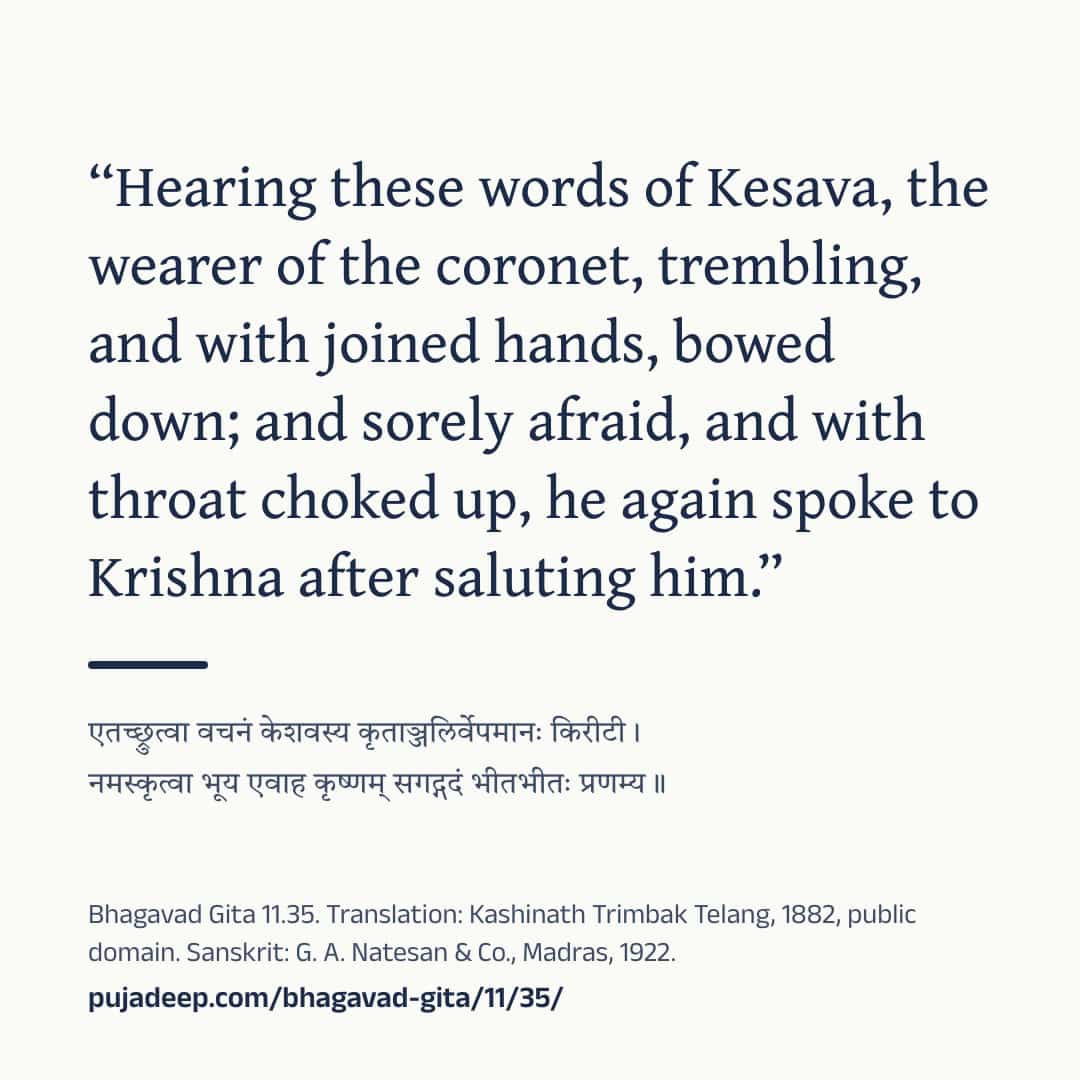
Drawing the picture
See the words
Bhagavad Gita 11.35

एतच्छ्रुत्वा वचनं केशवस्य कृताञ्जलिर्वेपमानः किरीटी ।
नमस्कृत्वा भूय एवाह कृष्णम् सगद्गदं भीतभीतः प्रणम्य ॥

“Hearing these words of Kesava, the wearer of the coronet, trembling, and with joined hands, bowed down; and sorely afraid, and with throat choked up, he again spoke to Krishna after saluting him.”
(K. T. Telang, The Bhagavadgîtâ (The Sacred Books of the East, vol. VIII, Oxford: Clarendon Press, 1882), p. 96, public domain)

“Having heard these words of Keshava, he who weareth a diadem, with joined palms, quaking, and prostrating himself, spake again to Krishna, stammering with fear, casting down his face.”
(Annie Besant, The Bhagavad Gîtâ, or The Lord's Song (London: Theosophical Publishing Society, 1895), p. 111, public domain)

“Having heard that speech of Keshava, the diademed one (Arjuna), with joined palms, trembling, prostrated himself, and again addressed Krishna in a choked voice, bowing down, overwhelmed with fear.”
(Swami Swarupananda, Srimad-Bhagavad-Gita (Mayavati: Prabuddha Bharata Press, 1909; first printed in Prabuddha Bharata, 1907–1909), p. 230, public domain)

Sanskrit: G. A. Natesan & Co., Madras, 1922.
https://pujadeep.com/bhagavad-gita/11/35/ Nothing is sent from this site. Your own app sends it, to the chat you choose. The picture quotes the translation you chose on this page, with its name and year.
Sanskrit text: The Bhagavad-Gita, or The Lord's Song, with the text in Devanagari and an English translation, 1922. Meanings: written for Pujadeep and checked against the cited edition. Source and changes
Questions families ask
Who speaks Bhagavad Gita 11.35?
Sanjaya speaks this verse, in chapter 11 (Vishvarupa Darshana Yoga).
Where does the Sanskrit text come from?
Sanskrit text: The Bhagavad-Gita, or The Lord's Song, with the text in Devanagari and an English translation, 1922. Meanings: written for Pujadeep and checked against the cited edition. See the source
Is the meaning on this page a translation?
Explanation written for this site from the sources listed here, and checked against the cited edition. It is not a translation and not the only way to read the text. Free to quote with credit.
Source and licence
- Sanskrit text
- The Bhagavad-Gita, or The Lord's Song, with the text in Devanagari and an English translation (Annie Besant, G. A. Natesan & Co., Madras, 1922). Public domain. The Sanskrit on these pages was read from this printing’s page images.
- Translation
- The Bhagavadgîtâ with the Sanatsugâtîya and the Anugîtâ, translated by Kâshinâth Trimbak Telang (The Sacred Books of the East, vol. VIII, ed. F. Max Müller) (Kashinath Trimbak Telang, F. Max Müller, Clarendon Press, Oxford, 1882). Public domain. Shown verbatim, as printed.
- Translation
- The Bhagavad Gîtâ, or The Lord's Song, translated by Annie Besant (Annie Besant, Theosophical Publishing Society, London, 1895). Public domain. Shown verbatim, as printed.
- Translation
- Srimad-Bhagavad-Gita, with Sanskrit Text; Paraphrase with Word-by-word Literal Translation; English Rendering and Comments, Index, &c., by the Swami Swarupananda (Himalayan Series, No. XX) (Swami Swarupananda, The Editors and Publishers, Advaita Ashrama, Mayavati, Prabuddha Bharata Press, Mayavati, Almora, Himalayas, 1909). Public domain. Shown verbatim, as printed.
- Common wording
- In this text, 32 words follow today's common wording, checked against sanskritdocuments.org; Sanskrit Wikisource; Gita Press, Gorakhpur; GRETIL, Göttingen and Bhaktivedanta Book Trust.
- Our explanation
- Explanation written for this site from the sources listed here, and checked against the cited edition. It is not a translation and not the only way to read the text. Free to quote with credit.
- Checked
- Checked against the cited edition, October 27, 2026.