Bhagavad Gita 11.28: meaning and translation
Chapter 11: Vishvarupa Darshana Yoga. Arjuna says
Arjuna gives a comparison: as the many currents of rivers run towards the sea, so these heroes of the world of men enter Krishna's blazing mouths.
Click or tap a word for its meaning and its dictionary page.
Text and layers
Text and layers
These choices stay in this browser.
Bhagavad Gita 11.28
यथा नदीनां बहवोऽम्बुवेगाः समुद्रमेवाभिमुखा द्रवन्ति ।तथा तवामी नरलोकवीराः विशन्ति वक्त्राण्यभिविज्वलन्ति ॥
Yatha nadinam bahavombuvegah samudramevabhimukha dravantiTatha tavami naralokavirah vishanti vaktranyabhivijvalanti
yathā nadīnāṃ bahavo’mbuvegāḥ samudramevābhimukhā dravanti |tathā tavāmī naralokavīrāḥ viśanti vaktrāṇyabhivijvalanti ||
Our explanation Arjuna gives a comparison: as the many currents of rivers run towards the sea, so these heroes of the world of men enter Krishna's blazing mouths.
हिंदी अर्थ अर्जुन उपमा देते हैं: जैसे नदियों की अनेक धाराएँ समुद्र की ओर ही बहती हैं, वैसे ही मनुष्य-लोक के ये वीर कृष्ण के जलते मुखों में प्रवेश कर रहे हैं।
Word by word
Every word, with its dictionary page
Word by word
- यथा yathā · as (indeclinable) Dictionary: yathā, Monier-Williams 1899, p. 841, col. 2 “in which manner or way, according as, as, like”
- नदीनाम् nadīnām · of rivers (noun (feminine), genitive plural) Dictionary: nadī, Monier-Williams 1899, p. 526, col. 1 “flowing water, a river”
- बहवः bahavaḥ · many (adjective (masculine), nominative plural) Dictionary: bahu, Monier-Williams 1899, p. 724, col. 2 “much, many, frequent, abundant, numerous”
- अम्बुवेगाः ambuvegāḥ · water currents (compound (masculine), nominative plural) Dictionary: ambu-vega, Monier-Williams 1899, p. 1316, col. 1 “a current of w°”
- समुद्रम् samudram · the ocean (noun (masculine), accusative singular) Dictionary: sam-udra, Monier-Williams 1899, p. 1166, col. 3
- एव eva · just, only (indeclinable) Dictionary: 1. eva, Monier-Williams 1899, p. 232, col. 2 “just, exactly, very, same, only, even, alone, merely”
- अभिमुखाः abhimukhāḥ · facing toward (adjective (masculine), nominative plural) Dictionary: abhi-mukha, Monier-Williams 1899, p. 67, col. 2 “with the face directed towards, turned towards, facing”
- द्रवन्ति dravanti · run, flow (present, 3rd person plural) Dictionary: 2. dru, Monier-Williams 1899, p. 502, col. 1 “to run, hasten, flee”
- तथा tathā · so (indeclinable) Dictionary: tathā, Monier-Williams 1899, p. 433, col. 3 “in that manner, so, thus”
- तव tava · your (pronoun, genitive singular) Dictionary: yuṣmad, Monier-Williams 1899, p. 855, col. 3 “the base of the 2nd pers. pron. as used in comp.”
- अमी amī · these (pronoun (masculine), nominative plural) Dictionary: adas, Monier-Williams 1899, p. 18, col. 1 “that; a certain”
- नरलोकवीराः naralokavīrāḥ · heroes of the human world (compound (masculine), nominative plural) Dictionary: nara-loka, Monier-Williams 1899, p. 529, col. 1 “‘men's world,’ the earth; mortals, men”; vīra, Monier-Williams 1899, p. 1005, col. 2 “a man, (esp.) a brave or eminent man, hero, chief”
- विशन्ति viśanti · enter (present, 3rd person plural) Dictionary: 1. viś, Monier-Williams 1899, p. 989, col. 2 “to enter, enter in or settle down on, go into”
- वक्त्राणि vaktrāṇi · mouths (noun (neuter), accusative plural) Dictionary: vaktra, Monier-Williams 1899, p. 912, col. 2 “‘organ of speech,’ the mouth, face”
- अभिविज्वलन्ति abhivijvalanti · blazing all around (present participle (neuter), accusative plural) Dictionary: abhi-vi-jval, Monier-Williams 1899, p. 69, col. 2 “to flame or blaze against or opposite to”
1 printing differs
Edition differences. Another printing or text reads this place differently.
- Spelling A digital text reads Same words. At the printed line end the 1922 edition keeps the visarga (वीराः); the e-text applies sandhi (वीरा).
Old translations
Kashinath Trimbak Telang, 1882. Public domain. Page 95.
As the many rapid currents of a river's waters run towards the sea alone, so do these heroes of the human world enter your mouths blazing all round.
Compare 3 translations
Kashinath Trimbak Telang, 1882. Public domain. Page 95.
As the many rapid currents of a river's waters run towards the sea alone, so do these heroes of the human world enter your mouths blazing all round.
You are reading this one
Annie Besant, 1895. Public domain. Page 109.
As river-floods impetuously rush,
Hurling their waters into ocean's lap,
So fling themselves into Thy flaming mouths,
In haste, these mighty men, these lords of earth.
You are reading this one
Swami Swarupananda, 1909 (first printed 1907). Public domain. Page 225.
Verily, as the many torrents of rivers flow towards the ocean, so do these heroes in the world of men enter Thy mouths fiercely flaming on all sides.
You are reading this one
Cite this verse
The translation: K. T. Telang, The Bhagavadgîtâ (The Sacred Books of the East, vol. VIII, Oxford: Clarendon Press, 1882), p. 95. Bhagavad Gita 11.28.
The translation: Annie Besant, The Bhagavad Gîtâ, or The Lord's Song (London: Theosophical Publishing Society, 1895), p. 109. Bhagavad Gita 11.28.
The translation: Swami Swarupananda, Srimad-Bhagavad-Gita (Mayavati: Prabuddha Bharata Press, 1909; first printed in Prabuddha Bharata, 1907–1909), p. 225. Bhagavad Gita 11.28.
Our explanation: “Bhagavad Gita 11.28: meaning and translation.” Pujadeep. Updated October 27, 2026. https://pujadeep.com/bhagavad-gita/11/28/
Pujadeep’s explanations are free to quote with credit: name Pujadeep and link to the page. How to credit
Classical readings, by school
No readings by school on this verse yet.
Share
Show the ways to share
Send one picture or the text to one chat. The picture names its source and the address of this page.
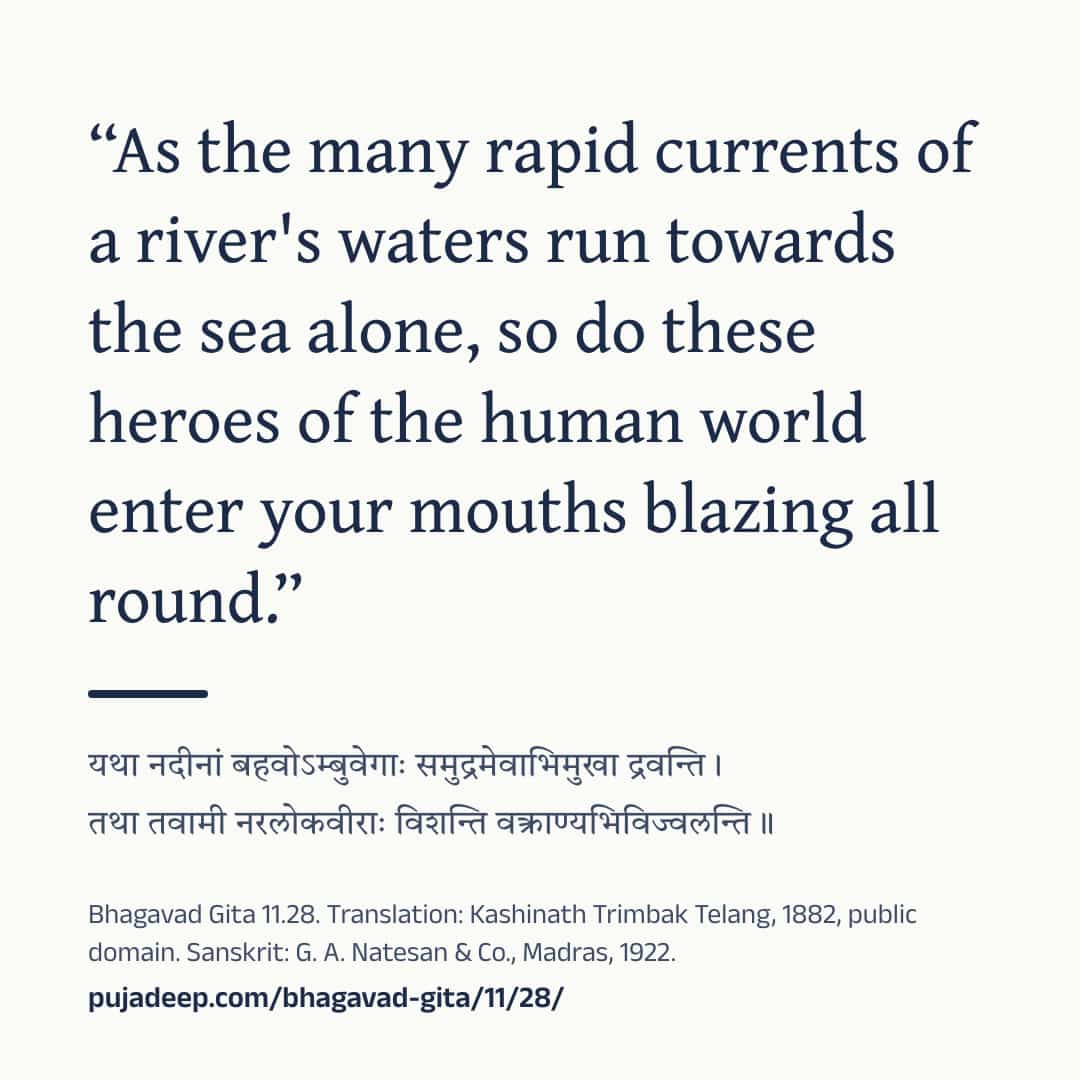
Drawing the picture
See the words
Bhagavad Gita 11.28

यथा नदीनां बहवोऽम्बुवेगाः समुद्रमेवाभिमुखा द्रवन्ति ।
तथा तवामी नरलोकवीराः विशन्ति वक्त्राण्यभिविज्वलन्ति ॥

“As the many rapid currents of a river's waters run towards the sea alone, so do these heroes of the human world enter your mouths blazing all round.”
(K. T. Telang, The Bhagavadgîtâ (The Sacred Books of the East, vol. VIII, Oxford: Clarendon Press, 1882), p. 95, public domain)

“As river-floods impetuously rush, Hurling their waters into ocean's lap, So fling themselves into Thy flaming mouths, In haste, these mighty men, these lords of earth.”
(Annie Besant, The Bhagavad Gîtâ, or The Lord's Song (London: Theosophical Publishing Society, 1895), p. 109, public domain)

“Verily, as the many torrents of rivers flow towards the ocean, so do these heroes in the world of men enter Thy mouths fiercely flaming on all sides.”
(Swami Swarupananda, Srimad-Bhagavad-Gita (Mayavati: Prabuddha Bharata Press, 1909; first printed in Prabuddha Bharata, 1907–1909), p. 225, public domain)

Sanskrit: G. A. Natesan & Co., Madras, 1922.
https://pujadeep.com/bhagavad-gita/11/28/ Nothing is sent from this site. Your own app sends it, to the chat you choose. The picture quotes the translation you chose on this page, with its name and year.
Sanskrit text: The Bhagavad-Gita, or The Lord's Song, with the text in Devanagari and an English translation, 1922. Meanings: written for Pujadeep and checked against the cited edition. Source and changes
Questions families ask
Who speaks Bhagavad Gita 11.28?
Arjuna speaks this verse, in chapter 11 (Vishvarupa Darshana Yoga).
Where does the Sanskrit text come from?
Sanskrit text: The Bhagavad-Gita, or The Lord's Song, with the text in Devanagari and an English translation, 1922. Meanings: written for Pujadeep and checked against the cited edition. See the source
Is the meaning on this page a translation?
Explanation written for this site from the sources listed here, and checked against the cited edition. It is not a translation and not the only way to read the text. Free to quote with credit.
Source and licence
- Sanskrit text
- The Bhagavad-Gita, or The Lord's Song, with the text in Devanagari and an English translation (Annie Besant, G. A. Natesan & Co., Madras, 1922). Public domain. The Sanskrit on these pages was read from this printing’s page images.
- Translation
- The Bhagavadgîtâ with the Sanatsugâtîya and the Anugîtâ, translated by Kâshinâth Trimbak Telang (The Sacred Books of the East, vol. VIII, ed. F. Max Müller) (Kashinath Trimbak Telang, F. Max Müller, Clarendon Press, Oxford, 1882). Public domain. Shown verbatim, as printed.
- Translation
- The Bhagavad Gîtâ, or The Lord's Song, translated by Annie Besant (Annie Besant, Theosophical Publishing Society, London, 1895). Public domain. Shown verbatim, as printed.
- Translation
- Srimad-Bhagavad-Gita, with Sanskrit Text; Paraphrase with Word-by-word Literal Translation; English Rendering and Comments, Index, &c., by the Swami Swarupananda (Himalayan Series, No. XX) (Swami Swarupananda, The Editors and Publishers, Advaita Ashrama, Mayavati, Prabuddha Bharata Press, Mayavati, Almora, Himalayas, 1909). Public domain. Shown verbatim, as printed.
- Common wording
- In this text, 32 words follow today's common wording, checked against sanskritdocuments.org; Sanskrit Wikisource; Gita Press, Gorakhpur; GRETIL, Göttingen and Bhaktivedanta Book Trust.
- Our explanation
- Explanation written for this site from the sources listed here, and checked against the cited edition. It is not a translation and not the only way to read the text. Free to quote with credit.
- Checked
- Checked against the cited edition, October 27, 2026.