Bhagavad Gita 11.23: meaning and translation
Chapter 11: Vishvarupa Darshana Yoga. Arjuna says
Arjuna calls Krishna mighty-armed.
Click or tap a word for its meaning and its dictionary page.
Text and layers
Text and layers
These choices stay in this browser.
Bhagavad Gita 11.23
रूपं महत्ते बहुवक्त्रनेत्रम् महाबाहो बहुबाहूरुपादम् ।बहूदरं बहुदंष्ट्राकरालम् दृष्ट्वा लोकाः प्रव्यथितास्तथाऽहम् ॥
Rupam mahatte bahuvaktranetram mahabaho bahubahurupadamBahudaram bahudanshtrakaralam drishtva lokah pravyathitastathaham
rūpaṃ mahatte bahuvaktranetram mahābāho bahubāhūrupādam |bahūdaraṃ bahudaṃṣṭrākarālam dṛṣṭvā lokāḥ pravyathitāstathā’ham ||
Our explanation Arjuna calls Krishna mighty-armed. Seeing his great form, with many mouths and eyes, many arms, thighs and feet, many bellies and many fearsome teeth, he says, the worlds are shaken, and so is he. In verses 23 to 30 Arjuna describes the form as he sees it; the descriptions are his words.
हिंदी अर्थ अर्जुन कृष्ण को महाबाहु कहते हैं। वे कहते हैं कि अनेक मुखों और नेत्रों, अनेक भुजाओं, जंघाओं और पैरों, अनेक उदरों और अनेक विकराल दाढ़ों वाले इस विशाल रूप को देखकर लोक व्यथित हैं, और वे स्वयं भी। श्लोक 23 से 30 तक अर्जुन उस रूप का वर्णन वैसे करते हैं जैसे वे उसे देख रहे हैं; ये वर्णन उनके अपने शब्द हैं।
Word by word
Every word, with its dictionary page
Word by word
- रूपम् rūpam · form (noun (neuter), accusative singular) Dictionary: rūpa, Monier-Williams 1899, p. 885, col. 3 “form, shape, figure”
- महत् mahat · great, vast (adjective (neuter), accusative singular) Dictionary: mahat, Monier-Williams 1899, p. 794, col. 2 “great (in space, time, quantity or degree)”
- ते te · your (pronoun, genitive singular) Dictionary: yuṣmad, Monier-Williams 1899, p. 855, col. 3 “the base of the 2nd pers. pron. as used in comp.”
- बहुवक्त्रनेत्रम् bahuvaktranetram · with many mouths and eyes (compound (neuter), accusative singular) Dictionary: bahu, Monier-Williams 1899, p. 724, col. 2 “much, many, frequent, abundant, numerous”; vaktra, Monier-Williams 1899, p. 912, col. 2 “‘organ of speech,’ the mouth, face”; netra, Monier-Williams 1899, p. 568, col. 3 “the eye”
- महाबाहो mahābāho · O mighty-armed one (Krishna) (compound (masculine), vocative singular) Dictionary: mahā-bāhu, Monier-Williams 1899, p. 798, col. 1 “long-armed”
- बहुबाहूरुपादम् bahubāhūrupādam · with many arms, thighs and feet (compound (neuter), accusative singular) Dictionary: bahu-bāhu, Monier-Williams 1899, p. 725, col. 2 “many-armed”; ūru, Monier-Williams 1899, p. 221, col. 2 “the thigh, shank”; pāda, Monier-Williams 1899, p. 617, col. 1 “the foot (of men and animals)”
- बहूदरम् bahūdaram · with many bellies (compound (neuter), accusative singular) Dictionary: bahu, Monier-Williams 1899, p. 724, col. 2 “much, many, frequent, abundant, numerous”; udara, Monier-Williams 1899, p. 184, col. 2 “the belly, abdomen, stomach, bowels”
- बहुदंष्ट्राकरालम् bahudaṃṣṭrākarālam · fearsome with many tusks (compound (neuter), accusative singular) Dictionary: bahu, Monier-Williams 1899, p. 724, col. 2 “much, many, frequent, abundant, numerous”; daṃṣṭrā-karāla, Monier-Williams 1899, p. 464, col. 3 “having terrible tusks”
- दृष्ट्वा dṛṣṭvā · having seen (absolutive (having done)) Dictionary: 1. dṛś, Monier-Williams 1899, p. 491, col. 2 “to see, behold, look at, regard, consider”
- लोकाः lokāḥ · the worlds, people (noun (masculine), nominative plural) Dictionary: loka, Monier-Williams 1899, p. 906, col. 1 “the wide space or world”
- प्रव्यथिताः pravyathitāḥ · are shaken (past participle (masculine), nominative plural) Dictionary: pra-vyathita, Monier-Williams 1899, p. 694, col. 2 “affrighted, distressed, pained”
- तथा tathā · so too (indeclinable) Dictionary: tathā, Monier-Williams 1899, p. 433, col. 3 “in that manner, so, thus”
- अहम् aham · "I" (Arjuna) (pronoun, nominative singular) Dictionary: aham, Monier-Williams 1899, p. 124, col. 2 “nom. sg. ‘I,’”
3 printings differ
Edition differences. Another printing or text reads this place differently.
- The printed edition reads: रूपं महत्ते बहुवक्त्रनेत्रम् महाबाहो बहुबाहूरुपादम् ।
बहूदरं बहुदंष्ट्राकरालम् दृष्ट्वा लोका प्रव्यथितास्तथाऽहम् ॥ The print has लोका with no visarga before प्रव्यथिताः; the visarga is restored (लोकाः), because sandhi keeps it before प्र and the form without it breaks the grammar. Both proofreading references read लोकाः, and so do Telang ('all people … are much alarmed') and Besant ('The worlds see'). - Spelling The 1922 Madras printing reads: दृष्ट्वा लोका प्रव्यथितास्तथाऽहम् The 1922 base printing (leaf n170) has लोका with no visarga, a printing flaw; see normalisations.
- Spelling A digital text reads Same words. At the printed line ends the 1922 edition writes नेत्रम् and करालम्, and it marks the merged vowel in तथाऽहम्; the e-text writes नेत्रं, करालं and तथाहम्. (The edition's लोका is a printing flaw; see editionReading.)
Old translations
Kashinath Trimbak Telang, 1882. Public domain. Page 94.
Seeing your mighty form, with many mouths and eyes, with many arms, thighs, and feet, with many stomachs, and fearful with many jaws, all people, and I likewise, are much alarmed, O you of mighty arms!
Compare 3 translations
Kashinath Trimbak Telang, 1882. Public domain. Page 94.
Seeing your mighty form, with many mouths and eyes, with many arms, thighs, and feet, with many stomachs, and fearful with many jaws, all people, and I likewise, are much alarmed, O you of mighty arms!
You are reading this one
Annie Besant, 1895. Public domain. Page 108.
Thy mighty Form, with many mouths and eyes,
Long-armed, with thighs and feet innumerate,
Vast-bosomed, set with many fearful teeth,
The worlds see terrorstruck, as also I.
You are reading this one
Swami Swarupananda, 1909 (first printed 1907). Public domain. Page 222–223.
Having seen Thy immeasurable Form—with many mouths and eyes, O mighty-armed, with many arms, thighs and feet, with many stomachs, and fearful with many tusks,—the worlds are terrified, and so am I.
You are reading this one
Cite this verse
The translation: K. T. Telang, The Bhagavadgîtâ (The Sacred Books of the East, vol. VIII, Oxford: Clarendon Press, 1882), p. 94. Bhagavad Gita 11.23.
The translation: Annie Besant, The Bhagavad Gîtâ, or The Lord's Song (London: Theosophical Publishing Society, 1895), p. 108. Bhagavad Gita 11.23.
The translation: Swami Swarupananda, Srimad-Bhagavad-Gita (Mayavati: Prabuddha Bharata Press, 1909; first printed in Prabuddha Bharata, 1907–1909), pp. 222–223. Bhagavad Gita 11.23.
Our explanation: “Bhagavad Gita 11.23: meaning and translation.” Pujadeep. Updated October 27, 2026. https://pujadeep.com/bhagavad-gita/11/23/
Pujadeep’s explanations are free to quote with credit: name Pujadeep and link to the page. How to credit
Classical readings, by school
No readings by school on this verse yet.
Share
Show the ways to share
Send one picture or the text to one chat. The picture names its source and the address of this page.
Drawing the picture
See the words
Bhagavad Gita 11.23

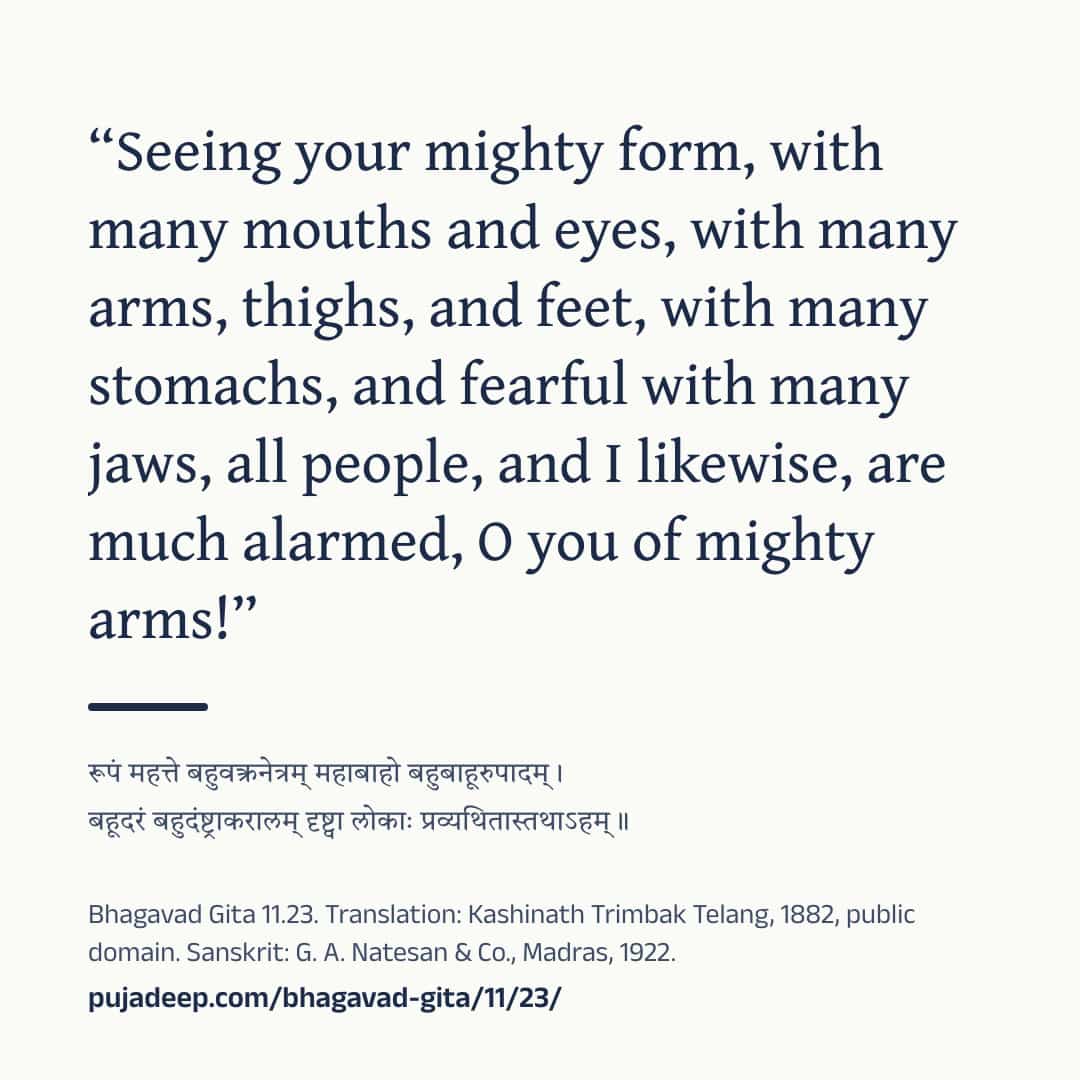
रूपं महत्ते बहुवक्त्रनेत्रम् महाबाहो बहुबाहूरुपादम् ।
बहूदरं बहुदंष्ट्राकरालम् दृष्ट्वा लोकाः प्रव्यथितास्तथाऽहम् ॥

“Seeing your mighty form, with many mouths and eyes, with many arms, thighs, and feet, with many stomachs, and fearful with many jaws, all people, and I likewise, are much alarmed, O you of mighty arms!”
(K. T. Telang, The Bhagavadgîtâ (The Sacred Books of the East, vol. VIII, Oxford: Clarendon Press, 1882), p. 94, public domain)

“Thy mighty Form, with many mouths and eyes, Long-armed, with thighs and feet innumerate, Vast-bosomed, set with many fearful teeth, The worlds see terrorstruck, as also I.”
(Annie Besant, The Bhagavad Gîtâ, or The Lord's Song (London: Theosophical Publishing Society, 1895), p. 108, public domain)

“Having seen Thy immeasurable Form—with many mouths and eyes, O mighty-armed, with many arms, thighs and feet, with many stomachs, and fearful with many tusks,—the worlds are terrified, and so am I.”
(Swami Swarupananda, Srimad-Bhagavad-Gita (Mayavati: Prabuddha Bharata Press, 1909; first printed in Prabuddha Bharata, 1907–1909), pp. 222–223, public domain)

Sanskrit: G. A. Natesan & Co., Madras, 1922.
https://pujadeep.com/bhagavad-gita/11/23/ Nothing is sent from this site. Your own app sends it, to the chat you choose. The picture quotes the translation you chose on this page, with its name and year.
Sanskrit text: The Bhagavad-Gita, or The Lord's Song, with the text in Devanagari and an English translation, 1922. Meanings: written for Pujadeep and checked against the cited edition. Source and changes
Questions families ask
Who speaks Bhagavad Gita 11.23?
Arjuna speaks this verse, in chapter 11 (Vishvarupa Darshana Yoga).
Where does the Sanskrit text come from?
Sanskrit text: The Bhagavad-Gita, or The Lord's Song, with the text in Devanagari and an English translation, 1922. Meanings: written for Pujadeep and checked against the cited edition. See the source
Is the meaning on this page a translation?
Explanation written for this site from the sources listed here, and checked against the cited edition. It is not a translation and not the only way to read the text. Free to quote with credit.
Source and licence
- Sanskrit text
- The Bhagavad-Gita, or The Lord's Song, with the text in Devanagari and an English translation (Annie Besant, G. A. Natesan & Co., Madras, 1922). Public domain. The Sanskrit on these pages was read from this printing’s page images.
- Translation
- The Bhagavadgîtâ with the Sanatsugâtîya and the Anugîtâ, translated by Kâshinâth Trimbak Telang (The Sacred Books of the East, vol. VIII, ed. F. Max Müller) (Kashinath Trimbak Telang, F. Max Müller, Clarendon Press, Oxford, 1882). Public domain. Shown verbatim, as printed.
- Translation
- The Bhagavad Gîtâ, or The Lord's Song, translated by Annie Besant (Annie Besant, Theosophical Publishing Society, London, 1895). Public domain. Shown verbatim, as printed.
- Translation
- Srimad-Bhagavad-Gita, with Sanskrit Text; Paraphrase with Word-by-word Literal Translation; English Rendering and Comments, Index, &c., by the Swami Swarupananda (Himalayan Series, No. XX) (Swami Swarupananda, The Editors and Publishers, Advaita Ashrama, Mayavati, Prabuddha Bharata Press, Mayavati, Almora, Himalayas, 1909). Public domain. Shown verbatim, as printed.
- Common wording
- In this text, 32 words follow today's common wording, checked against sanskritdocuments.org; Sanskrit Wikisource; Gita Press, Gorakhpur; GRETIL, Göttingen and Bhaktivedanta Book Trust.
- Our explanation
- Explanation written for this site from the sources listed here, and checked against the cited edition. It is not a translation and not the only way to read the text. Free to quote with credit.
- Checked
- Checked against the cited edition, October 27, 2026.