Bhagavad Gita 11.22: meaning and translation
Chapter 11: Vishvarupa Darshana Yoga. Arjuna says
Arjuna says the Rudras, Ādityas, Vasus and Sādhyas, the Viśvedevas, the Aśvins, the Maruts and the Ūṣmapas (a class of ancestors, pitṛs, as Shankara and Ramanuja explain), and the hosts of gandharvas, yakṣas, asuras and siddhas are all looking at Krishna in amazement.
Click or tap a word for its meaning and its dictionary page.
Text and layers
Text and layers
These choices stay in this browser.
Bhagavad Gita 11.22
रुद्रादित्या वसवो ये च साध्याः विश्वेऽश्विनौ मरुतश्चोष्मपाश्च ।गन्धर्वयक्षासुरसिद्धसङ्घाः वीक्षन्ते त्वां विस्मिताश्चैव सर्वे ॥
Rudraditya vasavo ye cha sadhyah vishveshvinau marutashchoshmapashchaGandharvayakshasurasiddhasanghah vikshante tvam vismitashchaiva sarve
rudrādityā vasavo ye ca sādhyāḥ viśve’śvinau marutaścoṣmapāśca |gandharvayakṣāsurasiddhasaṅghāḥ vīkṣante tvāṃ vismitāścaiva sarve ||
Our explanation Arjuna says the Rudras, Ādityas, Vasus and Sādhyas, the Viśvedevas, the Aśvins, the Maruts and the Ūṣmapas (a class of ancestors, pitṛs, as Shankara and Ramanuja explain), and the hosts of gandharvas, yakṣas, asuras and siddhas are all looking at Krishna in amazement.
हिंदी अर्थ अर्जुन कहते हैं कि रुद्र, आदित्य, वसु और साध्य, विश्वेदेव, अश्विनीकुमार, मरुत और ऊष्मप (शंकराचार्य और रामानुजाचार्य के अनुसार पितरों का एक वर्ग), और गंधर्वों, यक्षों, असुरों और सिद्धों के समूह, सब विस्मित होकर कृष्ण को देख रहे हैं।
Word by word
Every word, with its dictionary page
Word by word
- रुद्रादित्याः rudrādityāḥ · the Rudras and Adityas (compound (masculine), nominative plural) Dictionary: rudra, Monier-Williams 1899, p. 883, col. 1 “‘Roarer or Howler,’ N. of the god of tempests”; 1. āditya, Monier-Williams 1899, p. 137, col. 2 “N. of seven deities of the heavenly sphere”
- वसवः vasavaḥ · the Vasus (noun (masculine), nominative plural) Dictionary: 1. vasu, Monier-Williams 1899, p. 930, col. 3 “a partic. class of gods”
- ये ye · who (pronoun (masculine), nominative plural) Dictionary: yad, Monier-Williams 1899, p. 844, col. 2 “who, which, what, whichever, whatever, that”
- च ca · and (indeclinable) Dictionary: 2. ca, Monier-Williams 1899, p. 380, col. 1 “and, both, also, moreover, as well as”
- साध्याः sādhyāḥ · the Sadhyas (noun (masculine), nominative plural) Dictionary: sādhya, Monier-Williams 1899, p. 1202, col. 1 “N. of a class of celestial beings”
- विश्वे viśve · the Vishvedevas (noun (masculine), nominative plural) Dictionary: viśva, Monier-Williams 1899, p. 992, col. 2 “all, every, every one; whole, entire, universal”
- अश्विनौ aśvinau · the two Ashvins (noun (masculine), nominative dual) Dictionary: aśvin, Monier-Williams 1899, p. 116, col. 1 “‘the two charioteers,’ N. of two divinities”
- मरुतः marutaḥ · the Maruts (noun (masculine), nominative plural) Dictionary: marut, Monier-Williams 1899, p. 790, col. 2 “the storm-gods”
- च ca · and (indeclinable) Dictionary: 2. ca, Monier-Williams 1899, p. 380, col. 1 “and, both, also, moreover, as well as”
- ऊष्मपाः ūṣmapāḥ · the Ushmapas (the ancestors) (noun (masculine), nominative plural) Dictionary: ūṣma-pa, Monier-Williams 1899, p. 223, col. 1 “N. of a class of manes”
- च ca · and (indeclinable) Dictionary: 2. ca, Monier-Williams 1899, p. 380, col. 1 “and, both, also, moreover, as well as”
- गन्धर्वयक्षासुरसिद्धसङ्घाः gandharvayakṣāsurasiddhasaṅghāḥ · hosts of Gandharvas, Yakshas, Asuras and Siddhas (compound (masculine), nominative plural) Dictionary: gandharva, Monier-Williams 1899, p. 346, col. 1 “a Gandharva”; yakṣa, Monier-Williams 1899, p. 838, col. 2 “a living supernatural being”; asura, Monier-Williams 1899, p. 121, col. 1 “an evil spirit, demon, ghost, opponent of the gods”; siddha-saṃgha, Monier-Williams 1899, p. 1215, col. 3 “a company of Siddhas, assemblage of perfected beings”
- वीक्षन्ते vīkṣante · look at (present, 3rd person plural) Dictionary: vīkṣ, Monier-Williams 1899, p. 1004, col. 2 “to look at, see, behold”
- त्वाम् tvām · you (pronoun, accusative singular) Dictionary: yuṣmad, Monier-Williams 1899, p. 855, col. 3 “the base of the 2nd pers. pron. as used in comp.”
- विस्मिताः vismitāḥ · amazed (past participle (masculine), nominative plural) Dictionary: vi-smita, Monier-Williams 1899, p. 1002, col. 2 “amazed, surprised, perplexed”
- च ca · and (indeclinable) Dictionary: 2. ca, Monier-Williams 1899, p. 380, col. 1 “and, both, also, moreover, as well as”
- एव eva · indeed (indeclinable) Dictionary: 1. eva, Monier-Williams 1899, p. 232, col. 2 “just, exactly, very, same, only, even, alone, merely”
- सर्वे sarve · all (pronoun (masculine), nominative plural) Dictionary: sarva, Monier-Williams 1899, p. 1184, col. 3 “whole, entire, all, every”
1 printing differs
Edition differences. Another printing or text reads this place differently.
- Spelling A digital text reads Same words. At the printed line ends the 1922 edition keeps the visarga (साध्याः, सङ्घाः); the e-text applies sandhi (साध्या, सङ्घा).
Old translations
Kashinath Trimbak Telang, 1882. Public domain. Page 94.
The Rudras, and Âdityas, the Vasus, the Sâdhyas, the Visvas, the two Asvins, the Maruts, and the Ushmapas, and the groups of Gandharvas, Yakshas, demons, and Siddhas are all looking at you amazed.
Compare 3 translations
Kashinath Trimbak Telang, 1882. Public domain. Page 94.
The Rudras, and Âdityas, the Vasus, the Sâdhyas, the Visvas, the two Asvins, the Maruts, and the Ushmapas, and the groups of Gandharvas, Yakshas, demons, and Siddhas are all looking at you amazed.
You are reading this one
Annie Besant, 1895. Public domain. Page 107–108.
Rudras, Vasus, Sâdhyas and Âdityas,
Vishvas, the Ashvins, Maruts, Ushmapas,
Gandharvas, Yakshas, Siddhas, Asuras,
In wondering multitudes beholding Thee.
You are reading this one
Swami Swarupananda, 1909 (first printed 1907). Public domain. Page 222.
The Rudras, Adityas, Vasus, and Sádhyas, Vishve-Devas and Ashvins, Maruts and Ushmapás, hosts of Gandharvas, Yakshas, Asuras, and Siddhas, they are all looking at Thee, all quite astounded.
You are reading this one
Cite this verse
The translation: K. T. Telang, The Bhagavadgîtâ (The Sacred Books of the East, vol. VIII, Oxford: Clarendon Press, 1882), p. 94. Bhagavad Gita 11.22.
The translation: Annie Besant, The Bhagavad Gîtâ, or The Lord's Song (London: Theosophical Publishing Society, 1895), pp. 107–108. Bhagavad Gita 11.22.
The translation: Swami Swarupananda, Srimad-Bhagavad-Gita (Mayavati: Prabuddha Bharata Press, 1909; first printed in Prabuddha Bharata, 1907–1909), p. 222. Bhagavad Gita 11.22.
Our explanation: “Bhagavad Gita 11.22: meaning and translation.” Pujadeep. Updated October 27, 2026. https://pujadeep.com/bhagavad-gita/11/22/
Pujadeep’s explanations are free to quote with credit: name Pujadeep and link to the page. How to credit
Classical readings, by school
No readings by school on this verse yet.
Share
Show the ways to share
Send one picture or the text to one chat. The picture names its source and the address of this page.
Drawing the picture
See the words
Bhagavad Gita 11.22

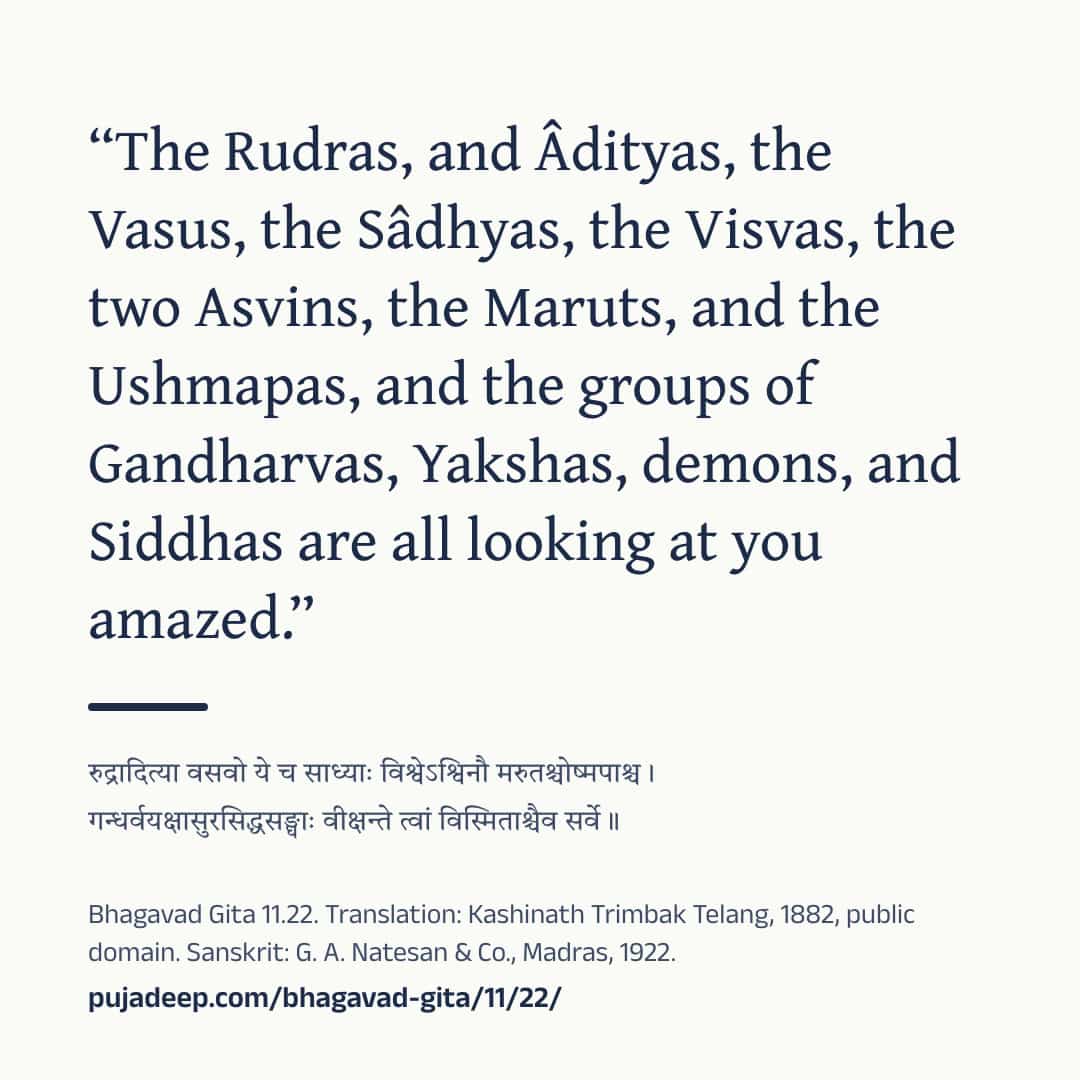
रुद्रादित्या वसवो ये च साध्याः विश्वेऽश्विनौ मरुतश्चोष्मपाश्च ।
गन्धर्वयक्षासुरसिद्धसङ्घाः वीक्षन्ते त्वां विस्मिताश्चैव सर्वे ॥

“The Rudras, and Âdityas, the Vasus, the Sâdhyas, the Visvas, the two Asvins, the Maruts, and the Ushmapas, and the groups of Gandharvas, Yakshas, demons, and Siddhas are all looking at you amazed.”
(K. T. Telang, The Bhagavadgîtâ (The Sacred Books of the East, vol. VIII, Oxford: Clarendon Press, 1882), p. 94, public domain)

“Rudras, Vasus, Sâdhyas and Âdityas, Vishvas, the Ashvins, Maruts, Ushmapas, Gandharvas, Yakshas, Siddhas, Asuras, In wondering multitudes beholding Thee.”
(Annie Besant, The Bhagavad Gîtâ, or The Lord's Song (London: Theosophical Publishing Society, 1895), pp. 107–108, public domain)

“The Rudras, Adityas, Vasus, and Sádhyas, Vishve-Devas and Ashvins, Maruts and Ushmapás, hosts of Gandharvas, Yakshas, Asuras, and Siddhas, they are all looking at Thee, all quite astounded.”
(Swami Swarupananda, Srimad-Bhagavad-Gita (Mayavati: Prabuddha Bharata Press, 1909; first printed in Prabuddha Bharata, 1907–1909), p. 222, public domain)

Sanskrit: G. A. Natesan & Co., Madras, 1922.
https://pujadeep.com/bhagavad-gita/11/22/ Nothing is sent from this site. Your own app sends it, to the chat you choose. The picture quotes the translation you chose on this page, with its name and year.
Sanskrit text: The Bhagavad-Gita, or The Lord's Song, with the text in Devanagari and an English translation, 1922. Meanings: written for Pujadeep and checked against the cited edition. Source and changes
Questions families ask
Who speaks Bhagavad Gita 11.22?
Arjuna speaks this verse, in chapter 11 (Vishvarupa Darshana Yoga).
Where does the Sanskrit text come from?
Sanskrit text: The Bhagavad-Gita, or The Lord's Song, with the text in Devanagari and an English translation, 1922. Meanings: written for Pujadeep and checked against the cited edition. See the source
Is the meaning on this page a translation?
Explanation written for this site from the sources listed here, and checked against the cited edition. It is not a translation and not the only way to read the text. Free to quote with credit.
Source and licence
- Sanskrit text
- The Bhagavad-Gita, or The Lord's Song, with the text in Devanagari and an English translation (Annie Besant, G. A. Natesan & Co., Madras, 1922). Public domain. The Sanskrit on these pages was read from this printing’s page images.
- Translation
- The Bhagavadgîtâ with the Sanatsugâtîya and the Anugîtâ, translated by Kâshinâth Trimbak Telang (The Sacred Books of the East, vol. VIII, ed. F. Max Müller) (Kashinath Trimbak Telang, F. Max Müller, Clarendon Press, Oxford, 1882). Public domain. Shown verbatim, as printed.
- Translation
- The Bhagavad Gîtâ, or The Lord's Song, translated by Annie Besant (Annie Besant, Theosophical Publishing Society, London, 1895). Public domain. Shown verbatim, as printed.
- Translation
- Srimad-Bhagavad-Gita, with Sanskrit Text; Paraphrase with Word-by-word Literal Translation; English Rendering and Comments, Index, &c., by the Swami Swarupananda (Himalayan Series, No. XX) (Swami Swarupananda, The Editors and Publishers, Advaita Ashrama, Mayavati, Prabuddha Bharata Press, Mayavati, Almora, Himalayas, 1909). Public domain. Shown verbatim, as printed.
- Common wording
- In this text, 32 words follow today's common wording, checked against sanskritdocuments.org; Sanskrit Wikisource; Gita Press, Gorakhpur; GRETIL, Göttingen and Bhaktivedanta Book Trust.
- Our explanation
- Explanation written for this site from the sources listed here, and checked against the cited edition. It is not a translation and not the only way to read the text. Free to quote with credit.
- Checked
- Checked against the cited edition, October 27, 2026.