Bhagavad Gita 11.12: meaning and translation
Chapter 11: Vishvarupa Darshana Yoga. Sanjaya says
If the light of a thousand suns were to blaze out at once in the sky, Sanjaya says, it might be like the light of that great being (mahātmā).
Click or tap a word for its meaning and its dictionary page.
Text and layers
Text and layers
These choices stay in this browser.
Bhagavad Gita 11.12
दिवि सूर्यसहस्रस्य भवेद्युगपदुत्थिता ।यदि भाः सदृशी सा स्याद्भासस्तस्य महात्मनः ॥
Divi suryasahasrasya bhavedyugapadutthitaYadi bhah sadrishi sa syadbhasastasya mahatmanah
divi sūryasahasrasya bhavedyugapadutthitā |yadi bhāḥ sadṛśī sā syādbhāsastasya mahātmanaḥ ||
Our explanation If the light of a thousand suns were to blaze out at once in the sky, Sanjaya says, it might be like the light of that great being (mahātmā).
हिंदी अर्थ संजय कहते हैं कि यदि आकाश में एक साथ हज़ार सूर्यों का प्रकाश फूट पड़े, तो वह शायद उस महात्मा के प्रकाश जैसा हो।
Word by word
Every word, with its dictionary page
Word by word
- दिवि divi · in the sky (noun (feminine), locative singular) Dictionary: 3. div, Monier-Williams 1899, p. 478, col. 3 “heaven, the sky”
- सूर्यसहस्रस्य sūryasahasrasya · of a thousand suns (compound (neuter), genitive singular) Dictionary: sūrya, Monier-Williams 1899, p. 1243, col. 1 “the sun or its deity”; sahasra, Monier-Williams 1899, p. 1195, col. 2 “a thousand”
- भवेत् bhavet · were to be (optative, 3rd person singular) Dictionary: 1. bhū, Monier-Williams 1899, p. 760, col. 2 “to become, be”
- युगपत् yugapat · at once (indeclinable) Dictionary: yugapad, Monier-Williams 1899, p. 854, col. 1 “together, at the same time, simultaneously”
- उत्थिता utthitā · risen (past participle (feminine), nominative singular) Dictionary: ut-thita, Monier-Williams 1899, p. 180, col. 1 “risen or rising”
- यदि yadi · if (indeclinable) Dictionary: yadi, Monier-Williams 1899, p. 844, col. 3 “if, in case that”
- भाः bhāḥ · light, splendour (noun (feminine), nominative singular) Dictionary: 2. bhās, Monier-Williams 1899, p. 756, col. 1 “light or ray of light, lustre, brightness”
- सदृशी sadṛśī · like, equal (adjective (feminine), nominative singular) Dictionary: sadṛśa, Monier-Williams 1899, p. 1140, col. 1 “like, resembling, similar to”
- सा sā · that (light) (pronoun (feminine), nominative singular) Dictionary: tad, Monier-Williams 1899, p. 434, col. 1 “m. he, f. she, n. it, that, this”
- स्यात् syāt · might be (optative, 3rd person singular) Dictionary: 1. as, Monier-Williams 1899, p. 117, col. 2 “to be, live, exist, be present”
- भासः bhāsaḥ · of the light (noun (feminine), genitive singular) Dictionary: 2. bhās, Monier-Williams 1899, p. 756, col. 1 “light or ray of light, lustre, brightness”
- तस्य tasya · of him (pronoun (masculine), genitive singular) Dictionary: tad, Monier-Williams 1899, p. 434, col. 1 “m. he, f. she, n. it, that, this”
- महात्मनः mahātmanaḥ · of the great being (compound (masculine), genitive singular) Dictionary: mahātman, Monier-Williams 1899, p. 796, col. 1 “‘high-souled,’ magnanimous, having gr° or noble nature, high-minded, noble”
Old translations
Kashinath Trimbak Telang, 1882. Public domain. Page 93.
If in the heavens, the lustre of a thousand suns burst forth all at once, that would be like the lustre of that mighty one.
Compare 3 translations
Kashinath Trimbak Telang, 1882. Public domain. Page 93.
If in the heavens, the lustre of a thousand suns burst forth all at once, that would be like the lustre of that mighty one.
You are reading this one
Annie Besant, 1895. Public domain. Page 105.
If the splendour of a thousand suns were to rise up together in the heaven, it would appear as the shining of that Mahâtmâ.
You are reading this one
Swami Swarupananda, 1909 (first printed 1907). Public domain. Page 217.
If the splendour of a thousand suns were to rise up at once in the sky, that would be like the splendour of the Mighty Being.
You are reading this one
Cite this verse
The translation: K. T. Telang, The Bhagavadgîtâ (The Sacred Books of the East, vol. VIII, Oxford: Clarendon Press, 1882), p. 93. Bhagavad Gita 11.12.
The translation: Annie Besant, The Bhagavad Gîtâ, or The Lord's Song (London: Theosophical Publishing Society, 1895), p. 105. Bhagavad Gita 11.12.
The translation: Swami Swarupananda, Srimad-Bhagavad-Gita (Mayavati: Prabuddha Bharata Press, 1909; first printed in Prabuddha Bharata, 1907–1909), p. 217. Bhagavad Gita 11.12.
Our explanation: “Bhagavad Gita 11.12: meaning and translation.” Pujadeep. Updated October 27, 2026. https://pujadeep.com/bhagavad-gita/11/12/
Pujadeep’s explanations are free to quote with credit: name Pujadeep and link to the page. How to credit
Classical readings, by school
No readings by school on this verse yet.
Share
Show the ways to share
Send one picture or the text to one chat. The picture names its source and the address of this page.
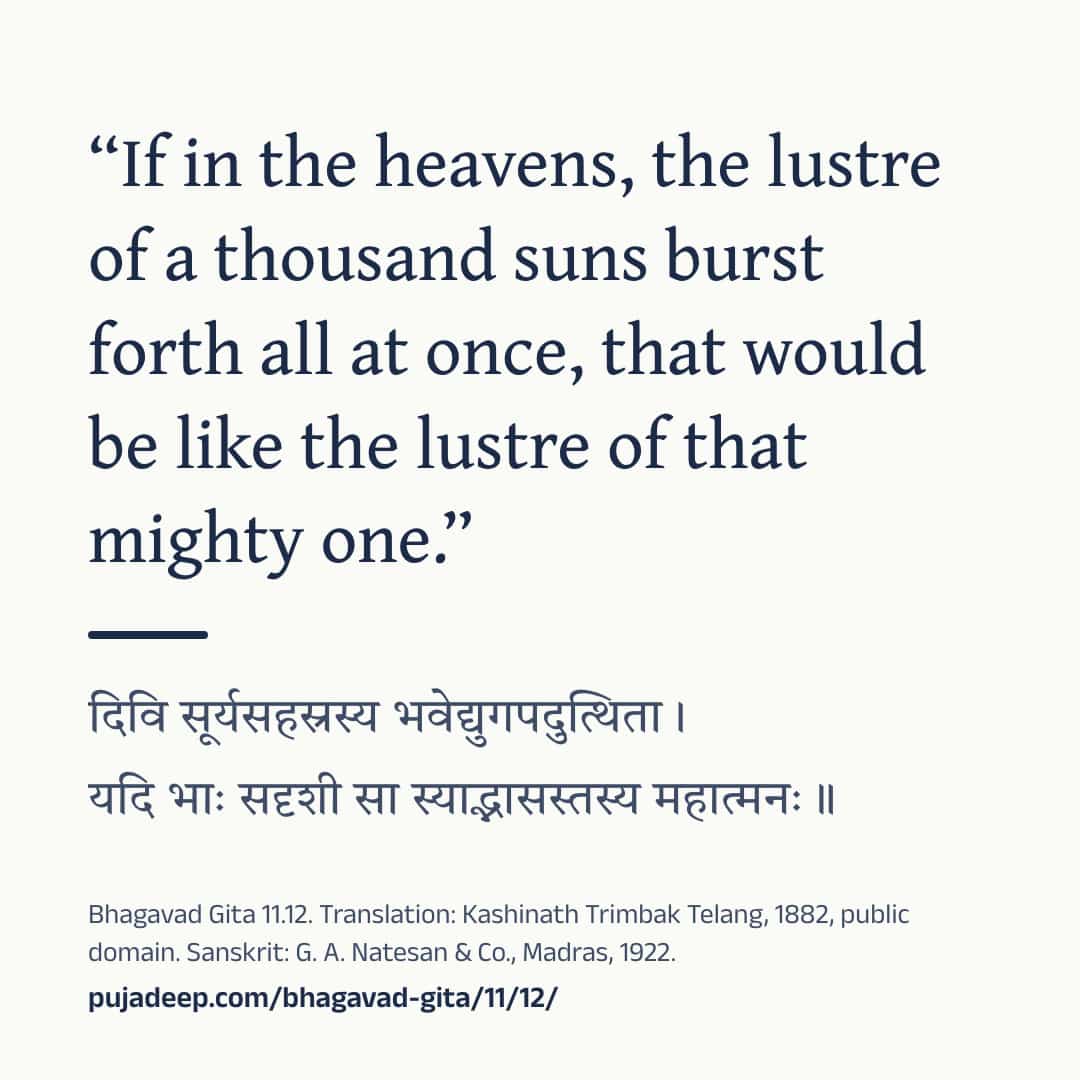
Drawing the picture
See the words
Bhagavad Gita 11.12

दिवि सूर्यसहस्रस्य भवेद्युगपदुत्थिता ।
यदि भाः सदृशी सा स्याद्भासस्तस्य महात्मनः ॥

“If in the heavens, the lustre of a thousand suns burst forth all at once, that would be like the lustre of that mighty one.”
(K. T. Telang, The Bhagavadgîtâ (The Sacred Books of the East, vol. VIII, Oxford: Clarendon Press, 1882), p. 93, public domain)

“If the splendour of a thousand suns were to rise up together in the heaven, it would appear as the shining of that Mahâtmâ.”
(Annie Besant, The Bhagavad Gîtâ, or The Lord's Song (London: Theosophical Publishing Society, 1895), p. 105, public domain)

“If the splendour of a thousand suns were to rise up at once in the sky, that would be like the splendour of the Mighty Being.”
(Swami Swarupananda, Srimad-Bhagavad-Gita (Mayavati: Prabuddha Bharata Press, 1909; first printed in Prabuddha Bharata, 1907–1909), p. 217, public domain)

Sanskrit: G. A. Natesan & Co., Madras, 1922.
https://pujadeep.com/bhagavad-gita/11/12/ Nothing is sent from this site. Your own app sends it, to the chat you choose. The picture quotes the translation you chose on this page, with its name and year.
Sanskrit text: The Bhagavad-Gita, or The Lord's Song, with the text in Devanagari and an English translation, 1922. Meanings: written for Pujadeep and checked against the cited edition. Source and changes
Questions families ask
Who speaks Bhagavad Gita 11.12?
Sanjaya speaks this verse, in chapter 11 (Vishvarupa Darshana Yoga).
Where does the Sanskrit text come from?
Sanskrit text: The Bhagavad-Gita, or The Lord's Song, with the text in Devanagari and an English translation, 1922. Meanings: written for Pujadeep and checked against the cited edition. See the source
Is the meaning on this page a translation?
Explanation written for this site from the sources listed here, and checked against the cited edition. It is not a translation and not the only way to read the text. Free to quote with credit.
Source and licence
- Sanskrit text
- The Bhagavad-Gita, or The Lord's Song, with the text in Devanagari and an English translation (Annie Besant, G. A. Natesan & Co., Madras, 1922). Public domain. The Sanskrit on these pages was read from this printing’s page images.
- Translation
- The Bhagavadgîtâ with the Sanatsugâtîya and the Anugîtâ, translated by Kâshinâth Trimbak Telang (The Sacred Books of the East, vol. VIII, ed. F. Max Müller) (Kashinath Trimbak Telang, F. Max Müller, Clarendon Press, Oxford, 1882). Public domain. Shown verbatim, as printed.
- Translation
- The Bhagavad Gîtâ, or The Lord's Song, translated by Annie Besant (Annie Besant, Theosophical Publishing Society, London, 1895). Public domain. Shown verbatim, as printed.
- Translation
- Srimad-Bhagavad-Gita, with Sanskrit Text; Paraphrase with Word-by-word Literal Translation; English Rendering and Comments, Index, &c., by the Swami Swarupananda (Himalayan Series, No. XX) (Swami Swarupananda, The Editors and Publishers, Advaita Ashrama, Mayavati, Prabuddha Bharata Press, Mayavati, Almora, Himalayas, 1909). Public domain. Shown verbatim, as printed.
- Common wording
- In this text, 32 words follow today's common wording, checked against sanskritdocuments.org; Sanskrit Wikisource; Gita Press, Gorakhpur; GRETIL, Göttingen and Bhaktivedanta Book Trust.
- Our explanation
- Explanation written for this site from the sources listed here, and checked against the cited edition. It is not a translation and not the only way to read the text. Free to quote with credit.
- Checked
- Checked against the cited edition, October 27, 2026.