Bhagavad Gita 11.18: meaning and translation
Chapter 11: Vishvarupa Darshana Yoga. Arjuna says
Arjuna says that Krishna is the imperishable (akṣara), the highest to be known, the highest resting place (nidhāna) of this universe, and the unchanging guardian of the eternal dharma.
Click or tap a word for its meaning and its dictionary page.
Text and layers
Text and layers
These choices stay in this browser.
Bhagavad Gita 11.18
त्वमक्षरं परमं वेदितव्यम् त्वमस्य विश्वस्य परं निधानम् ।त्वमव्ययः शाश्वतधर्मगोप्ता सनातनस्त्वं पुरुषो मतो मे ॥
Tvamaksharam paramam veditavyam tvamasya vishvasya param nidhanamTvamavyayah shashvatadharmagopta sanatanastvam purusho mato me
tvamakṣaraṃ paramaṃ veditavyam tvamasya viśvasya paraṃ nidhānam |tvamavyayaḥ śāśvatadharmagoptā sanātanastvaṃ puruṣo mato me ||
Our explanation Arjuna says that Krishna is the imperishable (akṣara), the highest to be known, the highest resting place (nidhāna) of this universe, and the unchanging guardian of the eternal dharma. He says he holds Krishna to be the eternal Person (puruṣa).
हिंदी अर्थ अर्जुन कहते हैं कि कृष्ण ही अक्षर (अविनाशी) हैं, जानने योग्य परम तत्त्व हैं, इस विश्व के परम आधार (निधान) हैं, और शाश्वत धर्म के अविनाशी रक्षक हैं। वे कहते हैं कि वे कृष्ण को सनातन पुरुष मानते हैं।
Word by word
Every word, with its dictionary page
Word by word
- त्वम् tvam · you (pronoun, nominative singular) Dictionary: yuṣmad, Monier-Williams 1899, p. 855, col. 3 “the base of the 2nd pers. pron. as used in comp.”
- अक्षरम् akṣaram · the Imperishable (noun (neuter), nominative singular) Dictionary: a-kṣara, Monier-Williams 1899, p. 3, col. 2 “imperishable; unalterable”
- परमम् paramam · supreme (adjective (neuter), nominative singular) Dictionary: parama, Monier-Williams 1899, p. 588, col. 1 “chief, highest, primary, most prominent or conspicuous”
- वेदितव्यम् veditavyam · to be known (gerundive (to be done) (neuter), nominative singular) Dictionary: 1. vid, Monier-Williams 1899, p. 963, col. 2 “to know, understand, perceive, learn”
- त्वम् tvam · you (pronoun, nominative singular) Dictionary: yuṣmad, Monier-Williams 1899, p. 855, col. 3 “the base of the 2nd pers. pron. as used in comp.”
- अस्य asya · of this (pronoun (neuter), genitive singular) Dictionary: 1. idam, Monier-Williams 1899, p. 165, col. 2 “this, this here”
- विश्वस्य viśvasya · of the universe (noun (neuter), genitive singular) Dictionary: viśva, Monier-Williams 1899, p. 992, col. 2 “all, every, every one; whole, entire, universal”
- परम् param · highest (adjective (neuter), nominative singular) Dictionary: 1. para, Monier-Williams 1899, p. 586, col. 1 “highest, supreme, chief”
- निधानम् nidhānam · resting-place, support (noun (neuter), nominative singular) Dictionary: ni-dhāna, Monier-Williams 1899, p. 548, col. 3 “place for depositing anything, receptacle … a store, hoard, treasure”
- त्वम् tvam · you (pronoun, nominative singular) Dictionary: yuṣmad, Monier-Williams 1899, p. 855, col. 3 “the base of the 2nd pers. pron. as used in comp.”
- अव्ययः avyayaḥ · imperishable (adjective (masculine), nominative singular) Dictionary: 2. a-vyaya, Monier-Williams 1899, p. 111, col. 3 “not liable to change, imperishable, undecaying”
- शाश्वतधर्मगोप्ता śāśvatadharmagoptā · guardian of the eternal dharma (compound (masculine), nominative singular) Dictionary: śāśvata, Monier-Williams 1899, p. 1068, col. 3 “eternal, constant, perpetual”; dharma, Monier-Williams 1899, p. 510, col. 3 “usage, practice, customary observance or prescribed conduct, duty”; goptṛ, Monier-Williams 1899, p. 368, col. 2 “one who preserves or protects or defends or cherishes”
- सनातनः sanātanaḥ · eternal (adjective (masculine), nominative singular) Dictionary: sanātana, Monier-Williams 1899, p. 1141, col. 1 “eternal, perpetual, permanent, everlasting, primeval, ancient”
- त्वम् tvam · you (pronoun, nominative singular) Dictionary: yuṣmad, Monier-Williams 1899, p. 855, col. 3 “the base of the 2nd pers. pron. as used in comp.”
- पुरुषः puruṣaḥ · Person, Purusha (noun (masculine), nominative singular) Dictionary: puruṣa, Monier-Williams 1899, p. 637, col. 1 “the Supreme Being or Soul of the universe”
- मतः mataḥ · thought, held (past participle (masculine), nominative singular) Dictionary: mata, Monier-Williams 1899, p. 783, col. 1 “thought, believed, imagined, supposed, understood; regarded or considered as”
- मे me · "by me", in Arjuna's view (pronoun, genitive singular) Dictionary: 1. mad, Monier-Williams 1899, p. 777, col. 2 “base of the first pers. pron. in the sg. number (esp. in comp.)”
1 printing differs
Edition differences. Another printing or text reads this place differently.
- Spelling A digital text reads Same words. At the printed line end the 1922 edition writes वेदितव्यम्; the e-text writes वेदितव्यं.
Old translations
Kashinath Trimbak Telang, 1882. Public domain. Page 94.
You are indestructible, the supreme one to be known. You are the highest support1 of this universe. You are the inexhaustible protector of everlasting piety. I believe you to be the eternal being.
Footnotes (the translator’s own) - The words are the same as at p. 97 infra, where see the note. ↩
Compare 3 translations
Kashinath Trimbak Telang, 1882. Public domain. Page 94.
You are indestructible, the supreme one to be known. You are the highest support1 of this universe. You are the inexhaustible protector of everlasting piety. I believe you to be the eternal being.
Footnotes (the translator’s own) - The words are the same as at p. 97 infra, where see the note. ↩
You are reading this one
Annie Besant, 1895. Public domain. Page 106.
Lofty beyond all thought, unperishing,
Thou treasure-house supreme; all-immanent,
Eternal Dharma's changeless Guardian, Thou;
As immemorial Man I think of Thee.
You are reading this one
Swami Swarupananda, 1909 (first printed 1907). Public domain. Page 220.
Thou art the Imperishable, the Supreme Being, the one thing to be known. Thou art the great Refuge of this Universe; Thou art the undying Guardian of the Eternal Dharma, Thou art the Ancient Purusha, I ween.
You are reading this one
Cite this verse
The translation: K. T. Telang, The Bhagavadgîtâ (The Sacred Books of the East, vol. VIII, Oxford: Clarendon Press, 1882), p. 94. Bhagavad Gita 11.18.
The translation: Annie Besant, The Bhagavad Gîtâ, or The Lord's Song (London: Theosophical Publishing Society, 1895), p. 106. Bhagavad Gita 11.18.
The translation: Swami Swarupananda, Srimad-Bhagavad-Gita (Mayavati: Prabuddha Bharata Press, 1909; first printed in Prabuddha Bharata, 1907–1909), p. 220. Bhagavad Gita 11.18.
Our explanation: “Bhagavad Gita 11.18: meaning and translation.” Pujadeep. Updated October 27, 2026. https://pujadeep.com/bhagavad-gita/11/18/
Pujadeep’s explanations are free to quote with credit: name Pujadeep and link to the page. How to credit
Classical readings, by school
No readings by school on this verse yet.
Share
Show the ways to share
Send one picture or the text to one chat. The picture names its source and the address of this page.
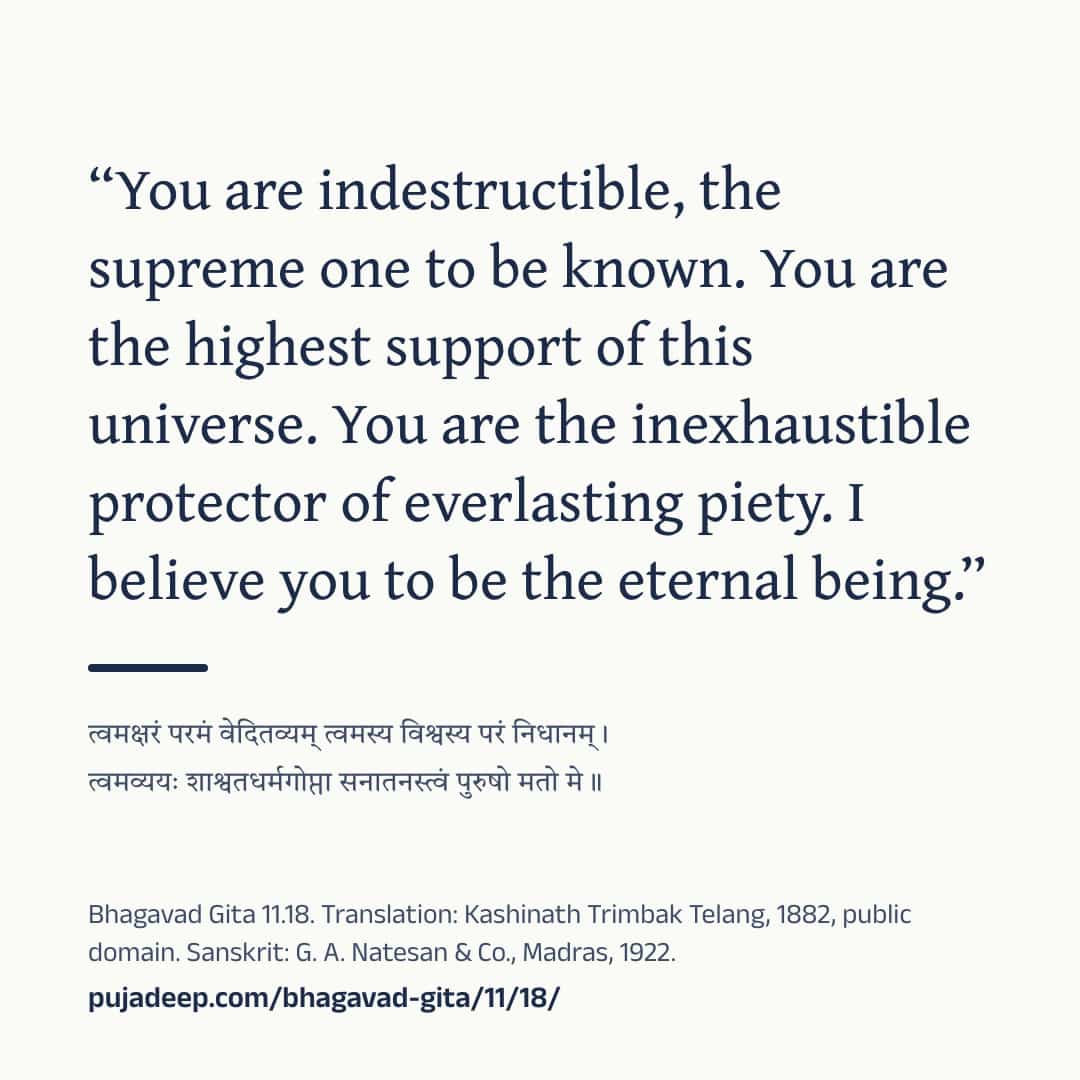
Drawing the picture
See the words
Bhagavad Gita 11.18

त्वमक्षरं परमं वेदितव्यम् त्वमस्य विश्वस्य परं निधानम् ।
त्वमव्ययः शाश्वतधर्मगोप्ता सनातनस्त्वं पुरुषो मतो मे ॥

“You are indestructible, the supreme one to be known. You are the highest support of this universe. You are the inexhaustible protector of everlasting piety. I believe you to be the eternal being.”
(K. T. Telang, The Bhagavadgîtâ (The Sacred Books of the East, vol. VIII, Oxford: Clarendon Press, 1882), p. 94, public domain)

“Lofty beyond all thought, unperishing, Thou treasure-house supreme; all-immanent, Eternal Dharma's changeless Guardian, Thou; As immemorial Man I think of Thee.”
(Annie Besant, The Bhagavad Gîtâ, or The Lord's Song (London: Theosophical Publishing Society, 1895), p. 106, public domain)

“Thou art the Imperishable, the Supreme Being, the one thing to be known. Thou art the great Refuge of this Universe; Thou art the undying Guardian of the Eternal Dharma, Thou art the Ancient Purusha, I ween.”
(Swami Swarupananda, Srimad-Bhagavad-Gita (Mayavati: Prabuddha Bharata Press, 1909; first printed in Prabuddha Bharata, 1907–1909), p. 220, public domain)

Sanskrit: G. A. Natesan & Co., Madras, 1922.
https://pujadeep.com/bhagavad-gita/11/18/ Nothing is sent from this site. Your own app sends it, to the chat you choose. The picture quotes the translation you chose on this page, with its name and year.
Sanskrit text: The Bhagavad-Gita, or The Lord's Song, with the text in Devanagari and an English translation, 1922. Meanings: written for Pujadeep and checked against the cited edition. Source and changes
Questions families ask
Who speaks Bhagavad Gita 11.18?
Arjuna speaks this verse, in chapter 11 (Vishvarupa Darshana Yoga).
Where does the Sanskrit text come from?
Sanskrit text: The Bhagavad-Gita, or The Lord's Song, with the text in Devanagari and an English translation, 1922. Meanings: written for Pujadeep and checked against the cited edition. See the source
Is the meaning on this page a translation?
Explanation written for this site from the sources listed here, and checked against the cited edition. It is not a translation and not the only way to read the text. Free to quote with credit.
Source and licence
- Sanskrit text
- The Bhagavad-Gita, or The Lord's Song, with the text in Devanagari and an English translation (Annie Besant, G. A. Natesan & Co., Madras, 1922). Public domain. The Sanskrit on these pages was read from this printing’s page images.
- Translation
- The Bhagavadgîtâ with the Sanatsugâtîya and the Anugîtâ, translated by Kâshinâth Trimbak Telang (The Sacred Books of the East, vol. VIII, ed. F. Max Müller) (Kashinath Trimbak Telang, F. Max Müller, Clarendon Press, Oxford, 1882). Public domain. Shown verbatim, as printed.
- Translation
- The Bhagavad Gîtâ, or The Lord's Song, translated by Annie Besant (Annie Besant, Theosophical Publishing Society, London, 1895). Public domain. Shown verbatim, as printed.
- Translation
- Srimad-Bhagavad-Gita, with Sanskrit Text; Paraphrase with Word-by-word Literal Translation; English Rendering and Comments, Index, &c., by the Swami Swarupananda (Himalayan Series, No. XX) (Swami Swarupananda, The Editors and Publishers, Advaita Ashrama, Mayavati, Prabuddha Bharata Press, Mayavati, Almora, Himalayas, 1909). Public domain. Shown verbatim, as printed.
- Common wording
- In this text, 32 words follow today's common wording, checked against sanskritdocuments.org; Sanskrit Wikisource; Gita Press, Gorakhpur; GRETIL, Göttingen and Bhaktivedanta Book Trust.
- Our explanation
- Explanation written for this site from the sources listed here, and checked against the cited edition. It is not a translation and not the only way to read the text. Free to quote with credit.
- Checked
- Checked against the cited edition, October 27, 2026.