Bhagavad Gita 11.30: meaning and translation
Chapter 11: Vishvarupa Darshana Yoga. Arjuna says
Arjuna says that Krishna, swallowing the worlds on every side, licks them with his flaming mouths, and that his fierce rays fill the whole universe with light and scorch it.
Click or tap a word for its meaning and its dictionary page.
Text and layers
Text and layers
These choices stay in this browser.
Bhagavad Gita 11.30
लेलिह्यसे ग्रसमानः समन्ताल्लोकान्समग्रान्वदनैर्ज्वलद्भिः ।तेजोभिरापूर्य जगत्समग्रम् भासस्तवोग्राः प्रतपन्ति विष्णो ॥
Lelihyase grasamanah samantallokansamagranvadanairjvaladbhihTejobhirapurya jagatsamagram bhasastavograh pratapanti vishno
lelihyase grasamānaḥ samantāllokānsamagrānvadanairjvaladbhiḥ |tejobhirāpūrya jagatsamagram bhāsastavogrāḥ pratapanti viṣṇo ||
Our explanation Arjuna says that Krishna, swallowing the worlds on every side, licks them with his flaming mouths, and that his fierce rays fill the whole universe with light and scorch it. He calls him Viṣṇu.
हिंदी अर्थ अर्जुन कहते हैं कि कृष्ण अपने जलते मुखों से सब ओर के लोकों को निगलते हुए बार-बार चाट रहे हैं, और उनकी उग्र किरणें पूरे जगत को तेज से भरकर तपा रही हैं। वे उन्हें विष्णु कहकर पुकारते हैं।
Word by word
Every word, with its dictionary page
Word by word
- लेलिह्यसे lelihyase · you lick again and again (intensive, present, 2nd person singular) Dictionary: 1. lih, Monier-Williams 1899, p. 903, col. 1 “to lick frequently or constantly”
- ग्रसमानः grasamānaḥ · swallowing (present participle (masculine), nominative singular) Dictionary: 1. gras, Monier-Williams 1899, p. 371, col. 2 “to seize with the mouth”
- समन्तात् samantāt · from all sides (indeclinable) Dictionary: sam-anta, Monier-Williams 1899, p. 1155, col. 1 “on all sides, around”
- लोकान् lokān · the worlds (noun (masculine), accusative plural) Dictionary: loka, Monier-Williams 1899, p. 906, col. 1 “the wide space or world”
- समग्रान् samagrān · all, entire (adjective (masculine), accusative plural) Dictionary: sam-agra, Monier-Williams 1899, p. 1153, col. 3 “all, entire, whole, complete”
- वदनैः vadanaiḥ · with mouths (noun (neuter), instrumental plural) Dictionary: vadana, Monier-Williams 1899, p. 916, col. 2 “the mouth, face, countenance”
- ज्वलद्भिः jvaladbhiḥ · blazing (present participle (neuter), instrumental plural) Dictionary: jval, Monier-Williams 1899, p. 428, col. 2 “to burn brightly, blaze, glow, shine”
- तेजोभिः tejobhiḥ · with radiance (noun (neuter), instrumental plural) Dictionary: tejas, Monier-Williams 1899, p. 454, col. 2 “glow, glare, splendour, brilliance, light, fire”
- आपूर्य āpūrya · having filled (absolutive (having done)) Dictionary: ā-pṝ, Monier-Williams 1899, p. 143, col. 3 “to fill up, fulfil, fill”
- जगत् jagat · the universe (noun (neuter), accusative singular) Dictionary: jagat, Monier-Williams 1899, p. 408, col. 1 “the world, esp. this world, earth”
- समग्रम् samagram · whole (adjective (neuter), accusative singular) Dictionary: sam-agra, Monier-Williams 1899, p. 1153, col. 3 “all, entire, whole, complete”
- भासः bhāsaḥ · rays, lights (noun (feminine), nominative plural) Dictionary: 2. bhās, Monier-Williams 1899, p. 756, col. 1 “light or ray of light, lustre, brightness”
- तव tava · your (pronoun, genitive singular) Dictionary: yuṣmad, Monier-Williams 1899, p. 855, col. 3 “the base of the 2nd pers. pron. as used in comp.”
- उग्राः ugrāḥ · fierce (adjective (feminine), nominative plural) Dictionary: ugra, Monier-Williams 1899, p. 172, col. 2 “powerful, violent, mighty, impetuous, strong”
- प्रतपन्ति pratapanti · scorch, burn (present, 3rd person plural) Dictionary: pra-tap, Monier-Williams 1899, p. 661, col. 1 “to give forth heat, burn, glow, shine (lit. and fig.)”
- विष्णो viṣṇo · O Vishnu (noun (masculine), vocative singular) Dictionary: viṣṇu, Monier-Williams 1899, p. 999, col. 1 “(prob. fr. √vish, 'All-pervader' or 'Worker') N. of one of the principal Hindū deities”
1 printing differs
Edition differences. Another printing or text reads this place differently.
- Spelling A digital text reads Same words. At the printed line end the 1922 edition writes समग्रम्; the e-text writes समग्रं.
Old translations
Kashinath Trimbak Telang, 1882. Public domain. Page 95.
Swallowing all these people, you are licking them over and over again from all sides, with your blazing mouths. Your fierce splendours, O Vishnu! filling the whole universe with (their) effulgence, are heating it.
Compare 3 translations
Kashinath Trimbak Telang, 1882. Public domain. Page 95.
Swallowing all these people, you are licking them over and over again from all sides, with your blazing mouths. Your fierce splendours, O Vishnu! filling the whole universe with (their) effulgence, are heating it.
You are reading this one
Annie Besant, 1895. Public domain. Page 110.
On every side, all-swallowing, fiery-tongued,
Thou lickest up mankind, devouring all;
Thy glory filleth space: the universe
Is burning, Vishnu, with Thy blazing rays.
You are reading this one
Swami Swarupananda, 1909 (first printed 1907). Public domain. Page 226.
Swallowing all the worlds on every side with Thy flaming mouths Thou art licking Thy lips. Thy fierce rays filling the whole world with radiance, are burning, O Vishnu!
You are reading this one
Cite this verse
The translation: K. T. Telang, The Bhagavadgîtâ (The Sacred Books of the East, vol. VIII, Oxford: Clarendon Press, 1882), p. 95. Bhagavad Gita 11.30.
The translation: Annie Besant, The Bhagavad Gîtâ, or The Lord's Song (London: Theosophical Publishing Society, 1895), p. 110. Bhagavad Gita 11.30.
The translation: Swami Swarupananda, Srimad-Bhagavad-Gita (Mayavati: Prabuddha Bharata Press, 1909; first printed in Prabuddha Bharata, 1907–1909), p. 226. Bhagavad Gita 11.30.
Our explanation: “Bhagavad Gita 11.30: meaning and translation.” Pujadeep. Updated October 27, 2026. https://pujadeep.com/bhagavad-gita/11/30/
Pujadeep’s explanations are free to quote with credit: name Pujadeep and link to the page. How to credit
Classical readings, by school
No readings by school on this verse yet.
Share
Show the ways to share
Send one picture or the text to one chat. The picture names its source and the address of this page.
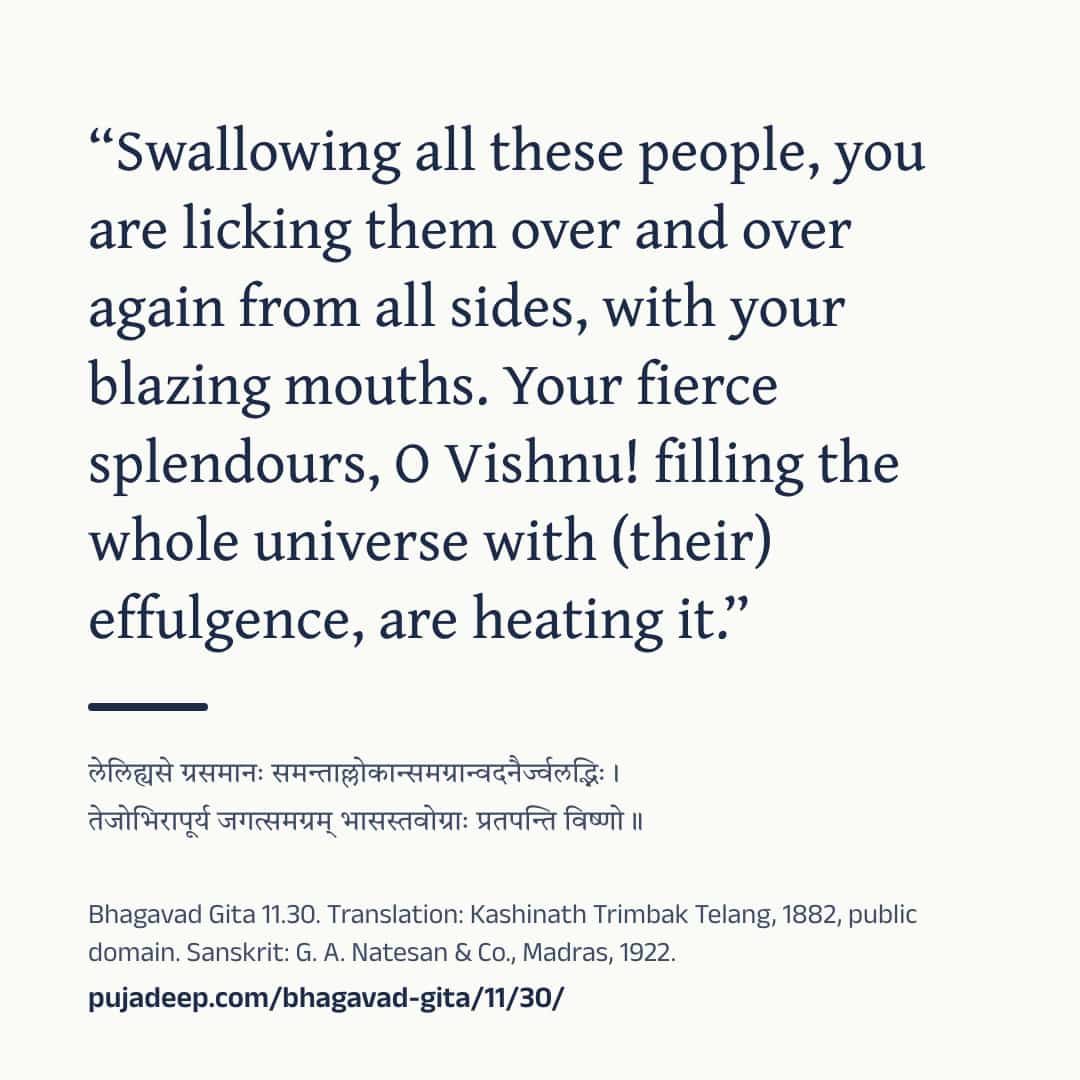
Drawing the picture
See the words
Bhagavad Gita 11.30

लेलिह्यसे ग्रसमानः समन्ताल्लोकान्समग्रान्वदनैर्ज्वलद्भिः ।
तेजोभिरापूर्य जगत्समग्रम् भासस्तवोग्राः प्रतपन्ति विष्णो ॥

“Swallowing all these people, you are licking them over and over again from all sides, with your blazing mouths. Your fierce splendours, O Vishnu! filling the whole universe with (their) effulgence, are heating it.”
(K. T. Telang, The Bhagavadgîtâ (The Sacred Books of the East, vol. VIII, Oxford: Clarendon Press, 1882), p. 95, public domain)

“On every side, all-swallowing, fiery-tongued, Thou lickest up mankind, devouring all; Thy glory filleth space: the universe Is burning, Vishnu, with Thy blazing rays.”
(Annie Besant, The Bhagavad Gîtâ, or The Lord's Song (London: Theosophical Publishing Society, 1895), p. 110, public domain)

“Swallowing all the worlds on every side with Thy flaming mouths Thou art licking Thy lips. Thy fierce rays filling the whole world with radiance, are burning, O Vishnu!”
(Swami Swarupananda, Srimad-Bhagavad-Gita (Mayavati: Prabuddha Bharata Press, 1909; first printed in Prabuddha Bharata, 1907–1909), p. 226, public domain)

Sanskrit: G. A. Natesan & Co., Madras, 1922.
https://pujadeep.com/bhagavad-gita/11/30/ Nothing is sent from this site. Your own app sends it, to the chat you choose. The picture quotes the translation you chose on this page, with its name and year.
Sanskrit text: The Bhagavad-Gita, or The Lord's Song, with the text in Devanagari and an English translation, 1922. Meanings: written for Pujadeep and checked against the cited edition. Source and changes
Questions families ask
Who speaks Bhagavad Gita 11.30?
Arjuna speaks this verse, in chapter 11 (Vishvarupa Darshana Yoga).
Where does the Sanskrit text come from?
Sanskrit text: The Bhagavad-Gita, or The Lord's Song, with the text in Devanagari and an English translation, 1922. Meanings: written for Pujadeep and checked against the cited edition. See the source
Is the meaning on this page a translation?
Explanation written for this site from the sources listed here, and checked against the cited edition. It is not a translation and not the only way to read the text. Free to quote with credit.
Source and licence
- Sanskrit text
- The Bhagavad-Gita, or The Lord's Song, with the text in Devanagari and an English translation (Annie Besant, G. A. Natesan & Co., Madras, 1922). Public domain. The Sanskrit on these pages was read from this printing’s page images.
- Translation
- The Bhagavadgîtâ with the Sanatsugâtîya and the Anugîtâ, translated by Kâshinâth Trimbak Telang (The Sacred Books of the East, vol. VIII, ed. F. Max Müller) (Kashinath Trimbak Telang, F. Max Müller, Clarendon Press, Oxford, 1882). Public domain. Shown verbatim, as printed.
- Translation
- The Bhagavad Gîtâ, or The Lord's Song, translated by Annie Besant (Annie Besant, Theosophical Publishing Society, London, 1895). Public domain. Shown verbatim, as printed.
- Translation
- Srimad-Bhagavad-Gita, with Sanskrit Text; Paraphrase with Word-by-word Literal Translation; English Rendering and Comments, Index, &c., by the Swami Swarupananda (Himalayan Series, No. XX) (Swami Swarupananda, The Editors and Publishers, Advaita Ashrama, Mayavati, Prabuddha Bharata Press, Mayavati, Almora, Himalayas, 1909). Public domain. Shown verbatim, as printed.
- Common wording
- In this text, 32 words follow today's common wording, checked against sanskritdocuments.org; Sanskrit Wikisource; Gita Press, Gorakhpur; GRETIL, Göttingen and Bhaktivedanta Book Trust.
- Our explanation
- Explanation written for this site from the sources listed here, and checked against the cited edition. It is not a translation and not the only way to read the text. Free to quote with credit.
- Checked
- Checked against the cited edition, October 27, 2026.