Bhagavad Gita 11.43: meaning and translation
Chapter 11: Vishvarupa Darshana Yoga. Arjuna says
Arjuna says Krishna is the father of the world, of all that moves and all that stands still; he is its object of worship and its greatest teacher (guru).
Click or tap a word for its meaning and its dictionary page.
Text and layers
Text and layers
These choices stay in this browser.
Bhagavad Gita 11.43
पिताऽसि लोकस्य चराचरस्य त्वमस्य पूज्यश्च गुरुर्गरीयान् ।न त्वत्समोऽस्त्यभ्यधिकः कुतोऽन्यो लोकत्रयेऽप्यप्रतिमप्रभाव ॥
Pitasi lokasya characharasya tvamasya pujyashcha gururgariyanNa tvatsamostyabhyadhikah kutonyo lokatrayepyapratimaprabhava
pitā’si lokasya carācarasya tvamasya pūjyaśca gururgarīyān |na tvatsamo’styabhyadhikaḥ kuto’nyo lokatraye’pyapratimaprabhāva ||
Our explanation Arjuna says Krishna is the father of the world, of all that moves and all that stands still; he is its object of worship and its greatest teacher (guru). There is no one equal to him in the three worlds; how could there be anyone greater? The verse ends with a form of address, 'O you whose power is unequalled', as today's texts read it and as Telang translates it; the 1922 printing has the statement 'his power is unequalled' (see the variants). The sense is the same.
हिंदी अर्थ अर्जुन कहते हैं कि कृष्ण इस चर-अचर जगत के पिता हैं; वे इसके पूज्य हैं और सबसे बड़े गुरु हैं। तीनों लोकों में उनके समान कोई नहीं; उनसे बड़ा कोई कैसे हो सकता है? श्लोक संबोधन से समाप्त होता है, “हे अनुपम प्रभाव वाले”, जैसा आज के पाठ पढ़ते हैं और तेलंग अनुवाद करते हैं; 1922 की छपाई में “अप्रतिमप्रभावः” (उनका प्रभाव अनुपम है) है (पाठभेद देखें)। अर्थ एक ही है।
Word by word
Every word, with its dictionary page
Word by word
- पिता pitā · father (noun (masculine), nominative singular) Dictionary: pitṛ, Monier-Williams 1899, p. 626, col. 2 “a father”
- असि asi · are (present, 2nd person singular) Dictionary: 1. as, Monier-Williams 1899, p. 117, col. 2 “to be, live, exist, be present”
- लोकस्य lokasya · of the world (noun (masculine), genitive singular) Dictionary: loka, Monier-Williams 1899, p. 906, col. 1 “the wide space or world”
- चराचरस्य carācarasya · moving and unmoving (compound (masculine), genitive singular) Dictionary: 1. carācara, Monier-Williams 1899, p. 389, col. 2 “movable and immovable, locomotive and stationary”
- त्वम् tvam · you (pronoun, nominative singular) Dictionary: yuṣmad, Monier-Williams 1899, p. 855, col. 3 “the base of the 2nd pers. pron. as used in comp.”
- अस्य asya · of this (pronoun (masculine), genitive singular) Dictionary: 1. idam, Monier-Williams 1899, p. 165, col. 2 “this, this here”
- पूज्यः pūjyaḥ · worthy of worship (gerundive (to be done) (masculine), nominative singular) Dictionary: pūjya, Monier-Williams 1899, p. 641, col. 2
- च ca · and (indeclinable) Dictionary: 2. ca, Monier-Williams 1899, p. 380, col. 1 “and, both, also, moreover, as well as”
- गुरुः guruḥ · teacher (noun (masculine), nominative singular) Dictionary: guru, Monier-Williams 1899, p. 359, col. 2 “a spiritual parent or preceptor”
- गरीयान् garīyān · greater, most honoured (adjective (masculine), nominative singular) Dictionary: garīyas, Monier-Williams 1899, p. 348, col. 3 “greater than (abl.)”
- न na · not (indeclinable) Dictionary: 2. na, Monier-Williams 1899, p. 523, col. 1 “not, no, nor, neither”
- त्वत्समः tvatsamaḥ · equal to you (compound (masculine), nominative singular) Dictionary: yuṣmad, Monier-Williams 1899, p. 855, col. 3 “the base of the 2nd pers. pron. as used in comp.”; sama, Monier-Williams 1899, p. 1152, col. 1 “same, equal, similar ...; always the same, constant, unchanged, fair, impartial towards”
- अस्ति asti · is (present, 3rd person singular) Dictionary: 1. as, Monier-Williams 1899, p. 117, col. 2 “to be, live, exist, be present”
- अभ्यधिकः abhyadhikaḥ · greater (adjective (masculine), nominative singular) Dictionary: abhy-adhika, Monier-Williams 1899, p. 75, col. 3 “superior to, more excellent than”
- कुतः kutaḥ · how then (indeclinable) Dictionary: kutas, Monier-Williams 1899, p. 290, col. 2 “from where? whence?”
- अन्यः anyaḥ · another (pronoun (masculine), nominative singular) Dictionary: 2. anya, Monier-Williams 1899, p. 45, col. 2 “other, different”
- लोकत्रये lokatraye · in the three worlds (compound (neuter), locative singular) Dictionary: loka-traya, Monier-Williams 1899, p. 906, col. 2 “'world-triad,' the three w°s (heaven, earth and atmosphere, or h°, earth and lower regions)”
- अपि api · even (indeclinable) Dictionary: api, Monier-Williams 1899, p. 55, col. 1 “even, also, very”
- अप्रतिमप्रभाव apratimaprabhāva · O you of matchless power (compound (masculine), vocative singular) Dictionary: a-pratima, Monier-Williams 1899, p. 57, col. 3 “unequalled, incomparable, without a match”; pra-bhāva, Monier-Williams 1899, p. 684, col. 2 “might, power, majesty, dignity, strength, efficacy”
3 printings differ
Edition differences. Another printing or text reads this place differently.
- The printed edition reads: पिताऽसि लोकस्य चराचरस्य त्वमस्य पूज्यश्च गुरुर्गरीयान् ।
न त्वत्समोऽस्त्यभ्यधिकः कुतोऽन्यो लोकत्रयेऽप्यप्रतिमप्रभावः ॥ - Word The 1922 Madras printing reads: न त्वत्समोऽस्त्यभ्यधिकः कुतोऽन्यो लोकत्रयेऽप्यप्रतिमप्रभावः The 1922 base printing (leaf n180, confirmed on a 3× crop) reads the nominative अप्रतिमप्रभावः ('[you,] whose power is unequalled'). Under decision 14 the display follows the vocative अप्रतिमप्रभाव, printed by Gita Press (p. 137) and read in sanskritdocuments.org, GRETIL and Sanskrit Wikisource.
- Spelling A digital text reads The e-text writes पितासि where the 1922 edition marks the merged vowel (पिताऽसि).
Old translations
Kashinath Trimbak Telang, 1882. Public domain. Page 97.
You are the father of the world—movable and immovable—you its great and venerable master; there is none equal to you, whence can there be one greater, O you whose power is unparalleled in all the three worlds?
Compare 3 translations
Kashinath Trimbak Telang, 1882. Public domain. Page 97.
You are the father of the world—movable and immovable—you its great and venerable master; there is none equal to you, whence can there be one greater, O you whose power is unparalleled in all the three worlds?
You are reading this one
Annie Besant, 1895. Public domain. Page 113–114.
Father of worlds, of all that moves and stands,
Worthier of reverence than the Guru's self,
There is none like to Thee. Who passeth Thee?
Pre-eminent Thy power in all the worlds.
You are reading this one
Swami Swarupananda, 1909 (first printed 1907). Public domain. Page 235.
Thou art the Father of the world, moving and unmoving; the object of its worship; greater than the great. None there exists who is equal to Thee in the three worlds: who then can excel Thee, O Thou of power incomparable?
You are reading this one
Cite this verse
The translation: K. T. Telang, The Bhagavadgîtâ (The Sacred Books of the East, vol. VIII, Oxford: Clarendon Press, 1882), p. 97. Bhagavad Gita 11.43.
The translation: Annie Besant, The Bhagavad Gîtâ, or The Lord's Song (London: Theosophical Publishing Society, 1895), pp. 113–114. Bhagavad Gita 11.43.
The translation: Swami Swarupananda, Srimad-Bhagavad-Gita (Mayavati: Prabuddha Bharata Press, 1909; first printed in Prabuddha Bharata, 1907–1909), p. 235. Bhagavad Gita 11.43.
Our explanation: “Bhagavad Gita 11.43: meaning and translation.” Pujadeep. Updated October 27, 2026. https://pujadeep.com/bhagavad-gita/11/43/
Pujadeep’s explanations are free to quote with credit: name Pujadeep and link to the page. How to credit
Classical readings, by school
No readings by school on this verse yet.
Share
Show the ways to share
Send one picture or the text to one chat. The picture names its source and the address of this page.
Drawing the picture
See the words
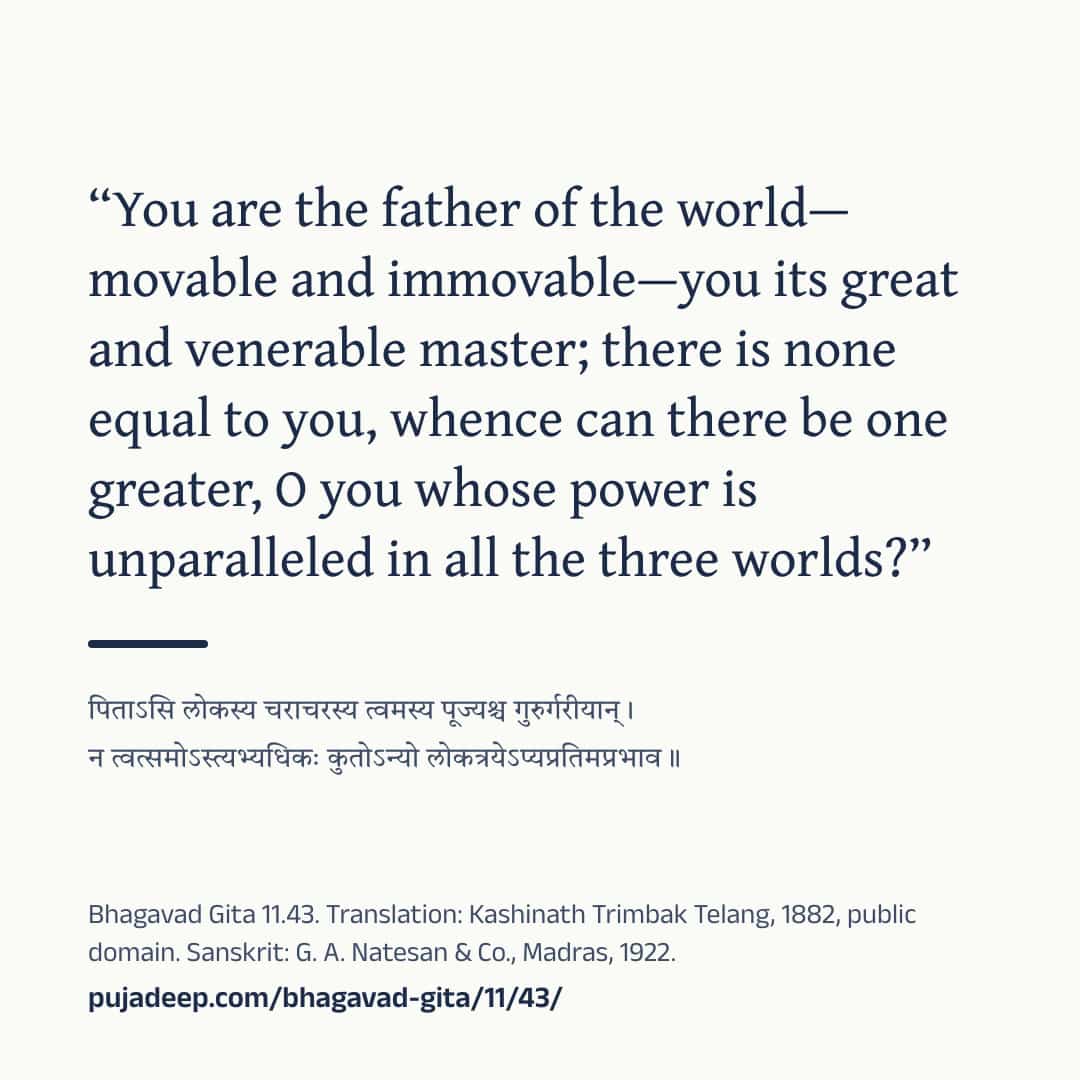
Bhagavad Gita 11.43

पिताऽसि लोकस्य चराचरस्य त्वमस्य पूज्यश्च गुरुर्गरीयान् ।
न त्वत्समोऽस्त्यभ्यधिकः कुतोऽन्यो लोकत्रयेऽप्यप्रतिमप्रभाव ॥

“You are the father of the world—movable and immovable—you its great and venerable master; there is none equal to you, whence can there be one greater, O you whose power is unparalleled in all the three worlds?”
(K. T. Telang, The Bhagavadgîtâ (The Sacred Books of the East, vol. VIII, Oxford: Clarendon Press, 1882), p. 97, public domain)

“Father of worlds, of all that moves and stands, Worthier of reverence than the Guru's self, There is none like to Thee. Who passeth Thee? Pre-eminent Thy power in all the worlds.”
(Annie Besant, The Bhagavad Gîtâ, or The Lord's Song (London: Theosophical Publishing Society, 1895), pp. 113–114, public domain)

“Thou art the Father of the world, moving and unmoving; the object of its worship; greater than the great. None there exists who is equal to Thee in the three worlds: who then can excel Thee, O Thou of power incomparable?”
(Swami Swarupananda, Srimad-Bhagavad-Gita (Mayavati: Prabuddha Bharata Press, 1909; first printed in Prabuddha Bharata, 1907–1909), p. 235, public domain)

Sanskrit: G. A. Natesan & Co., Madras, 1922.
https://pujadeep.com/bhagavad-gita/11/43/ Nothing is sent from this site. Your own app sends it, to the chat you choose. The picture quotes the translation you chose on this page, with its name and year.
Sanskrit text: The Bhagavad-Gita, or The Lord's Song, with the text in Devanagari and an English translation, 1922. Meanings: written for Pujadeep and checked against the cited edition. Source and changes
Questions families ask
Who speaks Bhagavad Gita 11.43?
Arjuna speaks this verse, in chapter 11 (Vishvarupa Darshana Yoga).
Where does the Sanskrit text come from?
Sanskrit text: The Bhagavad-Gita, or The Lord's Song, with the text in Devanagari and an English translation, 1922. Meanings: written for Pujadeep and checked against the cited edition. See the source
Is the meaning on this page a translation?
Explanation written for this site from the sources listed here, and checked against the cited edition. It is not a translation and not the only way to read the text. Free to quote with credit.
Source and licence
- Sanskrit text
- The Bhagavad-Gita, or The Lord's Song, with the text in Devanagari and an English translation (Annie Besant, G. A. Natesan & Co., Madras, 1922). Public domain. The Sanskrit on these pages was read from this printing’s page images.
- Translation
- The Bhagavadgîtâ with the Sanatsugâtîya and the Anugîtâ, translated by Kâshinâth Trimbak Telang (The Sacred Books of the East, vol. VIII, ed. F. Max Müller) (Kashinath Trimbak Telang, F. Max Müller, Clarendon Press, Oxford, 1882). Public domain. Shown verbatim, as printed.
- Translation
- The Bhagavad Gîtâ, or The Lord's Song, translated by Annie Besant (Annie Besant, Theosophical Publishing Society, London, 1895). Public domain. Shown verbatim, as printed.
- Translation
- Srimad-Bhagavad-Gita, with Sanskrit Text; Paraphrase with Word-by-word Literal Translation; English Rendering and Comments, Index, &c., by the Swami Swarupananda (Himalayan Series, No. XX) (Swami Swarupananda, The Editors and Publishers, Advaita Ashrama, Mayavati, Prabuddha Bharata Press, Mayavati, Almora, Himalayas, 1909). Public domain. Shown verbatim, as printed.
- Common wording
- In this text, 32 words follow today's common wording, checked against sanskritdocuments.org; Sanskrit Wikisource; Gita Press, Gorakhpur; GRETIL, Göttingen and Bhaktivedanta Book Trust.
- Our explanation
- Explanation written for this site from the sources listed here, and checked against the cited edition. It is not a translation and not the only way to read the text. Free to quote with credit.
- Checked
- Checked against the cited edition, October 27, 2026.