Bhagavad Gita 11.49: meaning and translation
Chapter 11: Vishvarupa Darshana Yoga. Krishna says
Krishna tells Arjuna not to be troubled or bewildered at seeing this fearsome (ghora) form of his.
Click or tap a word for its meaning and its dictionary page.
Text and layers
Text and layers
These choices stay in this browser.
Bhagavad Gita 11.49
मा ते व्यथा मा च विमूढभावो दृष्ट्वा रूपं घोरमीदृङ्ममेदम् ।व्यपेतभीः प्रीतमनाः पुनस्त्वम् तदेव मे रूपमिदं प्रपश्य ॥
Ma te vyatha ma cha vimudhabhavo drishtva rupam ghoramidrinmamedamVyapetabhih pritamanah punastvam tadeva me rupamidam prapashya
mā te vyathā mā ca vimūḍhabhāvo dṛṣṭvā rūpaṃ ghoramīdṛṅmamedam |vyapetabhīḥ prītamanāḥ punastvam tadeva me rūpamidaṃ prapaśya ||
Our explanation Krishna tells Arjuna not to be troubled or bewildered at seeing this fearsome (ghora) form of his. Free from fear and glad at heart, he says, Arjuna should see again his former form.
हिंदी अर्थ कृष्ण अर्जुन से कहते हैं कि कृष्ण का यह घोर रूप देखकर अर्जुन व्यथित या भ्रमित न हों। वे कहते हैं कि अर्जुन भय छोड़कर, प्रसन्न मन से, फिर से कृष्ण का पहले वाला रूप देखें।
Word by word
Every word, with its dictionary page
Word by word
- मा mā · let there not be (indeclinable) Dictionary: 1. mā, Monier-Williams 1899, p. 804, col. 1 “a particle of prohibition or negation”
- ते te · your (pronoun, genitive singular) Dictionary: yuṣmad, Monier-Williams 1899, p. 855, col. 3 “the base of the 2nd pers. pron. as used in comp.”
- व्यथा vyathā · distress (noun (feminine), nominative singular) Dictionary: vyathā, Monier-Williams 1899, p. 1031, col. 1 “agitation, perturbation, alarm, uneasiness, pain, anguish, fear”
- मा mā · not (indeclinable) Dictionary: 1. mā, Monier-Williams 1899, p. 804, col. 1 “a particle of prohibition or negation”
- च ca · and (indeclinable) Dictionary: 2. ca, Monier-Williams 1899, p. 380, col. 1 “and, both, also, moreover, as well as”
- विमूढभावः vimūḍhabhāvaḥ · bewilderment (compound (masculine), nominative singular) Dictionary: vi-mūḍha-bhāva, Monier-Williams 1899, p. 980, col. 3 “bewildered state, confusion”
- दृष्ट्वा dṛṣṭvā · having seen (absolutive (having done)) Dictionary: 1. dṛś, Monier-Williams 1899, p. 491, col. 2 “to see, behold, look at, regard, consider”
- रूपम् rūpam · form (noun (neuter), accusative singular) Dictionary: rūpa, Monier-Williams 1899, p. 885, col. 3 “form, shape, figure”
- घोरम् ghoram · terrible (adjective (neuter), accusative singular) Dictionary: ghora, Monier-Williams 1899, p. 379, col. 2 “terrific, frightful, terrible, dreadful”
- ईदृक् īdṛk · such (adjective (neuter), accusative singular) Dictionary: īdṛś, Monier-Williams 1899, p. 170, col. 2 “endowed with such qualities, such”
- मम mama · "my" (Krishna's) (pronoun, genitive singular) Dictionary: 1. mad, Monier-Williams 1899, p. 777, col. 2 “base of the first pers. pron. in the sg. number (esp. in comp.)”
- इदम् idam · this (pronoun (neuter), accusative singular) Dictionary: 1. idam, Monier-Williams 1899, p. 165, col. 2 “this, this here”
- व्यपेतभीः vyapetabhīḥ · free from fear (compound (masculine), nominative singular) Dictionary: vy-apeta-bhī, Monier-Williams 1899, p. 1032, col. 1 “free from fear”
- प्रीतमनाः prītamanāḥ · glad at heart (compound (masculine), nominative singular) Dictionary: prīta-manas, Monier-Williams 1899, p. 711, col. 1 “pleased or gratified in mind”
- पुनः punaḥ · again (indeclinable) Dictionary: punar, Monier-Williams 1899, p. 633, col. 2 “again, once more”
- त्वम् tvam · you (pronoun, nominative singular) Dictionary: yuṣmad, Monier-Williams 1899, p. 855, col. 3 “the base of the 2nd pers. pron. as used in comp.”
- तत् tat · that (pronoun (neuter), accusative singular) Dictionary: tad, Monier-Williams 1899, p. 434, col. 1 “m. he, f. she, n. it, that, this”
- एव eva · same (indeclinable) Dictionary: 1. eva, Monier-Williams 1899, p. 232, col. 2 “just, exactly, very, same, only, even, alone, merely”
- मे me · "my" (Krishna's) (pronoun, genitive singular) Dictionary: 1. mad, Monier-Williams 1899, p. 777, col. 2 “base of the first pers. pron. in the sg. number (esp. in comp.)”
- रूपम् rūpam · form (noun (neuter), accusative singular) Dictionary: rūpa, Monier-Williams 1899, p. 885, col. 3 “form, shape, figure”
- इदम् idam · this (pronoun (neuter), accusative singular) Dictionary: 1. idam, Monier-Williams 1899, p. 165, col. 2 “this, this here”
- प्रपश्य prapaśya · behold (imperative, 2nd person singular) Dictionary: pra-paś, Monier-Williams 1899, p. 682, col. 2 “look at, observe, behold”
1 printing differs
Edition differences. Another printing or text reads this place differently.
- Spelling A digital text reads Same words. At the printed line end the 1922 edition writes पुनस्त्वम्; the e-text writes पुनस्त्वं.
Old translations
Kashinath Trimbak Telang, 1882. Public domain. Page 98.
Be not alarmed, be not perplexed, at seeing this form of mine, fearful like this. Free from fear and with delighted heart, see now again that same form of mine.
Compare 3 translations
Kashinath Trimbak Telang, 1882. Public domain. Page 98.
Be not alarmed, be not perplexed, at seeing this form of mine, fearful like this. Free from fear and with delighted heart, see now again that same form of mine.
You are reading this one
Annie Besant, 1895. Public domain. Page 115.
Be not bewildered, be thou not afraid,
Because thou hast beheld this awful Form;
Cast fear away, and let thy heart rejoice;
Behold again mine own familiar Shape.
You are reading this one
Swami Swarupananda, 1909 (first printed 1907). Public domain. Page 238.
Be not afraid nor bewildered, having beheld this Form of Mine, so terrific. With thy fears dispelled and with gladdened heart, now see again this (former) Form of Mine.
You are reading this one
Cite this verse
The translation: K. T. Telang, The Bhagavadgîtâ (The Sacred Books of the East, vol. VIII, Oxford: Clarendon Press, 1882), p. 98. Bhagavad Gita 11.49.
The translation: Annie Besant, The Bhagavad Gîtâ, or The Lord's Song (London: Theosophical Publishing Society, 1895), p. 115. Bhagavad Gita 11.49.
The translation: Swami Swarupananda, Srimad-Bhagavad-Gita (Mayavati: Prabuddha Bharata Press, 1909; first printed in Prabuddha Bharata, 1907–1909), p. 238. Bhagavad Gita 11.49.
Our explanation: “Bhagavad Gita 11.49: meaning and translation.” Pujadeep. Updated October 27, 2026. https://pujadeep.com/bhagavad-gita/11/49/
Pujadeep’s explanations are free to quote with credit: name Pujadeep and link to the page. How to credit
Classical readings, by school
No readings by school on this verse yet.
Share
Show the ways to share
Send one picture or the text to one chat. The picture names its source and the address of this page.
Drawing the picture
See the words
Bhagavad Gita 11.49

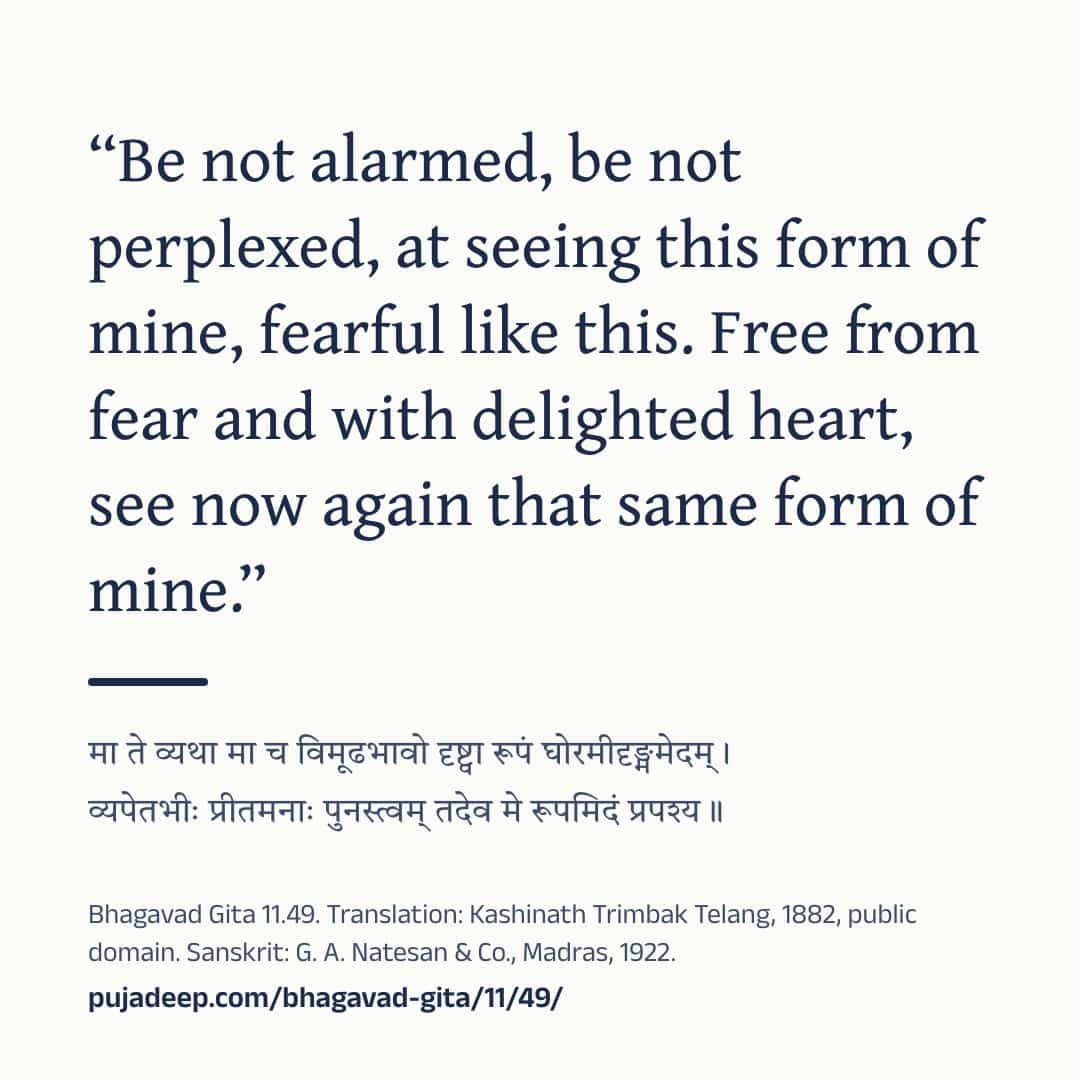
मा ते व्यथा मा च विमूढभावो दृष्ट्वा रूपं घोरमीदृङ्ममेदम् ।
व्यपेतभीः प्रीतमनाः पुनस्त्वम् तदेव मे रूपमिदं प्रपश्य ॥

“Be not alarmed, be not perplexed, at seeing this form of mine, fearful like this. Free from fear and with delighted heart, see now again that same form of mine.”
(K. T. Telang, The Bhagavadgîtâ (The Sacred Books of the East, vol. VIII, Oxford: Clarendon Press, 1882), p. 98, public domain)

“Be not bewildered, be thou not afraid, Because thou hast beheld this awful Form; Cast fear away, and let thy heart rejoice; Behold again mine own familiar Shape.”
(Annie Besant, The Bhagavad Gîtâ, or The Lord's Song (London: Theosophical Publishing Society, 1895), p. 115, public domain)

“Be not afraid nor bewildered, having beheld this Form of Mine, so terrific. With thy fears dispelled and with gladdened heart, now see again this (former) Form of Mine.”
(Swami Swarupananda, Srimad-Bhagavad-Gita (Mayavati: Prabuddha Bharata Press, 1909; first printed in Prabuddha Bharata, 1907–1909), p. 238, public domain)

Sanskrit: G. A. Natesan & Co., Madras, 1922.
https://pujadeep.com/bhagavad-gita/11/49/ Nothing is sent from this site. Your own app sends it, to the chat you choose. The picture quotes the translation you chose on this page, with its name and year.
Sanskrit text: The Bhagavad-Gita, or The Lord's Song, with the text in Devanagari and an English translation, 1922. Meanings: written for Pujadeep and checked against the cited edition. Source and changes
Questions families ask
Who speaks Bhagavad Gita 11.49?
Krishna speaks this verse, in chapter 11 (Vishvarupa Darshana Yoga).
Where does the Sanskrit text come from?
Sanskrit text: The Bhagavad-Gita, or The Lord's Song, with the text in Devanagari and an English translation, 1922. Meanings: written for Pujadeep and checked against the cited edition. See the source
Is the meaning on this page a translation?
Explanation written for this site from the sources listed here, and checked against the cited edition. It is not a translation and not the only way to read the text. Free to quote with credit.
Source and licence
- Sanskrit text
- The Bhagavad-Gita, or The Lord's Song, with the text in Devanagari and an English translation (Annie Besant, G. A. Natesan & Co., Madras, 1922). Public domain. The Sanskrit on these pages was read from this printing’s page images.
- Translation
- The Bhagavadgîtâ with the Sanatsugâtîya and the Anugîtâ, translated by Kâshinâth Trimbak Telang (The Sacred Books of the East, vol. VIII, ed. F. Max Müller) (Kashinath Trimbak Telang, F. Max Müller, Clarendon Press, Oxford, 1882). Public domain. Shown verbatim, as printed.
- Translation
- The Bhagavad Gîtâ, or The Lord's Song, translated by Annie Besant (Annie Besant, Theosophical Publishing Society, London, 1895). Public domain. Shown verbatim, as printed.
- Translation
- Srimad-Bhagavad-Gita, with Sanskrit Text; Paraphrase with Word-by-word Literal Translation; English Rendering and Comments, Index, &c., by the Swami Swarupananda (Himalayan Series, No. XX) (Swami Swarupananda, The Editors and Publishers, Advaita Ashrama, Mayavati, Prabuddha Bharata Press, Mayavati, Almora, Himalayas, 1909). Public domain. Shown verbatim, as printed.
- Common wording
- In this text, 32 words follow today's common wording, checked against sanskritdocuments.org; Sanskrit Wikisource; Gita Press, Gorakhpur; GRETIL, Göttingen and Bhaktivedanta Book Trust.
- Our explanation
- Explanation written for this site from the sources listed here, and checked against the cited edition. It is not a translation and not the only way to read the text. Free to quote with credit.
- Checked
- Checked against the cited edition, October 27, 2026.