Bhagavad Gita 11.51: meaning and translation
Chapter 11: Vishvarupa Darshana Yoga. Arjuna says
Arjuna speaks.
Click or tap a word for its meaning and its dictionary page.
Text and layers
Text and layers
These choices stay in this browser.
Bhagavad Gita 11.51
अर्जुन उवाच ।
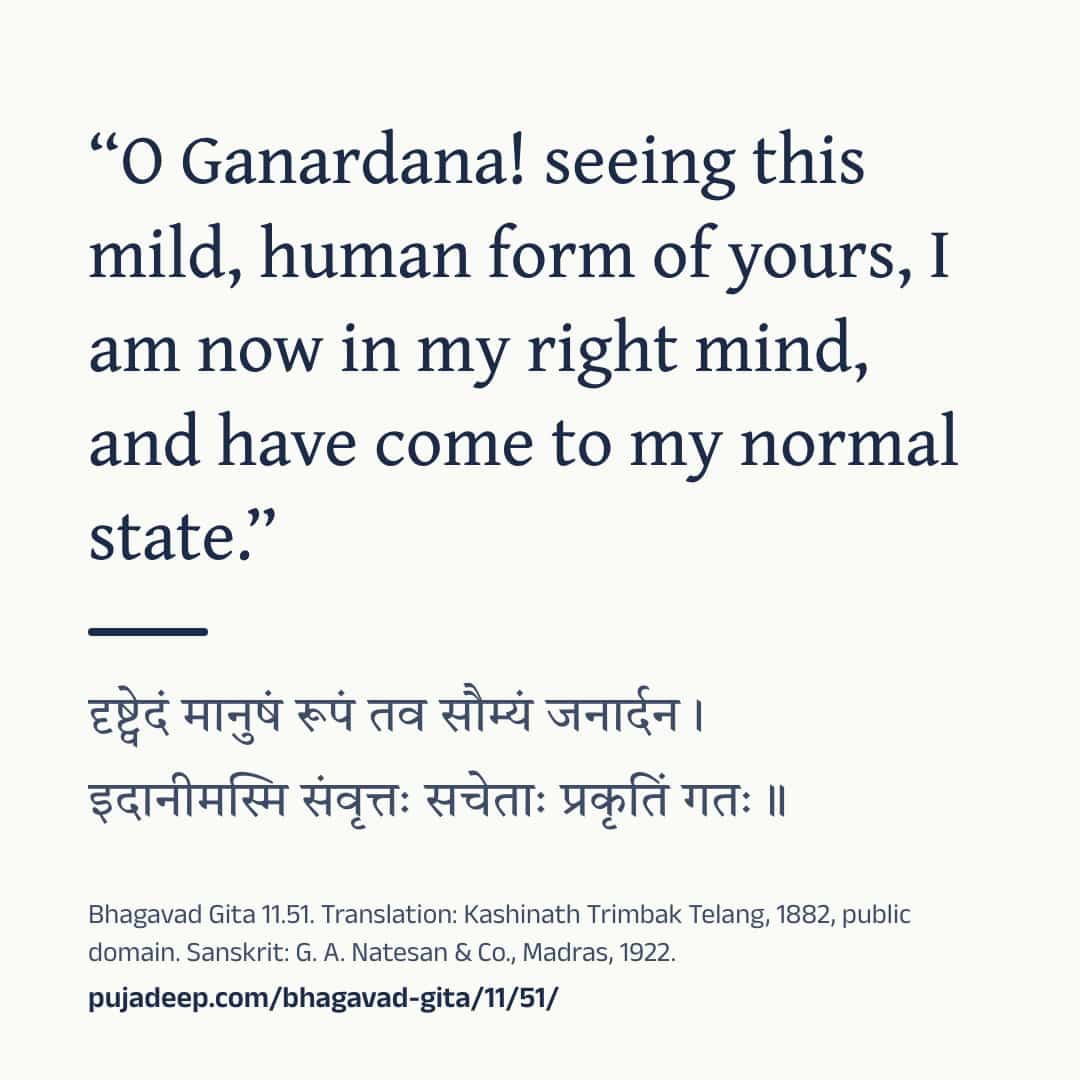
दृष्ट्वेदं मानुषं रूपं तव सौम्यं जनार्दन ।इदानीमस्मि संवृत्तः सचेताः प्रकृतिं गतः ॥
Drishtvedam manusham rupam tava saumyam janardanaIdanimasmi sanvrittah sachetah prakritim gatah
dṛṣṭvedaṃ mānuṣaṃ rūpaṃ tava saumyaṃ janārdana |idānīmasmi saṃvṛttaḥ sacetāḥ prakṛtiṃ gataḥ ||
Our explanation Arjuna speaks. Seeing this gentle human form of Krishna, Janārdana, he says, he is himself again: his mind is calm and he has come back to his normal state.
हिंदी अर्थ अर्जुन बोलते हैं। वे कहते हैं कि हे जनार्दन, कृष्ण का यह सौम्य मानव रूप देखकर वे फिर अपने में आ गए हैं: उनका मन शांत है और वे अपनी सामान्य अवस्था में लौट आए हैं।
Word by word
Every word, with its dictionary page
Word by word
- दृष्ट्वा dṛṣṭvā · having seen (absolutive (having done)) Dictionary: 1. dṛś, Monier-Williams 1899, p. 491, col. 2 “to see, behold, look at, regard, consider”
- इदम् idam · this (pronoun (neuter), accusative singular) Dictionary: 1. idam, Monier-Williams 1899, p. 165, col. 2 “this, this here”
- मानुषम् mānuṣam · human (adjective (neuter), accusative singular) Dictionary: mānuṣa, Monier-Williams 1899, p. 810, col. 2 “belonging to mankind, human”
- रूपम् rūpam · form (noun (neuter), accusative singular) Dictionary: rūpa, Monier-Williams 1899, p. 885, col. 3 “form, shape, figure”
- तव tava · your (pronoun, genitive singular) Dictionary: yuṣmad, Monier-Williams 1899, p. 855, col. 3 “the base of the 2nd pers. pron. as used in comp.”
- सौम्यम् saumyam · gentle (adjective (neuter), accusative singular) Dictionary: saumya, Monier-Williams 1899, p. 1254, col. 1 “‘resembling the moon,’ placid, gentle, mild”
- जनार्दन janārdana · O Janardana (Krishna) (noun (masculine), vocative singular) Dictionary: janārdana, Monier-Williams 1899, p. 410, col. 3 “‘exciting or agitating men,’ Vishṇu or Kṛishṇa”
- इदानीम् idānīm · now (indeclinable) Dictionary: i-dānīm, Monier-Williams 1899, p. 165, col. 3 “now, at this moment”
- अस्मि asmi · am (present, 1st person singular) Dictionary: 1. as, Monier-Williams 1899, p. 117, col. 2 “to be, live, exist, be present”
- संवृत्तः saṃvṛttaḥ · become (past participle (masculine), nominative singular) Dictionary: saṃ-vṛtta, Monier-Williams 1899, p. 1116, col. 3 “become, grown (with nom.)”
- सचेताः sacetāḥ · composed, in one's right mind (adjective (masculine), nominative singular) Dictionary: sa-cetas, Monier-Williams 1899, p. 1131, col. 1 “conscious, intelligent, rational”
- प्रकृतिम् prakṛtim · natural state (noun (feminine), accusative singular) Dictionary: pra-kṛti, Monier-Williams 1899, p. 654, col. 1 “the original or natural form or condition of anything”
- गतः gataḥ · returned to (past participle (masculine), nominative singular) Dictionary: gata, Monier-Williams 1899, p. 347, col. 1 “gone, gone away, departed”
Old translations
Kashinath Trimbak Telang, 1882. Public domain. Page 99.
Arguna said:
O Ganardana! seeing this mild, human form of yours, I am now in my right mind, and have come to my normal state.
Compare 3 translations
Kashinath Trimbak Telang, 1882. Public domain. Page 99.
Arguna said:
O Ganardana! seeing this mild, human form of yours, I am now in my right mind, and have come to my normal state.
You are reading this one
Annie Besant, 1895. Public domain. Page 116.
Arjuna said:
Beholding again Thy gentle human Form, O Janârdana, I am now collected, and am restored to my own nature.
You are reading this one
Swami Swarupananda, 1909 (first printed 1907). Public domain. Page 239.
Arjuna said:
Having seen this Thy gentle human form O Janárdana, my thoughts are now composed and I have recovered myself.
You are reading this one
Cite this verse
The translation: K. T. Telang, The Bhagavadgîtâ (The Sacred Books of the East, vol. VIII, Oxford: Clarendon Press, 1882), p. 99. Bhagavad Gita 11.51.
The translation: Annie Besant, The Bhagavad Gîtâ, or The Lord's Song (London: Theosophical Publishing Society, 1895), p. 116. Bhagavad Gita 11.51.
The translation: Swami Swarupananda, Srimad-Bhagavad-Gita (Mayavati: Prabuddha Bharata Press, 1909; first printed in Prabuddha Bharata, 1907–1909), p. 239. Bhagavad Gita 11.51.
Our explanation: “Bhagavad Gita 11.51: meaning and translation.” Pujadeep. Updated October 27, 2026. https://pujadeep.com/bhagavad-gita/11/51/
Pujadeep’s explanations are free to quote with credit: name Pujadeep and link to the page. How to credit
Classical readings, by school
No readings by school on this verse yet.
Share
Show the ways to share
Send one picture or the text to one chat. The picture names its source and the address of this page.
Drawing the picture
See the words
Bhagavad Gita 11.51

दृष्ट्वेदं मानुषं रूपं तव सौम्यं जनार्दन ।
इदानीमस्मि संवृत्तः सचेताः प्रकृतिं गतः ॥

“O Ganardana! seeing this mild, human form of yours, I am now in my right mind, and have come to my normal state.”
(K. T. Telang, The Bhagavadgîtâ (The Sacred Books of the East, vol. VIII, Oxford: Clarendon Press, 1882), p. 99, public domain)

“Beholding again Thy gentle human Form, O Janârdana, I am now collected, and am restored to my own nature.”
(Annie Besant, The Bhagavad Gîtâ, or The Lord's Song (London: Theosophical Publishing Society, 1895), p. 116, public domain)

“Having seen this Thy gentle human form O Janárdana, my thoughts are now composed and I have recovered myself.”
(Swami Swarupananda, Srimad-Bhagavad-Gita (Mayavati: Prabuddha Bharata Press, 1909; first printed in Prabuddha Bharata, 1907–1909), p. 239, public domain)

Sanskrit: G. A. Natesan & Co., Madras, 1922.
https://pujadeep.com/bhagavad-gita/11/51/ Nothing is sent from this site. Your own app sends it, to the chat you choose. The picture quotes the translation you chose on this page, with its name and year.
Sanskrit text: The Bhagavad-Gita, or The Lord's Song, with the text in Devanagari and an English translation, 1922. Meanings: written for Pujadeep and checked against the cited edition. Source and changes
Questions families ask
Who speaks Bhagavad Gita 11.51?
Arjuna speaks this verse, in chapter 11 (Vishvarupa Darshana Yoga).
Where does the Sanskrit text come from?
Sanskrit text: The Bhagavad-Gita, or The Lord's Song, with the text in Devanagari and an English translation, 1922. Meanings: written for Pujadeep and checked against the cited edition. See the source
Is the meaning on this page a translation?
Explanation written for this site from the sources listed here, and checked against the cited edition. It is not a translation and not the only way to read the text. Free to quote with credit.
Source and licence
- Sanskrit text
- The Bhagavad-Gita, or The Lord's Song, with the text in Devanagari and an English translation (Annie Besant, G. A. Natesan & Co., Madras, 1922). Public domain. The Sanskrit on these pages was read from this printing’s page images.
- Translation
- The Bhagavadgîtâ with the Sanatsugâtîya and the Anugîtâ, translated by Kâshinâth Trimbak Telang (The Sacred Books of the East, vol. VIII, ed. F. Max Müller) (Kashinath Trimbak Telang, F. Max Müller, Clarendon Press, Oxford, 1882). Public domain. Shown verbatim, as printed.
- Translation
- The Bhagavad Gîtâ, or The Lord's Song, translated by Annie Besant (Annie Besant, Theosophical Publishing Society, London, 1895). Public domain. Shown verbatim, as printed.
- Translation
- Srimad-Bhagavad-Gita, with Sanskrit Text; Paraphrase with Word-by-word Literal Translation; English Rendering and Comments, Index, &c., by the Swami Swarupananda (Himalayan Series, No. XX) (Swami Swarupananda, The Editors and Publishers, Advaita Ashrama, Mayavati, Prabuddha Bharata Press, Mayavati, Almora, Himalayas, 1909). Public domain. Shown verbatim, as printed.
- Common wording
- In this text, 32 words follow today's common wording, checked against sanskritdocuments.org; Sanskrit Wikisource; Gita Press, Gorakhpur; GRETIL, Göttingen and Bhaktivedanta Book Trust.
- Our explanation
- Explanation written for this site from the sources listed here, and checked against the cited edition. It is not a translation and not the only way to read the text. Free to quote with credit.
- Checked
- Checked against the cited edition, October 27, 2026.