Bhagavad Gita 11.32: meaning and translation
Chapter 11: Vishvarupa Darshana Yoga. Krishna says
Krishna answers.
Click or tap a word for its meaning and its dictionary page.
Text and layers
Text and layers
These choices stay in this browser.
Bhagavad Gita 11.32
श्रीभगवानुवाच ।
कालोऽस्मि लोकक्षयकृत्प्रवृद्धो लोकान्समाहर्तुमिह प्रवृत्तः ।ऋतेऽपि त्वां न भविष्यन्ति सर्वे येऽवस्थिताः प्रत्यनीकेषु योधाः ॥
Kalosmi lokakshayakritpravriddho lokansamahartumiha pravrittahRitepi tvam na bhavishyanti sarve yevasthitah pratyanikeshu yodhah
kālo’smi lokakṣayakṛtpravṛddho lokānsamāhartumiha pravṛttaḥ |ṛte’pi tvāṃ na bhaviṣyanti sarve ye’vasthitāḥ pratyanīkeṣu yodhāḥ ||
Our explanation Krishna answers. He says he is Time (kāla), grown mighty, the destroyer of the worlds, and is here engaged in bringing the worlds to their end. Even without Arjuna, he says, none of the warriors standing in the opposing armies will remain. Telang translates kāla as 'death'; Besant, as 'Time'. The schools read kāla in different ways (see the views).
हिंदी अर्थ कृष्ण उत्तर देते हैं। वे कहते हैं कि वे लोकों का क्षय करने वाले, बढ़े हुए काल हैं, और यहाँ लोकों का संहार करने में लगे हैं। वे कहते हैं कि अर्जुन के बिना भी विरोधी सेनाओं में खड़े ये सब योद्धा नहीं रहेंगे। तेलंग “काल” का अनुवाद death (मृत्यु) करते हैं, और बेसेंट Time (समय)। “काल” को परंपराएँ अलग-अलग ढंग से पढ़ती हैं।
Word by word
Every word, with its dictionary page
Word by word
- कालः kālaḥ · Time (noun (masculine), nominative singular) Dictionary: 2. kāla, Monier-Williams 1899, p. 278, col. 1 “time (as destroying all things), death, time of death”
- अस्मि asmi · am (present, 1st person singular) Dictionary: 1. as, Monier-Williams 1899, p. 117, col. 2 “to be, live, exist, be present”
- लोकक्षयकृत् lokakṣayakṛt · maker of the end of the worlds (compound (masculine), nominative singular) Dictionary: loka, Monier-Williams 1899, p. 906, col. 1 “the wide space or world”; kṣaya-kṛt, Monier-Williams 1899, p. 328, col. 2 “causing ruin or loss or destruction”
- प्रवृद्धः pravṛddhaḥ · grown mighty (past participle (masculine), nominative singular) Dictionary: pra-vṛddha, Monier-Williams 1899, p. 694, col. 1 “grown up, fully developed, increased, augmented”
- लोकान् lokān · the worlds, people (noun (masculine), accusative plural) Dictionary: loka, Monier-Williams 1899, p. 906, col. 1 “the wide space or world”
- समाहर्तुम् samāhartum · to gather up, to destroy (infinitive (to do)) Dictionary: sam-ā-hṛ, Monier-Williams 1899, p. 1163, col. 3 “to crush together, destroy, annihilate”
- इह iha · here (indeclinable) Dictionary: iha, Monier-Williams 1899, p. 169, col. 3 “in this place, here”
- प्रवृत्तः pravṛttaḥ · engaged, set to work (past participle (masculine), nominative singular) Dictionary: pra-vṛtta, Monier-Williams 1899, p. 693, col. 3 “engaged in, occupied with, devoted to”
- ऋते ṛte · without (indeclinable) Dictionary: ṛte, Monier-Williams 1899, p. 226, col. 1 “excepting, besides, without”
- अपि api · even (indeclinable) Dictionary: api, Monier-Williams 1899, p. 55, col. 1 “even, also, very”
- त्वाम् tvām · you (pronoun, accusative singular) Dictionary: yuṣmad, Monier-Williams 1899, p. 855, col. 3 “the base of the 2nd pers. pron. as used in comp.”
- न na · not (indeclinable) Dictionary: 2. na, Monier-Williams 1899, p. 523, col. 1 “not, no, nor, neither”
- भविष्यन्ति bhaviṣyanti · will be, will live on (future, 3rd person plural) Dictionary: 1. bhū, Monier-Williams 1899, p. 760, col. 2 “to become, be”
- सर्वे sarve · all (pronoun (masculine), nominative plural) Dictionary: sarva, Monier-Williams 1899, p. 1184, col. 3 “whole, entire, all, every”
- ये ye · who (pronoun (masculine), nominative plural) Dictionary: yad, Monier-Williams 1899, p. 844, col. 2 “who, which, what, whichever, whatever, that”
- अवस्थिताः avasthitāḥ · standing, arrayed (past participle (masculine), nominative plural) Dictionary: ava-sthita, Monier-Williams 1899, p. 106, col. 1 “placed, having its place or abode”
- प्रत्यनीकेषु pratyanīkeṣu · in the opposing armies (noun (neuter), locative plural) Dictionary: praty-anīka, Monier-Williams 1899, p. 664, col. 1 “hostile, opposed”
- योधाः yodhāḥ · warriors (noun (masculine), nominative plural) Dictionary: yodha, Monier-Williams 1899, p. 858, col. 2 “a fighter, warrior, soldier”
Old translations
Kashinath Trimbak Telang, 1882. Public domain. Page 95–96.
The Deity said:
I am death, the destroyer of the worlds, fully developed, and I am now active about the overthrow of the worlds. Even without you, the warriors standing in the adverse hosts, shall all cease to be.
Compare 3 translations
Kashinath Trimbak Telang, 1882. Public domain. Page 95–96.
The Deity said:
I am death, the destroyer of the worlds, fully developed, and I am now active about the overthrow of the worlds. Even without you, the warriors standing in the adverse hosts, shall all cease to be.
You are reading this one
Annie Besant, 1895. Public domain. Page 110.
The Blessed Lord said:
Time am I, laying desolate the world,
Made manifest on earth to slay mankind!
Not one of all these warriors ranged for strife
Escapeth death; thou shalt alone survive.
You are reading this one
Swami Swarupananda, 1909 (first printed 1907). Public domain. Page 227.
The Blessed Lord said:
I am the mighty world-destroying Time, here made manifest for the purpose of infolding the world. Even without thee, none of the warriors arrayed in the hostile armies shall live.
You are reading this one
Cite this verse
The translation: K. T. Telang, The Bhagavadgîtâ (The Sacred Books of the East, vol. VIII, Oxford: Clarendon Press, 1882), pp. 95–96. Bhagavad Gita 11.32.
The translation: Annie Besant, The Bhagavad Gîtâ, or The Lord's Song (London: Theosophical Publishing Society, 1895), p. 110. Bhagavad Gita 11.32.
The translation: Swami Swarupananda, Srimad-Bhagavad-Gita (Mayavati: Prabuddha Bharata Press, 1909; first printed in Prabuddha Bharata, 1907–1909), p. 227. Bhagavad Gita 11.32.
Our explanation: “Bhagavad Gita 11.32: meaning and translation.” Pujadeep. Updated October 27, 2026. https://pujadeep.com/bhagavad-gita/11/32/
Pujadeep’s explanations are free to quote with credit: name Pujadeep and link to the page. How to credit
Classical readings, by school
Each reading is named by its school. None is presented as the only meaning.
What Advaita, Vishishtadvaita and Dvaita teach, in short
Ramanuja Vishishtadvaita
Ramanuja derives kāla from kalayati, 'to count': the Lord is the one who reckons when the lifetimes of Dhritarashtra's sons and the other kings run out. He has taken this form to bring about their end himself, without waiting for Arjuna's help.
Source: Sri Bhagavad-Gita with Sri Ramanujacharya's Visishtadvaita commentary, translated by A. Govindacharya (Madras, 1898), commentary on 11.32, p. 364. Summarised in our own words; none of its text is reproduced.
Madhva Dvaita
Madhva lists several senses of kāla: the Lord as complete in every good quality, and as the one who holds the world in check, ends it and gives it light. He explains pravṛddha as having no start or finish and filling all time and space. 'Except you', he says, leaves room for other survivors: the other Pandavas, Aśvatthāman, Kṛtavarman and Kṛpa.
Source: The Bhagavad-Gita: translation and commentaries in English according to Sri Madhwacharya's Bhashyas, by S. Subba Rau (Madras, 1906), commentary on 11.32, pp. 228–229 (leaves n226–n227). Summarised in our own words; none of its text is reproduced.
Share
Show the ways to share
Send one picture or the text to one chat. The picture names its source and the address of this page.
Drawing the picture
See the words
Bhagavad Gita 11.32

कालोऽस्मि लोकक्षयकृत्प्रवृद्धो लोकान्समाहर्तुमिह प्रवृत्तः ।
ऋतेऽपि त्वां न भविष्यन्ति सर्वे येऽवस्थिताः प्रत्यनीकेषु योधाः ॥

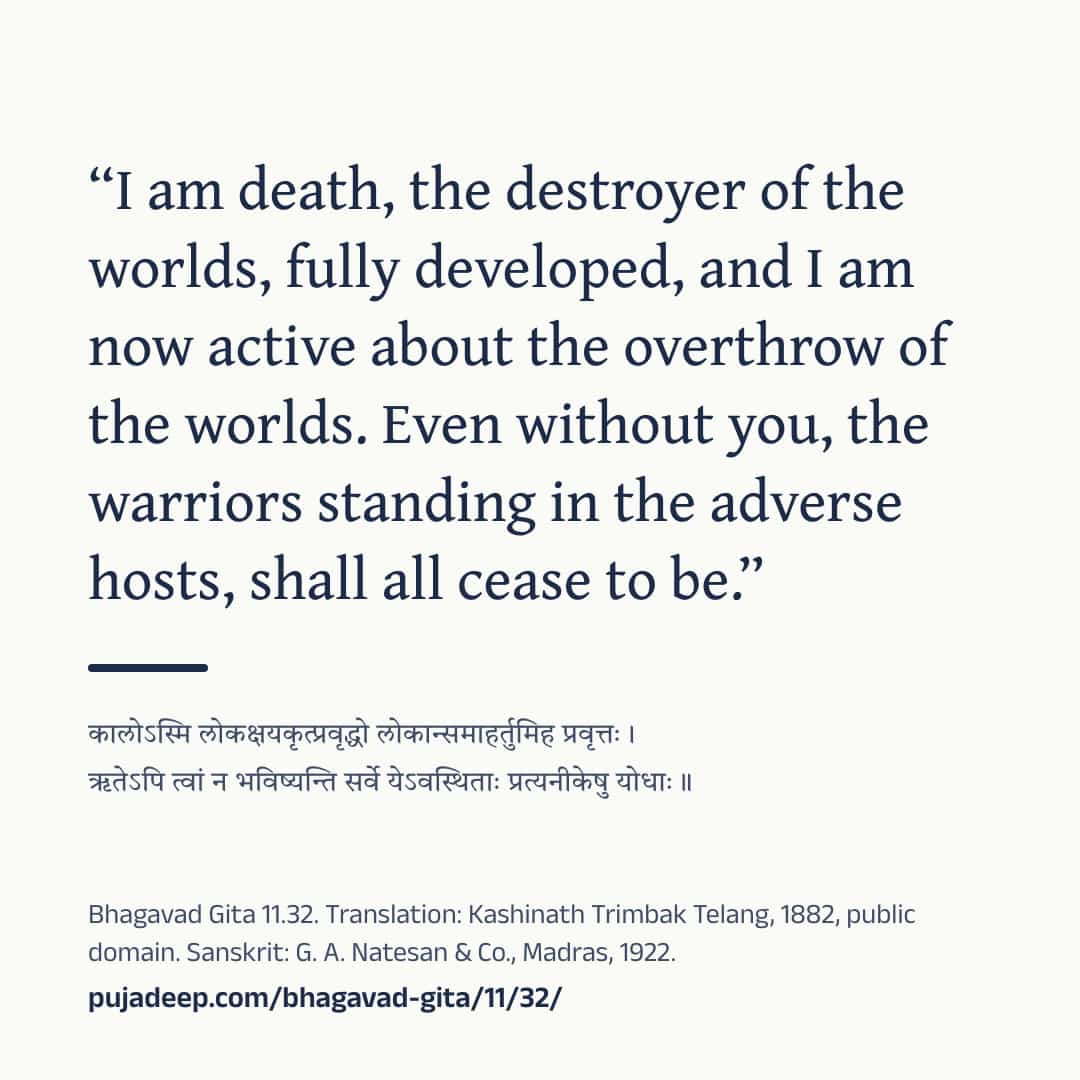
“I am death, the destroyer of the worlds, fully developed, and I am now active about the overthrow of the worlds. Even without you, the warriors standing in the adverse hosts, shall all cease to be.”
(K. T. Telang, The Bhagavadgîtâ (The Sacred Books of the East, vol. VIII, Oxford: Clarendon Press, 1882), pp. 95–96, public domain)

“Time am I, laying desolate the world, Made manifest on earth to slay mankind! Not one of all these warriors ranged for strife Escapeth death; thou shalt alone survive.”
(Annie Besant, The Bhagavad Gîtâ, or The Lord's Song (London: Theosophical Publishing Society, 1895), p. 110, public domain)

“I am the mighty world-destroying Time, here made manifest for the purpose of infolding the world. Even without thee, none of the warriors arrayed in the hostile armies shall live.”
(Swami Swarupananda, Srimad-Bhagavad-Gita (Mayavati: Prabuddha Bharata Press, 1909; first printed in Prabuddha Bharata, 1907–1909), p. 227, public domain)

Sanskrit: G. A. Natesan & Co., Madras, 1922.
https://pujadeep.com/bhagavad-gita/11/32/ Nothing is sent from this site. Your own app sends it, to the chat you choose. The picture quotes the translation you chose on this page, with its name and year.
Sanskrit text: The Bhagavad-Gita, or The Lord's Song, with the text in Devanagari and an English translation, 1922. Meanings: written for Pujadeep and checked against the cited edition. Source and changes
Questions families ask
Who speaks Bhagavad Gita 11.32?
Krishna speaks this verse, in chapter 11 (Vishvarupa Darshana Yoga).
Where does the Sanskrit text come from?
Sanskrit text: The Bhagavad-Gita, or The Lord's Song, with the text in Devanagari and an English translation, 1922. Meanings: written for Pujadeep and checked against the cited edition. See the source
Is the meaning on this page a translation?
Explanation written for this site from the sources listed here, and checked against the cited edition. It is not a translation and not the only way to read the text. Free to quote with credit.
Source and licence
- Sanskrit text
- The Bhagavad-Gita, or The Lord's Song, with the text in Devanagari and an English translation (Annie Besant, G. A. Natesan & Co., Madras, 1922). Public domain. The Sanskrit on these pages was read from this printing’s page images.
- Translation
- The Bhagavadgîtâ with the Sanatsugâtîya and the Anugîtâ, translated by Kâshinâth Trimbak Telang (The Sacred Books of the East, vol. VIII, ed. F. Max Müller) (Kashinath Trimbak Telang, F. Max Müller, Clarendon Press, Oxford, 1882). Public domain. Shown verbatim, as printed.
- Translation
- The Bhagavad Gîtâ, or The Lord's Song, translated by Annie Besant (Annie Besant, Theosophical Publishing Society, London, 1895). Public domain. Shown verbatim, as printed.
- Translation
- Srimad-Bhagavad-Gita, with Sanskrit Text; Paraphrase with Word-by-word Literal Translation; English Rendering and Comments, Index, &c., by the Swami Swarupananda (Himalayan Series, No. XX) (Swami Swarupananda, The Editors and Publishers, Advaita Ashrama, Mayavati, Prabuddha Bharata Press, Mayavati, Almora, Himalayas, 1909). Public domain. Shown verbatim, as printed.
- Commentary
- Sri Bhagavad-Gita with Sri Ramanujacharya's Visishtadvaita commentary, translated by A. Govindacharya (Madras, 1898) (Scan uploaded to archive.org (folkscanomy collection)). Summarised in our own words; none of its text is reproduced.
- Commentary
- The Bhagavad-Gita: translation and commentaries in English according to Sri Madhwacharya's Bhashyas, by S. Subba Rau (Madras, 1906) (Scan uploaded to archive.org (folkscanomy collection)). Summarised in our own words; none of its text is reproduced.
- Common wording
- In this text, 32 words follow today's common wording, checked against sanskritdocuments.org; Sanskrit Wikisource; Gita Press, Gorakhpur; GRETIL, Göttingen and Bhaktivedanta Book Trust.
- Our explanation
- Explanation written for this site from the sources listed here, and checked against the cited edition. It is not a translation and not the only way to read the text. Free to quote with credit.
- Checked
- Checked against the cited edition, October 27, 2026.