Bhagavad Gita 10.42: meaning and translation
Chapter 10: Vibhuti Yoga. Krishna says
Krishna closes the chapter.
Click or tap a word for its meaning and its dictionary page.
Text and layers
Text and layers
These choices stay in this browser.
Bhagavad Gita 10.42
अथवा बहुनैतेन किं ज्ञातेन तवार्जुन ।विष्टभ्याहमिदं कृत्स्नमेकांशेन स्थितो जगत् ॥
Athava bahunaitena kim jnatena tavarjunaVishtabhyahamidam kritsnamekanshena sthito jagat
athavā bahunaitena kiṃ jñātena tavārjuna |viṣṭabhyāhamidaṃ kṛtsnamekāṃśena sthito jagat ||
Our explanation Krishna closes the chapter. But what need is there for Arjuna to know all this in detail? Krishna says he stands supporting this whole world with a single portion of himself. The schools read 'a single portion' differently (see the views).
हिंदी अर्थ कृष्ण अध्याय पूरा करते हैं। पर अर्जुन को यह सब विस्तार से जानने की क्या आवश्यकता है? कृष्ण कहते हैं कि वे इस पूरे जगत को अपने एक अंश से धारण करके स्थित हैं। “एक अंश” को परंपराएँ अलग-अलग ढंग से समझती हैं।
Word by word
Every word, with its dictionary page
Word by word
- अथवा athavā · or rather (indeclinable) Dictionary: atha-vā, Monier-Williams 1899, p. 17, col. 3 “or; (when repeated) either or; or rather”
- बहुना bahunā · (this) much (adjective (neuter), instrumental singular) Dictionary: bahu, Monier-Williams 1899, p. 724, col. 2 “much, many, frequent, abundant, numerous”
- एतेन etena · this (pronoun (neuter), instrumental singular) Dictionary: etad, Monier-Williams 1899, p. 231, col. 2 “this, this here, here”
- किम् kim · what (use) (interrogative pronoun (neuter), nominative singular) Dictionary: kim, Monier-Williams 1899, p. 282, col. 2 “what? how? whence? wherefore? why?”
- ज्ञातेन jñātena · by knowing (past participle (neuter), instrumental singular) Dictionary: jñāta, Monier-Williams 1899, p. 425, col. 3 “known, ascertained, comprehended”
- तव tava · for you (pronoun, genitive singular) Dictionary: yuṣmad, Monier-Williams 1899, p. 855, col. 3 “the base of the 2nd pers. pron. as used in comp.”
- अर्जुन arjuna · O Arjuna (noun (masculine), vocative singular) Dictionary: arjuna, Monier-Williams 1899, p. 90, col. 1
- विष्टभ्य viṣṭabhya · supporting (absolutive (having done)) Dictionary: vi-ṣṭambh, Monier-Williams 1899, p. 998, col. 3 “to fix asunder, hold or keep apart, prop, fix, fasten, support”
- अहम् aham · "I" (Krishna) (pronoun, nominative singular) Dictionary: aham, Monier-Williams 1899, p. 124, col. 2 “nom. sg. ‘I,’”
- इदम् idam · this (pronoun (neuter), accusative singular) Dictionary: 1. idam, Monier-Williams 1899, p. 165, col. 2 “this, this here, referring to something near the speaker”
- कृत्स्नम् kṛtsnam · whole (adjective (neuter), accusative singular) Dictionary: kṛtsna, Monier-Williams 1899, p. 304, col. 3 “all, whole, entire”
- एकांशेन ekāṃśena · with a single portion (compound (masculine), instrumental singular) Dictionary: eka, Monier-Williams 1899, p. 227, col. 3 “one”; aṃśa, Monier-Williams 1899, p. 1, col. 1 “a share, portion, part, party”
- स्थितः sthitaḥ · stand, remain (past participle (masculine), nominative singular) Dictionary: sthita, Monier-Williams 1899, p. 1264, col. 1 “standing, staying, situated, resting or abiding or remaining in”
- जगत् jagat · world (noun (neuter), accusative singular) Dictionary: jagat, Monier-Williams 1899, p. 408, col. 1 “the world, esp. this world, earth”
1 printing differs
Edition differences. Another printing or text reads this place differently.
- The printed edition reads: अथवा वहुनैतेन किं ज्ञातेन तवार्जुन ।
विष्टभ्याहमिदं कृत्स्नमेकांशेन स्थितो जगत् ॥ The print reads वहुनैतेन, with व for ब; read as a wrong sort and corrected to बहुनैतेन ('with this much'), because बहु is the only reading that makes sense here and both proofreading references read बहुनैतेन.
Old translations
Kashinath Trimbak Telang, 1882. Public domain. Page 91.
Or rather, O Arguna! what have you to do, knowing all this at large? I stand supporting all this by (but) a single portion (of myself)1.
Footnotes (the translator’s own) - Cf. Purusha-sûkta (Muir, Sanskrit Texts, vol. i, p. 9). ↩
Compare 3 translations
Kashinath Trimbak Telang, 1882. Public domain. Page 91.
Or rather, O Arguna! what have you to do, knowing all this at large? I stand supporting all this by (but) a single portion (of myself)1.
Footnotes (the translator’s own) - Cf. Purusha-sûkta (Muir, Sanskrit Texts, vol. i, p. 9). ↩
You are reading this one
Annie Besant, 1895. Public domain. Page 102.
But what is the knowledge of all these details to thee, O Arjuna? Having pervaded this whole universe with a portion of Myself, I exist.
You are reading this one
Swami Swarupananda, 1909 (first printed 1907). Public domain. Page 211.
But what avails thee to know all this diversity, O Arjuna? (Know thou this that) I exist, supporting this whole world by a portion of Myself.
You are reading this one
Cite this verse
The translation: K. T. Telang, The Bhagavadgîtâ (The Sacred Books of the East, vol. VIII, Oxford: Clarendon Press, 1882), p. 91. Bhagavad Gita 10.42.
The translation: Annie Besant, The Bhagavad Gîtâ, or The Lord's Song (London: Theosophical Publishing Society, 1895), p. 102. Bhagavad Gita 10.42.
The translation: Swami Swarupananda, Srimad-Bhagavad-Gita (Mayavati: Prabuddha Bharata Press, 1909; first printed in Prabuddha Bharata, 1907–1909), p. 211. Bhagavad Gita 10.42.
Our explanation: “Bhagavad Gita 10.42: meaning and translation.” Pujadeep. Updated October 25, 2026. https://pujadeep.com/bhagavad-gita/10/42/
Pujadeep’s explanations are free to quote with credit: name Pujadeep and link to the page. How to credit
Classical readings, by school
Each reading is named by its school. None is presented as the only meaning.
What Advaita, Vishishtadvaita and Dvaita teach, in short
Shankara Advaita
Shankara says one part of the Lord, 'one foot', makes up all beings, and quotes the Veda: 'All beings form his foot.'
Source: The Bhagavad-Gita, with the commentary of Sri Sankaracharya, translated by A. Mahadeva Sastri (2nd ed., Mysore: G. T. A. Printing Works, 1901), commentary on 10.42, p. 247. Summarised in our own words; none of its text is reproduced.
Ramanuja Vishishtadvaita
Ramanuja says the whole universe of conscious and unconscious things, in every state, is upheld by a tiny fraction of the Lord's power and never goes beyond his will.
Source: Sri Bhagavad-Gita with Sri Ramanujacharya's Visishtadvaita commentary, translated by A. Govindacharya (Madras, 1898), commentary on 10.42, pp. 343–344. Summarised in our own words; none of its text is reproduced.
Share
Show the ways to share
Send one picture or the text to one chat. The picture names its source and the address of this page.
Drawing the picture
See the words
Bhagavad Gita 10.42

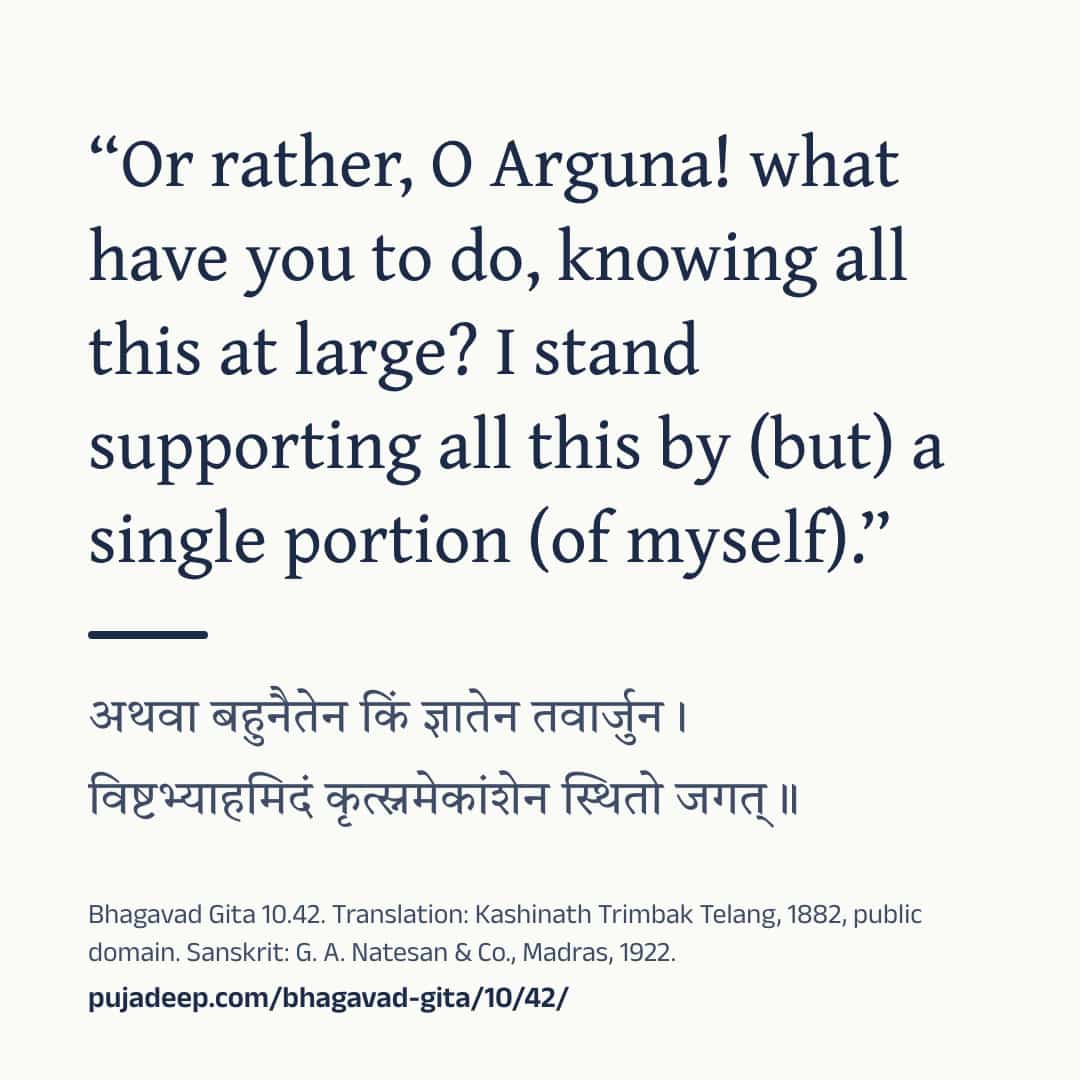
अथवा बहुनैतेन किं ज्ञातेन तवार्जुन ।
विष्टभ्याहमिदं कृत्स्नमेकांशेन स्थितो जगत् ॥

“Or rather, O Arguna! what have you to do, knowing all this at large? I stand supporting all this by (but) a single portion (of myself).”
(K. T. Telang, The Bhagavadgîtâ (The Sacred Books of the East, vol. VIII, Oxford: Clarendon Press, 1882), p. 91, public domain)

“But what is the knowledge of all these details to thee, O Arjuna? Having pervaded this whole universe with a portion of Myself, I exist.”
(Annie Besant, The Bhagavad Gîtâ, or The Lord's Song (London: Theosophical Publishing Society, 1895), p. 102, public domain)

“But what avails thee to know all this diversity, O Arjuna? (Know thou this that) I exist, supporting this whole world by a portion of Myself.”
(Swami Swarupananda, Srimad-Bhagavad-Gita (Mayavati: Prabuddha Bharata Press, 1909; first printed in Prabuddha Bharata, 1907–1909), p. 211, public domain)

Sanskrit: G. A. Natesan & Co., Madras, 1922.
https://pujadeep.com/bhagavad-gita/10/42/ Nothing is sent from this site. Your own app sends it, to the chat you choose. The picture quotes the translation you chose on this page, with its name and year.
Sanskrit text: The Bhagavad-Gita, or The Lord's Song, with the text in Devanagari and an English translation, 1922. Meanings: written for Pujadeep and checked against the cited edition. Source and changes
Questions families ask
Who speaks Bhagavad Gita 10.42?
Krishna speaks this verse, in chapter 10 (Vibhuti Yoga).
Where does the Sanskrit text come from?
Sanskrit text: The Bhagavad-Gita, or The Lord's Song, with the text in Devanagari and an English translation, 1922. Meanings: written for Pujadeep and checked against the cited edition. See the source
Is the meaning on this page a translation?
Explanation written for this site from the sources listed here, and checked against the cited edition. It is not a translation and not the only way to read the text. Free to quote with credit.
Source and licence
- Sanskrit text
- The Bhagavad-Gita, or The Lord's Song, with the text in Devanagari and an English translation (Annie Besant, G. A. Natesan & Co., Madras, 1922). Public domain. The Sanskrit on these pages was read from this printing’s page images.
- Translation
- The Bhagavadgîtâ with the Sanatsugâtîya and the Anugîtâ, translated by Kâshinâth Trimbak Telang (The Sacred Books of the East, vol. VIII, ed. F. Max Müller) (Kashinath Trimbak Telang, F. Max Müller, Clarendon Press, Oxford, 1882). Public domain. Shown verbatim, as printed.
- Translation
- The Bhagavad Gîtâ, or The Lord's Song, translated by Annie Besant (Annie Besant, Theosophical Publishing Society, London, 1895). Public domain. Shown verbatim, as printed.
- Translation
- Srimad-Bhagavad-Gita, with Sanskrit Text; Paraphrase with Word-by-word Literal Translation; English Rendering and Comments, Index, &c., by the Swami Swarupananda (Himalayan Series, No. XX) (Swami Swarupananda, The Editors and Publishers, Advaita Ashrama, Mayavati, Prabuddha Bharata Press, Mayavati, Almora, Himalayas, 1909). Public domain. Shown verbatim, as printed.
- Commentary
- The Bhagavad-Gita, with the commentary of Sri Sankaracharya, translated by A. Mahadeva Sastri (2nd ed., Mysore: G. T. A. Printing Works, 1901) (Public-domain scan, University of California Libraries). Summarised in our own words; none of its text is reproduced.
- Commentary
- Sri Bhagavad-Gita with Sri Ramanujacharya's Visishtadvaita commentary, translated by A. Govindacharya (Madras, 1898) (Scan uploaded to archive.org (folkscanomy collection)). Summarised in our own words; none of its text is reproduced.
- Common wording
- In this text, 32 words follow today's common wording, checked against sanskritdocuments.org; Sanskrit Wikisource; Gita Press, Gorakhpur; GRETIL, Göttingen and Bhaktivedanta Book Trust.
- Our explanation
- Explanation written for this site from the sources listed here, and checked against the cited edition. It is not a translation and not the only way to read the text. Free to quote with credit.
- Checked
- Checked against the cited edition, October 15, 2026.
- Updated
- October 25, 2026