Bhagavad Gita 10.40: meaning and translation
Chapter 10: Vibhuti Yoga. Krishna says
Krishna tells Arjuna, scorcher of foes (parantapa), that there is no end to his divine glories; what he has said is only a brief account of their extent.
Click or tap a word for its meaning and its dictionary page.
Text and layers
Text and layers
These choices stay in this browser.
Bhagavad Gita 10.40
नान्तोऽस्ति मम दिव्यानां विभूतीनां परन्तप ।एष तूद्देशतः प्रोक्तो विभूतेर्विस्तरो मया ॥
Nantosti mama divyanam vibhutinam parantapaEsha tuddeshatah prokto vibhutervistaro maya
nānto’sti mama divyānāṃ vibhūtīnāṃ parantapa |eṣa tūddeśataḥ prokto vibhūtervistaro mayā ||
Our explanation Krishna tells Arjuna, scorcher of foes (parantapa), that there is no end to his divine glories; what he has said is only a brief account of their extent.
हिंदी अर्थ कृष्ण अर्जुन (परंतप) से कहते हैं कि उनकी दिव्य विभूतियों का अंत नहीं है; उन्होंने जो कहा, वह उनके विस्तार का केवल संक्षिप्त वर्णन है।
Word by word
Every word, with its dictionary page
Word by word
- न na · not (indeclinable) Dictionary: 2. na, Monier-Williams 1899, p. 523, col. 1 “not, no, nor, neither”
- अन्तः antaḥ · end (noun (masculine), nominative singular) Dictionary: anta, Monier-Williams 1899, p. 42, col. 3 “end, limit, boundary, term”
- अस्ति asti · is (present, 3rd person singular) Dictionary: 1. as, Monier-Williams 1899, p. 117, col. 2 “to be, live, exist, be present”
- मम mama · "my" (Krishna's) (pronoun, genitive singular) Dictionary: 1. mad, Monier-Williams 1899, p. 777, col. 2 “base of the first pers. pron. in the sg. number (esp. in comp.)”
- दिव्यानाम् divyānām · divine (adjective (feminine), genitive plural) Dictionary: 2. divya, Monier-Williams 1899, p. 479, col. 2 “divine, heavenly, celestial”
- विभूतीनाम् vibhūtīnām · of the glories (noun (feminine), genitive plural) Dictionary: vi-bhūti, Monier-Williams 1899, p. 978, col. 3 “manifestation of might, great power, superhuman power”
- परन्तप parantapa · O scorcher of foes (noun (masculine), vocative singular) Dictionary: param-tapa, Monier-Williams 1899, p. 586, col. 3 “destroying foes (said of heroes)”
- एषः eṣaḥ · this (pronoun (masculine), nominative singular) Dictionary: etad, Monier-Williams 1899, p. 231, col. 2 “this, this here, here”
- तु tu · but (indeclinable) Dictionary: 2. tu, Monier-Williams 1899, p. 449, col. 3 “but”
- उद्देशतः uddeśataḥ · in brief, by way of example (indeclinable) Dictionary: ud-deśa, Monier-Williams 1899, p. 188, col. 1 “brief statement; exemplification, illustration, explanation”
- प्रोक्तः proktaḥ · spoken (past participle (masculine), nominative singular) Dictionary: pra-vac, Monier-Williams 1899, p. 690, col. 1 “to speak, say, tell”
- विभूतेः vibhūteḥ · of the glory (noun (feminine), genitive singular) Dictionary: vi-bhūti, Monier-Williams 1899, p. 978, col. 3 “manifestation of might, great power, superhuman power”
- विस्तरः vistaraḥ · extent (noun (masculine), nominative singular) Dictionary: vi-stara, Monier-Williams 1899, p. 1001, col. 3 “spreading, extension, expansion”
- मया mayā · by "me" (Krishna) (pronoun, instrumental singular) Dictionary: 1. mad, Monier-Williams 1899, p. 777, col. 2 “base of the first pers. pron. in the sg. number (esp. in comp.)”
Old translations
Kashinath Trimbak Telang, 1882. Public domain. Page 91.
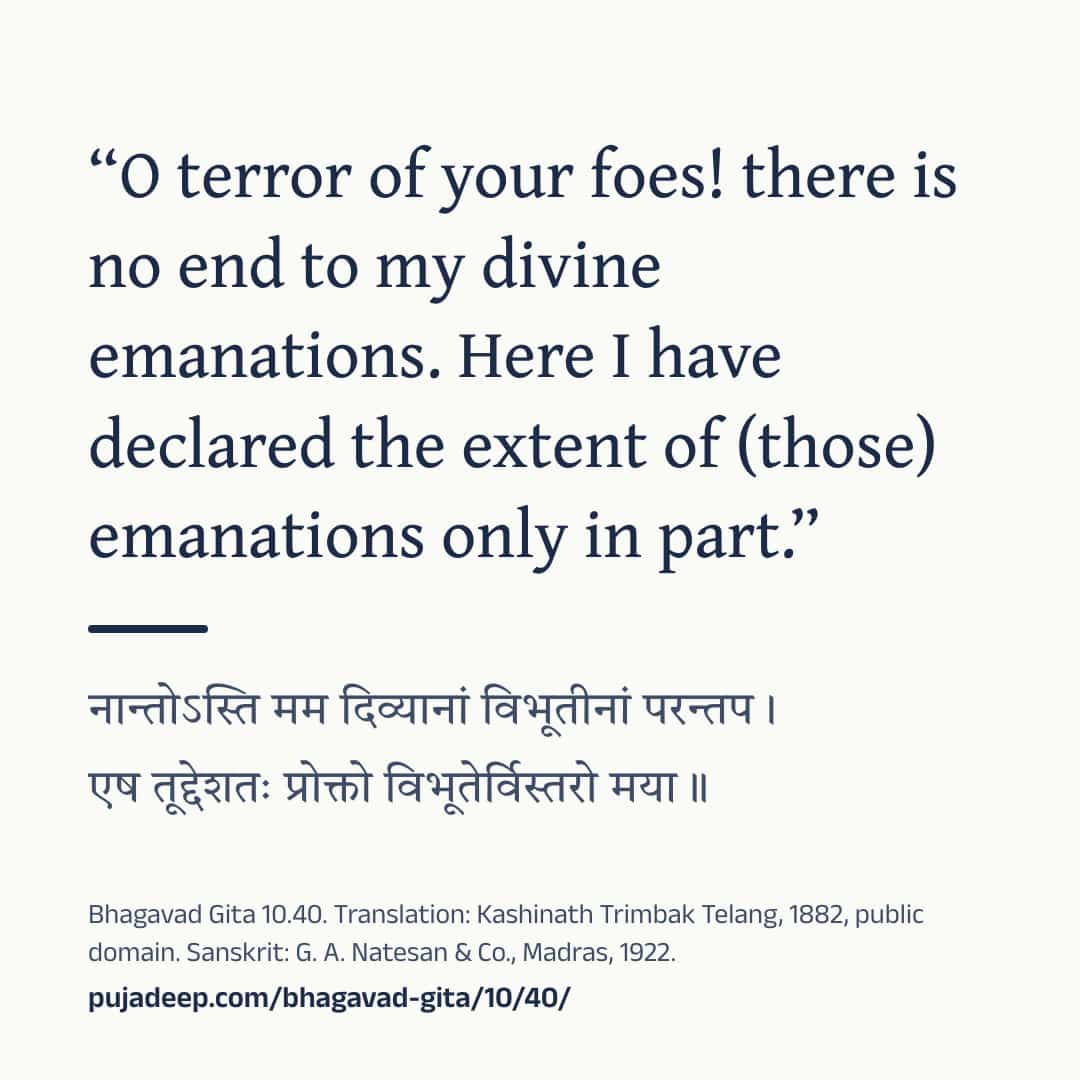
O terror of your foes! there is no end to my divine emanations. Here I have declared the extent of (those) emanations only in part.
Compare 3 translations
Kashinath Trimbak Telang, 1882. Public domain. Page 91.
O terror of your foes! there is no end to my divine emanations. Here I have declared the extent of (those) emanations only in part.
You are reading this one
Annie Besant, 1895. Public domain. Page 102.
There is no end of My divine powers, O Parantapa! these details of My sovereignty have been declared only in brief.
You are reading this one
Swami Swarupananda, 1909 (first printed 1907). Public domain. Page 210.
There is no end to the manifestations of My Divine attributes, O scorcher of foes; but this is a partial statement by Me of the particulars of My Divine attributes.
You are reading this one
Cite this verse
The translation: K. T. Telang, The Bhagavadgîtâ (The Sacred Books of the East, vol. VIII, Oxford: Clarendon Press, 1882), p. 91. Bhagavad Gita 10.40.
The translation: Annie Besant, The Bhagavad Gîtâ, or The Lord's Song (London: Theosophical Publishing Society, 1895), p. 102. Bhagavad Gita 10.40.
The translation: Swami Swarupananda, Srimad-Bhagavad-Gita (Mayavati: Prabuddha Bharata Press, 1909; first printed in Prabuddha Bharata, 1907–1909), p. 210. Bhagavad Gita 10.40.
Our explanation: “Bhagavad Gita 10.40: meaning and translation.” Pujadeep. Updated October 25, 2026. https://pujadeep.com/bhagavad-gita/10/40/
Pujadeep’s explanations are free to quote with credit: name Pujadeep and link to the page. How to credit
Classical readings, by school
No readings by school on this verse yet.
Share
Show the ways to share
Send one picture or the text to one chat. The picture names its source and the address of this page.
Drawing the picture
See the words
Bhagavad Gita 10.40

नान्तोऽस्ति मम दिव्यानां विभूतीनां परन्तप ।
एष तूद्देशतः प्रोक्तो विभूतेर्विस्तरो मया ॥

“O terror of your foes! there is no end to my divine emanations. Here I have declared the extent of (those) emanations only in part.”
(K. T. Telang, The Bhagavadgîtâ (The Sacred Books of the East, vol. VIII, Oxford: Clarendon Press, 1882), p. 91, public domain)

“There is no end of My divine powers, O Parantapa! these details of My sovereignty have been declared only in brief.”
(Annie Besant, The Bhagavad Gîtâ, or The Lord's Song (London: Theosophical Publishing Society, 1895), p. 102, public domain)

“There is no end to the manifestations of My Divine attributes, O scorcher of foes; but this is a partial statement by Me of the particulars of My Divine attributes.”
(Swami Swarupananda, Srimad-Bhagavad-Gita (Mayavati: Prabuddha Bharata Press, 1909; first printed in Prabuddha Bharata, 1907–1909), p. 210, public domain)

Sanskrit: G. A. Natesan & Co., Madras, 1922.
https://pujadeep.com/bhagavad-gita/10/40/ Nothing is sent from this site. Your own app sends it, to the chat you choose. The picture quotes the translation you chose on this page, with its name and year.
Sanskrit text: The Bhagavad-Gita, or The Lord's Song, with the text in Devanagari and an English translation, 1922. Meanings: written for Pujadeep and checked against the cited edition. Source and changes
Questions families ask
Who speaks Bhagavad Gita 10.40?
Krishna speaks this verse, in chapter 10 (Vibhuti Yoga).
Where does the Sanskrit text come from?
Sanskrit text: The Bhagavad-Gita, or The Lord's Song, with the text in Devanagari and an English translation, 1922. Meanings: written for Pujadeep and checked against the cited edition. See the source
Is the meaning on this page a translation?
Explanation written for this site from the sources listed here, and checked against the cited edition. It is not a translation and not the only way to read the text. Free to quote with credit.
Source and licence
- Sanskrit text
- The Bhagavad-Gita, or The Lord's Song, with the text in Devanagari and an English translation (Annie Besant, G. A. Natesan & Co., Madras, 1922). Public domain. The Sanskrit on these pages was read from this printing’s page images.
- Translation
- The Bhagavadgîtâ with the Sanatsugâtîya and the Anugîtâ, translated by Kâshinâth Trimbak Telang (The Sacred Books of the East, vol. VIII, ed. F. Max Müller) (Kashinath Trimbak Telang, F. Max Müller, Clarendon Press, Oxford, 1882). Public domain. Shown verbatim, as printed.
- Translation
- The Bhagavad Gîtâ, or The Lord's Song, translated by Annie Besant (Annie Besant, Theosophical Publishing Society, London, 1895). Public domain. Shown verbatim, as printed.
- Translation
- Srimad-Bhagavad-Gita, with Sanskrit Text; Paraphrase with Word-by-word Literal Translation; English Rendering and Comments, Index, &c., by the Swami Swarupananda (Himalayan Series, No. XX) (Swami Swarupananda, The Editors and Publishers, Advaita Ashrama, Mayavati, Prabuddha Bharata Press, Mayavati, Almora, Himalayas, 1909). Public domain. Shown verbatim, as printed.
- Common wording
- In this text, 32 words follow today's common wording, checked against sanskritdocuments.org; Sanskrit Wikisource; Gita Press, Gorakhpur; GRETIL, Göttingen and Bhaktivedanta Book Trust.
- Our explanation
- Explanation written for this site from the sources listed here, and checked against the cited edition. It is not a translation and not the only way to read the text. Free to quote with credit.
- Checked
- Checked against the cited edition, October 15, 2026.
- Updated
- October 25, 2026