Bhagavad Gita 10.37: meaning and translation
Chapter 10: Vibhuti Yoga. Krishna says
Among the Vṛṣṇis (Krishna's clan), Krishna says, he is Vāsudeva; among the Pāṇḍavas, Dhanañjaya (Arjuna); among the sages (munis), Vyāsa; among seers and poets, Uśanā (the teacher of the Daityas).
Click or tap a word for its meaning and its dictionary page.
Text and layers
Text and layers
These choices stay in this browser.
Bhagavad Gita 10.37
वृष्णीनां वासुदेवोऽस्मि पाण्डवानां धनञ्जयः ।मुनीनामप्यहं व्यासः कवीनामुशना कविः ॥
Vrishninam vasudevosmi pandavanam dhananjayahMuninamapyaham vyasah kavinamushana kavih
vṛṣṇīnāṃ vāsudevo’smi pāṇḍavānāṃ dhanañjayaḥ |munīnāmapyahaṃ vyāsaḥ kavīnāmuśanā kaviḥ ||
Our explanation Among the Vṛṣṇis (Krishna's clan), Krishna says, he is Vāsudeva; among the Pāṇḍavas, Dhanañjaya (Arjuna); among the sages (munis), Vyāsa; among seers and poets, Uśanā (the teacher of the Daityas).
हिंदी अर्थ कृष्ण कहते हैं कि वृष्णियों (उनके अपने कुल) में वे वासुदेव हैं; पांडवों में धनंजय (अर्जुन); मुनियों में व्यास; और कवियों में उशना (दैत्यों के गुरु शुक्राचार्य)।
Word by word
Every word, with its dictionary page
Word by word
- वृष्णीनाम् vṛṣṇīnām · among the Vṛṣṇis (noun (masculine), genitive plural) Dictionary: vṛṣṇi, Monier-Williams 1899, p. 1013, col. 2 “pl. N. of a tribe or family”
- वासुदेवः vāsudevaḥ · Vāsudeva (noun (masculine), nominative singular) Dictionary: vāsudeva, Monier-Williams 1899, p. 948, col. 2 “(fr. vasu-d°) patr. of Kṛishṇa”
- अस्मि asmi · am (present, 1st person singular) Dictionary: 1. as, Monier-Williams 1899, p. 117, col. 2 “to be, live, exist, be present”
- पाण्डवानाम् pāṇḍavānām · among the Pāṇḍavas (noun (masculine), genitive plural) Dictionary: pāṇḍava, Monier-Williams 1899, p. 616, col. 2 “a son or descendant of Pāṇḍu”
- धनञ्जयः dhanañjayaḥ · Dhanañjaya (Arjuna) (compound (masculine), nominative singular) Dictionary: dhanaṃ-jaya, Monier-Williams 1899, p. 508, col. 2 “N. of Arjuna”
- मुनीनाम् munīnām · among the sages (munis) (noun (masculine), genitive plural) Dictionary: muni, Monier-Williams 1899, p. 823, col. 1 “a saint, sage, seer, ascetic, monk, devotee, hermit”
- अपि api · also (indeclinable) Dictionary: api, Monier-Williams 1899, p. 55, col. 1 “and, also, moreover, besides”
- अहम् aham · "I" (Krishna) (pronoun, nominative singular) Dictionary: aham, Monier-Williams 1899, p. 124, col. 2 “nom. sg. ‘I,’”
- व्यासः vyāsaḥ · Vyāsa (noun (masculine), nominative singular) Dictionary: vy-āsa, Monier-Williams 1899, p. 1035, col. 2 “N. of a celebrated mythical sage and author”
- कवीनाम् kavīnām · among seers (noun (masculine), genitive plural) Dictionary: kavi, Monier-Williams 1899, p. 264, col. 2 “gifted with insight, intelligent, knowing, enlightened, wise”
- उशना uśanā · Uśanā (noun (masculine), nominative singular) Dictionary: uśanas, Monier-Williams 1899, p. 219, col. 3 “N. of an ancient sage with the patronymic Kāvya”
- कविः kaviḥ · the seer (noun (masculine), nominative singular) Dictionary: kavi, Monier-Williams 1899, p. 264, col. 2 “gifted with insight, intelligent, knowing, enlightened, wise”
Old translations
Kashinath Trimbak Telang, 1882. Public domain. Page 91.
I am Vâsudeva among the descendants of Vrishni1, and Arguna among the Pândavas. Among sages also, I am Vyâsa2; and among the discerning ones, I am the discerning Usanas3.
Footnotes (the translator’s own) Compare 3 translations
Kashinath Trimbak Telang, 1882. Public domain. Page 91.
I am Vâsudeva among the descendants of Vrishni1, and Arguna among the Pândavas. Among sages also, I am Vyâsa2; and among the discerning ones, I am the discerning Usanas3.
Footnotes (the translator’s own) You are reading this one
Annie Besant, 1895. Public domain. Page 101.
Of the Vrîshnis Vâsudeva am I, of the Pândavas Dhananjaya; of the Munis also I am Vyâsa, of wise men Ushana the Sage.
You are reading this one
Swami Swarupananda, 1909 (first printed 1907). Public domain. Page 209.
Of the Vrishnis I am Vâsudeva; of the Pàndavas, Dhananjaya; and also of the Munis I am Vyàsa; of the sages, Ushanás the sage.
You are reading this one
Cite this verse
The translation: K. T. Telang, The Bhagavadgîtâ (The Sacred Books of the East, vol. VIII, Oxford: Clarendon Press, 1882), p. 91. Bhagavad Gita 10.37.
The translation: Annie Besant, The Bhagavad Gîtâ, or The Lord's Song (London: Theosophical Publishing Society, 1895), p. 101. Bhagavad Gita 10.37.
The translation: Swami Swarupananda, Srimad-Bhagavad-Gita (Mayavati: Prabuddha Bharata Press, 1909; first printed in Prabuddha Bharata, 1907–1909), p. 209. Bhagavad Gita 10.37.
Our explanation: “Bhagavad Gita 10.37: meaning and translation.” Pujadeep. Updated October 25, 2026. https://pujadeep.com/bhagavad-gita/10/37/
Pujadeep’s explanations are free to quote with credit: name Pujadeep and link to the page. How to credit
Classical readings, by school
No readings by school on this verse yet.
Share
Show the ways to share
Send one picture or the text to one chat. The picture names its source and the address of this page.
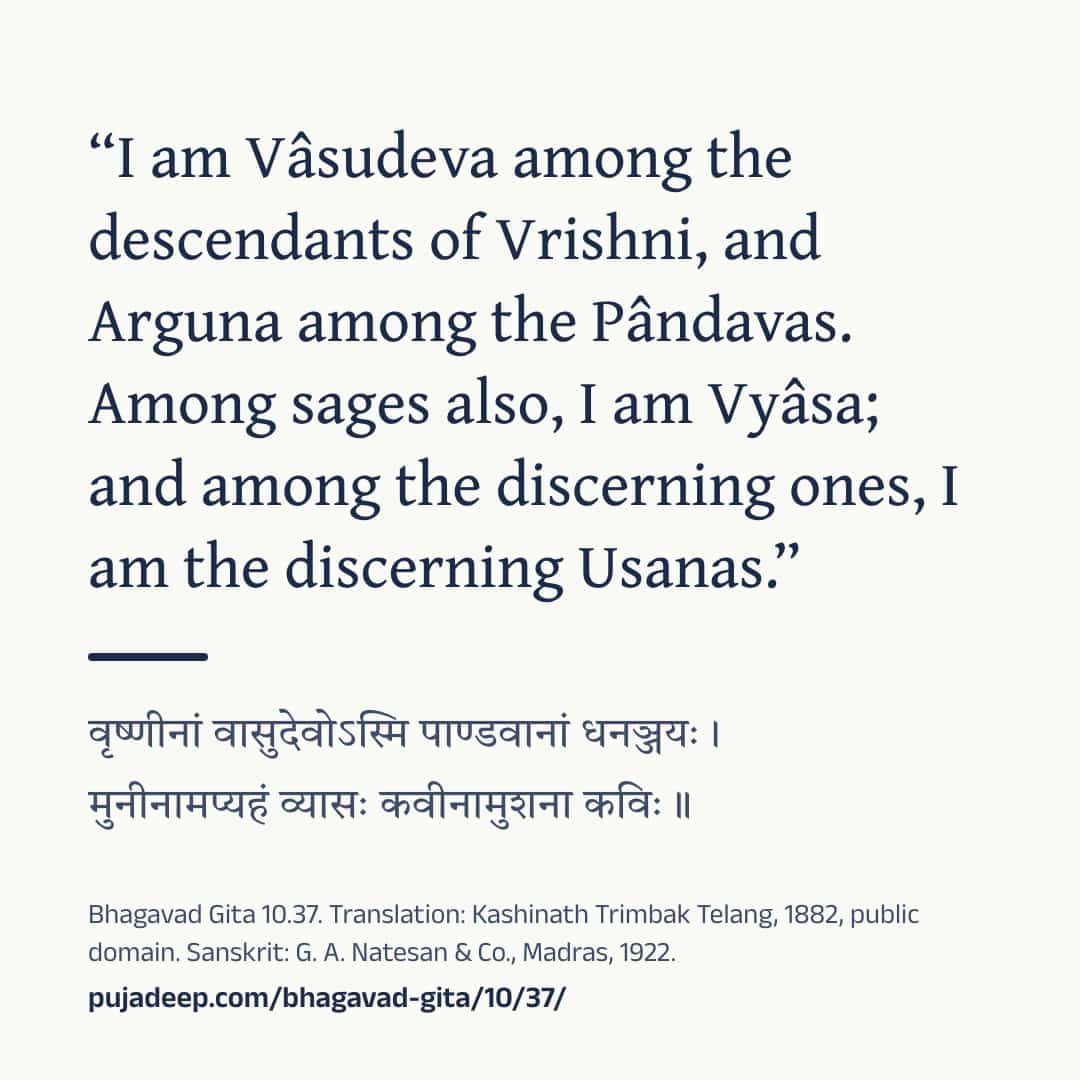
Drawing the picture
See the words
Bhagavad Gita 10.37

वृष्णीनां वासुदेवोऽस्मि पाण्डवानां धनञ्जयः ।
मुनीनामप्यहं व्यासः कवीनामुशना कविः ॥

“I am Vâsudeva among the descendants of Vrishni, and Arguna among the Pândavas. Among sages also, I am Vyâsa; and among the discerning ones, I am the discerning Usanas.”
(K. T. Telang, The Bhagavadgîtâ (The Sacred Books of the East, vol. VIII, Oxford: Clarendon Press, 1882), p. 91, public domain)

“Of the Vrîshnis Vâsudeva am I, of the Pândavas Dhananjaya; of the Munis also I am Vyâsa, of wise men Ushana the Sage.”
(Annie Besant, The Bhagavad Gîtâ, or The Lord's Song (London: Theosophical Publishing Society, 1895), p. 101, public domain)

“Of the Vrishnis I am Vâsudeva; of the Pàndavas, Dhananjaya; and also of the Munis I am Vyàsa; of the sages, Ushanás the sage.”
(Swami Swarupananda, Srimad-Bhagavad-Gita (Mayavati: Prabuddha Bharata Press, 1909; first printed in Prabuddha Bharata, 1907–1909), p. 209, public domain)

Sanskrit: G. A. Natesan & Co., Madras, 1922.
https://pujadeep.com/bhagavad-gita/10/37/ Nothing is sent from this site. Your own app sends it, to the chat you choose. The picture quotes the translation you chose on this page, with its name and year.
Sanskrit text: The Bhagavad-Gita, or The Lord's Song, with the text in Devanagari and an English translation, 1922. Meanings: written for Pujadeep and checked against the cited edition. Source and changes
Questions families ask
Who speaks Bhagavad Gita 10.37?
Krishna speaks this verse, in chapter 10 (Vibhuti Yoga).
Where does the Sanskrit text come from?
Sanskrit text: The Bhagavad-Gita, or The Lord's Song, with the text in Devanagari and an English translation, 1922. Meanings: written for Pujadeep and checked against the cited edition. See the source
Is the meaning on this page a translation?
Explanation written for this site from the sources listed here, and checked against the cited edition. It is not a translation and not the only way to read the text. Free to quote with credit.
Source and licence
- Sanskrit text
- The Bhagavad-Gita, or The Lord's Song, with the text in Devanagari and an English translation (Annie Besant, G. A. Natesan & Co., Madras, 1922). Public domain. The Sanskrit on these pages was read from this printing’s page images.
- Translation
- The Bhagavadgîtâ with the Sanatsugâtîya and the Anugîtâ, translated by Kâshinâth Trimbak Telang (The Sacred Books of the East, vol. VIII, ed. F. Max Müller) (Kashinath Trimbak Telang, F. Max Müller, Clarendon Press, Oxford, 1882). Public domain. Shown verbatim, as printed.
- Translation
- The Bhagavad Gîtâ, or The Lord's Song, translated by Annie Besant (Annie Besant, Theosophical Publishing Society, London, 1895). Public domain. Shown verbatim, as printed.
- Translation
- Srimad-Bhagavad-Gita, with Sanskrit Text; Paraphrase with Word-by-word Literal Translation; English Rendering and Comments, Index, &c., by the Swami Swarupananda (Himalayan Series, No. XX) (Swami Swarupananda, The Editors and Publishers, Advaita Ashrama, Mayavati, Prabuddha Bharata Press, Mayavati, Almora, Himalayas, 1909). Public domain. Shown verbatim, as printed.
- Common wording
- In this text, 32 words follow today's common wording, checked against sanskritdocuments.org; Sanskrit Wikisource; Gita Press, Gorakhpur; GRETIL, Göttingen and Bhaktivedanta Book Trust.
- Our explanation
- Explanation written for this site from the sources listed here, and checked against the cited edition. It is not a translation and not the only way to read the text. Free to quote with credit.
- Checked
- Checked against the cited edition, October 15, 2026.
- Updated
- October 25, 2026