Bhagavad Gita 10.29: meaning and translation
Chapter 10: Vibhuti Yoga. Krishna says
Among the nāgas, Krishna says, he is Ananta; among water beings, Varuṇa; among the ancestors (pitṛs), Aryaman; among those who keep order, Yama.
Click or tap a word for its meaning and its dictionary page.
Text and layers
Text and layers
These choices stay in this browser.
Bhagavad Gita 10.29
अनन्तश्चास्मि नागानां वरुणो यादसामहम् ।पितॄणामर्यमा चास्मि यमः संयमतामहम् ॥
Anantashchasmi naganam varuno yadasamahamPitrinamaryama chasmi yamah sanyamatamaham
anantaścāsmi nāgānāṃ varuṇo yādasāmaham |pitṝṇāmaryamā cāsmi yamaḥ saṃyamatāmaham ||
Our explanation Among the nāgas, Krishna says, he is Ananta; among water beings, Varuṇa; among the ancestors (pitṛs), Aryaman; among those who keep order, Yama.
हिंदी अर्थ कृष्ण कहते हैं कि नागों में वे अनंत हैं; जल के प्राणियों में वरुण; पितरों में अर्यमा; और नियम में रखने वालों में यम।
Word by word
Every word, with its dictionary page
Word by word
- अनन्तः anantaḥ · Ananta (noun (masculine), nominative singular) Dictionary: an-anta, Monier-Williams 1899, p. 25, col. 1 “Śesha (the snake-god)”
- च ca · and (indeclinable) Dictionary: 2. ca, Monier-Williams 1899, p. 380, col. 1 “and, both, also, moreover, as well as”
- अस्मि asmi · am (present, 1st person singular) Dictionary: 1. as, Monier-Williams 1899, p. 117, col. 2 “to be, live, exist, be present”
- नागानाम् nāgānām · among the nāgas (noun (masculine), genitive plural) Dictionary: nāga, Monier-Williams 1899, p. 532, col. 3 “a Nāga or serpent-demon”
- वरुणः varuṇaḥ · Varuṇa (noun (masculine), nominative singular) Dictionary: varuṇa, Monier-Williams 1899, p. 921, col. 2 “N. of an Āditya”
- यादसाम् yādasām · among water beings (noun (neuter), genitive plural) Dictionary: yādas, Monier-Williams 1899, p. 851, col. 2 “any large aquatic animal, sea monster”
- अहम् aham · "I" (Krishna) (pronoun, nominative singular) Dictionary: aham, Monier-Williams 1899, p. 124, col. 2 “nom. sg. ‘I,’”
- पितॄणाम् pitṝṇām · among the ancestors (pitṛs) (noun (masculine), genitive plural) Dictionary: pitṛ, Monier-Williams 1899, p. 626, col. 2 “the fathers, forefathers, ancestors, (esp.) the Pitṛis or deceased ancestors”
- अर्यमा aryamā · Aryaman (noun (masculine), nominative singular) Dictionary: aryaman, Monier-Williams 1899, p. 93, col. 1 “he is supposed to be the chief of the Manes”
- च ca · and (indeclinable) Dictionary: 2. ca, Monier-Williams 1899, p. 380, col. 1 “and, both, also, moreover, as well as”
- अस्मि asmi · am (present, 1st person singular) Dictionary: 1. as, Monier-Williams 1899, p. 117, col. 2 “to be, live, exist, be present”
- यमः yamaḥ · Yama (noun (masculine), nominative singular) Dictionary: yama, Monier-Williams 1899, p. 846, col. 1 “N. of the god who presides over the Pitṛis”
- संयमताम् saṃyamatām · among those who keep order (present participle (masculine), genitive plural) Dictionary: saṃ-yam, Monier-Williams 1899, p. 1111, col. 3 “to hold together, hold in, hold fast, restrain, curb, suppress, control”
- अहम् aham · "I" (Krishna) (pronoun, nominative singular) Dictionary: aham, Monier-Williams 1899, p. 124, col. 2 “nom. sg. ‘I,’”
Old translations
Kashinath Trimbak Telang, 1882. Public domain. Page 89.
Among Nâga1 snakes I am Ananta; I am Varuna among aquatic beings. And I am Aryaman among the manes, and Yama2 among rulers.
Footnotes (the translator’s own) Compare 3 translations
Kashinath Trimbak Telang, 1882. Public domain. Page 89.
Among Nâga1 snakes I am Ananta; I am Varuna among aquatic beings. And I am Aryaman among the manes, and Yama2 among rulers.
Footnotes (the translator’s own) You are reading this one
Annie Besant, 1895. Public domain. Page 100.
And I am Ananta of Nâgas, Varuna of sea-monsters I; and of Pitris Aryaman, Yama of judges am I.
You are reading this one
Swami Swarupananda, 1909 (first printed 1907). Public domain. Page 205.
And Ananta of snakes I am, I am Varuna of water-beings; and Aryamà of Pitris I am, I am Yama of controllers.
You are reading this one
Cite this verse
The translation: K. T. Telang, The Bhagavadgîtâ (The Sacred Books of the East, vol. VIII, Oxford: Clarendon Press, 1882), p. 89. Bhagavad Gita 10.29.
The translation: Annie Besant, The Bhagavad Gîtâ, or The Lord's Song (London: Theosophical Publishing Society, 1895), p. 100. Bhagavad Gita 10.29.
The translation: Swami Swarupananda, Srimad-Bhagavad-Gita (Mayavati: Prabuddha Bharata Press, 1909; first printed in Prabuddha Bharata, 1907–1909), p. 205. Bhagavad Gita 10.29.
Our explanation: “Bhagavad Gita 10.29: meaning and translation.” Pujadeep. Updated October 25, 2026. https://pujadeep.com/bhagavad-gita/10/29/
Pujadeep’s explanations are free to quote with credit: name Pujadeep and link to the page. How to credit
Classical readings, by school
No readings by school on this verse yet.
Share
Show the ways to share
Send one picture or the text to one chat. The picture names its source and the address of this page.
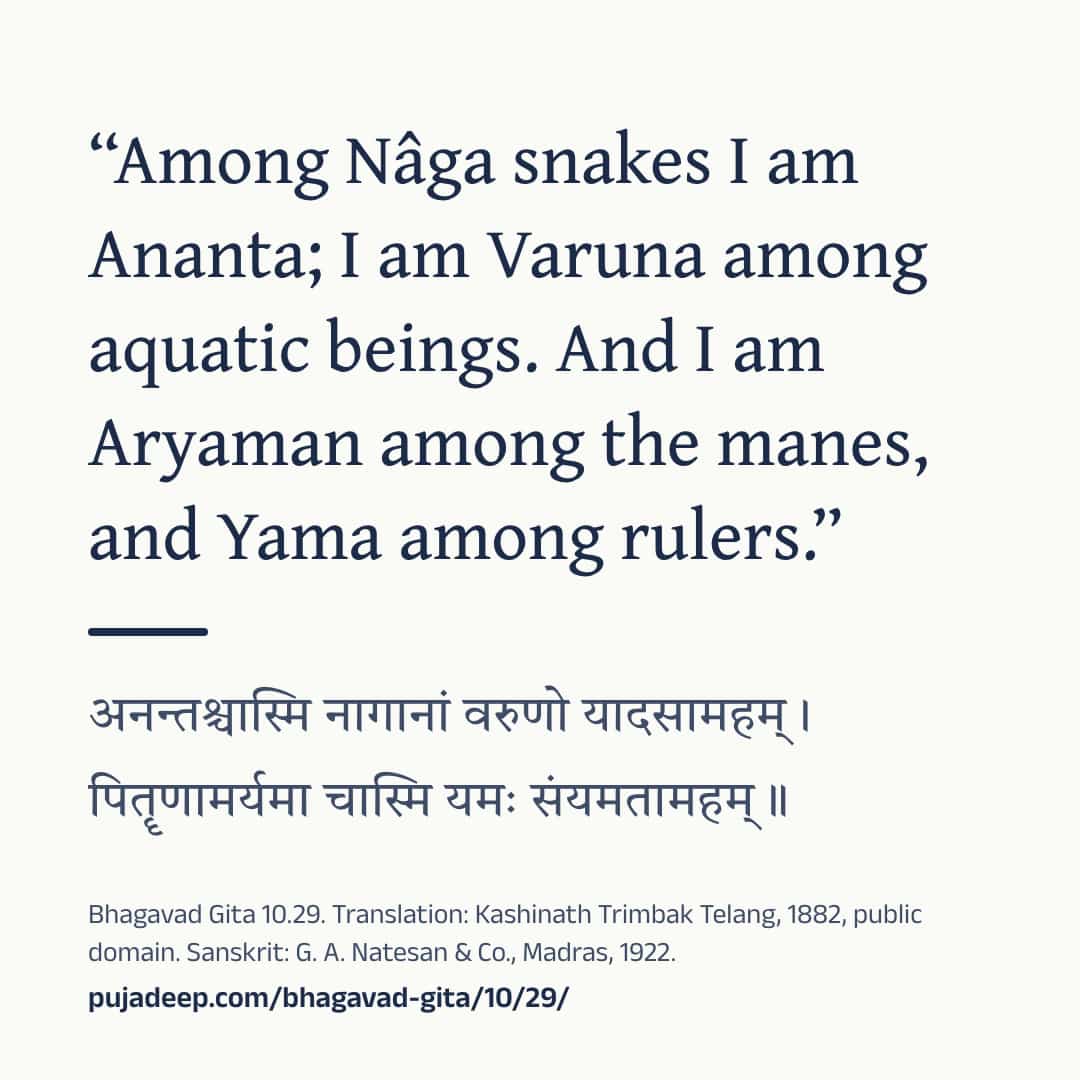
Drawing the picture
See the words
Bhagavad Gita 10.29

अनन्तश्चास्मि नागानां वरुणो यादसामहम् ।
पितॄणामर्यमा चास्मि यमः संयमतामहम् ॥

“Among Nâga snakes I am Ananta; I am Varuna among aquatic beings. And I am Aryaman among the manes, and Yama among rulers.”
(K. T. Telang, The Bhagavadgîtâ (The Sacred Books of the East, vol. VIII, Oxford: Clarendon Press, 1882), p. 89, public domain)

“And I am Ananta of Nâgas, Varuna of sea-monsters I; and of Pitris Aryaman, Yama of judges am I.”
(Annie Besant, The Bhagavad Gîtâ, or The Lord's Song (London: Theosophical Publishing Society, 1895), p. 100, public domain)

“And Ananta of snakes I am, I am Varuna of water-beings; and Aryamà of Pitris I am, I am Yama of controllers.”
(Swami Swarupananda, Srimad-Bhagavad-Gita (Mayavati: Prabuddha Bharata Press, 1909; first printed in Prabuddha Bharata, 1907–1909), p. 205, public domain)

Sanskrit: G. A. Natesan & Co., Madras, 1922.
https://pujadeep.com/bhagavad-gita/10/29/ Nothing is sent from this site. Your own app sends it, to the chat you choose. The picture quotes the translation you chose on this page, with its name and year.
Sanskrit text: The Bhagavad-Gita, or The Lord's Song, with the text in Devanagari and an English translation, 1922. Meanings: written for Pujadeep and checked against the cited edition. Source and changes
Questions families ask
Who speaks Bhagavad Gita 10.29?
Krishna speaks this verse, in chapter 10 (Vibhuti Yoga).
Where does the Sanskrit text come from?
Sanskrit text: The Bhagavad-Gita, or The Lord's Song, with the text in Devanagari and an English translation, 1922. Meanings: written for Pujadeep and checked against the cited edition. See the source
Is the meaning on this page a translation?
Explanation written for this site from the sources listed here, and checked against the cited edition. It is not a translation and not the only way to read the text. Free to quote with credit.
Source and licence
- Sanskrit text
- The Bhagavad-Gita, or The Lord's Song, with the text in Devanagari and an English translation (Annie Besant, G. A. Natesan & Co., Madras, 1922). Public domain. The Sanskrit on these pages was read from this printing’s page images.
- Translation
- The Bhagavadgîtâ with the Sanatsugâtîya and the Anugîtâ, translated by Kâshinâth Trimbak Telang (The Sacred Books of the East, vol. VIII, ed. F. Max Müller) (Kashinath Trimbak Telang, F. Max Müller, Clarendon Press, Oxford, 1882). Public domain. Shown verbatim, as printed.
- Translation
- The Bhagavad Gîtâ, or The Lord's Song, translated by Annie Besant (Annie Besant, Theosophical Publishing Society, London, 1895). Public domain. Shown verbatim, as printed.
- Translation
- Srimad-Bhagavad-Gita, with Sanskrit Text; Paraphrase with Word-by-word Literal Translation; English Rendering and Comments, Index, &c., by the Swami Swarupananda (Himalayan Series, No. XX) (Swami Swarupananda, The Editors and Publishers, Advaita Ashrama, Mayavati, Prabuddha Bharata Press, Mayavati, Almora, Himalayas, 1909). Public domain. Shown verbatim, as printed.
- Common wording
- In this text, 32 words follow today's common wording, checked against sanskritdocuments.org; Sanskrit Wikisource; Gita Press, Gorakhpur; GRETIL, Göttingen and Bhaktivedanta Book Trust.
- Our explanation
- Explanation written for this site from the sources listed here, and checked against the cited edition. It is not a translation and not the only way to read the text. Free to quote with credit.
- Checked
- Checked against the cited edition, October 15, 2026.
- Updated
- October 25, 2026