Bhagavad Gita 10.23: meaning and translation
Chapter 10: Vibhuti Yoga. Krishna says
Among the Rudras, Krishna says, he is Śaṅkara; among the yakṣas and rākṣasas, the lord of wealth (Kubera); among the Vasus, fire (Pāvaka); among mountains, Meru.
Click or tap a word for its meaning and its dictionary page.
Text and layers
Text and layers
These choices stay in this browser.
Bhagavad Gita 10.23
रुद्राणां शङ्करश्चास्मि वित्तेशो यक्षरक्षसाम् ।वसूनां पावकश्चास्मि मेरुः शिखरिणामहम् ॥
Rudranam shankarashchasmi vittesho yaksharakshasamVasunam pavakashchasmi meruh shikharinamaham
rudrāṇāṃ śaṅkaraścāsmi vitteśo yakṣarakṣasām |vasūnāṃ pāvakaścāsmi meruḥ śikhariṇāmaham ||
Our explanation Among the Rudras, Krishna says, he is Śaṅkara; among the yakṣas and rākṣasas, the lord of wealth (Kubera); among the Vasus, fire (Pāvaka); among mountains, Meru.
हिंदी अर्थ कृष्ण कहते हैं कि रुद्रों में वे शंकर हैं; यक्षों और राक्षसों में धन के स्वामी (कुबेर); वसुओं में अग्नि (पावक); और पर्वतों में मेरु।
Word by word
Every word, with its dictionary page
Word by word
- रुद्राणाम् rudrāṇām · among the Rudras (noun (masculine), genitive plural) Dictionary: rudra, Monier-Williams 1899, p. 883, col. 1 “‘Roarer or Howler,’ N. of the god of tempests”
- शङ्करः śaṅkaraḥ · Śaṅkara (Shiva) (noun (masculine), nominative singular) Dictionary: śaṃ-kara, Monier-Williams 1899, p. 1054, col. 3 “causing prosperity, auspicious, beneficent … m. N. of Rudra or Śiva”
- च ca · and (indeclinable) Dictionary: 2. ca, Monier-Williams 1899, p. 380, col. 1 “and, both, also, moreover, as well as”
- अस्मि asmi · am (present, 1st person singular) Dictionary: 1. as, Monier-Williams 1899, p. 117, col. 2 “to be, live, exist, be present”
- वित्तेशः vitteśaḥ · the lord of wealth (Kubera) (compound (masculine), nominative singular) Dictionary: vitteśa, Monier-Williams 1899, p. 965, col. 1 “'wealth-lord,' Kubera”
- यक्षरक्षसाम् yakṣarakṣasām · among yakṣas and rākṣasas (compound (neuter), genitive plural) Dictionary: yakṣa, Monier-Williams 1899, p. 838, col. 2 “a living supernatural being”; rakṣas, Monier-Williams 1899, p. 860, col. 1 “an evil being or demon, a Rākshasa”
- वसूनाम् vasūnām · among the Vasus (noun (masculine), genitive plural) Dictionary: vasu, Monier-Williams 1899, p. 930, col. 3 “N. of the gods”
- पावकः pāvakaḥ · fire (Pāvaka) (noun (masculine), nominative singular) Dictionary: pāvaka, Monier-Williams 1899, p. 623, col. 2 “fire or the god of fire”
- च ca · and (indeclinable) Dictionary: 2. ca, Monier-Williams 1899, p. 380, col. 1 “and, both, also, moreover, as well as”
- अस्मि asmi · am (present, 1st person singular) Dictionary: 1. as, Monier-Williams 1899, p. 117, col. 2 “to be, live, exist, be present”
- मेरुः meruḥ · Meru (noun (masculine), nominative singular) Dictionary: meru, Monier-Williams 1899, p. 833, col. 2 “N. of a fabulous mountain”
- शिखरिणाम् śikhariṇām · among mountains (noun (masculine), genitive plural) Dictionary: śikharin, Monier-Williams 1899, p. 1070, col. 3 “a peaked mountain, any mountain”
- अहम् aham · "I" (Krishna) (pronoun, nominative singular) Dictionary: aham, Monier-Williams 1899, p. 124, col. 2 “nom. sg. ‘I,’”
Old translations
Kashinath Trimbak Telang, 1882. Public domain. Page 88.
And I am Saṅkara1 among the Rudras, the lord of wealth2 among Yakshas and Rakshases. And I am fire among the Vasus, and Meru3 among the high-topped (mountains).
Footnotes (the translator’s own) Compare 3 translations
Kashinath Trimbak Telang, 1882. Public domain. Page 88.
And I am Saṅkara1 among the Rudras, the lord of wealth2 among Yakshas and Rakshases. And I am fire among the Vasus, and Meru3 among the high-topped (mountains).
Footnotes (the translator’s own) You are reading this one
Annie Besant, 1895. Public domain. Page 99.
And of the Rudras Shankara am I, Vittesha of the Yakshas and Râkshasas; and of the Vasus I am Pâvaka, Meru of high mountains am I.
You are reading this one
Swami Swarupananda, 1909 (first printed 1907). Public domain. Page 203.
And of the Rudras I am Shankara, of the Yakshas and Ràkshasas the Lord of wealth (Kuvera), of the Vasus I am Pâvaka, and of mountains, Meru am I.
You are reading this one
Cite this verse
The translation: K. T. Telang, The Bhagavadgîtâ (The Sacred Books of the East, vol. VIII, Oxford: Clarendon Press, 1882), p. 88. Bhagavad Gita 10.23.
The translation: Annie Besant, The Bhagavad Gîtâ, or The Lord's Song (London: Theosophical Publishing Society, 1895), p. 99. Bhagavad Gita 10.23.
The translation: Swami Swarupananda, Srimad-Bhagavad-Gita (Mayavati: Prabuddha Bharata Press, 1909; first printed in Prabuddha Bharata, 1907–1909), p. 203. Bhagavad Gita 10.23.
Our explanation: “Bhagavad Gita 10.23: meaning and translation.” Pujadeep. Updated October 25, 2026. https://pujadeep.com/bhagavad-gita/10/23/
Pujadeep’s explanations are free to quote with credit: name Pujadeep and link to the page. How to credit
Classical readings, by school
No readings by school on this verse yet.
Share
Show the ways to share
Send one picture or the text to one chat. The picture names its source and the address of this page.
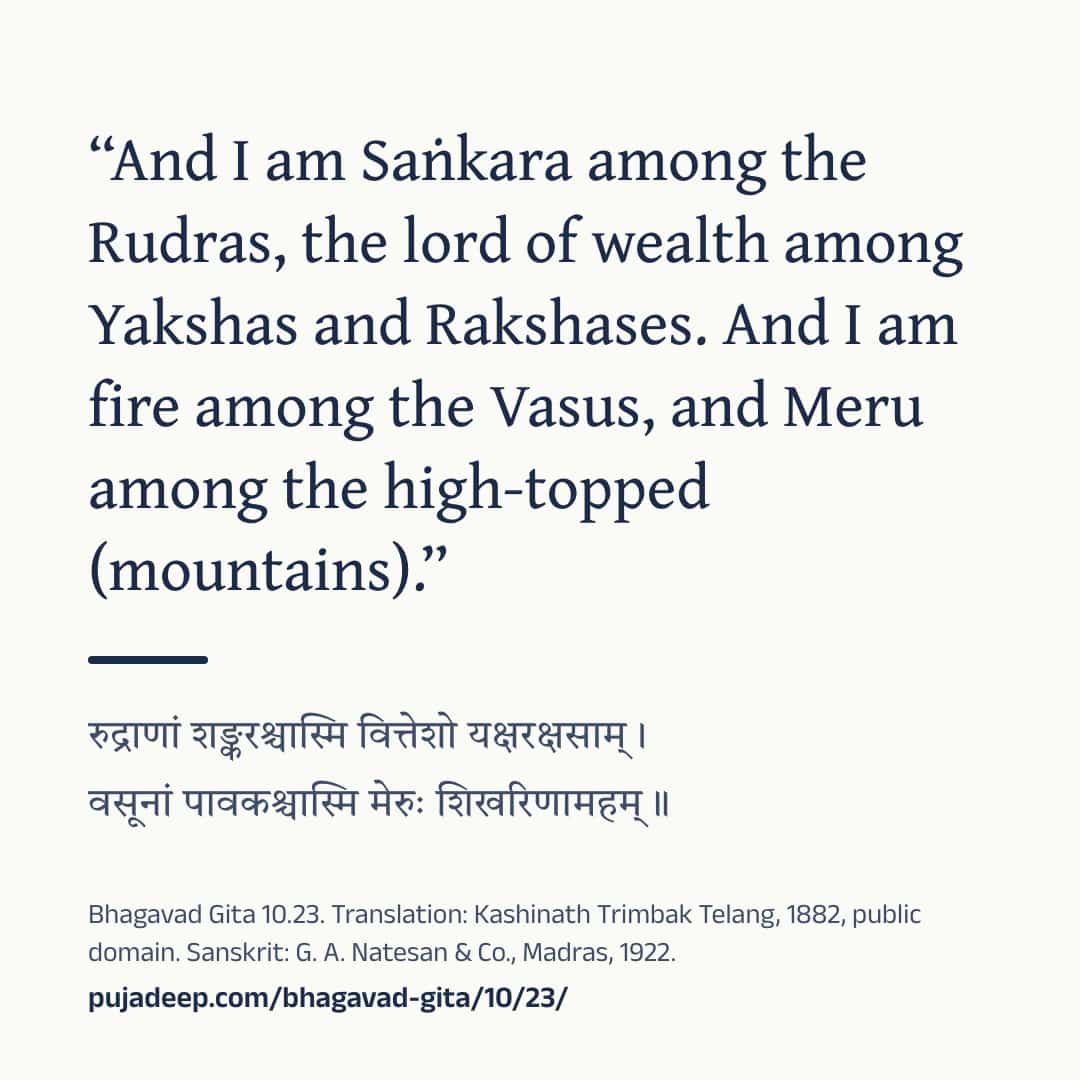
Drawing the picture
See the words
Bhagavad Gita 10.23

रुद्राणां शङ्करश्चास्मि वित्तेशो यक्षरक्षसाम् ।
वसूनां पावकश्चास्मि मेरुः शिखरिणामहम् ॥

“And I am Saṅkara among the Rudras, the lord of wealth among Yakshas and Rakshases. And I am fire among the Vasus, and Meru among the high-topped (mountains).”
(K. T. Telang, The Bhagavadgîtâ (The Sacred Books of the East, vol. VIII, Oxford: Clarendon Press, 1882), p. 88, public domain)

“And of the Rudras Shankara am I, Vittesha of the Yakshas and Râkshasas; and of the Vasus I am Pâvaka, Meru of high mountains am I.”
(Annie Besant, The Bhagavad Gîtâ, or The Lord's Song (London: Theosophical Publishing Society, 1895), p. 99, public domain)

“And of the Rudras I am Shankara, of the Yakshas and Ràkshasas the Lord of wealth (Kuvera), of the Vasus I am Pâvaka, and of mountains, Meru am I.”
(Swami Swarupananda, Srimad-Bhagavad-Gita (Mayavati: Prabuddha Bharata Press, 1909; first printed in Prabuddha Bharata, 1907–1909), p. 203, public domain)

Sanskrit: G. A. Natesan & Co., Madras, 1922.
https://pujadeep.com/bhagavad-gita/10/23/ Nothing is sent from this site. Your own app sends it, to the chat you choose. The picture quotes the translation you chose on this page, with its name and year.
Sanskrit text: The Bhagavad-Gita, or The Lord's Song, with the text in Devanagari and an English translation, 1922. Meanings: written for Pujadeep and checked against the cited edition. Source and changes
Questions families ask
Who speaks Bhagavad Gita 10.23?
Krishna speaks this verse, in chapter 10 (Vibhuti Yoga).
Where does the Sanskrit text come from?
Sanskrit text: The Bhagavad-Gita, or The Lord's Song, with the text in Devanagari and an English translation, 1922. Meanings: written for Pujadeep and checked against the cited edition. See the source
Is the meaning on this page a translation?
Explanation written for this site from the sources listed here, and checked against the cited edition. It is not a translation and not the only way to read the text. Free to quote with credit.
Source and licence
- Sanskrit text
- The Bhagavad-Gita, or The Lord's Song, with the text in Devanagari and an English translation (Annie Besant, G. A. Natesan & Co., Madras, 1922). Public domain. The Sanskrit on these pages was read from this printing’s page images.
- Translation
- The Bhagavadgîtâ with the Sanatsugâtîya and the Anugîtâ, translated by Kâshinâth Trimbak Telang (The Sacred Books of the East, vol. VIII, ed. F. Max Müller) (Kashinath Trimbak Telang, F. Max Müller, Clarendon Press, Oxford, 1882). Public domain. Shown verbatim, as printed.
- Translation
- The Bhagavad Gîtâ, or The Lord's Song, translated by Annie Besant (Annie Besant, Theosophical Publishing Society, London, 1895). Public domain. Shown verbatim, as printed.
- Translation
- Srimad-Bhagavad-Gita, with Sanskrit Text; Paraphrase with Word-by-word Literal Translation; English Rendering and Comments, Index, &c., by the Swami Swarupananda (Himalayan Series, No. XX) (Swami Swarupananda, The Editors and Publishers, Advaita Ashrama, Mayavati, Prabuddha Bharata Press, Mayavati, Almora, Himalayas, 1909). Public domain. Shown verbatim, as printed.
- Common wording
- In this text, 32 words follow today's common wording, checked against sanskritdocuments.org; Sanskrit Wikisource; Gita Press, Gorakhpur; GRETIL, Göttingen and Bhaktivedanta Book Trust.
- Our explanation
- Explanation written for this site from the sources listed here, and checked against the cited edition. It is not a translation and not the only way to read the text. Free to quote with credit.
- Checked
- Checked against the cited edition, October 15, 2026.
- Updated
- October 25, 2026