Bhagavad Gita 10.22: meaning and translation
Chapter 10: Vibhuti Yoga. Krishna says
Among the Vedas, Krishna says, he is the Sāma Veda; among the gods, Vāsava (Indra); among the senses, the mind; among living beings, consciousness (cetanā).
Click or tap a word for its meaning and its dictionary page.
Text and layers
Text and layers
These choices stay in this browser.
Bhagavad Gita 10.22
वेदानां सामवेदोऽस्मि देवानामस्मि वासवः ।इन्द्रियाणां मनश्चास्मि भूतानामस्मि चेतना ॥
Vedanam samavedosmi devanamasmi vasavahIndriyanam manashchasmi bhutanamasmi chetana
vedānāṃ sāmavedo’smi devānāmasmi vāsavaḥ |indriyāṇāṃ manaścāsmi bhūtānāmasmi cetanā ||
Our explanation Among the Vedas, Krishna says, he is the Sāma Veda; among the gods, Vāsava (Indra); among the senses, the mind; among living beings, consciousness (cetanā).
हिंदी अर्थ कृष्ण कहते हैं कि वेदों में वे सामवेद हैं; देवताओं में वासव (इंद्र); इंद्रियों में मन; और प्राणियों में चेतना।
Word by word
Every word, with its dictionary page
Word by word
- वेदानाम् vedānām · among the Vedas (noun (masculine), genitive plural) Dictionary: 1. veda, Monier-Williams 1899, p. 1015, col. 1 “knowledge, true or sacred knowledge or lore”
- सामवेदः sāmavedaḥ · the Sāma Veda (compound (masculine), nominative singular) Dictionary: sāma-veda, Monier-Williams 1899, p. 1205, col. 2 “‘Veda of chants,’ N. of one of the three principal Vedas”
- अस्मि asmi · am (present, 1st person singular) Dictionary: 1. as, Monier-Williams 1899, p. 117, col. 2 “to be, live, exist, be present”
- देवानाम् devānām · among the gods (noun (masculine), genitive plural) Dictionary: deva, Monier-Williams 1899, p. 492, col. 2 “a deity, god”
- अस्मि asmi · am (present, 1st person singular) Dictionary: 1. as, Monier-Williams 1899, p. 117, col. 2 “to be, live, exist, be present”
- वासवः vāsavaḥ · Vāsava (Indra) (noun (masculine), nominative singular) Dictionary: vāsava, Monier-Williams 1899, p. 948, col. 1 “N. of Indra (as chief of the Vasus)”
- इन्द्रियाणाम् indriyāṇām · among the senses (noun (neuter), genitive plural) Dictionary: indriya, Monier-Williams 1899, p. 167, col. 2 “faculty of sense, sense, organ of sense”
- मनः manaḥ · the mind (noun (neuter), nominative singular) Dictionary: manas, Monier-Williams 1899, p. 783, col. 3 “mind (in its widest sense as applied to all the mental powers)”
- च ca · and (indeclinable) Dictionary: 2. ca, Monier-Williams 1899, p. 380, col. 1 “and, both, also, moreover, as well as”
- अस्मि asmi · am (present, 1st person singular) Dictionary: 1. as, Monier-Williams 1899, p. 117, col. 2 “to be, live, exist, be present”
- भूतानाम् bhūtānām · in living beings (noun (neuter), genitive plural) Dictionary: bhūta, Monier-Williams 1899, p. 761, col. 3 “that which is or exists, any living being (divine, human, animal, and even vegetable)”
- अस्मि asmi · am (present, 1st person singular) Dictionary: 1. as, Monier-Williams 1899, p. 117, col. 2 “to be, live, exist, be present”
- चेतना cetanā · consciousness (noun (feminine), nominative singular) Dictionary: cetana, Monier-Williams 1899, p. 397, col. 3 “consciousness, understanding, sense, intelligence”
1 printing differs
Edition differences. Another printing or text reads this place differently.
- The printed edition reads: वेदान सामवेदोऽस्मि देवानामस्मि वासवः ।
इन्द्रियाणां मनश्चास्मि भूतानामस्मि चेतना ॥ The print reads वेदान (with a short, broken stroke after न and no anusvara) where the genitive plural वेदानां ('among the Vedas') is needed; read as a damaged ā-sign and lost anusvara and restored, because the parallel genitives of the list (देवानाम्, इन्द्रियाणाम्, भूतानाम्) and both proofreading references read वेदानां.
Old translations
Kashinath Trimbak Telang, 1882. Public domain. Page 88.
Among the Vedas, I am the Sâma-veda1. I am Indra among the gods. And I am mind among the senses2. I am consciousness in (living) beings.
Footnotes (the translator’s own) Compare 3 translations
Kashinath Trimbak Telang, 1882. Public domain. Page 88.
Among the Vedas, I am the Sâma-veda1. I am Indra among the gods. And I am mind among the senses2. I am consciousness in (living) beings.
Footnotes (the translator’s own) You are reading this one
Annie Besant, 1895. Public domain. Page 99.
Of the Vedas I am the Sâma-Veda, I am Vâsava of the Gods; and of the senses I am Manas, I am of living beings the intelligence.
You are reading this one
Swami Swarupananda, 1909 (first printed 1907). Public domain. Page 203.
I am the Sâma-Veda of the Vedas, Vàsava (Indra) of the gods, and of the senses I am Manas, and intelligence in living beings am I.
You are reading this one
Cite this verse
The translation: K. T. Telang, The Bhagavadgîtâ (The Sacred Books of the East, vol. VIII, Oxford: Clarendon Press, 1882), p. 88. Bhagavad Gita 10.22.
The translation: Annie Besant, The Bhagavad Gîtâ, or The Lord's Song (London: Theosophical Publishing Society, 1895), p. 99. Bhagavad Gita 10.22.
The translation: Swami Swarupananda, Srimad-Bhagavad-Gita (Mayavati: Prabuddha Bharata Press, 1909; first printed in Prabuddha Bharata, 1907–1909), p. 203. Bhagavad Gita 10.22.
Our explanation: “Bhagavad Gita 10.22: meaning and translation.” Pujadeep. Updated October 25, 2026. https://pujadeep.com/bhagavad-gita/10/22/
Pujadeep’s explanations are free to quote with credit: name Pujadeep and link to the page. How to credit
Classical readings, by school
No readings by school on this verse yet.
Share
Show the ways to share
Send one picture or the text to one chat. The picture names its source and the address of this page.
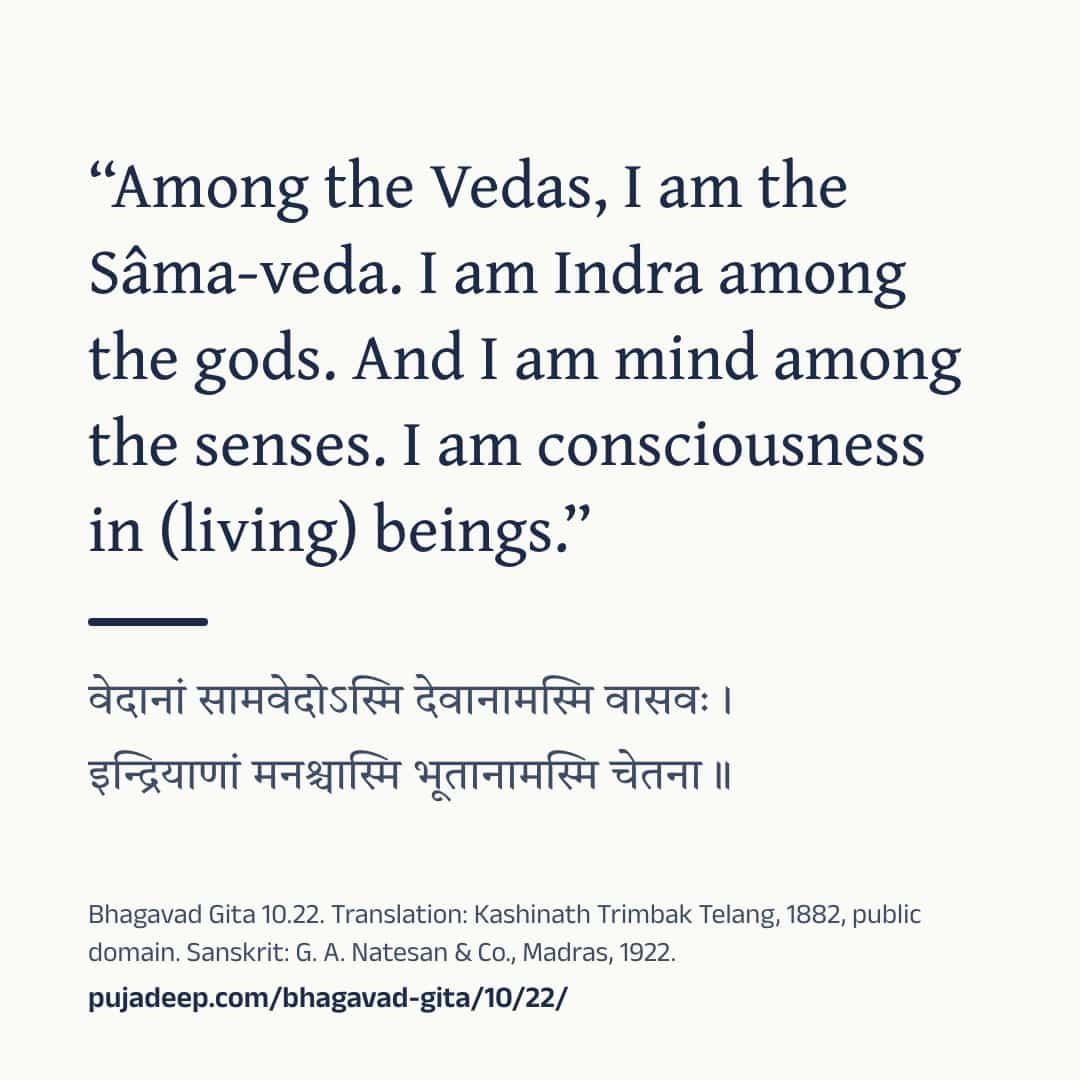
Drawing the picture
See the words
Bhagavad Gita 10.22

वेदानां सामवेदोऽस्मि देवानामस्मि वासवः ।
इन्द्रियाणां मनश्चास्मि भूतानामस्मि चेतना ॥

“Among the Vedas, I am the Sâma-veda. I am Indra among the gods. And I am mind among the senses. I am consciousness in (living) beings.”
(K. T. Telang, The Bhagavadgîtâ (The Sacred Books of the East, vol. VIII, Oxford: Clarendon Press, 1882), p. 88, public domain)

“Of the Vedas I am the Sâma-Veda, I am Vâsava of the Gods; and of the senses I am Manas, I am of living beings the intelligence.”
(Annie Besant, The Bhagavad Gîtâ, or The Lord's Song (London: Theosophical Publishing Society, 1895), p. 99, public domain)

“I am the Sâma-Veda of the Vedas, Vàsava (Indra) of the gods, and of the senses I am Manas, and intelligence in living beings am I.”
(Swami Swarupananda, Srimad-Bhagavad-Gita (Mayavati: Prabuddha Bharata Press, 1909; first printed in Prabuddha Bharata, 1907–1909), p. 203, public domain)

Sanskrit: G. A. Natesan & Co., Madras, 1922.
https://pujadeep.com/bhagavad-gita/10/22/ Nothing is sent from this site. Your own app sends it, to the chat you choose. The picture quotes the translation you chose on this page, with its name and year.
Sanskrit text: The Bhagavad-Gita, or The Lord's Song, with the text in Devanagari and an English translation, 1922. Meanings: written for Pujadeep and checked against the cited edition. Source and changes
Questions families ask
Who speaks Bhagavad Gita 10.22?
Krishna speaks this verse, in chapter 10 (Vibhuti Yoga).
Where does the Sanskrit text come from?
Sanskrit text: The Bhagavad-Gita, or The Lord's Song, with the text in Devanagari and an English translation, 1922. Meanings: written for Pujadeep and checked against the cited edition. See the source
Is the meaning on this page a translation?
Explanation written for this site from the sources listed here, and checked against the cited edition. It is not a translation and not the only way to read the text. Free to quote with credit.
Source and licence
- Sanskrit text
- The Bhagavad-Gita, or The Lord's Song, with the text in Devanagari and an English translation (Annie Besant, G. A. Natesan & Co., Madras, 1922). Public domain. The Sanskrit on these pages was read from this printing’s page images.
- Translation
- The Bhagavadgîtâ with the Sanatsugâtîya and the Anugîtâ, translated by Kâshinâth Trimbak Telang (The Sacred Books of the East, vol. VIII, ed. F. Max Müller) (Kashinath Trimbak Telang, F. Max Müller, Clarendon Press, Oxford, 1882). Public domain. Shown verbatim, as printed.
- Translation
- The Bhagavad Gîtâ, or The Lord's Song, translated by Annie Besant (Annie Besant, Theosophical Publishing Society, London, 1895). Public domain. Shown verbatim, as printed.
- Translation
- Srimad-Bhagavad-Gita, with Sanskrit Text; Paraphrase with Word-by-word Literal Translation; English Rendering and Comments, Index, &c., by the Swami Swarupananda (Himalayan Series, No. XX) (Swami Swarupananda, The Editors and Publishers, Advaita Ashrama, Mayavati, Prabuddha Bharata Press, Mayavati, Almora, Himalayas, 1909). Public domain. Shown verbatim, as printed.
- Common wording
- In this text, 32 words follow today's common wording, checked against sanskritdocuments.org; Sanskrit Wikisource; Gita Press, Gorakhpur; GRETIL, Göttingen and Bhaktivedanta Book Trust.
- Our explanation
- Explanation written for this site from the sources listed here, and checked against the cited edition. It is not a translation and not the only way to read the text. Free to quote with credit.
- Checked
- Checked against the cited edition, October 15, 2026.
- Updated
- October 25, 2026