Bhagavad Gita 10.16: meaning and translation
Chapter 10: Vibhuti Yoga. Arjuna says
Arjuna asks Krishna to describe in full his own divine glories (vibhūtis), the glories by which he pervades these worlds and remains in them.
Click or tap a word for its meaning and its dictionary page.
Text and layers
Text and layers
These choices stay in this browser.
Bhagavad Gita 10.16
वक्तुमर्हस्यशेषेण दिव्या ह्यात्मविभूतयः ।याभिर्विभूतिभिर्लोकानिमांस्त्वं व्याप्य तिष्ठसि ॥
Vaktumarhasyasheshena divya hyatmavibhutayahYabhirvibhutibhirlokanimanstvam vyapya tishthasi
vaktumarhasyaśeṣeṇa divyā hyātmavibhūtayaḥ |yābhirvibhūtibhirlokānimāṃstvaṃ vyāpya tiṣṭhasi ||
Our explanation Arjuna asks Krishna to describe in full his own divine glories (vibhūtis), the glories by which he pervades these worlds and remains in them.
हिंदी अर्थ अर्जुन कृष्ण से कहते हैं कि वे अपनी उन दिव्य विभूतियों का पूरा वर्णन करें, जिनके द्वारा वे इन लोकों में व्याप्त होकर स्थित हैं।
Word by word
Every word, with its dictionary page
Word by word
- वक्तुम् vaktum · to tell (infinitive (to do)) Dictionary: vac, Monier-Williams 1899, p. 912, col. 1 “to speak, say, tell, utter, announce”
- अर्हसि arhasi · you should, please (present, 2nd person singular) Dictionary: arh, Monier-Williams 1899, p. 93, col. 3 “to be able”; arh, Monier-Williams 1899, p. 93, col. 3 “is often used as a softened form of Imper.”
- अशेषेण aśeṣeṇa · in full, leaving nothing out (adverb) Dictionary: a-śeṣa, Monier-Williams 1899, p. 113, col. 3 “without remainder, entire, perfect, all”
- दिव्याः divyāḥ · divine (adjective (feminine), nominative plural) Dictionary: 2. divya, Monier-Williams 1899, p. 479, col. 2 “divine, heavenly, celestial”
- हि hi · indeed (indeclinable) Dictionary: 2. hi, Monier-Williams 1899, p. 1297, col. 3 “for, because, on account of”
- आत्मविभूतयः ātmavibhūtayaḥ · your own glories (compound (feminine), nominative plural) Dictionary: ātman, Monier-Williams 1899, p. 135, col. 1 “the individual soul, self”; vi-bhūti, Monier-Williams 1899, p. 979, col. 1 “splendour, glory, magnificence”
- याभिः yābhiḥ · by which (relative pronoun (feminine), instrumental plural) Dictionary: yad, Monier-Williams 1899, p. 844, col. 2 “who, which, what, whichever, whatever, that”
- विभूतिभिः vibhūtibhiḥ · glories (noun (feminine), instrumental plural) Dictionary: vi-bhūti, Monier-Williams 1899, p. 978, col. 3 “manifestation of might, great power, superhuman power”
- लोकान् lokān · worlds (noun (masculine), accusative plural) Dictionary: loka, Monier-Williams 1899, p. 906, col. 1 “the wide space or world”
- इमान् imān · these (pronoun (masculine), accusative plural) Dictionary: 1. idam, Monier-Williams 1899, p. 165, col. 2 “this, this here, referring to something near the speaker”
- त्वम् tvam · you (pronoun, nominative singular) Dictionary: yuṣmad, Monier-Williams 1899, p. 855, col. 3 “the base of the 2nd pers. pron. as used in comp.”
- व्याप्य vyāpya · pervading (absolutive (having done)) Dictionary: vy-āp, Monier-Williams 1899, p. 1037, col. 2 “to reach or spread through, pervade, permeate”
- तिष्ठसि tiṣṭhasi · you remain (present, 2nd person singular) Dictionary: sthā, Monier-Williams 1899, p. 1262, col. 2 “to stand, stand firmly, station one's self”
Old translations
Kashinath Trimbak Telang, 1882. Public domain.
Telang translates verses 15–16 together; see 10.15. Read it at 10.15
Compare 3 translations
Kashinath Trimbak Telang, 1882. Public domain.
Telang translates verses 15–16 together; see 10.15. Read it at 10.15
You are reading this one
Annie Besant, 1895. Public domain. Page 98.
Deign to tell without reserve of Thy divine SELF-sovereignty, by which sovereignty Thou stayest, pervading these worlds.
You are reading this one
Swami Swarupananda, 1909 (first printed 1907). Public domain. Page 200.
Thou shouldst indeed speak without reserve of Thy Divine attributes by which, filling all these worlds, Thou existest.
You are reading this one
Cite this verse
The translation: K. T. Telang, The Bhagavadgîtâ (The Sacred Books of the East, vol. VIII, Oxford: Clarendon Press, 1882), pp. 87–88. Bhagavad Gita 10.15–16.
The translation: Annie Besant, The Bhagavad Gîtâ, or The Lord's Song (London: Theosophical Publishing Society, 1895), p. 98. Bhagavad Gita 10.16.
The translation: Swami Swarupananda, Srimad-Bhagavad-Gita (Mayavati: Prabuddha Bharata Press, 1909; first printed in Prabuddha Bharata, 1907–1909), p. 200. Bhagavad Gita 10.16.
Our explanation: “Bhagavad Gita 10.16: meaning and translation.” Pujadeep. Updated October 25, 2026. https://pujadeep.com/bhagavad-gita/10/16/
Pujadeep’s explanations are free to quote with credit: name Pujadeep and link to the page. How to credit
Classical readings, by school
No readings by school on this verse yet.
Share
Show the ways to share
Send one picture or the text to one chat. The picture names its source and the address of this page.
Drawing the picture
See the words
Bhagavad Gita 10.16

वक्तुमर्हस्यशेषेण दिव्या ह्यात्मविभूतयः ।
याभिर्विभूतिभिर्लोकानिमांस्त्वं व्याप्य तिष्ठसि ॥

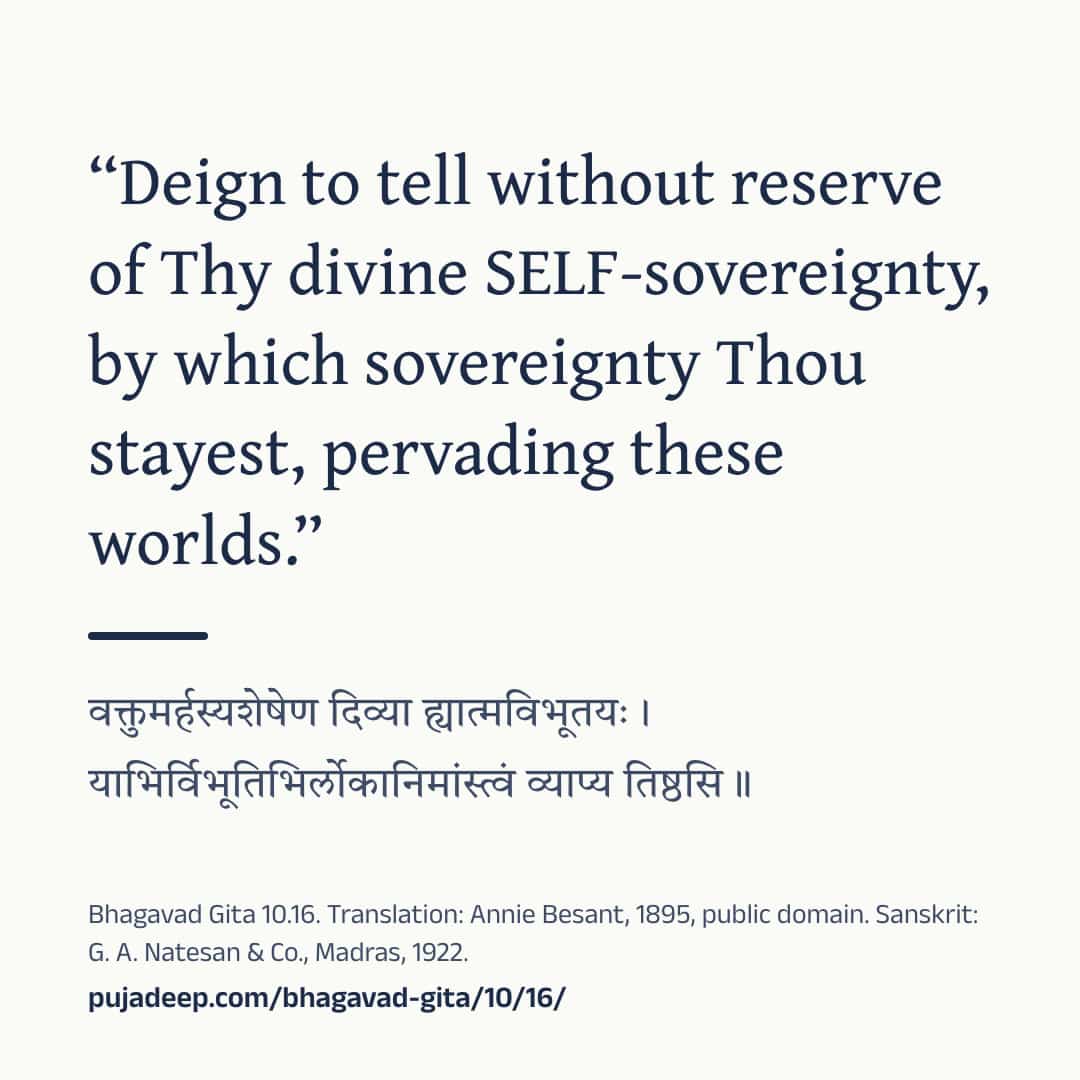
“Deign to tell without reserve of Thy divine SELF-sovereignty, by which sovereignty Thou stayest, pervading these worlds.”
(Annie Besant, The Bhagavad Gîtâ, or The Lord's Song (London: Theosophical Publishing Society, 1895), p. 98, public domain)

“Thou shouldst indeed speak without reserve of Thy Divine attributes by which, filling all these worlds, Thou existest.”
(Swami Swarupananda, Srimad-Bhagavad-Gita (Mayavati: Prabuddha Bharata Press, 1909; first printed in Prabuddha Bharata, 1907–1909), p. 200, public domain)

Sanskrit: G. A. Natesan & Co., Madras, 1922.
https://pujadeep.com/bhagavad-gita/10/16/ Nothing is sent from this site. Your own app sends it, to the chat you choose. The picture quotes the translation you chose on this page, with its name and year.
Sanskrit text: The Bhagavad-Gita, or The Lord's Song, with the text in Devanagari and an English translation, 1922. Meanings: written for Pujadeep and checked against the cited edition. Source and changes
Questions families ask
Who speaks Bhagavad Gita 10.16?
Arjuna speaks this verse, in chapter 10 (Vibhuti Yoga).
Where does the Sanskrit text come from?
Sanskrit text: The Bhagavad-Gita, or The Lord's Song, with the text in Devanagari and an English translation, 1922. Meanings: written for Pujadeep and checked against the cited edition. See the source
Is the meaning on this page a translation?
Explanation written for this site from the sources listed here, and checked against the cited edition. It is not a translation and not the only way to read the text. Free to quote with credit.
Source and licence
- Sanskrit text
- The Bhagavad-Gita, or The Lord's Song, with the text in Devanagari and an English translation (Annie Besant, G. A. Natesan & Co., Madras, 1922). Public domain. The Sanskrit on these pages was read from this printing’s page images.
- Translation
- The Bhagavadgîtâ with the Sanatsugâtîya and the Anugîtâ, translated by Kâshinâth Trimbak Telang (The Sacred Books of the East, vol. VIII, ed. F. Max Müller) (Kashinath Trimbak Telang, F. Max Müller, Clarendon Press, Oxford, 1882). Public domain. Shown verbatim, as printed.
- Translation
- The Bhagavad Gîtâ, or The Lord's Song, translated by Annie Besant (Annie Besant, Theosophical Publishing Society, London, 1895). Public domain. Shown verbatim, as printed.
- Translation
- Srimad-Bhagavad-Gita, with Sanskrit Text; Paraphrase with Word-by-word Literal Translation; English Rendering and Comments, Index, &c., by the Swami Swarupananda (Himalayan Series, No. XX) (Swami Swarupananda, The Editors and Publishers, Advaita Ashrama, Mayavati, Prabuddha Bharata Press, Mayavati, Almora, Himalayas, 1909). Public domain. Shown verbatim, as printed.
- Common wording
- In this text, 32 words follow today's common wording, checked against sanskritdocuments.org; Sanskrit Wikisource; Gita Press, Gorakhpur; GRETIL, Göttingen and Bhaktivedanta Book Trust.
- Our explanation
- Explanation written for this site from the sources listed here, and checked against the cited edition. It is not a translation and not the only way to read the text. Free to quote with credit.
- Checked
- Checked against the cited edition, October 15, 2026.
- Updated
- October 25, 2026