Bhagavad Gita 10.8: meaning and translation
Chapter 10: Vibhuti Yoga. Krishna says
Krishna says he is the source of all, and everything moves forth from him.
Click or tap a word for its meaning and its dictionary page.
Text and layers
Text and layers
These choices stay in this browser.
Bhagavad Gita 10.8
अहं सर्वस्य प्रभवो मत्तः सर्वं प्रवर्तते ।इति मत्वा भजन्ते मां बुधा भावसमन्विताः ॥
Aham sarvasya prabhavo mattah sarvam pravartateIti matva bhajante mam budha bhavasamanvitah
ahaṃ sarvasya prabhavo mattaḥ sarvaṃ pravartate |iti matvā bhajante māṃ budhā bhāvasamanvitāḥ ||
Our explanation Krishna says he is the source of all, and everything moves forth from him. Knowing this, the wise worship him, filled with bhāva. The commentators read bhāva differently (see the views).
हिंदी अर्थ कृष्ण कहते हैं कि वे सबके मूल हैं और सब कुछ उन्हीं से प्रवृत्त होता है। यह जानकर बुद्धिमान लोग भाव से भरकर उनकी उपासना करते हैं। टीकाकार “भाव” शब्द को अलग-अलग ढंग से समझते हैं।
Word by word
Every word, with its dictionary page
Word by word
- अहम् aham · "I" (Krishna) (pronoun, nominative singular) Dictionary: aham, Monier-Williams 1899, p. 124, col. 2 “nom. sg. ‘I,’”
- सर्वस्य sarvasya · of all (pronoun (neuter), genitive singular) Dictionary: sarva, Monier-Williams 1899, p. 1184, col. 3 “whole, entire, all, every”
- प्रभवः prabhavaḥ · the source (noun (masculine), nominative singular) Dictionary: pra-bhava, Monier-Williams 1899, p. 684, col. 2 “m. production, source, origin, cause of existence”
- मत्तः mattaḥ · from "me" (Krishna) (pronoun, ablative singular) Dictionary: 1. mad, Monier-Williams 1899, p. 777, col. 2 “base of the first pers. pron. in the sg. number (esp. in comp.)”
- सर्वम् sarvam · everything (pronoun (neuter), nominative singular) Dictionary: sarva, Monier-Williams 1899, p. 1184, col. 3 “whole, entire, all, every”
- प्रवर्तते pravartate · moves forth, proceeds (present, 3rd person singular) Dictionary: pra-vṛt, Monier-Williams 1899, p. 693, col. 2 “to come forth, issue, originate, arise, be produced”
- इति iti · thus (indeclinable) Dictionary: 2. iti, Monier-Williams 1899, p. 165, col. 1 “in this manner, thus”
- मत्वा matvā · having understood (absolutive (having done)) Dictionary: man, Monier-Williams 1899, p. 783, col. 1 “to think, believe, imagine, suppose, conjecture”
- भजन्ते bhajante · worship (present, 3rd person plural) Dictionary: bhaj, Monier-Williams 1899, p. 743, col. 1 “to serve, honour, revere, love, adore”
- माम् mām · "me" (Krishna) (pronoun, accusative singular) Dictionary: 1. mad, Monier-Williams 1899, p. 777, col. 2 “base of the first pers. pron. in the sg. number (esp. in comp.)”
- बुधाः budhāḥ · the wise (noun (masculine), nominative plural) Dictionary: budha, Monier-Williams 1899, p. 734, col. 1 “a wise or learned man, sage”
- भावसमन्विताः bhāvasamanvitāḥ · filled with bhāva (deep feeling) (compound (masculine), nominative plural) Dictionary: bhāva, Monier-Williams 1899, p. 754, col. 2 “any state of mind or body, way of thinking or feeling, sentiment”; sam-anvita, Monier-Williams 1899, p. 1155, col. 2 “connected or associated with, completely possessed of, fully endowed with”
Old translations
Kashinath Trimbak Telang, 1882. Public domain. Page 87.
The wise, full of love1, worship me, believing that I am the origin of all, and that all moves on through me.
Footnotes (the translator’s own) - Saṅkara renders the word here by perseverance in pursuit of truth. ↩
Compare 3 translations
Kashinath Trimbak Telang, 1882. Public domain. Page 87.
The wise, full of love1, worship me, believing that I am the origin of all, and that all moves on through me.
Footnotes (the translator’s own) - Saṅkara renders the word here by perseverance in pursuit of truth. ↩
You are reading this one
Annie Besant, 1895. Public domain. Page 96.
I am the Generator of all; all evolves from Me; having thus thought, the wise adore Me, partaking of My Nature.
You are reading this one
Swami Swarupananda, 1909 (first printed 1907). Public domain. Page 196.
I am the origin of all, from Me everything evolves;—thus thinking the wise worship Me with loving consciousness.
You are reading this one
Cite this verse
The translation: K. T. Telang, The Bhagavadgîtâ (The Sacred Books of the East, vol. VIII, Oxford: Clarendon Press, 1882), p. 87. Bhagavad Gita 10.8.
The translation: Annie Besant, The Bhagavad Gîtâ, or The Lord's Song (London: Theosophical Publishing Society, 1895), p. 96. Bhagavad Gita 10.8.
The translation: Swami Swarupananda, Srimad-Bhagavad-Gita (Mayavati: Prabuddha Bharata Press, 1909; first printed in Prabuddha Bharata, 1907–1909), p. 196. Bhagavad Gita 10.8.
Our explanation: “Bhagavad Gita 10.8: meaning and translation.” Pujadeep. Updated October 25, 2026. https://pujadeep.com/bhagavad-gita/10/8/
Pujadeep’s explanations are free to quote with credit: name Pujadeep and link to the page. How to credit
Classical readings, by school
Each reading is named by its school. None is presented as the only meaning.
What Advaita, Vishishtadvaita and Dvaita teach, in short
Shankara Advaita
Shankara says the wise, who know the supreme reality, worship the Lord while deeply absorbed in contemplating that reality; that is what 'filled with bhāva' means.
Source: The Bhagavad-Gita, with the commentary of Sri Sankaracharya, translated by A. Mahadeva Sastri (2nd ed., Mysore: G. T. A. Printing Works, 1901), commentary on 10.8, p. 237. Summarised in our own words; none of its text is reproduced.
Ramanuja Vishishtadvaita
Ramanuja says bhāva is the mood of the mind turned towards the Lord in loving devotion. The wise know him as the free Lord of creation, with qualities such as gentleness, beauty and tender affection, and worship him in that way.
Source: Sri Bhagavad-Gita with Sri Ramanujacharya's Visishtadvaita commentary, translated by A. Govindacharya (Madras, 1898), commentary on 10.8, p. 326. Summarised in our own words; none of its text is reproduced.
Share
Show the ways to share
Send one picture or the text to one chat. The picture names its source and the address of this page.
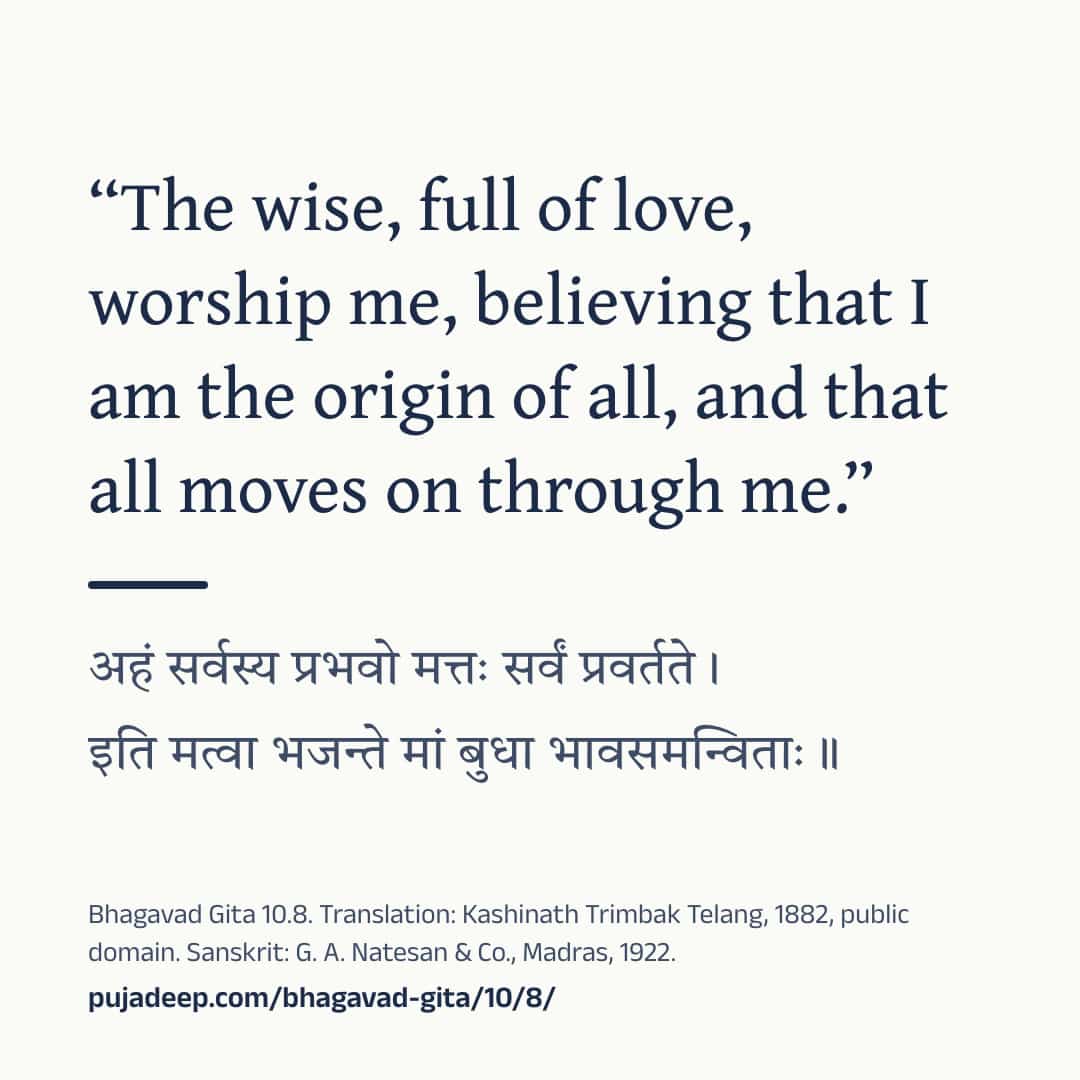
Drawing the picture
See the words
Bhagavad Gita 10.8

अहं सर्वस्य प्रभवो मत्तः सर्वं प्रवर्तते ।
इति मत्वा भजन्ते मां बुधा भावसमन्विताः ॥

“The wise, full of love, worship me, believing that I am the origin of all, and that all moves on through me.”
(K. T. Telang, The Bhagavadgîtâ (The Sacred Books of the East, vol. VIII, Oxford: Clarendon Press, 1882), p. 87, public domain)

“I am the Generator of all; all evolves from Me; having thus thought, the wise adore Me, partaking of My Nature.”
(Annie Besant, The Bhagavad Gîtâ, or The Lord's Song (London: Theosophical Publishing Society, 1895), p. 96, public domain)

“I am the origin of all, from Me everything evolves;—thus thinking the wise worship Me with loving consciousness.”
(Swami Swarupananda, Srimad-Bhagavad-Gita (Mayavati: Prabuddha Bharata Press, 1909; first printed in Prabuddha Bharata, 1907–1909), p. 196, public domain)

Sanskrit: G. A. Natesan & Co., Madras, 1922.
https://pujadeep.com/bhagavad-gita/10/8/ Nothing is sent from this site. Your own app sends it, to the chat you choose. The picture quotes the translation you chose on this page, with its name and year.
Sanskrit text: The Bhagavad-Gita, or The Lord's Song, with the text in Devanagari and an English translation, 1922. Meanings: written for Pujadeep and checked against the cited edition. Source and changes
Questions families ask
Who speaks Bhagavad Gita 10.8?
Krishna speaks this verse, in chapter 10 (Vibhuti Yoga).
Where does the Sanskrit text come from?
Sanskrit text: The Bhagavad-Gita, or The Lord's Song, with the text in Devanagari and an English translation, 1922. Meanings: written for Pujadeep and checked against the cited edition. See the source
Is the meaning on this page a translation?
Explanation written for this site from the sources listed here, and checked against the cited edition. It is not a translation and not the only way to read the text. Free to quote with credit.
Source and licence
- Sanskrit text
- The Bhagavad-Gita, or The Lord's Song, with the text in Devanagari and an English translation (Annie Besant, G. A. Natesan & Co., Madras, 1922). Public domain. The Sanskrit on these pages was read from this printing’s page images.
- Translation
- The Bhagavadgîtâ with the Sanatsugâtîya and the Anugîtâ, translated by Kâshinâth Trimbak Telang (The Sacred Books of the East, vol. VIII, ed. F. Max Müller) (Kashinath Trimbak Telang, F. Max Müller, Clarendon Press, Oxford, 1882). Public domain. Shown verbatim, as printed.
- Translation
- The Bhagavad Gîtâ, or The Lord's Song, translated by Annie Besant (Annie Besant, Theosophical Publishing Society, London, 1895). Public domain. Shown verbatim, as printed.
- Translation
- Srimad-Bhagavad-Gita, with Sanskrit Text; Paraphrase with Word-by-word Literal Translation; English Rendering and Comments, Index, &c., by the Swami Swarupananda (Himalayan Series, No. XX) (Swami Swarupananda, The Editors and Publishers, Advaita Ashrama, Mayavati, Prabuddha Bharata Press, Mayavati, Almora, Himalayas, 1909). Public domain. Shown verbatim, as printed.
- Commentary
- The Bhagavad-Gita, with the commentary of Sri Sankaracharya, translated by A. Mahadeva Sastri (2nd ed., Mysore: G. T. A. Printing Works, 1901) (Public-domain scan, University of California Libraries). Summarised in our own words; none of its text is reproduced.
- Commentary
- Sri Bhagavad-Gita with Sri Ramanujacharya's Visishtadvaita commentary, translated by A. Govindacharya (Madras, 1898) (Scan uploaded to archive.org (folkscanomy collection)). Summarised in our own words; none of its text is reproduced.
- Common wording
- In this text, 32 words follow today's common wording, checked against sanskritdocuments.org; Sanskrit Wikisource; Gita Press, Gorakhpur; GRETIL, Göttingen and Bhaktivedanta Book Trust.
- Our explanation
- Explanation written for this site from the sources listed here, and checked against the cited edition. It is not a translation and not the only way to read the text. Free to quote with credit.
- Checked
- Checked against the cited edition, October 15, 2026.
- Updated
- October 25, 2026