Bhagavad Gita 10.1: meaning and translation
Chapter 10: Vibhuti Yoga. Krishna says
Krishna speaks again.
Click or tap a word for its meaning and its dictionary page.
Text and layers
Text and layers
These choices stay in this browser.
Bhagavad Gita 10.1
श्रीभगवानुवाच ।
भूय एव महाबाहो शृणु मे परमं वचः ।यत्तेऽहं प्रीयमाणाय वक्ष्यामि हितकाम्यया ॥
Bhuya eva mahabaho shrinu me paramam vachahYatteham priyamanaya vakshyami hitakamyaya
bhūya eva mahābāho śṛṇu me paramaṃ vacaḥ |yatte’haṃ prīyamāṇāya vakṣyāmi hitakāmyayā ||
Our explanation Krishna speaks again. He asks Arjuna, the mighty-armed, to listen once more to his highest word, which he will speak for Arjuna's good, because Arjuna takes delight in hearing it.
हिंदी अर्थ कृष्ण फिर बोलते हैं। वे महाबाहु अर्जुन से कहते हैं कि वे एक बार फिर उनका परम वचन सुनें, जो वे अर्जुन के हित के लिए कहेंगे, क्योंकि अर्जुन उसे सुनकर प्रसन्न होते हैं।
Word by word
Every word, with its dictionary page
Word by word
- भूयः bhūyaḥ · again (indeclinable) Dictionary: bhūyas, Monier-Williams 1899, p. 763, col. 3 “once more, again, anew”
- एव eva · indeed, just (indeclinable) Dictionary: 1. eva, Monier-Williams 1899, p. 232, col. 2 “just, exactly, very, same, only, even, alone, merely”
- महाबाहो mahābāho · O mighty-armed one (Arjuna) (compound (masculine), vocative singular) Dictionary: mahā-bāhu, Monier-Williams 1899, p. 798, col. 1 “long-armed”
- शृणु śṛṇu · listen (imperative, 2nd person singular) Dictionary: 1. śru, Monier-Williams 1899, p. 1100, col. 3 “to hear, listen or attend to anything”
- मे me · "my" (Krishna's) (pronoun, genitive singular) Dictionary: 1. mad, Monier-Williams 1899, p. 777, col. 2 “base of the first pers. pron. in the sg. number (esp. in comp.)”
- परमम् paramam · highest, supreme (adjective (neuter), accusative singular) Dictionary: parama, Monier-Williams 1899, p. 588, col. 1 “chief, highest, primary, most prominent or conspicuous”
- वचः vacaḥ · word, speech (noun (neuter), accusative singular) Dictionary: 1. vacas, Monier-Williams 1899, p. 912, col. 3 “speech, voice, word”
- यत् yat · which (relative pronoun (neuter), accusative singular) Dictionary: yad, Monier-Williams 1899, p. 844, col. 2 “who, which, what, whichever, whatever, that”
- ते te · to you (Arjuna) (pronoun, dative singular) Dictionary: yuṣmad, Monier-Williams 1899, p. 855, col. 3 “the base of the 2nd pers. pron. as used in comp.”
- अहम् aham · "I" (Krishna) (pronoun, nominative singular) Dictionary: aham, Monier-Williams 1899, p. 124, col. 2 “nom. sg. ‘I,’”
- प्रीयमाणाय prīyamāṇāya · to one who takes delight (present participle (masculine), dative singular) Dictionary: 1. prī, Monier-Williams 1899, p. 710, col. 1 “to be pleased or satisfied”
- वक्ष्यामि vakṣyāmi · will speak (future, 1st person singular) Dictionary: vac, Monier-Williams 1899, p. 912, col. 1 “to speak, say, tell, utter, announce”
- हितकाम्यया hitakāmyayā · out of a wish for (your) good (compound (feminine), instrumental singular) Dictionary: hita, Monier-Williams 1899, p. 1298, col. 2 “beneficial, advantageous, salutary, wholesome, suitable”; kāmyā, Monier-Williams 1899, p. 273, col. 3 “wish, desire, longing for or striving after”
Old translations
Kashinath Trimbak Telang, 1882. Public domain. Page 86.
Yet again, O you of mighty arms! listen to my excellent1 words, which, out of a wish for your welfare, I speak to you who are delighted (with them).
Footnotes (the translator’s own) - As referring to the supreme soul. ↩
Compare 3 translations
Kashinath Trimbak Telang, 1882. Public domain. Page 86.
Yet again, O you of mighty arms! listen to my excellent1 words, which, out of a wish for your welfare, I speak to you who are delighted (with them).
Footnotes (the translator’s own) - As referring to the supreme soul. ↩
You are reading this one
Annie Besant, 1895. Public domain. Page 95.
The Blessed Lord said:
Again, O mighty-armed, hear thou My supreme word, that desiring thy welfare, I will declare to thee who art beloved.
You are reading this one
Swami Swarupananda, 1909 (first printed 1907). Public domain. Page 193.
The Blessed Lord said:
Again, O mighty-armed, do thou listen to My Supreme word, which I, wishing thy welfare, will tell thee who art delighted (to hear Me).
You are reading this one
Cite this verse
The translation: K. T. Telang, The Bhagavadgîtâ (The Sacred Books of the East, vol. VIII, Oxford: Clarendon Press, 1882), p. 86. Bhagavad Gita 10.1.
The translation: Annie Besant, The Bhagavad Gîtâ, or The Lord's Song (London: Theosophical Publishing Society, 1895), p. 95. Bhagavad Gita 10.1.
The translation: Swami Swarupananda, Srimad-Bhagavad-Gita (Mayavati: Prabuddha Bharata Press, 1909; first printed in Prabuddha Bharata, 1907–1909), p. 193. Bhagavad Gita 10.1.
Our explanation: “Bhagavad Gita 10.1: meaning and translation.” Pujadeep. Updated October 25, 2026. https://pujadeep.com/bhagavad-gita/10/1/
Pujadeep’s explanations are free to quote with credit: name Pujadeep and link to the page. How to credit
Classical readings, by school
No readings by school on this verse yet.
Share
Show the ways to share
Send one picture or the text to one chat. The picture names its source and the address of this page.
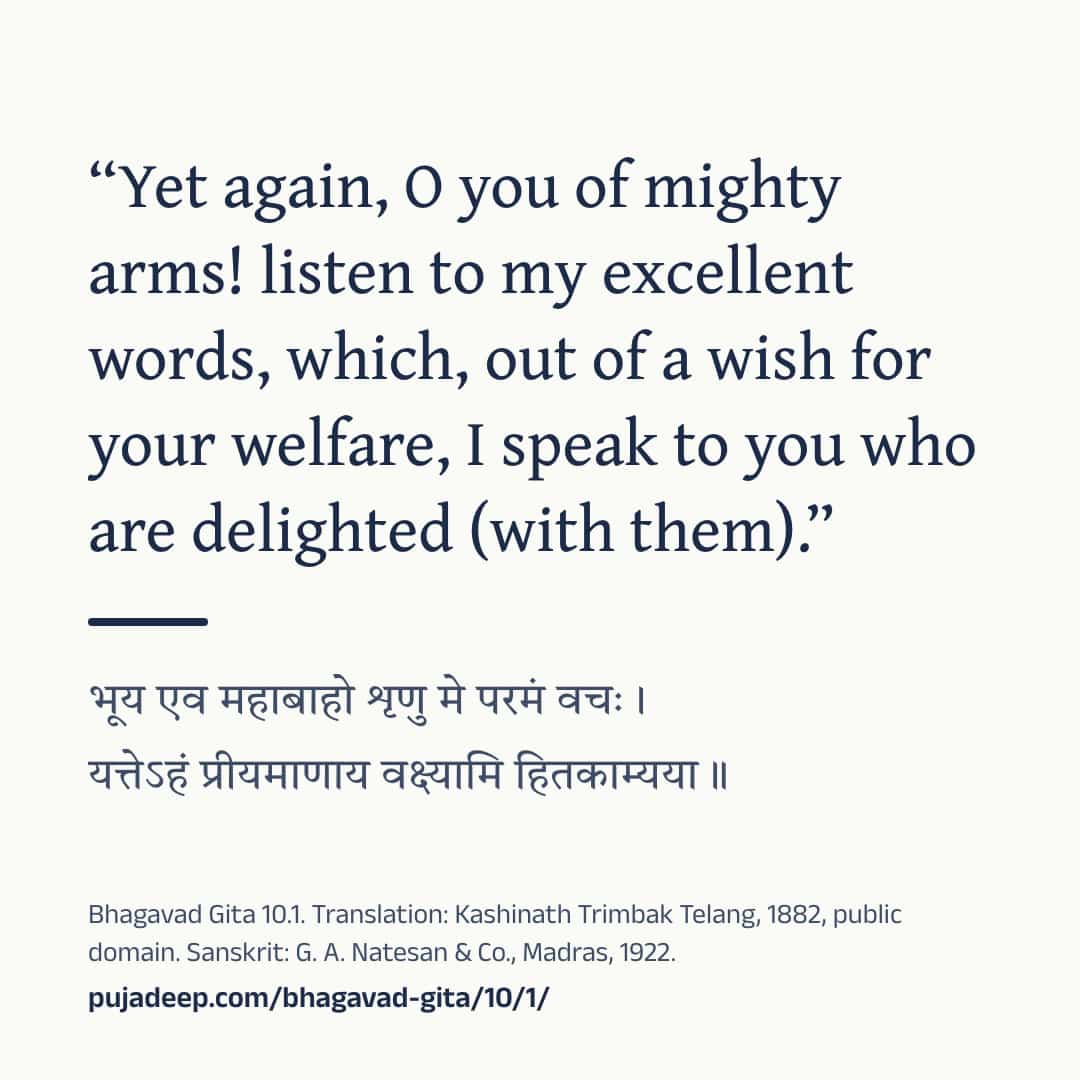
Drawing the picture
See the words
Bhagavad Gita 10.1

भूय एव महाबाहो शृणु मे परमं वचः ।
यत्तेऽहं प्रीयमाणाय वक्ष्यामि हितकाम्यया ॥

“Yet again, O you of mighty arms! listen to my excellent words, which, out of a wish for your welfare, I speak to you who are delighted (with them).”
(K. T. Telang, The Bhagavadgîtâ (The Sacred Books of the East, vol. VIII, Oxford: Clarendon Press, 1882), p. 86, public domain)

“Again, O mighty-armed, hear thou My supreme word, that desiring thy welfare, I will declare to thee who art beloved.”
(Annie Besant, The Bhagavad Gîtâ, or The Lord's Song (London: Theosophical Publishing Society, 1895), p. 95, public domain)

“Again, O mighty-armed, do thou listen to My Supreme word, which I, wishing thy welfare, will tell thee who art delighted (to hear Me).”
(Swami Swarupananda, Srimad-Bhagavad-Gita (Mayavati: Prabuddha Bharata Press, 1909; first printed in Prabuddha Bharata, 1907–1909), p. 193, public domain)

Sanskrit: G. A. Natesan & Co., Madras, 1922.
https://pujadeep.com/bhagavad-gita/10/1/ Nothing is sent from this site. Your own app sends it, to the chat you choose. The picture quotes the translation you chose on this page, with its name and year.
Sanskrit text: The Bhagavad-Gita, or The Lord's Song, with the text in Devanagari and an English translation, 1922. Meanings: written for Pujadeep and checked against the cited edition. Source and changes
Questions families ask
Who speaks Bhagavad Gita 10.1?
Krishna speaks this verse, in chapter 10 (Vibhuti Yoga).
Where does the Sanskrit text come from?
Sanskrit text: The Bhagavad-Gita, or The Lord's Song, with the text in Devanagari and an English translation, 1922. Meanings: written for Pujadeep and checked against the cited edition. See the source
Is the meaning on this page a translation?
Explanation written for this site from the sources listed here, and checked against the cited edition. It is not a translation and not the only way to read the text. Free to quote with credit.
Source and licence
- Sanskrit text
- The Bhagavad-Gita, or The Lord's Song, with the text in Devanagari and an English translation (Annie Besant, G. A. Natesan & Co., Madras, 1922). Public domain. The Sanskrit on these pages was read from this printing’s page images.
- Translation
- The Bhagavadgîtâ with the Sanatsugâtîya and the Anugîtâ, translated by Kâshinâth Trimbak Telang (The Sacred Books of the East, vol. VIII, ed. F. Max Müller) (Kashinath Trimbak Telang, F. Max Müller, Clarendon Press, Oxford, 1882). Public domain. Shown verbatim, as printed.
- Translation
- The Bhagavad Gîtâ, or The Lord's Song, translated by Annie Besant (Annie Besant, Theosophical Publishing Society, London, 1895). Public domain. Shown verbatim, as printed.
- Translation
- Srimad-Bhagavad-Gita, with Sanskrit Text; Paraphrase with Word-by-word Literal Translation; English Rendering and Comments, Index, &c., by the Swami Swarupananda (Himalayan Series, No. XX) (Swami Swarupananda, The Editors and Publishers, Advaita Ashrama, Mayavati, Prabuddha Bharata Press, Mayavati, Almora, Himalayas, 1909). Public domain. Shown verbatim, as printed.
- Common wording
- In this text, 32 words follow today's common wording, checked against sanskritdocuments.org; Sanskrit Wikisource; Gita Press, Gorakhpur; GRETIL, Göttingen and Bhaktivedanta Book Trust.
- Our explanation
- Explanation written for this site from the sources listed here, and checked against the cited edition. It is not a translation and not the only way to read the text. Free to quote with credit.
- Checked
- Checked against the cited edition, October 15, 2026.
- Updated
- October 25, 2026