Bhagavad Gita 10.5: meaning and translation
Chapter 10: Vibhuti Yoga. Krishna says
Krishna: The list goes on: harmlessness (ahiṃsā), evenness, contentment, austerity, giving, fame and disgrace.
Click or tap a word for its meaning and its dictionary page.
Text and layers
Text and layers
These choices stay in this browser.
Bhagavad Gita 10.5
अहिंसा समता तुष्टिस्तपो दानं यशोऽयशः ।भवन्ति भावा भूतानां मत्त एव पृथग्विधाः ॥
Ahinsa samata tushtistapo danam yashoyashahBhavanti bhava bhutanam matta eva prithagvidhah
ahiṃsā samatā tuṣṭistapo dānaṃ yaśo’yaśaḥ |bhavanti bhāvā bhūtānāṃ matta eva pṛthagvidhāḥ ||
Our explanation The list goes on: harmlessness (ahiṃsā), evenness, contentment, austerity, giving, fame and disgrace. Krishna says that all these different states of beings arise from him alone.
हिंदी अर्थ सूची आगे चलती है: अहिंसा, समता, संतोष, तप, दान, यश और अपयश। कृष्ण कहते हैं कि प्राणियों के ये सब अलग-अलग भाव उन्हीं से उत्पन्न होते हैं।
Word by word
Every word, with its dictionary page
Word by word
- अहिंसा ahiṃsā · not harming (noun (feminine), nominative singular) Dictionary: a-hiṃsā, Monier-Williams 1899, p. 125, col. 2 “not injuring anything, harmlessness”
- समता samatā · evenness of mind (noun (feminine), nominative singular) Dictionary: sama-tā, Monier-Williams 1899, p. 1152, col. 2 “equality, sameness”
- तुष्टिः tuṣṭiḥ · contentment (noun (feminine), nominative singular) Dictionary: tuṣṭi, Monier-Williams 1899, p. 452, col. 1 “satisfaction, contentment”
- तपः tapaḥ · austerity (noun (neuter), nominative singular) Dictionary: tapas, Monier-Williams 1899, p. 437, col. 1 “religious austerity, bodily mortification, penance”
- दानम् dānam · giving (noun (neuter), nominative singular) Dictionary: 1. dāna, Monier-Williams 1899, p. 474, col. 1 “the act of giving”
- यशः yaśaḥ · fame (noun (neuter), nominative singular) Dictionary: yaśas, Monier-Williams 1899, p. 848, col. 2 “honour, glory, fame, renown”
- अयशः ayaśaḥ · disgrace (noun (neuter), nominative singular) Dictionary: a-yaśas, Monier-Williams 1899, p. 85, col. 1 “infamy”
- भवन्ति bhavanti · arise, come to be (present, 3rd person plural) Dictionary: 1. bhū, Monier-Williams 1899, p. 760, col. 2 “to become, be”
- भावाः bhāvāḥ · states, conditions (noun (masculine), nominative plural) Dictionary: bhāva, Monier-Williams 1899, p. 754, col. 2 “state, condition, rank”
- भूतानाम् bhūtānām · of beings (noun (neuter), genitive plural) Dictionary: bhūta, Monier-Williams 1899, p. 761, col. 3 “that which is or exists, any living being (divine, human, animal, and even vegetable)”
- मत्तः mattaḥ · from "me" (Krishna) (pronoun, ablative singular) Dictionary: 1. mad, Monier-Williams 1899, p. 777, col. 2 “base of the first pers. pron. in the sg. number (esp. in comp.)”
- एव eva · alone (indeclinable) Dictionary: 1. eva, Monier-Williams 1899, p. 232, col. 2 “just, exactly, very, same, only, even, alone, merely”
- पृथग्विधाः pṛthagvidhāḥ · of different kinds (compound (masculine), nominative plural) Dictionary: pṛthag-vidha, Monier-Williams 1899, p. 646, col. 1 “of d° kinds, manifold, various”
Old translations
Kashinath Trimbak Telang, 1882. Public domain.
Telang translates verses 4–5 as one sentence; see 10.4. Read it at 10.4
Compare 3 translations
Kashinath Trimbak Telang, 1882. Public domain.
Telang translates verses 4–5 as one sentence; see 10.4. Read it at 10.4
You are reading this one
Annie Besant, 1895. Public domain. Page 96.
Harmlessness, equanimity, content, austerity, almsgiving, fame and obloquy, are the characteristics of beings as severally apportioned by Me.
This sentence begins in 10.4.
You are reading this one
Swami Swarupananda, 1909 (first printed 1907). Public domain.
Swarupananda renders verses 4–5 together; see 10.4. Read it at 10.4
You are reading this one
Cite this verse
The translation: K. T. Telang, The Bhagavadgîtâ (The Sacred Books of the East, vol. VIII, Oxford: Clarendon Press, 1882), p. 86. Bhagavad Gita 10.4–5.
The translation: Annie Besant, The Bhagavad Gîtâ, or The Lord's Song (London: Theosophical Publishing Society, 1895), p. 96. Bhagavad Gita 10.5.
The translation: Swami Swarupananda, Srimad-Bhagavad-Gita (Mayavati: Prabuddha Bharata Press, 1909; first printed in Prabuddha Bharata, 1907–1909), p. 195. Bhagavad Gita 10.4–5.
Our explanation: “Bhagavad Gita 10.5: meaning and translation.” Pujadeep. Updated October 25, 2026. https://pujadeep.com/bhagavad-gita/10/5/
Pujadeep’s explanations are free to quote with credit: name Pujadeep and link to the page. How to credit
Classical readings, by school
No readings by school on this verse yet.
Share
Show the ways to share
Send one picture or the text to one chat. The picture names its source and the address of this page.
Drawing the picture
See the words
Bhagavad Gita 10.5

अहिंसा समता तुष्टिस्तपो दानं यशोऽयशः ।
भवन्ति भावा भूतानां मत्त एव पृथग्विधाः ॥

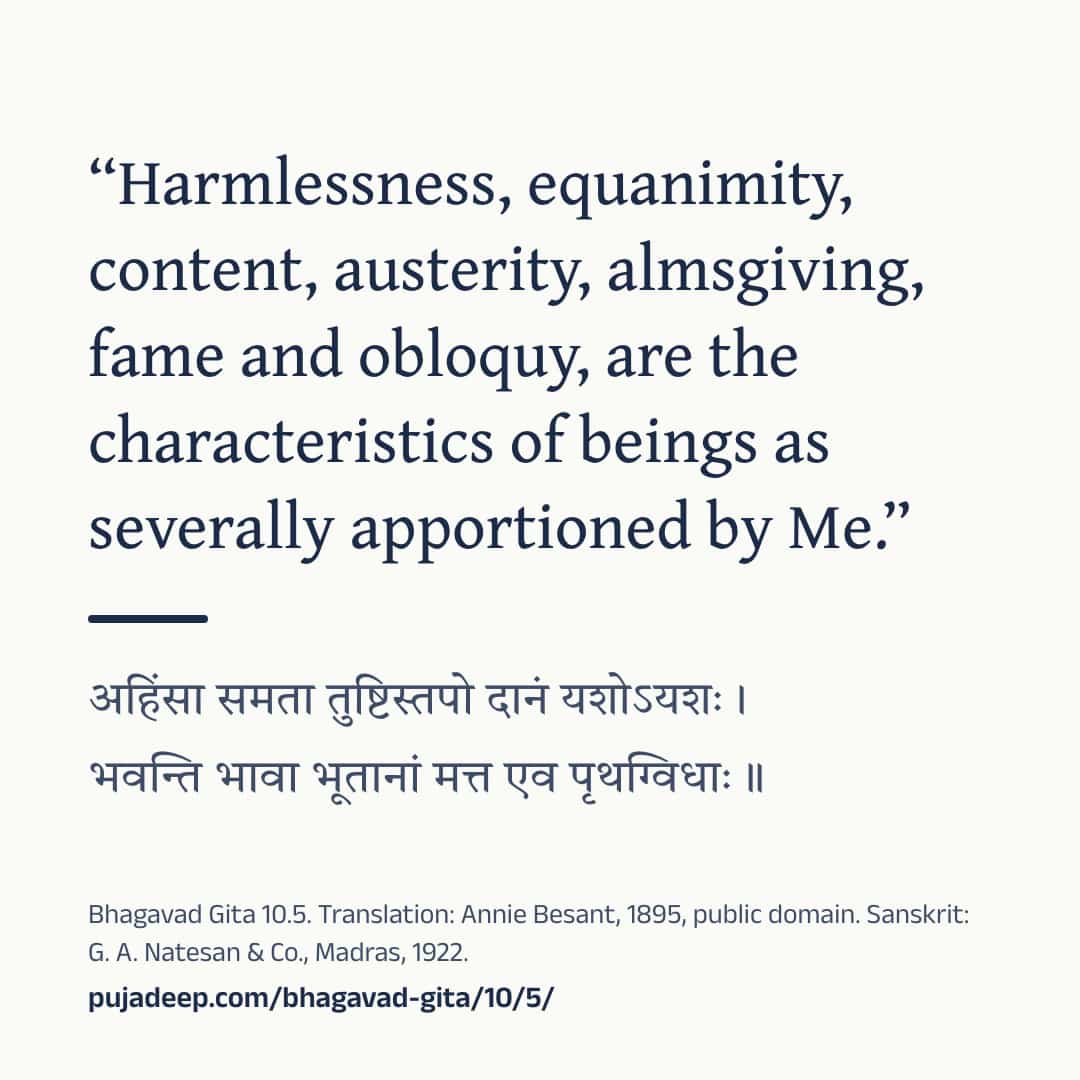
“Harmlessness, equanimity, content, austerity, almsgiving, fame and obloquy, are the characteristics of beings as severally apportioned by Me.”
(Annie Besant, The Bhagavad Gîtâ, or The Lord's Song (London: Theosophical Publishing Society, 1895), p. 96, public domain)
This sentence begins in 10.4.

Sanskrit: G. A. Natesan & Co., Madras, 1922.
https://pujadeep.com/bhagavad-gita/10/5/ Nothing is sent from this site. Your own app sends it, to the chat you choose. The picture quotes the translation you chose on this page, with its name and year.
Sanskrit text: The Bhagavad-Gita, or The Lord's Song, with the text in Devanagari and an English translation, 1922. Meanings: written for Pujadeep and checked against the cited edition. Source and changes
Questions families ask
Who speaks Bhagavad Gita 10.5?
Krishna speaks this verse, in chapter 10 (Vibhuti Yoga).
Where does the Sanskrit text come from?
Sanskrit text: The Bhagavad-Gita, or The Lord's Song, with the text in Devanagari and an English translation, 1922. Meanings: written for Pujadeep and checked against the cited edition. See the source
Is the meaning on this page a translation?
Explanation written for this site from the sources listed here, and checked against the cited edition. It is not a translation and not the only way to read the text. Free to quote with credit.
Source and licence
- Sanskrit text
- The Bhagavad-Gita, or The Lord's Song, with the text in Devanagari and an English translation (Annie Besant, G. A. Natesan & Co., Madras, 1922). Public domain. The Sanskrit on these pages was read from this printing’s page images.
- Translation
- The Bhagavadgîtâ with the Sanatsugâtîya and the Anugîtâ, translated by Kâshinâth Trimbak Telang (The Sacred Books of the East, vol. VIII, ed. F. Max Müller) (Kashinath Trimbak Telang, F. Max Müller, Clarendon Press, Oxford, 1882). Public domain. Shown verbatim, as printed.
- Translation
- The Bhagavad Gîtâ, or The Lord's Song, translated by Annie Besant (Annie Besant, Theosophical Publishing Society, London, 1895). Public domain. Shown verbatim, as printed.
- Translation
- Srimad-Bhagavad-Gita, with Sanskrit Text; Paraphrase with Word-by-word Literal Translation; English Rendering and Comments, Index, &c., by the Swami Swarupananda (Himalayan Series, No. XX) (Swami Swarupananda, The Editors and Publishers, Advaita Ashrama, Mayavati, Prabuddha Bharata Press, Mayavati, Almora, Himalayas, 1909). Public domain. Shown verbatim, as printed.
- Common wording
- In this text, 32 words follow today's common wording, checked against sanskritdocuments.org; Sanskrit Wikisource; Gita Press, Gorakhpur; GRETIL, Göttingen and Bhaktivedanta Book Trust.
- Our explanation
- Explanation written for this site from the sources listed here, and checked against the cited edition. It is not a translation and not the only way to read the text. Free to quote with credit.
- Checked
- Checked against the cited edition, October 15, 2026.
- Updated
- October 25, 2026