Bhagavad Gita 10.11: meaning and translation
Chapter 10: Vibhuti Yoga. Krishna says
Out of compassion for them, Krishna says, he dwells within them and destroys the darkness born of ignorance with the shining lamp of knowledge.
Click or tap a word for its meaning and its dictionary page.
Text and layers
Text and layers
These choices stay in this browser.
Bhagavad Gita 10.11
तेषामेवानुकम्पार्थमहमज्ञानजं तमः ।नाशयाम्यात्मभावस्थो ज्ञानदीपेन भास्वता ॥
Teshamevanukamparthamahamajnanajam tamahNashayamyatmabhavastho jnanadipena bhasvata
teṣāmevānukampārthamahamajñānajaṃ tamaḥ |nāśayāmyātmabhāvastho jñānadīpena bhāsvatā ||
Our explanation Out of compassion for them, Krishna says, he dwells within them and destroys the darkness born of ignorance with the shining lamp of knowledge. The schools explain how he dwells in them (see the views).
हिंदी अर्थ कृष्ण कहते हैं कि उन पर करुणा करके वे उनके भीतर स्थित होकर, ज्ञान के प्रकाशमान दीपक से अज्ञान से उत्पन्न अंधकार का नाश करते हैं। परंपराएँ बताती हैं कि वे उनमें कैसे स्थित होते हैं।
Word by word
Every word, with its dictionary page
Word by word
- तेषाम् teṣām · for them (pronoun (masculine), genitive plural) Dictionary: tad, Monier-Williams 1899, p. 434, col. 1 “m. he, f. she, n. it, that, this”
- एव eva · only, indeed (indeclinable) Dictionary: 1. eva, Monier-Williams 1899, p. 232, col. 2 “just, exactly, very, same, only, even, alone, merely”
- अनुकम्पार्थम् anukampārtham · out of compassion (adverb) Dictionary: anu-kampā, Monier-Williams 1899, p. 31, col. 1; anu-kampana, Monier-Williams 1899, p. 31, col. 1 “sympathy, compassion”; artha, Monier-Williams 1899, p. 90, col. 3 “for the sake of, on account of, in behalf of, for”
- अहम् aham · "I" (Krishna) (pronoun, nominative singular) Dictionary: aham, Monier-Williams 1899, p. 124, col. 2 “nom. sg. ‘I,’”
- अज्ञानजम् ajñānajam · born of ignorance (compound (neuter), accusative singular) Dictionary: a-jñāna, Monier-Williams 1899, p. 10, col. 3 “non-cognizance; ignorance”; 2. ja, Monier-Williams 1899, p. 407, col. 3 “born or descended from, produced or caused by”
- तमः tamaḥ · darkness (noun (neuter), accusative singular) Dictionary: tamas, Monier-Williams 1899, p. 438, col. 1 “darkness, gloom”
- नाशयामि nāśayāmi · destroy (causative present, 1st person singular) Dictionary: 2. naś, Monier-Williams 1899, p. 532, col. 1 “to cause to be lost or disappear, drive away, expel, remove, destroy”
- आत्मभावस्थः ātmabhāvasthaḥ · dwelling within their being (compound (masculine), nominative singular) Dictionary: ātma-bhāva, Monier-Williams 1899, p. 135, col. 3 “existence of the soul”; stha, Monier-Williams 1899, p. 1262, col. 3 “standing, staying, abiding, being situated in”
- ज्ञानदीपेन jñānadīpena · with the lamp of knowledge (compound (masculine), instrumental singular) Dictionary: jñāna, Monier-Williams 1899, p. 426, col. 1 “knowing, becoming acquainted with, knowledge”; dīpa, Monier-Williams 1899, p. 481, col. 1 “a light, lamp, lantern”
- भास्वता bhāsvatā · shining (adjective (masculine), instrumental singular) Dictionary: bhās-vat, Monier-Williams 1899, p. 756, col. 1 “luminous, splendid, shining”
Old translations
Kashinath Trimbak Telang, 1882. Public domain. Page 87.
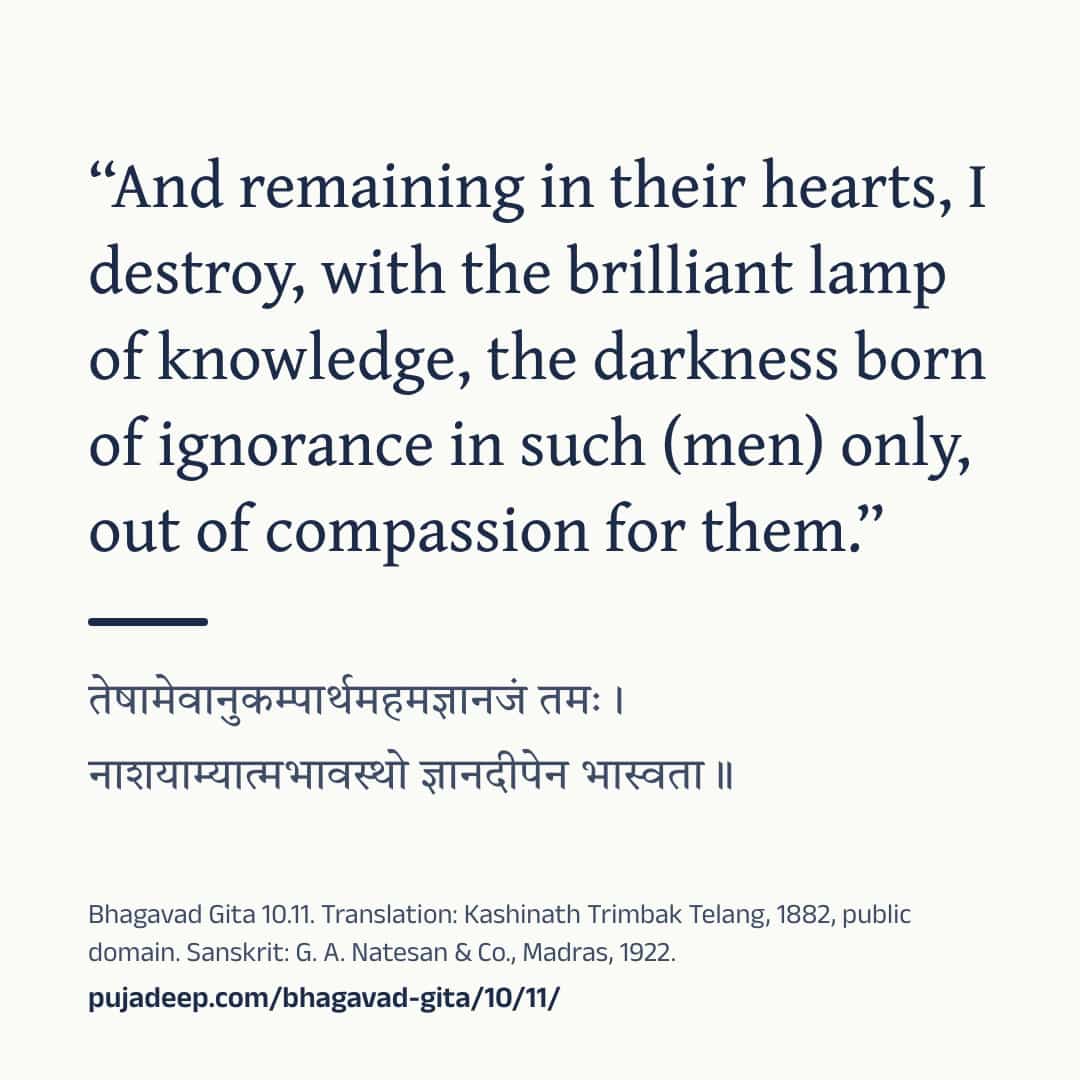
And remaining in their hearts, I destroy, with the brilliant lamp of knowledge, the darkness born of ignorance in such (men) only, out of compassion for them.
Compare 3 translations
Kashinath Trimbak Telang, 1882. Public domain. Page 87.
And remaining in their hearts, I destroy, with the brilliant lamp of knowledge, the darkness born of ignorance in such (men) only, out of compassion for them.
You are reading this one
Annie Besant, 1895. Public domain. Page 97.
In them, out of compassion, dwelling within their SELF, I destroy the ignorance-born darkness by the shining lamp of wisdom.
You are reading this one
Swami Swarupananda, 1909 (first printed 1907). Public domain. Page 198.
Out of mere compassion for them, I, abiding in their hearts, destroy the darkness (in them) born of ignorance, by the luminous lamp of knowledge.
You are reading this one
Cite this verse
The translation: K. T. Telang, The Bhagavadgîtâ (The Sacred Books of the East, vol. VIII, Oxford: Clarendon Press, 1882), p. 87. Bhagavad Gita 10.11.
The translation: Annie Besant, The Bhagavad Gîtâ, or The Lord's Song (London: Theosophical Publishing Society, 1895), p. 97. Bhagavad Gita 10.11.
The translation: Swami Swarupananda, Srimad-Bhagavad-Gita (Mayavati: Prabuddha Bharata Press, 1909; first printed in Prabuddha Bharata, 1907–1909), p. 198. Bhagavad Gita 10.11.
Our explanation: “Bhagavad Gita 10.11: meaning and translation.” Pujadeep. Updated October 25, 2026. https://pujadeep.com/bhagavad-gita/10/11/
Pujadeep’s explanations are free to quote with credit: name Pujadeep and link to the page. How to credit
Classical readings, by school
Each reading is named by its school. None is presented as the only meaning.
What Advaita, Vishishtadvaita and Dvaita teach, in short
Shankara Advaita
Shankara says the Lord dwells in their inner sense, which is turned only to the Self, and removes the darkness of mistaken knowledge with the lamp of discernment. He describes the lamp as fed by devotion, fanned by meditation and sheltered from the wind of worldly concerns.
Source: The Bhagavad-Gita, with the commentary of Sri Sankaracharya, translated by A. Mahadeva Sastri (2nd ed., Mysore: G. T. A. Printing Works, 1901), commentary on 10.11, pp. 238–239. Summarised in our own words; none of its text is reproduced.
Ramanuja Vishishtadvaita
Ramanuja says the Lord is present in their thoughts as the one object of those thoughts and makes his blessed qualities shine there. The darkness is the long habit, shaped by past karma, of wanting things other than him.
Source: Sri Bhagavad-Gita with Sri Ramanujacharya's Visishtadvaita commentary, translated by A. Govindacharya (Madras, 1898), commentary on 10.11, p. 327. Summarised in our own words; none of its text is reproduced.
Share
Show the ways to share
Send one picture or the text to one chat. The picture names its source and the address of this page.
Drawing the picture
See the words
Bhagavad Gita 10.11

तेषामेवानुकम्पार्थमहमज्ञानजं तमः ।
नाशयाम्यात्मभावस्थो ज्ञानदीपेन भास्वता ॥

“And remaining in their hearts, I destroy, with the brilliant lamp of knowledge, the darkness born of ignorance in such (men) only, out of compassion for them.”
(K. T. Telang, The Bhagavadgîtâ (The Sacred Books of the East, vol. VIII, Oxford: Clarendon Press, 1882), p. 87, public domain)

“In them, out of compassion, dwelling within their SELF, I destroy the ignorance-born darkness by the shining lamp of wisdom.”
(Annie Besant, The Bhagavad Gîtâ, or The Lord's Song (London: Theosophical Publishing Society, 1895), p. 97, public domain)

“Out of mere compassion for them, I, abiding in their hearts, destroy the darkness (in them) born of ignorance, by the luminous lamp of knowledge.”
(Swami Swarupananda, Srimad-Bhagavad-Gita (Mayavati: Prabuddha Bharata Press, 1909; first printed in Prabuddha Bharata, 1907–1909), p. 198, public domain)

Sanskrit: G. A. Natesan & Co., Madras, 1922.
https://pujadeep.com/bhagavad-gita/10/11/ Nothing is sent from this site. Your own app sends it, to the chat you choose. The picture quotes the translation you chose on this page, with its name and year.
Sanskrit text: The Bhagavad-Gita, or The Lord's Song, with the text in Devanagari and an English translation, 1922. Meanings: written for Pujadeep and checked against the cited edition. Source and changes
Questions families ask
Who speaks Bhagavad Gita 10.11?
Krishna speaks this verse, in chapter 10 (Vibhuti Yoga).
Where does the Sanskrit text come from?
Sanskrit text: The Bhagavad-Gita, or The Lord's Song, with the text in Devanagari and an English translation, 1922. Meanings: written for Pujadeep and checked against the cited edition. See the source
Is the meaning on this page a translation?
Explanation written for this site from the sources listed here, and checked against the cited edition. It is not a translation and not the only way to read the text. Free to quote with credit.
Source and licence
- Sanskrit text
- The Bhagavad-Gita, or The Lord's Song, with the text in Devanagari and an English translation (Annie Besant, G. A. Natesan & Co., Madras, 1922). Public domain. The Sanskrit on these pages was read from this printing’s page images.
- Translation
- The Bhagavadgîtâ with the Sanatsugâtîya and the Anugîtâ, translated by Kâshinâth Trimbak Telang (The Sacred Books of the East, vol. VIII, ed. F. Max Müller) (Kashinath Trimbak Telang, F. Max Müller, Clarendon Press, Oxford, 1882). Public domain. Shown verbatim, as printed.
- Translation
- The Bhagavad Gîtâ, or The Lord's Song, translated by Annie Besant (Annie Besant, Theosophical Publishing Society, London, 1895). Public domain. Shown verbatim, as printed.
- Translation
- Srimad-Bhagavad-Gita, with Sanskrit Text; Paraphrase with Word-by-word Literal Translation; English Rendering and Comments, Index, &c., by the Swami Swarupananda (Himalayan Series, No. XX) (Swami Swarupananda, The Editors and Publishers, Advaita Ashrama, Mayavati, Prabuddha Bharata Press, Mayavati, Almora, Himalayas, 1909). Public domain. Shown verbatim, as printed.
- Commentary
- The Bhagavad-Gita, with the commentary of Sri Sankaracharya, translated by A. Mahadeva Sastri (2nd ed., Mysore: G. T. A. Printing Works, 1901) (Public-domain scan, University of California Libraries). Summarised in our own words; none of its text is reproduced.
- Commentary
- Sri Bhagavad-Gita with Sri Ramanujacharya's Visishtadvaita commentary, translated by A. Govindacharya (Madras, 1898) (Scan uploaded to archive.org (folkscanomy collection)). Summarised in our own words; none of its text is reproduced.
- Common wording
- In this text, 32 words follow today's common wording, checked against sanskritdocuments.org; Sanskrit Wikisource; Gita Press, Gorakhpur; GRETIL, Göttingen and Bhaktivedanta Book Trust.
- Our explanation
- Explanation written for this site from the sources listed here, and checked against the cited edition. It is not a translation and not the only way to read the text. Free to quote with credit.
- Checked
- Checked against the cited edition, October 15, 2026.
- Updated
- October 25, 2026