Bhagavad Gita 10.14: meaning and translation
Chapter 10: Vibhuti Yoga. Arjuna says
Arjuna tells Krishna, Keshava, that he believes all he has said to be true, for neither the gods nor the demons (dānavas) know his manifestation.
Click or tap a word for its meaning and its dictionary page.
Text and layers
Text and layers
These choices stay in this browser.
Bhagavad Gita 10.14
सर्वमेतदृतं मन्ये यन्मां वदसि केशव ।न हि ते भगवन्व्यक्तिं विदुर्देवा न दानवाः ॥
Sarvametadritam manye yanmam vadasi keshavaNa hi te bhagavanvyaktim vidurdeva na danavah
sarvametadṛtaṃ manye yanmāṃ vadasi keśava |na hi te bhagavanvyaktiṃ vidurdevā na dānavāḥ ||
Our explanation Arjuna tells Krishna, Keshava, that he believes all he has said to be true, for neither the gods nor the demons (dānavas) know his manifestation.
हिंदी अर्थ अर्जुन कृष्ण (केशव) से कहते हैं कि वे जो कुछ कह रहे हैं, उसे वे सत्य मानते हैं, क्योंकि न देवता उनके स्वरूप की अभिव्यक्ति को जानते हैं, न दानव।
Word by word
Every word, with its dictionary page
Word by word
- सर्वम् sarvam · all (pronoun (neuter), accusative singular) Dictionary: sarva, Monier-Williams 1899, p. 1184, col. 3 “whole, entire, all, every”
- एतत् etat · this (pronoun (neuter), accusative singular) Dictionary: etad, Monier-Williams 1899, p. 231, col. 2 “this, this here, here”
- ऋतम् ṛtam · true (adjective (neuter), accusative singular) Dictionary: ṛta, Monier-Williams 1899, p. 223, col. 3 “truth in general, righteousness, right”
- मन्ये manye · "I" (Arjuna) hold (present, 1st person singular) Dictionary: man, Monier-Williams 1899, p. 783, col. 1 “to think, believe, imagine, suppose, conjecture”
- यत् yat · which (relative pronoun (neuter), accusative singular) Dictionary: yad, Monier-Williams 1899, p. 844, col. 2 “who, which, what, whichever, whatever, that”
- माम् mām · to "me" (Arjuna) (pronoun, accusative singular) Dictionary: 1. mad, Monier-Williams 1899, p. 777, col. 2 “base of the first pers. pron. in the sg. number (esp. in comp.)”
- वदसि vadasi · you say (present, 2nd person singular) Dictionary: vad, Monier-Williams 1899, p. 916, col. 1 “to speak, say, utter, tell, report”
- केशव keśava · O Keshava (Krishna) (noun (masculine), vocative singular) Dictionary: keśava, Monier-Williams 1899, p. 310, col. 3 “N. of Vishṇu or Kṛishṇa”
- न na · not (indeclinable) Dictionary: 2. na, Monier-Williams 1899, p. 523, col. 1 “not, no, nor, neither”
- हि hi · indeed, for (indeclinable) Dictionary: 2. hi, Monier-Williams 1899, p. 1297, col. 3 “for, because, on account of”
- ते te · your (pronoun, genitive singular) Dictionary: yuṣmad, Monier-Williams 1899, p. 855, col. 3 “the base of the 2nd pers. pron. as used in comp.”
- भगवन् bhagavan · O Lord (noun (masculine), vocative singular) Dictionary: 2. bhagavat, Monier-Williams 1899, p. 743, col. 3 “glorious, illustrious, divine, adorable, venerable”
- व्यक्तिम् vyaktim · manifestation (noun (feminine), accusative singular) Dictionary: vy-akti, Monier-Williams 1899, p. 1029, col. 3 “visible appearance or manifestation”
- विदुः viduḥ · know (perfect with present sense, 3rd person plural) Dictionary: 1. vid, Monier-Williams 1899, p. 963, col. 2 “to know, understand, perceive, learn”
- देवाः devāḥ · the gods (noun (masculine), nominative plural) Dictionary: deva, Monier-Williams 1899, p. 492, col. 2 “a deity, god”
- न na · nor (indeclinable) Dictionary: 2. na, Monier-Williams 1899, p. 523, col. 1 “not, no, nor, neither”
- दानवाः dānavāḥ · the dānavas (demons) (noun (masculine), nominative plural) Dictionary: dānava, Monier-Williams 1899, p. 474, col. 3 “a class of demons often identified with the Daityas or Asuras”
Old translations
Kashinath Trimbak Telang, 1882. Public domain. Page 87.
I believe all this that you tell me (to be) true; for, O lord! neither the gods nor demons understand your manifestation1.
Footnotes (the translator’s own) - Scil. in human form for the good of the gods and the destruction of demons. ↩
Compare 3 translations
Kashinath Trimbak Telang, 1882. Public domain. Page 87.
I believe all this that you tell me (to be) true; for, O lord! neither the gods nor demons understand your manifestation1.
Footnotes (the translator’s own) - Scil. in human form for the good of the gods and the destruction of demons. ↩
You are reading this one
Annie Besant, 1895. Public domain. Page 97.
All this I believe true that Thou sayest to me, O Keshava. Thy manifestation, O Blessed Lord, neither Gods nor Dânavas comprehend.
You are reading this one
Swami Swarupananda, 1909 (first printed 1907). Public domain. Page 199.
I regard all this that Thou sayest to me as true, O Keshava. Verily O Bhagavan, neither the Devas nor the Dânavas know Thy manifestation.
You are reading this one
Cite this verse
The translation: K. T. Telang, The Bhagavadgîtâ (The Sacred Books of the East, vol. VIII, Oxford: Clarendon Press, 1882), p. 87. Bhagavad Gita 10.14.
The translation: Annie Besant, The Bhagavad Gîtâ, or The Lord's Song (London: Theosophical Publishing Society, 1895), p. 97. Bhagavad Gita 10.14.
The translation: Swami Swarupananda, Srimad-Bhagavad-Gita (Mayavati: Prabuddha Bharata Press, 1909; first printed in Prabuddha Bharata, 1907–1909), p. 199. Bhagavad Gita 10.14.
Our explanation: “Bhagavad Gita 10.14: meaning and translation.” Pujadeep. Updated October 25, 2026. https://pujadeep.com/bhagavad-gita/10/14/
Pujadeep’s explanations are free to quote with credit: name Pujadeep and link to the page. How to credit
Classical readings, by school
No readings by school on this verse yet.
Share
Show the ways to share
Send one picture or the text to one chat. The picture names its source and the address of this page.
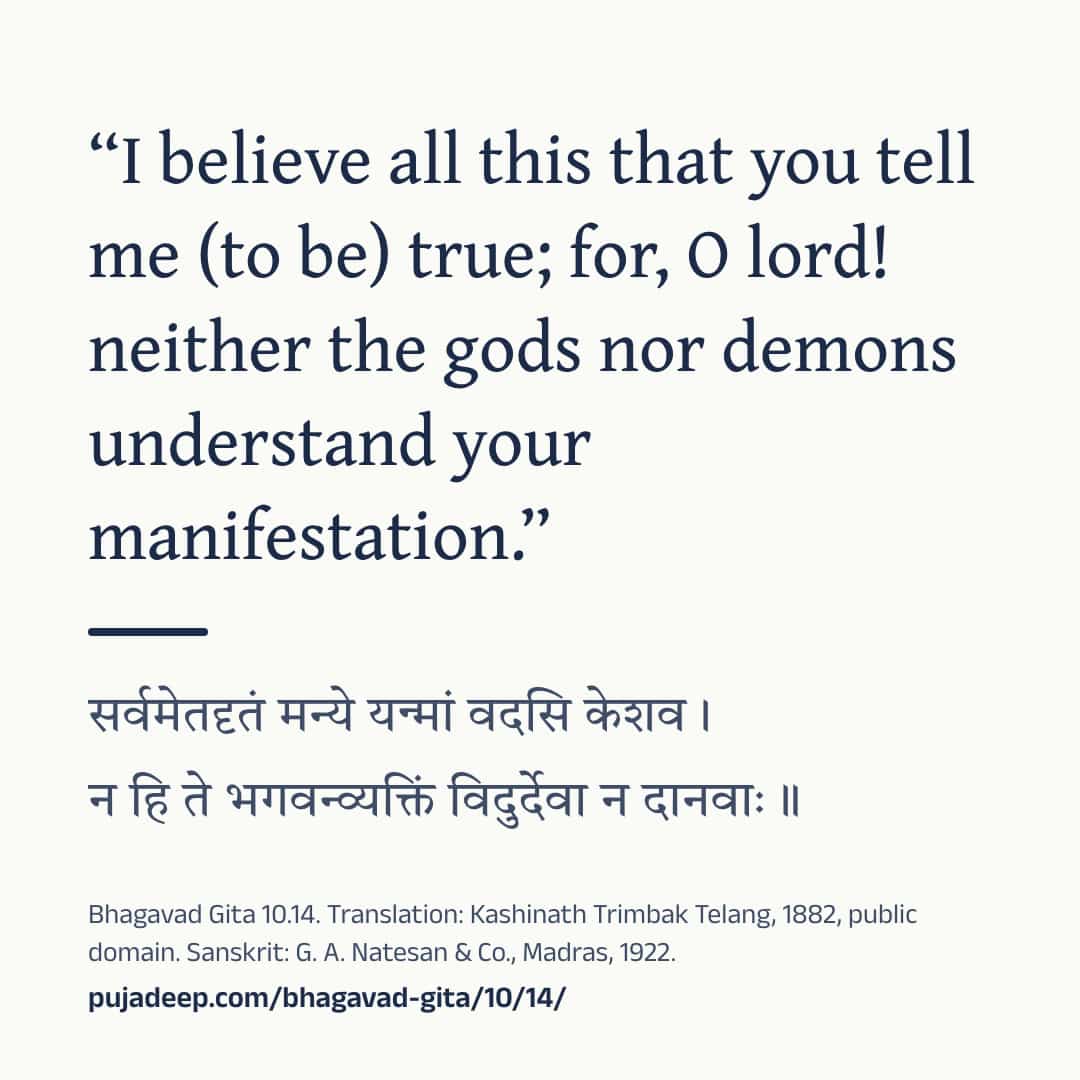
Drawing the picture
See the words
Bhagavad Gita 10.14

सर्वमेतदृतं मन्ये यन्मां वदसि केशव ।
न हि ते भगवन्व्यक्तिं विदुर्देवा न दानवाः ॥

“I believe all this that you tell me (to be) true; for, O lord! neither the gods nor demons understand your manifestation.”
(K. T. Telang, The Bhagavadgîtâ (The Sacred Books of the East, vol. VIII, Oxford: Clarendon Press, 1882), p. 87, public domain)

“All this I believe true that Thou sayest to me, O Keshava. Thy manifestation, O Blessed Lord, neither Gods nor Dânavas comprehend.”
(Annie Besant, The Bhagavad Gîtâ, or The Lord's Song (London: Theosophical Publishing Society, 1895), p. 97, public domain)

“I regard all this that Thou sayest to me as true, O Keshava. Verily O Bhagavan, neither the Devas nor the Dânavas know Thy manifestation.”
(Swami Swarupananda, Srimad-Bhagavad-Gita (Mayavati: Prabuddha Bharata Press, 1909; first printed in Prabuddha Bharata, 1907–1909), p. 199, public domain)

Sanskrit: G. A. Natesan & Co., Madras, 1922.
https://pujadeep.com/bhagavad-gita/10/14/ Nothing is sent from this site. Your own app sends it, to the chat you choose. The picture quotes the translation you chose on this page, with its name and year.
Sanskrit text: The Bhagavad-Gita, or The Lord's Song, with the text in Devanagari and an English translation, 1922. Meanings: written for Pujadeep and checked against the cited edition. Source and changes
Questions families ask
Who speaks Bhagavad Gita 10.14?
Arjuna speaks this verse, in chapter 10 (Vibhuti Yoga).
Where does the Sanskrit text come from?
Sanskrit text: The Bhagavad-Gita, or The Lord's Song, with the text in Devanagari and an English translation, 1922. Meanings: written for Pujadeep and checked against the cited edition. See the source
Is the meaning on this page a translation?
Explanation written for this site from the sources listed here, and checked against the cited edition. It is not a translation and not the only way to read the text. Free to quote with credit.
Source and licence
- Sanskrit text
- The Bhagavad-Gita, or The Lord's Song, with the text in Devanagari and an English translation (Annie Besant, G. A. Natesan & Co., Madras, 1922). Public domain. The Sanskrit on these pages was read from this printing’s page images.
- Translation
- The Bhagavadgîtâ with the Sanatsugâtîya and the Anugîtâ, translated by Kâshinâth Trimbak Telang (The Sacred Books of the East, vol. VIII, ed. F. Max Müller) (Kashinath Trimbak Telang, F. Max Müller, Clarendon Press, Oxford, 1882). Public domain. Shown verbatim, as printed.
- Translation
- The Bhagavad Gîtâ, or The Lord's Song, translated by Annie Besant (Annie Besant, Theosophical Publishing Society, London, 1895). Public domain. Shown verbatim, as printed.
- Translation
- Srimad-Bhagavad-Gita, with Sanskrit Text; Paraphrase with Word-by-word Literal Translation; English Rendering and Comments, Index, &c., by the Swami Swarupananda (Himalayan Series, No. XX) (Swami Swarupananda, The Editors and Publishers, Advaita Ashrama, Mayavati, Prabuddha Bharata Press, Mayavati, Almora, Himalayas, 1909). Public domain. Shown verbatim, as printed.
- Common wording
- In this text, 32 words follow today's common wording, checked against sanskritdocuments.org; Sanskrit Wikisource; Gita Press, Gorakhpur; GRETIL, Göttingen and Bhaktivedanta Book Trust.
- Our explanation
- Explanation written for this site from the sources listed here, and checked against the cited edition. It is not a translation and not the only way to read the text. Free to quote with credit.
- Checked
- Checked against the cited edition, October 15, 2026.
- Updated
- October 25, 2026