Bhagavad Gita 10.26: meaning and translation
Chapter 10: Vibhuti Yoga. Krishna says
Among all trees, Krishna says, he is the aśvattha (the sacred fig); among the divine sages, Nārada; among the gandharvas (heavenly musicians), Citraratha; among the perfected ones (siddhas), the sage Kapila.
Click or tap a word for its meaning and its dictionary page.
Text and layers
Text and layers
These choices stay in this browser.
Bhagavad Gita 10.26
अश्वत्थः सर्ववृक्षाणां देवर्षीणां च नारदः ।गन्धर्वाणां चित्ररथः सिद्धानां कपिलो मुनिः ॥
Ashvatthah sarvavrikshanam devarshinam cha naradahGandharvanam chitrarathah siddhanam kapilo munih
aśvatthaḥ sarvavṛkṣāṇāṃ devarṣīṇāṃ ca nāradaḥ |gandharvāṇāṃ citrarathaḥ siddhānāṃ kapilo muniḥ ||
Our explanation Among all trees, Krishna says, he is the aśvattha (the sacred fig); among the divine sages, Nārada; among the gandharvas (heavenly musicians), Citraratha; among the perfected ones (siddhas), the sage Kapila.
हिंदी अर्थ कृष्ण कहते हैं कि सब वृक्षों में वे अश्वत्थ (पीपल) हैं; देवर्षियों में नारद; गंधर्वों (स्वर्ग के गायकों) में चित्ररथ; और सिद्धों में कपिल मुनि।
Word by word
Every word, with its dictionary page
Word by word
- अश्वत्थः aśvatthaḥ · the aśvattha (sacred fig) (noun (masculine), nominative singular) Dictionary: aśvattha, Monier-Williams 1899, p. 115, col. 3 “the holy fig tree, Ficus Religiosa”
- सर्ववृक्षाणाम् sarvavṛkṣāṇām · among all trees (compound (masculine), genitive plural) Dictionary: sarva, Monier-Williams 1899, p. 1184, col. 3 “whole, entire, all, every”; vṛkṣa, Monier-Williams 1899, p. 1008, col. 2 “a tree”
- देवर्षीणाम् devarṣīṇām · among the divine sages (compound (masculine), genitive plural) Dictionary: deva-rṣi, Monier-Williams 1899, p. 494, col. 2 “a saint of the celestial class, as Nārada”
- च ca · and (indeclinable) Dictionary: 2. ca, Monier-Williams 1899, p. 380, col. 1 “and, both, also, moreover, as well as”
- नारदः nāradaḥ · Nārada (noun (masculine), nominative singular) Dictionary: nārada, Monier-Williams 1899, p. 537, col. 2 “N. of a Ṛishi”
- गन्धर्वाणाम् gandharvāṇām · among the gandharvas (noun (masculine), genitive plural) Dictionary: gandharva, Monier-Williams 1899, p. 346, col. 1 “a Gandharva”
- चित्ररथः citrarathaḥ · Citraratha (noun (masculine), nominative singular) Dictionary: citra-ratha, Monier-Williams 1899, p. 397, col. 1 “the king of the Gandharvas”
- सिद्धानाम् siddhānām · among the perfected ones (siddhas) (noun (masculine), genitive plural) Dictionary: siddha, Monier-Williams 1899, p. 1215, col. 1 “perfected, become perfect, beatified”
- कपिलः kapilaḥ · Kapila (noun (masculine), nominative singular) Dictionary: kapila, Monier-Williams 1899, p. 250, col. 3 “N. of an ancient sage”
- मुनिः muniḥ · the sage (noun (masculine), nominative singular) Dictionary: muni, Monier-Williams 1899, p. 823, col. 1 “a saint, sage, seer, ascetic, monk, devotee, hermit”
Old translations
Kashinath Trimbak Telang, 1882. Public domain. Page 89.
the Asvattha1 among all trees, and Nârada among divine sages; Kitraratha among the heavenly choristers, the sage Kapila among the Siddhas2.
This sentence begins in 10.25.
Footnotes (the translator’s own) Compare 3 translations
Kashinath Trimbak Telang, 1882. Public domain. Page 89.
the Asvattha1 among all trees, and Nârada among divine sages; Kitraratha among the heavenly choristers, the sage Kapila among the Siddhas2.
This sentence begins in 10.25.
Footnotes (the translator’s own) You are reading this one
Annie Besant, 1895. Public domain. Page 100.
Asvattha of all trees, and of divine Rishis Nârada; of Gandharvas Chitraratha, of the perfected the Muni Kapila.
You are reading this one
Swami Swarupananda, 1909 (first printed 1907). Public domain. Page 204.
Of all trees (I am) the Ashvattha, and Nàrada of Deva-Rishis; Chitraratha of Gandharvas am I, and the Muni Kapila of the perfected ones.
You are reading this one
Cite this verse
The translation: K. T. Telang, The Bhagavadgîtâ (The Sacred Books of the East, vol. VIII, Oxford: Clarendon Press, 1882), p. 89. Bhagavad Gita 10.26.
The translation: Annie Besant, The Bhagavad Gîtâ, or The Lord's Song (London: Theosophical Publishing Society, 1895), p. 100. Bhagavad Gita 10.26.
The translation: Swami Swarupananda, Srimad-Bhagavad-Gita (Mayavati: Prabuddha Bharata Press, 1909; first printed in Prabuddha Bharata, 1907–1909), p. 204. Bhagavad Gita 10.26.
Our explanation: “Bhagavad Gita 10.26: meaning and translation.” Pujadeep. Updated October 25, 2026. https://pujadeep.com/bhagavad-gita/10/26/
Pujadeep’s explanations are free to quote with credit: name Pujadeep and link to the page. How to credit
Classical readings, by school
No readings by school on this verse yet.
Share
Show the ways to share
Send one picture or the text to one chat. The picture names its source and the address of this page.
Drawing the picture
See the words
Bhagavad Gita 10.26

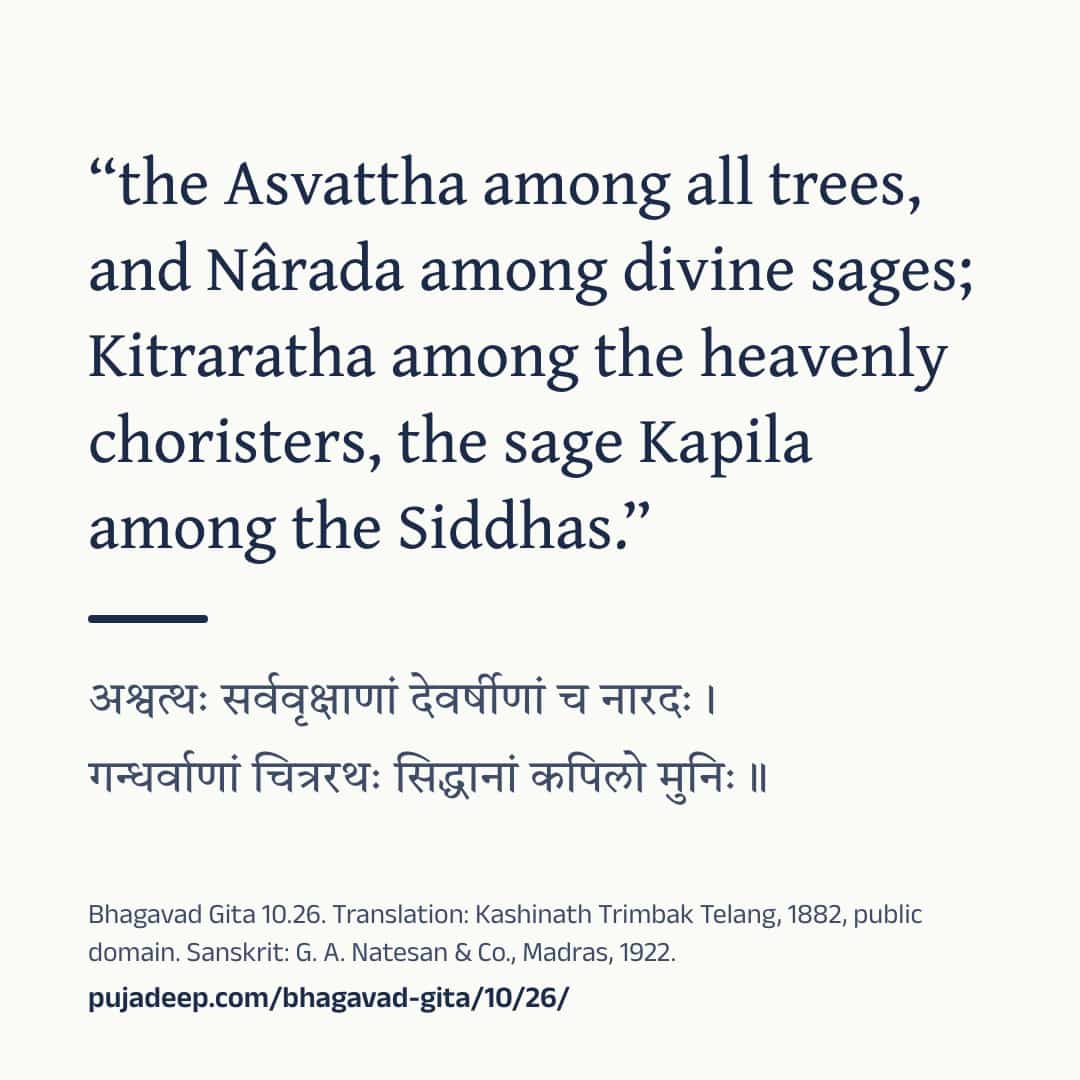
अश्वत्थः सर्ववृक्षाणां देवर्षीणां च नारदः ।
गन्धर्वाणां चित्ररथः सिद्धानां कपिलो मुनिः ॥

“the Asvattha among all trees, and Nârada among divine sages; Kitraratha among the heavenly choristers, the sage Kapila among the Siddhas.”
(K. T. Telang, The Bhagavadgîtâ (The Sacred Books of the East, vol. VIII, Oxford: Clarendon Press, 1882), p. 89, public domain)
This sentence begins in 10.25.

“Asvattha of all trees, and of divine Rishis Nârada; of Gandharvas Chitraratha, of the perfected the Muni Kapila.”
(Annie Besant, The Bhagavad Gîtâ, or The Lord's Song (London: Theosophical Publishing Society, 1895), p. 100, public domain)

“Of all trees (I am) the Ashvattha, and Nàrada of Deva-Rishis; Chitraratha of Gandharvas am I, and the Muni Kapila of the perfected ones.”
(Swami Swarupananda, Srimad-Bhagavad-Gita (Mayavati: Prabuddha Bharata Press, 1909; first printed in Prabuddha Bharata, 1907–1909), p. 204, public domain)

Sanskrit: G. A. Natesan & Co., Madras, 1922.
https://pujadeep.com/bhagavad-gita/10/26/ Nothing is sent from this site. Your own app sends it, to the chat you choose. The picture quotes the translation you chose on this page, with its name and year.
Sanskrit text: The Bhagavad-Gita, or The Lord's Song, with the text in Devanagari and an English translation, 1922. Meanings: written for Pujadeep and checked against the cited edition. Source and changes
Questions families ask
Who speaks Bhagavad Gita 10.26?
Krishna speaks this verse, in chapter 10 (Vibhuti Yoga).
Where does the Sanskrit text come from?
Sanskrit text: The Bhagavad-Gita, or The Lord's Song, with the text in Devanagari and an English translation, 1922. Meanings: written for Pujadeep and checked against the cited edition. See the source
Is the meaning on this page a translation?
Explanation written for this site from the sources listed here, and checked against the cited edition. It is not a translation and not the only way to read the text. Free to quote with credit.
Source and licence
- Sanskrit text
- The Bhagavad-Gita, or The Lord's Song, with the text in Devanagari and an English translation (Annie Besant, G. A. Natesan & Co., Madras, 1922). Public domain. The Sanskrit on these pages was read from this printing’s page images.
- Translation
- The Bhagavadgîtâ with the Sanatsugâtîya and the Anugîtâ, translated by Kâshinâth Trimbak Telang (The Sacred Books of the East, vol. VIII, ed. F. Max Müller) (Kashinath Trimbak Telang, F. Max Müller, Clarendon Press, Oxford, 1882). Public domain. Shown verbatim, as printed.
- Translation
- The Bhagavad Gîtâ, or The Lord's Song, translated by Annie Besant (Annie Besant, Theosophical Publishing Society, London, 1895). Public domain. Shown verbatim, as printed.
- Translation
- Srimad-Bhagavad-Gita, with Sanskrit Text; Paraphrase with Word-by-word Literal Translation; English Rendering and Comments, Index, &c., by the Swami Swarupananda (Himalayan Series, No. XX) (Swami Swarupananda, The Editors and Publishers, Advaita Ashrama, Mayavati, Prabuddha Bharata Press, Mayavati, Almora, Himalayas, 1909). Public domain. Shown verbatim, as printed.
- Common wording
- In this text, 32 words follow today's common wording, checked against sanskritdocuments.org; Sanskrit Wikisource; Gita Press, Gorakhpur; GRETIL, Göttingen and Bhaktivedanta Book Trust.
- Our explanation
- Explanation written for this site from the sources listed here, and checked against the cited edition. It is not a translation and not the only way to read the text. Free to quote with credit.
- Checked
- Checked against the cited edition, October 15, 2026.
- Updated
- October 25, 2026