Bhagavad Gita 10.28: meaning and translation
Chapter 10: Vibhuti Yoga. Krishna says
Among weapons, Krishna says, he is the thunderbolt (vajra); among cows, the wish-giving cow (kāmadhuk); among begetters, Kandarpa, the god of love; among serpents, Vāsuki.
Click or tap a word for its meaning and its dictionary page.
Text and layers
Text and layers
These choices stay in this browser.
Bhagavad Gita 10.28
आयुधानामहं वज्रं धेनूनामस्मि कामधुक् ।प्रजनश्चास्मि कन्दर्पः सर्पाणामस्मि वासुकिः ॥
Ayudhanamaham vajram dhenunamasmi kamadhukPrajanashchasmi kandarpah sarpanamasmi vasukih
āyudhānāmahaṃ vajraṃ dhenūnāmasmi kāmadhuk |prajanaścāsmi kandarpaḥ sarpāṇāmasmi vāsukiḥ ||
Our explanation Among weapons, Krishna says, he is the thunderbolt (vajra); among cows, the wish-giving cow (kāmadhuk); among begetters, Kandarpa, the god of love; among serpents, Vāsuki.
हिंदी अर्थ कृष्ण कहते हैं कि शस्त्रों में वे वज्र हैं; गायों में कामधेनु; संतान उत्पन्न करने वालों में कंदर्प (कामदेव); और सर्पों में वासुकि।
Word by word
Every word, with its dictionary page
Word by word
- आयुधानाम् āyudhānām · among weapons (noun (neuter), genitive plural) Dictionary: ā-yudha, Monier-Williams 1899, p. 149, col. 1 “a weapon”
- अहम् aham · "I" (Krishna) (pronoun, nominative singular) Dictionary: aham, Monier-Williams 1899, p. 124, col. 2 “nom. sg. ‘I,’”
- वज्रम् vajram · the thunderbolt (vajra) (noun (neuter), nominative singular) Dictionary: vajra, Monier-Williams 1899, p. 913, col. 1 “a thunderbolt”
- धेनूनाम् dhenūnām · among cows (noun (feminine), genitive plural) Dictionary: dhenu, Monier-Williams 1899, p. 520, col. 1 “a milch cow or any cow”
- अस्मि asmi · am (present, 1st person singular) Dictionary: 1. as, Monier-Williams 1899, p. 117, col. 2 “to be, live, exist, be present”
- कामधुक् kāmadhuk · the wish-giving cow (compound (feminine), nominative singular) Dictionary: kāma-duh, Monier-Williams 1899, p. 272, col. 2; kāma-dhenu, Monier-Williams 1899, p. 272, col. 2 “the mythical cow of Vasishṭha which satisfies all desires, cow of plenty”
- प्रजनः prajanaḥ · the begetter (noun (masculine), nominative singular) Dictionary: pra-jana, Monier-Williams 1899, p. 658, col. 2 “one who begets, generator, progenitor”
- च ca · and (indeclinable) Dictionary: 2. ca, Monier-Williams 1899, p. 380, col. 1 “and, both, also, moreover, as well as”
- अस्मि asmi · am (present, 1st person singular) Dictionary: 1. as, Monier-Williams 1899, p. 117, col. 2 “to be, live, exist, be present”
- कन्दर्पः kandarpaḥ · Kandarpa (the god of love) (noun (masculine), nominative singular) Dictionary: kandarpa, Monier-Williams 1899, p. 249, col. 3 “N. of Kāma”
- सर्पाणाम् sarpāṇām · among serpents (noun (masculine), genitive plural) Dictionary: sarpa, Monier-Williams 1899, p. 1184, col. 1 “a snake, serpent, serpent-demon”
- अस्मि asmi · am (present, 1st person singular) Dictionary: 1. as, Monier-Williams 1899, p. 117, col. 2 “to be, live, exist, be present”
- वासुकिः vāsukiḥ · Vāsuki (noun (masculine), nominative singular) Dictionary: vāsuki, Monier-Williams 1899, p. 948, col. 3 “of a serpent-king”
Old translations
Kashinath Trimbak Telang, 1882. Public domain. Page 89.
I am the thunderbolt among weapons, the wish-giving (cow) among cows. And I am love which generates1. Among serpents I am Vâsuki.
Footnotes (the translator’s own) - I. e. not the merely carnal passion. Cf. p. 74 supra. ↩
Compare 3 translations
Kashinath Trimbak Telang, 1882. Public domain. Page 89.
I am the thunderbolt among weapons, the wish-giving (cow) among cows. And I am love which generates1. Among serpents I am Vâsuki.
Footnotes (the translator’s own) - I. e. not the merely carnal passion. Cf. p. 74 supra. ↩
You are reading this one
Annie Besant, 1895. Public domain. Page 100.
Of weapons I am the Thunderbolt, of cows I am Kâmaduk: and of progenitors I am Kandarpa, of serpents Vâsuki am I.
You are reading this one
Swami Swarupananda, 1909 (first printed 1907). Public domain. Page 205.
Of weapons I am the thunderbolt, of cows I am Kamadhuk; I am the Kandarpa, the cause of offspring; of serpents I am Vàsuki.
You are reading this one
Cite this verse
The translation: K. T. Telang, The Bhagavadgîtâ (The Sacred Books of the East, vol. VIII, Oxford: Clarendon Press, 1882), p. 89. Bhagavad Gita 10.28.
The translation: Annie Besant, The Bhagavad Gîtâ, or The Lord's Song (London: Theosophical Publishing Society, 1895), p. 100. Bhagavad Gita 10.28.
The translation: Swami Swarupananda, Srimad-Bhagavad-Gita (Mayavati: Prabuddha Bharata Press, 1909; first printed in Prabuddha Bharata, 1907–1909), p. 205. Bhagavad Gita 10.28.
Our explanation: “Bhagavad Gita 10.28: meaning and translation.” Pujadeep. Updated October 25, 2026. https://pujadeep.com/bhagavad-gita/10/28/
Pujadeep’s explanations are free to quote with credit: name Pujadeep and link to the page. How to credit
Classical readings, by school
No readings by school on this verse yet.
Share
Show the ways to share
Send one picture or the text to one chat. The picture names its source and the address of this page.
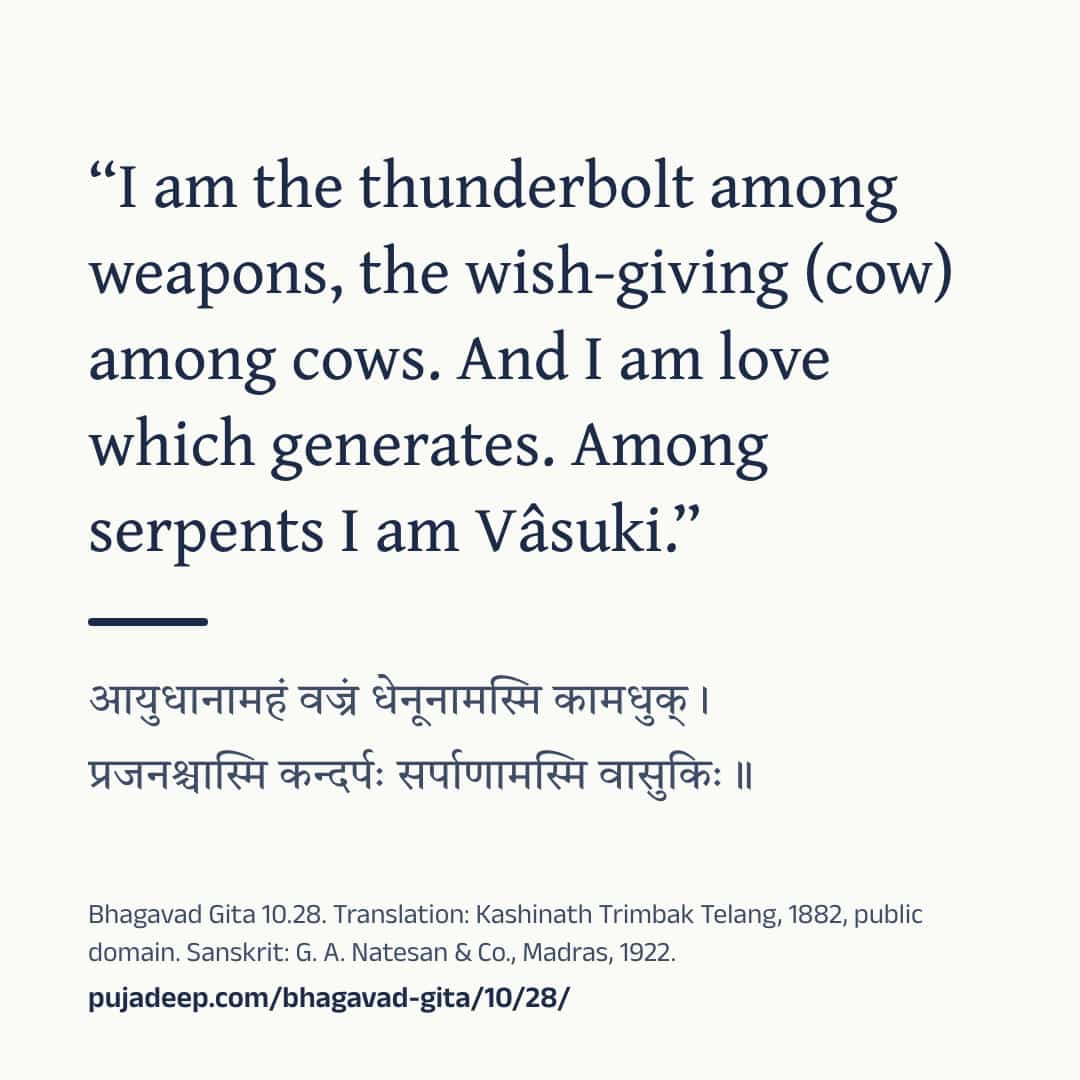
Drawing the picture
See the words
Bhagavad Gita 10.28

आयुधानामहं वज्रं धेनूनामस्मि कामधुक् ।
प्रजनश्चास्मि कन्दर्पः सर्पाणामस्मि वासुकिः ॥

“I am the thunderbolt among weapons, the wish-giving (cow) among cows. And I am love which generates. Among serpents I am Vâsuki.”
(K. T. Telang, The Bhagavadgîtâ (The Sacred Books of the East, vol. VIII, Oxford: Clarendon Press, 1882), p. 89, public domain)

“Of weapons I am the Thunderbolt, of cows I am Kâmaduk: and of progenitors I am Kandarpa, of serpents Vâsuki am I.”
(Annie Besant, The Bhagavad Gîtâ, or The Lord's Song (London: Theosophical Publishing Society, 1895), p. 100, public domain)

“Of weapons I am the thunderbolt, of cows I am Kamadhuk; I am the Kandarpa, the cause of offspring; of serpents I am Vàsuki.”
(Swami Swarupananda, Srimad-Bhagavad-Gita (Mayavati: Prabuddha Bharata Press, 1909; first printed in Prabuddha Bharata, 1907–1909), p. 205, public domain)

Sanskrit: G. A. Natesan & Co., Madras, 1922.
https://pujadeep.com/bhagavad-gita/10/28/ Nothing is sent from this site. Your own app sends it, to the chat you choose. The picture quotes the translation you chose on this page, with its name and year.
Sanskrit text: The Bhagavad-Gita, or The Lord's Song, with the text in Devanagari and an English translation, 1922. Meanings: written for Pujadeep and checked against the cited edition. Source and changes
Questions families ask
Who speaks Bhagavad Gita 10.28?
Krishna speaks this verse, in chapter 10 (Vibhuti Yoga).
Where does the Sanskrit text come from?
Sanskrit text: The Bhagavad-Gita, or The Lord's Song, with the text in Devanagari and an English translation, 1922. Meanings: written for Pujadeep and checked against the cited edition. See the source
Is the meaning on this page a translation?
Explanation written for this site from the sources listed here, and checked against the cited edition. It is not a translation and not the only way to read the text. Free to quote with credit.
Source and licence
- Sanskrit text
- The Bhagavad-Gita, or The Lord's Song, with the text in Devanagari and an English translation (Annie Besant, G. A. Natesan & Co., Madras, 1922). Public domain. The Sanskrit on these pages was read from this printing’s page images.
- Translation
- The Bhagavadgîtâ with the Sanatsugâtîya and the Anugîtâ, translated by Kâshinâth Trimbak Telang (The Sacred Books of the East, vol. VIII, ed. F. Max Müller) (Kashinath Trimbak Telang, F. Max Müller, Clarendon Press, Oxford, 1882). Public domain. Shown verbatim, as printed.
- Translation
- The Bhagavad Gîtâ, or The Lord's Song, translated by Annie Besant (Annie Besant, Theosophical Publishing Society, London, 1895). Public domain. Shown verbatim, as printed.
- Translation
- Srimad-Bhagavad-Gita, with Sanskrit Text; Paraphrase with Word-by-word Literal Translation; English Rendering and Comments, Index, &c., by the Swami Swarupananda (Himalayan Series, No. XX) (Swami Swarupananda, The Editors and Publishers, Advaita Ashrama, Mayavati, Prabuddha Bharata Press, Mayavati, Almora, Himalayas, 1909). Public domain. Shown verbatim, as printed.
- Common wording
- In this text, 32 words follow today's common wording, checked against sanskritdocuments.org; Sanskrit Wikisource; Gita Press, Gorakhpur; GRETIL, Göttingen and Bhaktivedanta Book Trust.
- Our explanation
- Explanation written for this site from the sources listed here, and checked against the cited edition. It is not a translation and not the only way to read the text. Free to quote with credit.
- Checked
- Checked against the cited edition, October 15, 2026.
- Updated
- October 25, 2026