Bhagavad Gita 10.30: meaning and translation
Chapter 10: Vibhuti Yoga. Krishna says
Among the Daityas, Krishna says, he is Prahlāda; among those who reckon, Time (kāla); among beasts, the lion, their king; among birds, Vainateya (Garuḍa, son of Vinatā).
Click or tap a word for its meaning and its dictionary page.
Text and layers
Text and layers
These choices stay in this browser.
Bhagavad Gita 10.30
प्रह्लादश्चास्मि दैत्यानां कालः कलयतामहम् ।मृगाणां च मृगेन्द्रोऽहं वैनतेयश्च पक्षिणाम् ॥
Prahladashchasmi daityanam kalah kalayatamahamMriganam cha mrigendroham vainateyashcha pakshinam
prahlādaścāsmi daityānāṃ kālaḥ kalayatāmaham |mṛgāṇāṃ ca mṛgendro’haṃ vainateyaśca pakṣiṇām ||
Our explanation Among the Daityas, Krishna says, he is Prahlāda; among those who reckon, Time (kāla); among beasts, the lion, their king; among birds, Vainateya (Garuḍa, son of Vinatā).
हिंदी अर्थ कृष्ण कहते हैं कि दैत्यों में वे प्रह्लाद हैं; गणना करने वालों में काल (समय); पशुओं में उनका राजा सिंह; और पक्षियों में वैनतेय (विनता के पुत्र गरुड़)।
Word by word
Every word, with its dictionary page
Word by word
- प्रह्लादः prahlādaḥ · Prahlāda (noun (masculine), nominative singular) Dictionary: pra-hlāda, Monier-Williams 1899, p. 701, col. 3 “N. of a pious Daitya”
- च ca · and (indeclinable) Dictionary: 2. ca, Monier-Williams 1899, p. 380, col. 1 “and, both, also, moreover, as well as”
- अस्मि asmi · am (present, 1st person singular) Dictionary: 1. as, Monier-Williams 1899, p. 117, col. 2 “to be, live, exist, be present”
- दैत्यानाम् daityānām · among the Daityas (noun (masculine), genitive plural) Dictionary: daitya, Monier-Williams 1899, p. 497, col. 1 “a son of Diti, a demon”
- कालः kālaḥ · time (noun (masculine), nominative singular) Dictionary: 2. kāla, Monier-Williams 1899, p. 278, col. 1 “time (as destroying all things), death, time of death”
- कलयताम् kalayatām · among those who reckon (present participle (masculine), genitive plural) Dictionary: 3. kal, Monier-Williams 1899, p. 260, col. 1 “to consider, count, take for”
- अहम् aham · "I" (Krishna) (pronoun, nominative singular) Dictionary: aham, Monier-Williams 1899, p. 124, col. 2 “nom. sg. ‘I,’”
- मृगाणाम् mṛgāṇām · among beasts (noun (masculine), genitive plural) Dictionary: mṛga, Monier-Williams 1899, p. 828, col. 2 “a forest animal or wild beast, game of any kind”
- च ca · and (indeclinable) Dictionary: 2. ca, Monier-Williams 1899, p. 380, col. 1 “and, both, also, moreover, as well as”
- मृगेन्द्रः mṛgendraḥ · the lion, king of beasts (compound (masculine), nominative singular) Dictionary: mṛgendra, Monier-Williams 1899, p. 829, col. 1 “'king of beasts,' a lion”
- अहम् aham · "I" (Krishna) (pronoun, nominative singular) Dictionary: aham, Monier-Williams 1899, p. 124, col. 2 “nom. sg. ‘I,’”
- वैनतेयः vainateyaḥ · Vainateya (Garuḍa) (noun (masculine), nominative singular) Dictionary: vainateya, Monier-Williams 1899, p. 1023, col. 2 “N. of Garuḍa”
- च ca · and (indeclinable) Dictionary: 2. ca, Monier-Williams 1899, p. 380, col. 1 “and, both, also, moreover, as well as”
- पक्षिणाम् pakṣiṇām · among birds (noun (masculine), genitive plural) Dictionary: pakṣin, Monier-Williams 1899, p. 574, col. 2 “a bird or any winged animal”
1 printing differs
Edition differences. Another printing or text reads this place differently.
- Spelling A digital text reads Another digital text writes pralhāda (the l before the h), a form also found in manuscripts; Telang's translation has 'Pralhâda'. The 1922 edition and another digital text read प्रह्लाद.
Old translations
Kashinath Trimbak Telang, 1882. Public domain. Page 89–90.
Among demons, too, I am Pralhâda. I am the king of death (Kâla, time) among those that count1. Among beasts I am the lord of beasts, and the son of Vinatâ2 among birds.
Footnotes (the translator’s own) Compare 3 translations
Kashinath Trimbak Telang, 1882. Public domain. Page 89–90.
Among demons, too, I am Pralhâda. I am the king of death (Kâla, time) among those that count1. Among beasts I am the lord of beasts, and the son of Vinatâ2 among birds.
Footnotes (the translator’s own) You are reading this one
Annie Besant, 1895. Public domain. Page 100.
And I am Prahlâda of Daityas, of measures Time am I; and of wild beasts I the imperial Beast1, and Vainateya of birds.
Footnotes (the translator’s own) - Lion or Tiger. ↩
You are reading this one
Swami Swarupananda, 1909 (first printed 1907). Public domain. Page 206.
And Prahláda am I of Diti's progeny, of measurers I am Time; and of beasts I am the lord of beasts, and Garuda of birds.
You are reading this one
Cite this verse
The translation: K. T. Telang, The Bhagavadgîtâ (The Sacred Books of the East, vol. VIII, Oxford: Clarendon Press, 1882), pp. 89–90. Bhagavad Gita 10.30.
The translation: Annie Besant, The Bhagavad Gîtâ, or The Lord's Song (London: Theosophical Publishing Society, 1895), p. 100. Bhagavad Gita 10.30.
The translation: Swami Swarupananda, Srimad-Bhagavad-Gita (Mayavati: Prabuddha Bharata Press, 1909; first printed in Prabuddha Bharata, 1907–1909), p. 206. Bhagavad Gita 10.30.
Our explanation: “Bhagavad Gita 10.30: meaning and translation.” Pujadeep. Updated October 25, 2026. https://pujadeep.com/bhagavad-gita/10/30/
Pujadeep’s explanations are free to quote with credit: name Pujadeep and link to the page. How to credit
Classical readings, by school
No readings by school on this verse yet.
Share
Show the ways to share
Send one picture or the text to one chat. The picture names its source and the address of this page.
Drawing the picture
See the words
Bhagavad Gita 10.30

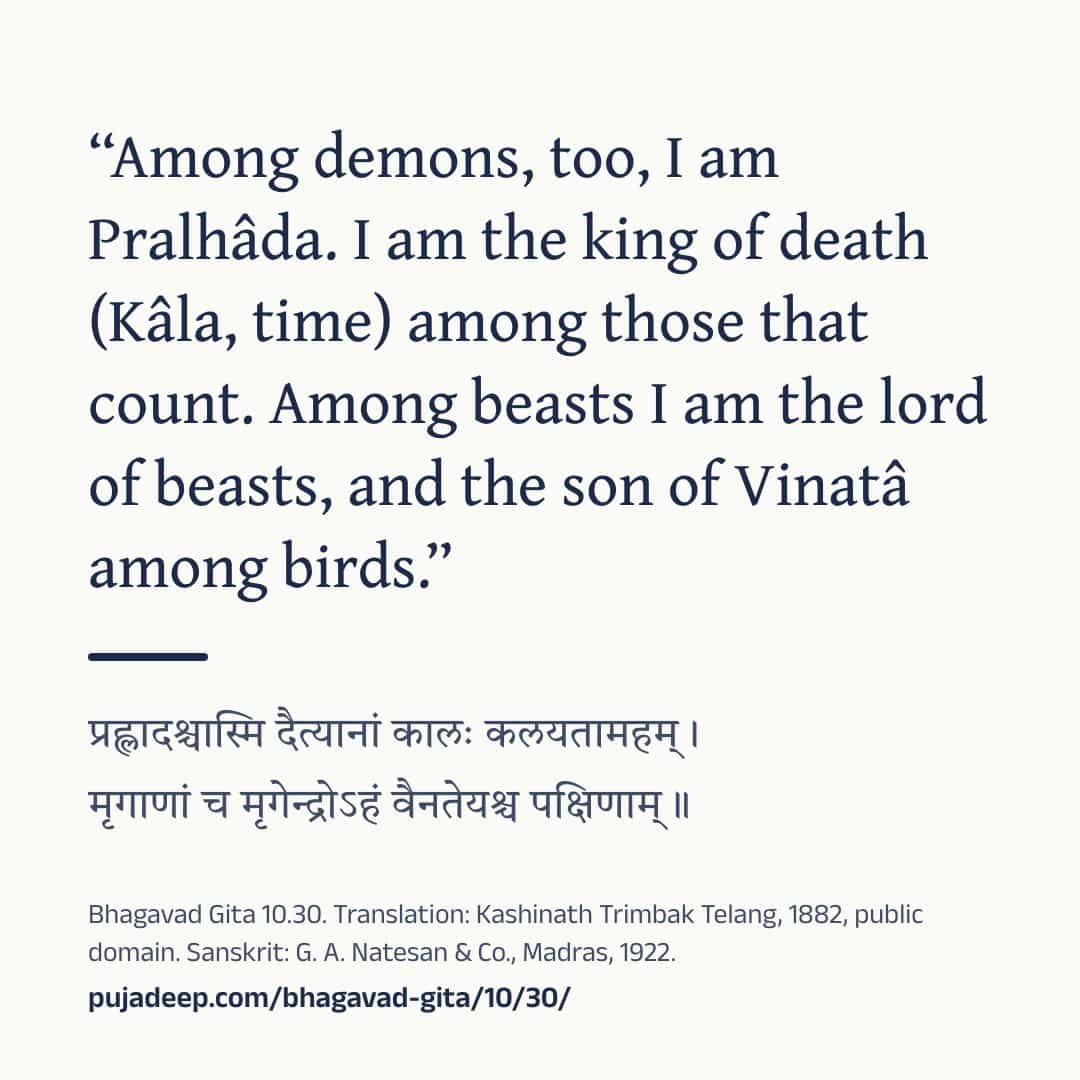
प्रह्लादश्चास्मि दैत्यानां कालः कलयतामहम् ।
मृगाणां च मृगेन्द्रोऽहं वैनतेयश्च पक्षिणाम् ॥

“Among demons, too, I am Pralhâda. I am the king of death (Kâla, time) among those that count. Among beasts I am the lord of beasts, and the son of Vinatâ among birds.”
(K. T. Telang, The Bhagavadgîtâ (The Sacred Books of the East, vol. VIII, Oxford: Clarendon Press, 1882), pp. 89–90, public domain)

“And I am Prahlâda of Daityas, of measures Time am I; and of wild beasts I the imperial Beast, and Vainateya of birds.”
(Annie Besant, The Bhagavad Gîtâ, or The Lord's Song (London: Theosophical Publishing Society, 1895), p. 100, public domain)

“And Prahláda am I of Diti's progeny, of measurers I am Time; and of beasts I am the lord of beasts, and Garuda of birds.”
(Swami Swarupananda, Srimad-Bhagavad-Gita (Mayavati: Prabuddha Bharata Press, 1909; first printed in Prabuddha Bharata, 1907–1909), p. 206, public domain)

Sanskrit: G. A. Natesan & Co., Madras, 1922.
https://pujadeep.com/bhagavad-gita/10/30/ Nothing is sent from this site. Your own app sends it, to the chat you choose. The picture quotes the translation you chose on this page, with its name and year.
Sanskrit text: The Bhagavad-Gita, or The Lord's Song, with the text in Devanagari and an English translation, 1922. Meanings: written for Pujadeep and checked against the cited edition. Source and changes
Questions families ask
Who speaks Bhagavad Gita 10.30?
Krishna speaks this verse, in chapter 10 (Vibhuti Yoga).
Where does the Sanskrit text come from?
Sanskrit text: The Bhagavad-Gita, or The Lord's Song, with the text in Devanagari and an English translation, 1922. Meanings: written for Pujadeep and checked against the cited edition. See the source
Is the meaning on this page a translation?
Explanation written for this site from the sources listed here, and checked against the cited edition. It is not a translation and not the only way to read the text. Free to quote with credit.
Source and licence
- Sanskrit text
- The Bhagavad-Gita, or The Lord's Song, with the text in Devanagari and an English translation (Annie Besant, G. A. Natesan & Co., Madras, 1922). Public domain. The Sanskrit on these pages was read from this printing’s page images.
- Translation
- The Bhagavadgîtâ with the Sanatsugâtîya and the Anugîtâ, translated by Kâshinâth Trimbak Telang (The Sacred Books of the East, vol. VIII, ed. F. Max Müller) (Kashinath Trimbak Telang, F. Max Müller, Clarendon Press, Oxford, 1882). Public domain. Shown verbatim, as printed.
- Translation
- The Bhagavad Gîtâ, or The Lord's Song, translated by Annie Besant (Annie Besant, Theosophical Publishing Society, London, 1895). Public domain. Shown verbatim, as printed.
- Translation
- Srimad-Bhagavad-Gita, with Sanskrit Text; Paraphrase with Word-by-word Literal Translation; English Rendering and Comments, Index, &c., by the Swami Swarupananda (Himalayan Series, No. XX) (Swami Swarupananda, The Editors and Publishers, Advaita Ashrama, Mayavati, Prabuddha Bharata Press, Mayavati, Almora, Himalayas, 1909). Public domain. Shown verbatim, as printed.
- Common wording
- In this text, 32 words follow today's common wording, checked against sanskritdocuments.org; Sanskrit Wikisource; Gita Press, Gorakhpur; GRETIL, Göttingen and Bhaktivedanta Book Trust.
- Our explanation
- Explanation written for this site from the sources listed here, and checked against the cited edition. It is not a translation and not the only way to read the text. Free to quote with credit.
- Checked
- Checked against the cited edition, October 15, 2026.
- Updated
- October 25, 2026