Bhagavad Gita 10.36: meaning and translation
Chapter 10: Vibhuti Yoga. Krishna says
Among those who cheat, Krishna says, he is the dice game; he is the splendour of the splendid, victory, firm resolve, and the goodness (sattva) of the good.
Click or tap a word for its meaning and its dictionary page.
Text and layers
Text and layers
These choices stay in this browser.
Bhagavad Gita 10.36
द्यूतं छलयतामस्मि तेजस्तेजस्विनामहम् ।जयोऽस्मि व्यवसायोऽस्मि सत्त्वं सत्त्ववतामहम् ॥
Dyutam chhalayatamasmi tejastejasvinamahamJayosmi vyavasayosmi sattvam sattvavatamaham
dyūtaṃ chalayatāmasmi tejastejasvināmaham |jayo’smi vyavasāyo’smi sattvaṃ sattvavatāmaham ||
Our explanation Among those who cheat, Krishna says, he is the dice game; he is the splendour of the splendid, victory, firm resolve, and the goodness (sattva) of the good. The verse names the foremost in each class, even an undesirable one; Shankara and Ramanuja both take the first item simply as gambling, such as dice.
हिंदी अर्थ कृष्ण कहते हैं कि छल करने वालों में वे जुआ (द्यूत) हैं; वे तेजस्वियों का तेज, विजय, दृढ़ निश्चय और सात्त्विक लोगों का सत्त्व हैं। यह श्लोक हर वर्ग में सबसे प्रमुख का नाम लेता है, किसी अनचाहे वर्ग में भी; शंकराचार्य और रामानुजाचार्य दोनों पहली बात को सीधे जुए, जैसे पासे के खेल, के अर्थ में लेते हैं।
Word by word
Every word, with its dictionary page
Word by word
- द्यूतम् dyūtam · the dice game (noun (neuter), nominative singular) Dictionary: dyūta, Monier-Williams 1899, p. 500, col. 2 “play, gaming, gambling”
- छलयताम् chalayatām · of those who cheat (present participle (masculine), genitive plural) Dictionary: chal, Monier-Williams 1899, p. 405, col. 2 “to deceive, cheat, delude, outwit”
- अस्मि asmi · am (present, 1st person singular) Dictionary: 1. as, Monier-Williams 1899, p. 117, col. 2 “to be, live, exist, be present”
- तेजः tejaḥ · splendour (noun (neuter), nominative singular) Dictionary: tejas, Monier-Williams 1899, p. 454, col. 2 “glow, glare, splendour, brilliance, light, fire”
- तेजस्विनाम् tejasvinām · of the splendid (adjective (masculine), genitive plural) Dictionary: tejas-vin, Monier-Williams 1899, p. 454, col. 3 “brilliant, splendid, bright, powerful, energetic”
- अहम् aham · "I" (Krishna) (pronoun, nominative singular) Dictionary: aham, Monier-Williams 1899, p. 124, col. 2 “nom. sg. ‘I,’”
- जयः jayaḥ · victory (noun (masculine), nominative singular) Dictionary: jaya, Monier-Williams 1899, p. 412, col. 3 “conquest, victory, triumph, winning”
- अस्मि asmi · am (present, 1st person singular) Dictionary: 1. as, Monier-Williams 1899, p. 117, col. 2 “to be, live, exist, be present”
- व्यवसायः vyavasāyaḥ · firm resolve, effort (noun (masculine), nominative singular) Dictionary: vy-avasāya, Monier-Williams 1899, p. 1033, col. 3 “strenuous effort or exertion; settled determination, resolve, purpose, intention”
- अस्मि asmi · am (present, 1st person singular) Dictionary: 1. as, Monier-Williams 1899, p. 117, col. 2 “to be, live, exist, be present”
- सत्त्वम् sattvam · goodness (sattva) (noun (neuter), nominative singular) Dictionary: sat-tva, Monier-Williams 1899, p. 1135, col. 2 “the quality of purity or goodness”
- सत्त्ववताम् sattvavatām · of the good (adjective (masculine), genitive plural) Dictionary: sattva-vat, Monier-Williams 1899, p. 1135, col. 2 “abounding in the quality S°”
- अहम् aham · "I" (Krishna) (pronoun, nominative singular) Dictionary: aham, Monier-Williams 1899, p. 124, col. 2 “nom. sg. ‘I,’”
Old translations
Kashinath Trimbak Telang, 1882. Public domain. Page 91.
of cheats, I am the game of dice; I am the glory of the glorious; I am victory, I am industry, I am the goodness of the good.
This sentence begins in 10.35.
Compare 3 translations
Kashinath Trimbak Telang, 1882. Public domain. Page 91.
of cheats, I am the game of dice; I am the glory of the glorious; I am victory, I am industry, I am the goodness of the good.
This sentence begins in 10.35.
You are reading this one
Annie Besant, 1895. Public domain. Page 101.
I am the Gambling of the rogue, and the Splendour of splendid things I; I am Victory, I am Strenuous Exertion, and the Truth of the truthful I.
You are reading this one
Swami Swarupananda, 1909 (first printed 1907). Public domain. Page 208–209.
I am the gambling of the fraudulent, I am the power of the powerful; I am victory, I am effort, I the Sàttva of the Sâttvic.
You are reading this one
Cite this verse
The translation: K. T. Telang, The Bhagavadgîtâ (The Sacred Books of the East, vol. VIII, Oxford: Clarendon Press, 1882), p. 91. Bhagavad Gita 10.36.
The translation: Annie Besant, The Bhagavad Gîtâ, or The Lord's Song (London: Theosophical Publishing Society, 1895), p. 101. Bhagavad Gita 10.36.
The translation: Swami Swarupananda, Srimad-Bhagavad-Gita (Mayavati: Prabuddha Bharata Press, 1909; first printed in Prabuddha Bharata, 1907–1909), pp. 208–209. Bhagavad Gita 10.36.
Our explanation: “Bhagavad Gita 10.36: meaning and translation.” Pujadeep. Updated October 25, 2026. https://pujadeep.com/bhagavad-gita/10/36/
Pujadeep’s explanations are free to quote with credit: name Pujadeep and link to the page. How to credit
Classical readings, by school
No readings by school on this verse yet.
Share
Show the ways to share
Send one picture or the text to one chat. The picture names its source and the address of this page.
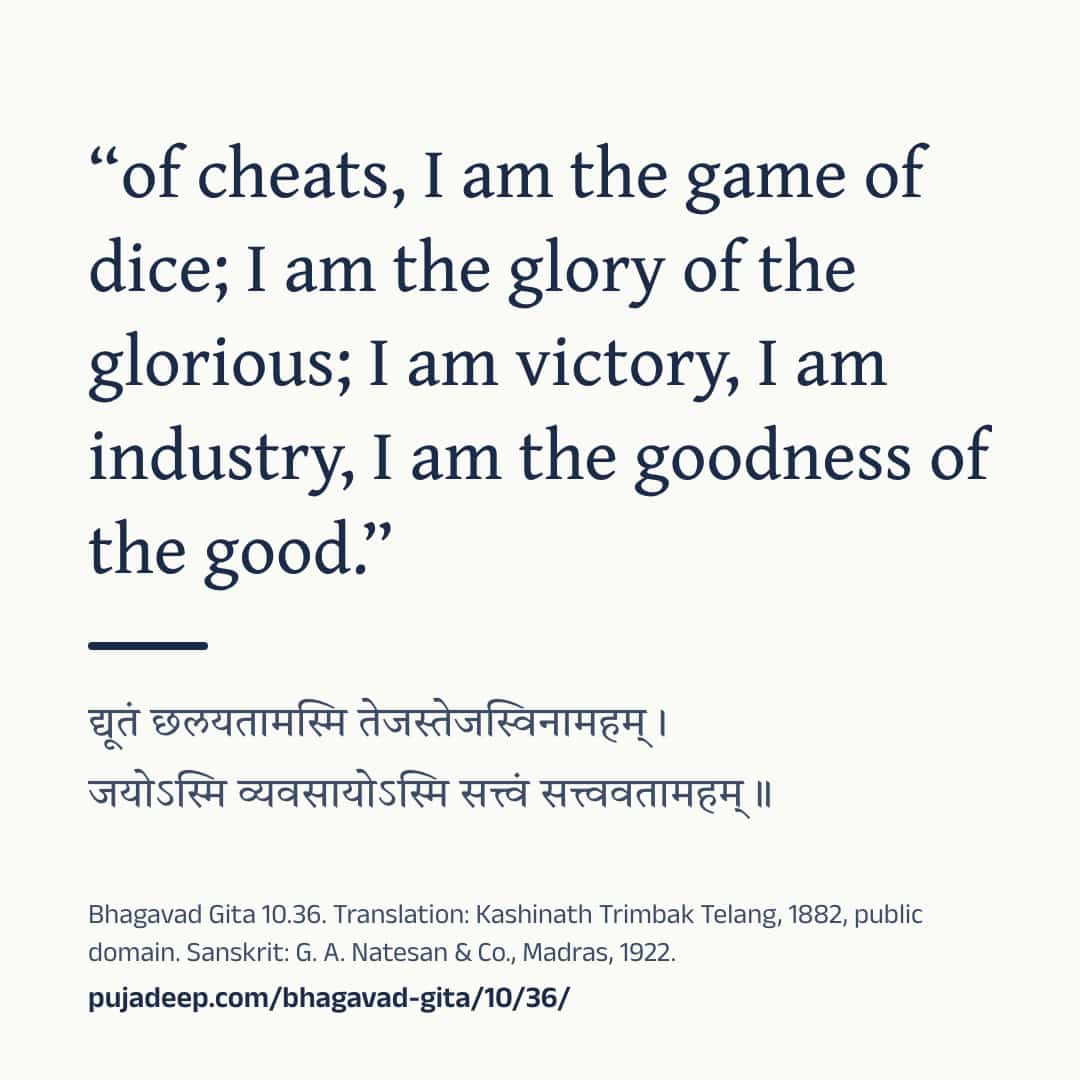
Drawing the picture
See the words
Bhagavad Gita 10.36

द्यूतं छलयतामस्मि तेजस्तेजस्विनामहम् ।
जयोऽस्मि व्यवसायोऽस्मि सत्त्वं सत्त्ववतामहम् ॥

“of cheats, I am the game of dice; I am the glory of the glorious; I am victory, I am industry, I am the goodness of the good.”
(K. T. Telang, The Bhagavadgîtâ (The Sacred Books of the East, vol. VIII, Oxford: Clarendon Press, 1882), p. 91, public domain)
This sentence begins in 10.35.

“I am the Gambling of the rogue, and the Splendour of splendid things I; I am Victory, I am Strenuous Exertion, and the Truth of the truthful I.”
(Annie Besant, The Bhagavad Gîtâ, or The Lord's Song (London: Theosophical Publishing Society, 1895), p. 101, public domain)

“I am the gambling of the fraudulent, I am the power of the powerful; I am victory, I am effort, I the Sàttva of the Sâttvic.”
(Swami Swarupananda, Srimad-Bhagavad-Gita (Mayavati: Prabuddha Bharata Press, 1909; first printed in Prabuddha Bharata, 1907–1909), pp. 208–209, public domain)

Sanskrit: G. A. Natesan & Co., Madras, 1922.
https://pujadeep.com/bhagavad-gita/10/36/ Nothing is sent from this site. Your own app sends it, to the chat you choose. The picture quotes the translation you chose on this page, with its name and year.
Sanskrit text: The Bhagavad-Gita, or The Lord's Song, with the text in Devanagari and an English translation, 1922. Meanings: written for Pujadeep and checked against the cited edition. Source and changes
Questions families ask
Who speaks Bhagavad Gita 10.36?
Krishna speaks this verse, in chapter 10 (Vibhuti Yoga).
Where does the Sanskrit text come from?
Sanskrit text: The Bhagavad-Gita, or The Lord's Song, with the text in Devanagari and an English translation, 1922. Meanings: written for Pujadeep and checked against the cited edition. See the source
Is the meaning on this page a translation?
Explanation written for this site from the sources listed here, and checked against the cited edition. It is not a translation and not the only way to read the text. Free to quote with credit.
Source and licence
- Sanskrit text
- The Bhagavad-Gita, or The Lord's Song, with the text in Devanagari and an English translation (Annie Besant, G. A. Natesan & Co., Madras, 1922). Public domain. The Sanskrit on these pages was read from this printing’s page images.
- Translation
- The Bhagavadgîtâ with the Sanatsugâtîya and the Anugîtâ, translated by Kâshinâth Trimbak Telang (The Sacred Books of the East, vol. VIII, ed. F. Max Müller) (Kashinath Trimbak Telang, F. Max Müller, Clarendon Press, Oxford, 1882). Public domain. Shown verbatim, as printed.
- Translation
- The Bhagavad Gîtâ, or The Lord's Song, translated by Annie Besant (Annie Besant, Theosophical Publishing Society, London, 1895). Public domain. Shown verbatim, as printed.
- Translation
- Srimad-Bhagavad-Gita, with Sanskrit Text; Paraphrase with Word-by-word Literal Translation; English Rendering and Comments, Index, &c., by the Swami Swarupananda (Himalayan Series, No. XX) (Swami Swarupananda, The Editors and Publishers, Advaita Ashrama, Mayavati, Prabuddha Bharata Press, Mayavati, Almora, Himalayas, 1909). Public domain. Shown verbatim, as printed.
- Common wording
- In this text, 32 words follow today's common wording, checked against sanskritdocuments.org; Sanskrit Wikisource; Gita Press, Gorakhpur; GRETIL, Göttingen and Bhaktivedanta Book Trust.
- Our explanation
- Explanation written for this site from the sources listed here, and checked against the cited edition. It is not a translation and not the only way to read the text. Free to quote with credit.
- Checked
- Checked against the cited edition, October 15, 2026.
- Updated
- October 25, 2026