Bhagavad Gita 10.38: meaning and translation
Chapter 10: Vibhuti Yoga. Krishna says
Of those who restrain, Krishna says, he is the rod of punishment (daṇḍa); of those who seek victory, good policy (nīti); of secrets, silence; and of those who know, knowledge.
Click or tap a word for its meaning and its dictionary page.
Text and layers
Text and layers
These choices stay in this browser.
Bhagavad Gita 10.38
दण्डो दमयतामस्मि नीतिरस्मि जिगीषताम् ।मौनं चैवास्मि गुह्यानां ज्ञानं ज्ञानवतामहम् ॥
Dando damayatamasmi nitirasmi jigishatamMaunam chaivasmi guhyanam jnanam jnanavatamaham
daṇḍo damayatāmasmi nītirasmi jigīṣatām |maunaṃ caivāsmi guhyānāṃ jñānaṃ jñānavatāmaham ||
Our explanation Of those who restrain, Krishna says, he is the rod of punishment (daṇḍa); of those who seek victory, good policy (nīti); of secrets, silence; and of those who know, knowledge.
हिंदी अर्थ कृष्ण कहते हैं कि दमन करने वालों में वे दंड हैं; विजय चाहने वालों में नीति; गुप्त बातों में मौन; और ज्ञानियों में ज्ञान।
Word by word
Every word, with its dictionary page
Word by word
- दण्डः daṇḍaḥ · the rod (of rule) (noun (masculine), nominative singular) Dictionary: daṇḍa, Monier-Williams 1899, p. 466, col. 2 “a stick, staff, rod, pole, cudgel, club”
- दमयताम् damayatām · of those who restrain (present participle (masculine), genitive plural) Dictionary: 1. dam, Monier-Williams 1899, p. 469, col. 2 “to tame, subdue, conquer”
- अस्मि asmi · am (present, 1st person singular) Dictionary: 1. as, Monier-Williams 1899, p. 117, col. 2 “to be, live, exist, be present”
- नीतिः nītiḥ · right policy (noun (feminine), nominative singular) Dictionary: nīti, Monier-Williams 1899, p. 565, col. 1 “conduct, (esp.) right or wise or moral c° or behaviour, prudence, policy”
- अस्मि asmi · am (present, 1st person singular) Dictionary: 1. as, Monier-Williams 1899, p. 117, col. 2 “to be, live, exist, be present”
- जिगीषताम् jigīṣatām · of those who seek victory (present participle (masculine), genitive plural) Dictionary: 1. ji, Monier-Williams 1899, p. 420, col. 2 “to wish to win or obtain or conquer or excel”
- मौनम् maunam · silence (noun (neuter), nominative singular) Dictionary: mauna, Monier-Williams 1899, p. 837, col. 1 “silence, taciturnity”
- च ca · and (indeclinable) Dictionary: 2. ca, Monier-Williams 1899, p. 380, col. 1 “and, both, also, moreover, as well as”
- एव eva · also (indeclinable) Dictionary: 1. eva, Monier-Williams 1899, p. 232, col. 2 “just, exactly, very, same, only, even, alone, merely”
- अस्मि asmi · am (present, 1st person singular) Dictionary: 1. as, Monier-Williams 1899, p. 117, col. 2 “to be, live, exist, be present”
- गुह्यानाम् guhyānām · of secrets (adjective (neuter), genitive plural) Dictionary: guhya, Monier-Williams 1899, p. 360, col. 3 “a secret, mystery”
- ज्ञानम् jñānam · knowledge (noun (neuter), nominative singular) Dictionary: jñāna, Monier-Williams 1899, p. 426, col. 1 “knowing, becoming acquainted with, knowledge”
- ज्ञानवताम् jñānavatām · of those who know (adjective (masculine), genitive plural) Dictionary: jñāna-vat, Monier-Williams 1899, p. 426, col. 2 “endowed with knowledge or science, intelligent, wise”
- अहम् aham · "I" (Krishna) (pronoun, nominative singular) Dictionary: aham, Monier-Williams 1899, p. 124, col. 2 “nom. sg. ‘I,’”
Old translations
Kashinath Trimbak Telang, 1882. Public domain. Page 91.
I am the rod of those that restrain, and the policy1 of those that desire victory. I am silence respecting secrets. I am the knowledge of those that have knowledge.
Footnotes (the translator’s own) - Making peace, bribing, &c. ↩
Compare 3 translations
Kashinath Trimbak Telang, 1882. Public domain. Page 91.
I am the rod of those that restrain, and the policy1 of those that desire victory. I am silence respecting secrets. I am the knowledge of those that have knowledge.
Footnotes (the translator’s own) - Making peace, bribing, &c. ↩
You are reading this one
Annie Besant, 1895. Public domain. Page 102.
Of subjugating things I am the Sceptre, of conquerors I am Statesmanship; and of secrecy I am also Silence, the Knowledge of knowers am I.
You are reading this one
Swami Swarupananda, 1909 (first printed 1907). Public domain. Page 209.
Of punishers I am the sceptre; of those who seek to conquer, I am the polity; and also of things secret I am silence, and the knowledge of knowers am I.
You are reading this one
Cite this verse
The translation: K. T. Telang, The Bhagavadgîtâ (The Sacred Books of the East, vol. VIII, Oxford: Clarendon Press, 1882), p. 91. Bhagavad Gita 10.38.
The translation: Annie Besant, The Bhagavad Gîtâ, or The Lord's Song (London: Theosophical Publishing Society, 1895), p. 102. Bhagavad Gita 10.38.
The translation: Swami Swarupananda, Srimad-Bhagavad-Gita (Mayavati: Prabuddha Bharata Press, 1909; first printed in Prabuddha Bharata, 1907–1909), p. 209. Bhagavad Gita 10.38.
Our explanation: “Bhagavad Gita 10.38: meaning and translation.” Pujadeep. Updated October 25, 2026. https://pujadeep.com/bhagavad-gita/10/38/
Pujadeep’s explanations are free to quote with credit: name Pujadeep and link to the page. How to credit
Classical readings, by school
No readings by school on this verse yet.
Share
Show the ways to share
Send one picture or the text to one chat. The picture names its source and the address of this page.
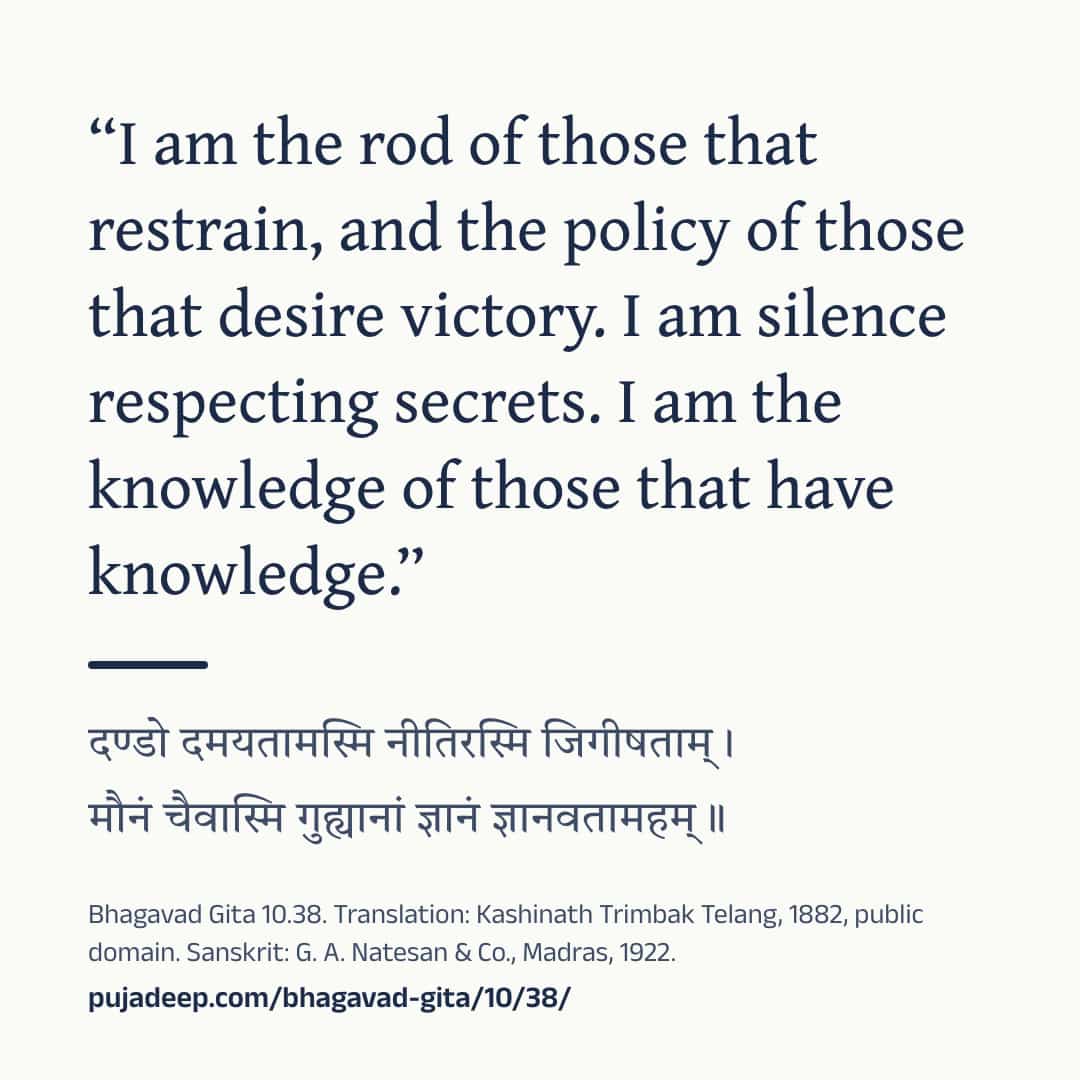
Drawing the picture
See the words
Bhagavad Gita 10.38

दण्डो दमयतामस्मि नीतिरस्मि जिगीषताम् ।
मौनं चैवास्मि गुह्यानां ज्ञानं ज्ञानवतामहम् ॥

“I am the rod of those that restrain, and the policy of those that desire victory. I am silence respecting secrets. I am the knowledge of those that have knowledge.”
(K. T. Telang, The Bhagavadgîtâ (The Sacred Books of the East, vol. VIII, Oxford: Clarendon Press, 1882), p. 91, public domain)

“Of subjugating things I am the Sceptre, of conquerors I am Statesmanship; and of secrecy I am also Silence, the Knowledge of knowers am I.”
(Annie Besant, The Bhagavad Gîtâ, or The Lord's Song (London: Theosophical Publishing Society, 1895), p. 102, public domain)

“Of punishers I am the sceptre; of those who seek to conquer, I am the polity; and also of things secret I am silence, and the knowledge of knowers am I.”
(Swami Swarupananda, Srimad-Bhagavad-Gita (Mayavati: Prabuddha Bharata Press, 1909; first printed in Prabuddha Bharata, 1907–1909), p. 209, public domain)

Sanskrit: G. A. Natesan & Co., Madras, 1922.
https://pujadeep.com/bhagavad-gita/10/38/ Nothing is sent from this site. Your own app sends it, to the chat you choose. The picture quotes the translation you chose on this page, with its name and year.
Sanskrit text: The Bhagavad-Gita, or The Lord's Song, with the text in Devanagari and an English translation, 1922. Meanings: written for Pujadeep and checked against the cited edition. Source and changes
Questions families ask
Who speaks Bhagavad Gita 10.38?
Krishna speaks this verse, in chapter 10 (Vibhuti Yoga).
Where does the Sanskrit text come from?
Sanskrit text: The Bhagavad-Gita, or The Lord's Song, with the text in Devanagari and an English translation, 1922. Meanings: written for Pujadeep and checked against the cited edition. See the source
Is the meaning on this page a translation?
Explanation written for this site from the sources listed here, and checked against the cited edition. It is not a translation and not the only way to read the text. Free to quote with credit.
Source and licence
- Sanskrit text
- The Bhagavad-Gita, or The Lord's Song, with the text in Devanagari and an English translation (Annie Besant, G. A. Natesan & Co., Madras, 1922). Public domain. The Sanskrit on these pages was read from this printing’s page images.
- Translation
- The Bhagavadgîtâ with the Sanatsugâtîya and the Anugîtâ, translated by Kâshinâth Trimbak Telang (The Sacred Books of the East, vol. VIII, ed. F. Max Müller) (Kashinath Trimbak Telang, F. Max Müller, Clarendon Press, Oxford, 1882). Public domain. Shown verbatim, as printed.
- Translation
- The Bhagavad Gîtâ, or The Lord's Song, translated by Annie Besant (Annie Besant, Theosophical Publishing Society, London, 1895). Public domain. Shown verbatim, as printed.
- Translation
- Srimad-Bhagavad-Gita, with Sanskrit Text; Paraphrase with Word-by-word Literal Translation; English Rendering and Comments, Index, &c., by the Swami Swarupananda (Himalayan Series, No. XX) (Swami Swarupananda, The Editors and Publishers, Advaita Ashrama, Mayavati, Prabuddha Bharata Press, Mayavati, Almora, Himalayas, 1909). Public domain. Shown verbatim, as printed.
- Common wording
- In this text, 32 words follow today's common wording, checked against sanskritdocuments.org; Sanskrit Wikisource; Gita Press, Gorakhpur; GRETIL, Göttingen and Bhaktivedanta Book Trust.
- Our explanation
- Explanation written for this site from the sources listed here, and checked against the cited edition. It is not a translation and not the only way to read the text. Free to quote with credit.
- Checked
- Checked against the cited edition, October 15, 2026.
- Updated
- October 25, 2026