Bhagavad Gita 10.33: meaning and translation
Chapter 10: Vibhuti Yoga. Krishna says
Among letters, Krishna says, he is the letter a; among compounds, the dvandva, in which each word has equal weight.
Click or tap a word for its meaning and its dictionary page.
Text and layers
Text and layers
These choices stay in this browser.
Bhagavad Gita 10.33
अक्षराणामकारोऽस्मि द्वन्द्वः सामासिकस्य च ।अहमेवाक्षयः कालो धाताऽहं विश्वतोमुखः ॥
Aksharanamakarosmi dvandvah samasikasya chaAhamevakshayah kalo dhataham vishvatomukhah
akṣarāṇāmakāro’smi dvandvaḥ sāmāsikasya ca |ahamevākṣayaḥ kālo dhātā’haṃ viśvatomukhaḥ ||
Our explanation Among letters, Krishna says, he is the letter a; among compounds, the dvandva, in which each word has equal weight. He is unending Time, and he is the Dhātṛ whose faces turn everywhere. The commentators read Dhātṛ differently (see the views).
हिंदी अर्थ कृष्ण कहते हैं कि अक्षरों में वे अकार (अ) हैं; समासों में द्वंद्व, जिसमें हर शब्द का बराबर महत्व होता है। वे अक्षय काल हैं, और वे सब ओर मुख वाले धाता हैं। टीकाकार “धाता” को अलग-अलग ढंग से समझते हैं।
Word by word
Every word, with its dictionary page
Word by word
- अक्षराणाम् akṣarāṇām · among letters (noun (neuter), genitive plural) Dictionary: a-kṣara, Monier-Williams 1899, p. 3, col. 2 “a letter”
- अकारः akāraḥ · the letter a (noun (masculine), nominative singular) Dictionary: a-kāra, Monier-Williams 1899, p. 1, col. 1 “the letter or sound a”
- अस्मि asmi · am (present, 1st person singular) Dictionary: 1. as, Monier-Williams 1899, p. 117, col. 2 “to be, live, exist, be present”
- द्वन्द्वः dvandvaḥ · the dvandva (pair) compound (noun (masculine), nominative singular) Dictionary: dvaṃdva, Monier-Williams 1899, p. 503, col. 2 “a copulative compound”
- सामासिकस्य sāmāsikasya · of (all) compounds (noun (masculine or neuter), genitive singular) Dictionary: sāmāsika, Monier-Williams 1899, p. 1206, col. 2 “m. or n. a compound word”
- च ca · and (indeclinable) Dictionary: 2. ca, Monier-Williams 1899, p. 380, col. 1 “and, both, also, moreover, as well as”
- अहम् aham · "I" (Krishna) (pronoun, nominative singular) Dictionary: aham, Monier-Williams 1899, p. 124, col. 2 “nom. sg. ‘I,’”
- एव eva · alone, also (indeclinable) Dictionary: 1. eva, Monier-Williams 1899, p. 232, col. 2 “just, exactly, very, same, only, even, alone, merely”
- अक्षयः akṣayaḥ · unending (adjective (masculine), nominative singular) Dictionary: a-kṣaya, Monier-Williams 1899, p. 3, col. 2 “exempt from decay, undecaying”
- कालः kālaḥ · Time (noun (masculine), nominative singular) Dictionary: 2. kāla, Monier-Williams 1899, p. 278, col. 1 “time (as destroying all things), death, time of death”
- धाता dhātā · the Dhātṛ (sustainer, ordainer) (noun (masculine), nominative singular) Dictionary: dhātṛ, Monier-Williams 1899, p. 514, col. 1 “later chiefly the creator and maintainer of the world”
- अहम् aham · "I" (Krishna) (pronoun, nominative singular) Dictionary: aham, Monier-Williams 1899, p. 124, col. 2 “nom. sg. ‘I,’”
- विश्वतोमुखः viśvatomukhaḥ · facing every way (compound (masculine), nominative singular) Dictionary: viśvato-mukha, Monier-Williams 1899, p. 994, col. 3 “facing all sides, one whose face is turned everywhere”
1 printing differs
Edition differences. Another printing or text reads this place differently.
- Spelling A digital text reads Same words. The 1922 edition marks the merged vowel with an avagraha (धाताऽहं); this e-text does not.
Old translations
Kashinath Trimbak Telang, 1882. Public domain. Page 90.
Among letters I am the letter A1, and among the group of compounds the copulative2 compound. I myself am time inexhaustible, and I the creator whose faces are in all directions.
Footnotes (the translator’s own) Compare 3 translations
Kashinath Trimbak Telang, 1882. Public domain. Page 90.
Among letters I am the letter A1, and among the group of compounds the copulative2 compound. I myself am time inexhaustible, and I the creator whose faces are in all directions.
Footnotes (the translator’s own) You are reading this one
Annie Besant, 1895. Public domain. Page 101.
Of letters the letter A I am, and the Dvandva of a composite; I also inexhaustible Time, I the Supporter whose Face turns everywhere.
You are reading this one
Swami Swarupananda, 1909 (first printed 1907). Public domain. Page 207.
Of letters the letter A am I, and Dvanda of all compounds; Myself the inexhaustible Time, I the sustainer (by dispensing fruits of actions) All-formed.
You are reading this one
Cite this verse
The translation: K. T. Telang, The Bhagavadgîtâ (The Sacred Books of the East, vol. VIII, Oxford: Clarendon Press, 1882), p. 90. Bhagavad Gita 10.33.
The translation: Annie Besant, The Bhagavad Gîtâ, or The Lord's Song (London: Theosophical Publishing Society, 1895), p. 101. Bhagavad Gita 10.33.
The translation: Swami Swarupananda, Srimad-Bhagavad-Gita (Mayavati: Prabuddha Bharata Press, 1909; first printed in Prabuddha Bharata, 1907–1909), p. 207. Bhagavad Gita 10.33.
Our explanation: “Bhagavad Gita 10.33: meaning and translation.” Pujadeep. Updated October 25, 2026. https://pujadeep.com/bhagavad-gita/10/33/
Pujadeep’s explanations are free to quote with credit: name Pujadeep and link to the page. How to credit
Classical readings, by school
Each reading is named by its school. None is presented as the only meaning.
What Advaita, Vishishtadvaita and Dvaita teach, in short
Shankara Advaita
Shankara says 'Time' here is either the smallest moment or the Supreme Lord, who is the Time of time. He reads Dhātṛ as the dispenser of the results of actions to the whole world.
Source: The Bhagavad-Gita, with the commentary of Sri Sankaracharya, translated by A. Mahadeva Sastri (2nd ed., Mysore: G. T. A. Printing Works, 1901), commentary on 10.33, p. 245. Summarised in our own words; none of its text is reproduced.
Ramanuja Vishishtadvaita
Ramanuja says 'Time' is time made of its divisions, such as kalā and muhūrta, and reads Dhātṛ as the creator of all, the four-faced Brahmā (Hiraṇyagarbha).
Source: Sri Bhagavad-Gita with Sri Ramanujacharya's Visishtadvaita commentary, translated by A. Govindacharya (Madras, 1898), commentary on 10.33, pp. 339–340. Summarised in our own words; none of its text is reproduced.
Share
Show the ways to share
Send one picture or the text to one chat. The picture names its source and the address of this page.
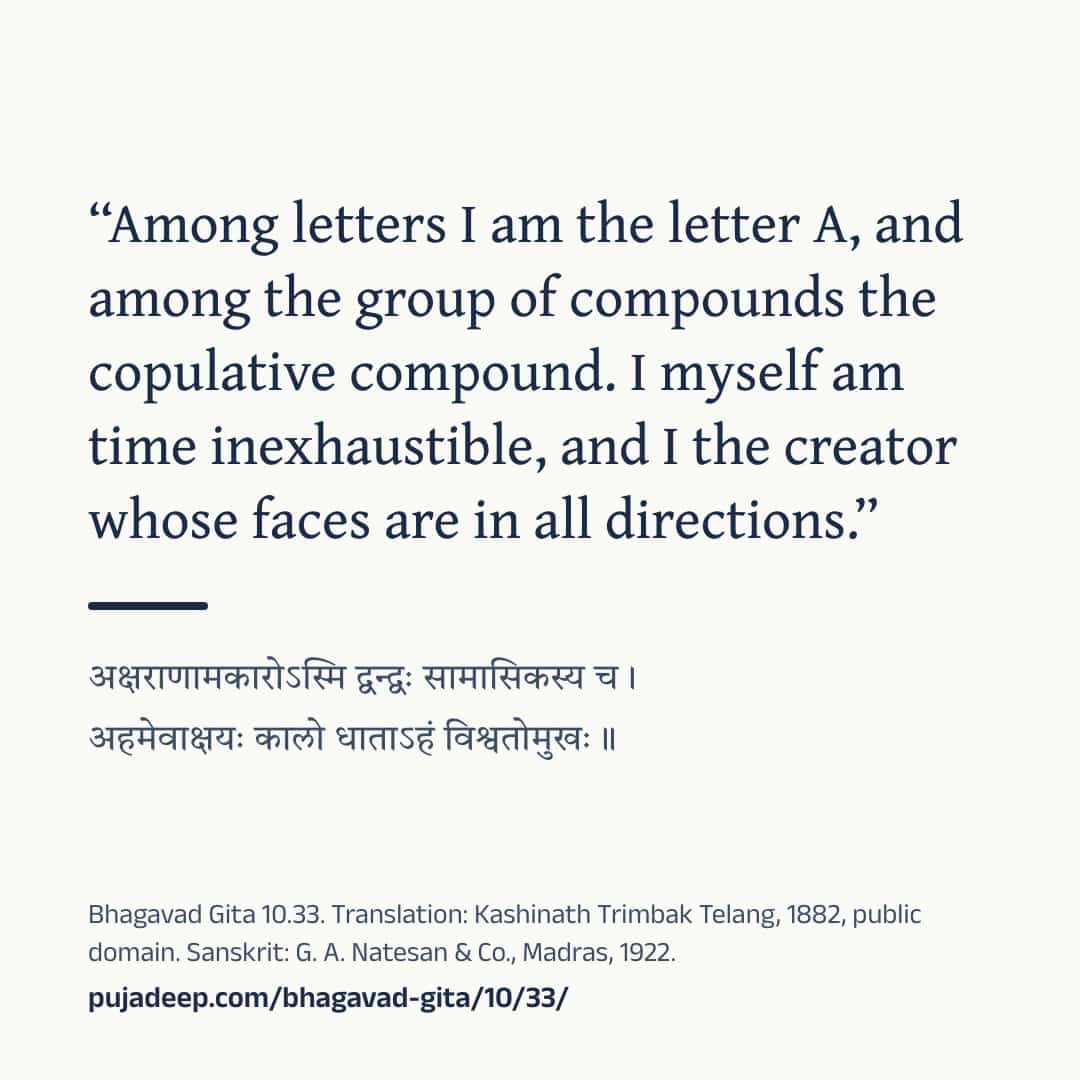
Drawing the picture
See the words
Bhagavad Gita 10.33

अक्षराणामकारोऽस्मि द्वन्द्वः सामासिकस्य च ।
अहमेवाक्षयः कालो धाताऽहं विश्वतोमुखः ॥

“Among letters I am the letter A, and among the group of compounds the copulative compound. I myself am time inexhaustible, and I the creator whose faces are in all directions.”
(K. T. Telang, The Bhagavadgîtâ (The Sacred Books of the East, vol. VIII, Oxford: Clarendon Press, 1882), p. 90, public domain)

“Of letters the letter A I am, and the Dvandva of a composite; I also inexhaustible Time, I the Supporter whose Face turns everywhere.”
(Annie Besant, The Bhagavad Gîtâ, or The Lord's Song (London: Theosophical Publishing Society, 1895), p. 101, public domain)

“Of letters the letter A am I, and Dvanda of all compounds; Myself the inexhaustible Time, I the sustainer (by dispensing fruits of actions) All-formed.”
(Swami Swarupananda, Srimad-Bhagavad-Gita (Mayavati: Prabuddha Bharata Press, 1909; first printed in Prabuddha Bharata, 1907–1909), p. 207, public domain)

Sanskrit: G. A. Natesan & Co., Madras, 1922.
https://pujadeep.com/bhagavad-gita/10/33/ Nothing is sent from this site. Your own app sends it, to the chat you choose. The picture quotes the translation you chose on this page, with its name and year.
Sanskrit text: The Bhagavad-Gita, or The Lord's Song, with the text in Devanagari and an English translation, 1922. Meanings: written for Pujadeep and checked against the cited edition. Source and changes
Questions families ask
Who speaks Bhagavad Gita 10.33?
Krishna speaks this verse, in chapter 10 (Vibhuti Yoga).
Where does the Sanskrit text come from?
Sanskrit text: The Bhagavad-Gita, or The Lord's Song, with the text in Devanagari and an English translation, 1922. Meanings: written for Pujadeep and checked against the cited edition. See the source
Is the meaning on this page a translation?
Explanation written for this site from the sources listed here, and checked against the cited edition. It is not a translation and not the only way to read the text. Free to quote with credit.
Source and licence
- Sanskrit text
- The Bhagavad-Gita, or The Lord's Song, with the text in Devanagari and an English translation (Annie Besant, G. A. Natesan & Co., Madras, 1922). Public domain. The Sanskrit on these pages was read from this printing’s page images.
- Translation
- The Bhagavadgîtâ with the Sanatsugâtîya and the Anugîtâ, translated by Kâshinâth Trimbak Telang (The Sacred Books of the East, vol. VIII, ed. F. Max Müller) (Kashinath Trimbak Telang, F. Max Müller, Clarendon Press, Oxford, 1882). Public domain. Shown verbatim, as printed.
- Translation
- The Bhagavad Gîtâ, or The Lord's Song, translated by Annie Besant (Annie Besant, Theosophical Publishing Society, London, 1895). Public domain. Shown verbatim, as printed.
- Translation
- Srimad-Bhagavad-Gita, with Sanskrit Text; Paraphrase with Word-by-word Literal Translation; English Rendering and Comments, Index, &c., by the Swami Swarupananda (Himalayan Series, No. XX) (Swami Swarupananda, The Editors and Publishers, Advaita Ashrama, Mayavati, Prabuddha Bharata Press, Mayavati, Almora, Himalayas, 1909). Public domain. Shown verbatim, as printed.
- Commentary
- The Bhagavad-Gita, with the commentary of Sri Sankaracharya, translated by A. Mahadeva Sastri (2nd ed., Mysore: G. T. A. Printing Works, 1901) (Public-domain scan, University of California Libraries). Summarised in our own words; none of its text is reproduced.
- Commentary
- Sri Bhagavad-Gita with Sri Ramanujacharya's Visishtadvaita commentary, translated by A. Govindacharya (Madras, 1898) (Scan uploaded to archive.org (folkscanomy collection)). Summarised in our own words; none of its text is reproduced.
- Common wording
- In this text, 32 words follow today's common wording, checked against sanskritdocuments.org; Sanskrit Wikisource; Gita Press, Gorakhpur; GRETIL, Göttingen and Bhaktivedanta Book Trust.
- Our explanation
- Explanation written for this site from the sources listed here, and checked against the cited edition. It is not a translation and not the only way to read the text. Free to quote with credit.
- Checked
- Checked against the cited edition, October 15, 2026.
- Updated
- October 25, 2026