Bhagavad Gita 10.39: meaning and translation
Chapter 10: Vibhuti Yoga. Krishna says
Krishna says that whatever is the seed of all beings, that is he, Arjuna; there is nothing, moving or unmoving, that could exist without him.
Click or tap a word for its meaning and its dictionary page.
Text and layers
Text and layers
These choices stay in this browser.
Bhagavad Gita 10.39
यच्चापि सर्वभूतानां बीजं तदहमर्जुन ।न तदस्ति विना यत्स्यान्मया भूतं चराचरम् ॥
Yachchapi sarvabhutanam bijam tadahamarjunaNa tadasti vina yatsyanmaya bhutam characharam
yaccāpi sarvabhūtānāṃ bījaṃ tadahamarjuna |na tadasti vinā yatsyānmayā bhūtaṃ carācaram ||
Our explanation Krishna says that whatever is the seed of all beings, that is he, Arjuna; there is nothing, moving or unmoving, that could exist without him. The schools explain why nothing exists without him (see the views).
हिंदी अर्थ कृष्ण कहते हैं कि हे अर्जुन, जो सब प्राणियों का बीज है, वह वही हैं; चर या अचर, ऐसा कुछ नहीं जो उनके बिना रह सके। परंपराएँ समझाती हैं कि उनके बिना कुछ क्यों नहीं रह सकता।
Word by word
Every word, with its dictionary page
Word by word
- यत् yat · whatever (relative pronoun (neuter), nominative singular) Dictionary: yad, Monier-Williams 1899, p. 844, col. 2 “who, which, what, whichever, whatever, that”
- च ca · and (indeclinable) Dictionary: 2. ca, Monier-Williams 1899, p. 380, col. 1 “and, both, also, moreover, as well as”
- अपि api · also (indeclinable) Dictionary: api, Monier-Williams 1899, p. 55, col. 1 “and, also, moreover, besides”
- सर्वभूतानाम् sarvabhūtānām · of all beings (compound (neuter), genitive plural) Dictionary: sarva-bhūta, Monier-Williams 1899, p. 1186, col. 2 “all beings”
- बीजम् bījam · the seed (noun (neuter), nominative singular) Dictionary: bīja, Monier-Williams 1899, p. 732, col. 2 “seed (of plants), semen (of men and animals)”
- तत् tat · that (pronoun (neuter), nominative singular) Dictionary: tad, Monier-Williams 1899, p. 434, col. 1 “m. he, f. she, n. it, that, this”
- अहम् aham · "I" (Krishna) (pronoun, nominative singular) Dictionary: aham, Monier-Williams 1899, p. 124, col. 2 “nom. sg. ‘I,’”
- अर्जुन arjuna · O Arjuna (noun (masculine), vocative singular) Dictionary: arjuna, Monier-Williams 1899, p. 90, col. 1
- न na · not (indeclinable) Dictionary: 2. na, Monier-Williams 1899, p. 523, col. 1 “not, no, nor, neither”
- तत् tat · that (pronoun (neuter), nominative singular) Dictionary: tad, Monier-Williams 1899, p. 434, col. 1 “m. he, f. she, n. it, that, this”
- अस्ति asti · is (present, 3rd person singular) Dictionary: 1. as, Monier-Williams 1899, p. 117, col. 2 “to be, live, exist, be present”
- विना vinā · without (indeclinable) Dictionary: vinā, Monier-Williams 1899, p. 969, col. 3 “without, except”
- यत् yat · which (relative pronoun (neuter), nominative singular) Dictionary: yad, Monier-Williams 1899, p. 844, col. 2 “who, which, what, whichever, whatever, that”
- स्यात् syāt · could be (optative, 3rd person singular) Dictionary: 1. as, Monier-Williams 1899, p. 117, col. 2 “to be, live, exist, be present”
- मया mayā · "me" (Krishna) (pronoun, instrumental singular) Dictionary: 1. mad, Monier-Williams 1899, p. 777, col. 2 “base of the first pers. pron. in the sg. number (esp. in comp.)”
- भूतम् bhūtam · being, thing (noun (neuter), nominative singular) Dictionary: bhūta, Monier-Williams 1899, p. 761, col. 3 “that which is or exists, any living being (divine, human, animal, and even vegetable)”
- चराचरम् carācaram · moving or unmoving (compound (neuter), nominative singular) Dictionary: 1. carācara, Monier-Williams 1899, p. 389, col. 2 “movable and immovable, locomotive and stationary”
Old translations
Kashinath Trimbak Telang, 1882. Public domain. Page 91.
And, O Arguna! I am also that which is the seed of all things. There is nothing movable or immovable which can exist without me.
Compare 3 translations
Kashinath Trimbak Telang, 1882. Public domain. Page 91.
And, O Arguna! I am also that which is the seed of all things. There is nothing movable or immovable which can exist without me.
You are reading this one
Annie Besant, 1895. Public domain. Page 102.
And whatsoever is the seed of all beings, that am I, O Arjuna! nor is there aught, moving or unmoving, that may exist bereft of Me.
You are reading this one
Swami Swarupananda, 1909 (first printed 1907). Public domain. Page 210.
And whatsoever is the seed of all beings, that also am I, O Arjuna. There is no being, whether moving or unmoving, that can exist without Me.
You are reading this one
Cite this verse
The translation: K. T. Telang, The Bhagavadgîtâ (The Sacred Books of the East, vol. VIII, Oxford: Clarendon Press, 1882), p. 91. Bhagavad Gita 10.39.
The translation: Annie Besant, The Bhagavad Gîtâ, or The Lord's Song (London: Theosophical Publishing Society, 1895), p. 102. Bhagavad Gita 10.39.
The translation: Swami Swarupananda, Srimad-Bhagavad-Gita (Mayavati: Prabuddha Bharata Press, 1909; first printed in Prabuddha Bharata, 1907–1909), p. 210. Bhagavad Gita 10.39.
Our explanation: “Bhagavad Gita 10.39: meaning and translation.” Pujadeep. Updated October 25, 2026. https://pujadeep.com/bhagavad-gita/10/39/
Pujadeep’s explanations are free to quote with credit: name Pujadeep and link to the page. How to credit
Classical readings, by school
Each reading is named by its school. None is presented as the only meaning.
What Advaita, Vishishtadvaita and Dvaita teach, in short
Shankara Advaita
Shankara says anything the Lord had not entered would be without a self and would be void; so everything has the Lord as its essence.
Source: The Bhagavad-Gita, with the commentary of Sri Sankaracharya, translated by A. Mahadeva Sastri (2nd ed., Mysore: G. T. A. Printing Works, 1901), commentary on 10.39, p. 246. Summarised in our own words; none of its text is reproduced.
Ramanuja Vishishtadvaita
Ramanuja says nothing can exist unless the Lord is its soul; all things, in every state, are joined to him as to their inner self. He takes this verse to close the list that began at 10.20.
Source: Sri Bhagavad-Gita with Sri Ramanujacharya's Visishtadvaita commentary, translated by A. Govindacharya (Madras, 1898), commentary on 10.39, p. 342. Summarised in our own words; none of its text is reproduced.
Share
Show the ways to share
Send one picture or the text to one chat. The picture names its source and the address of this page.
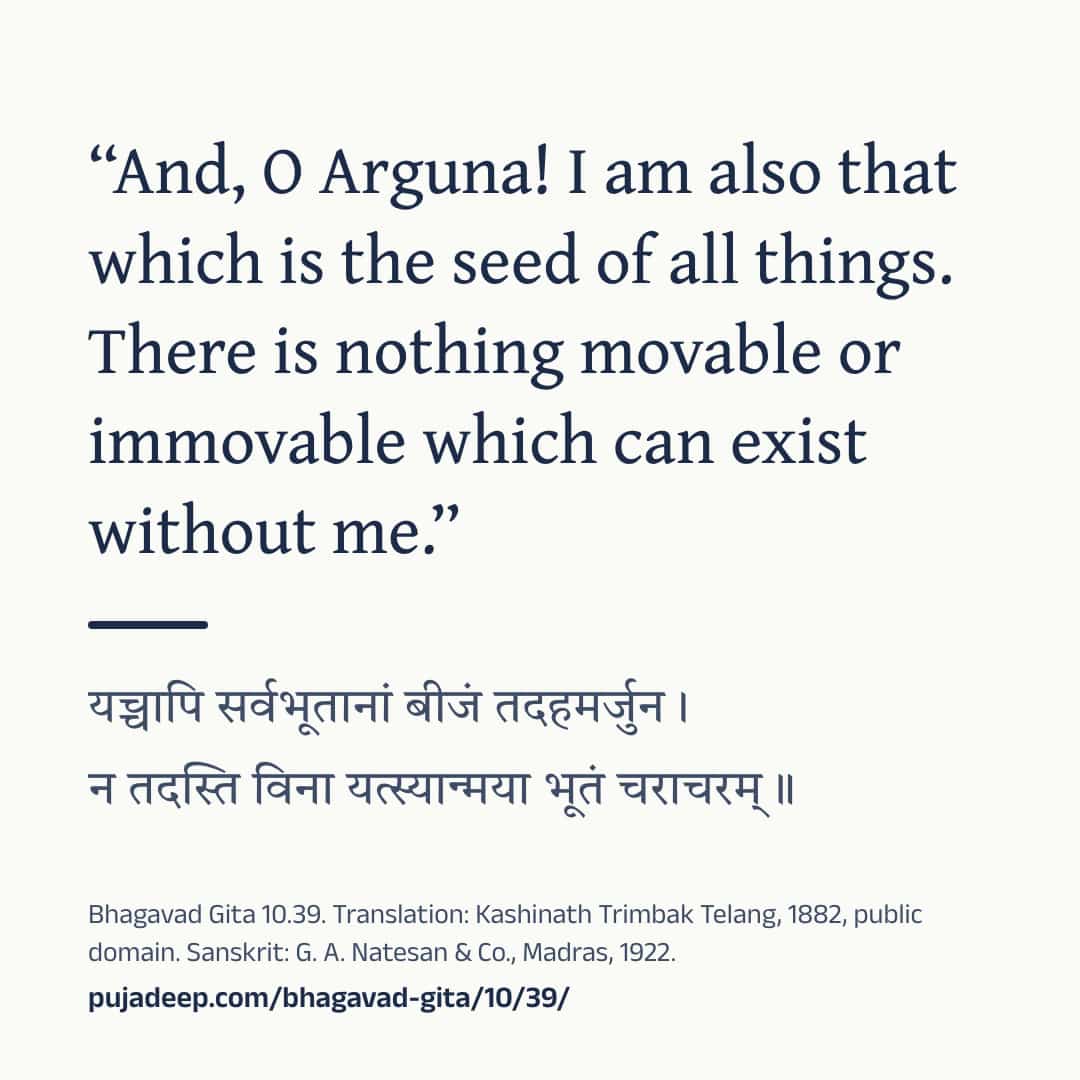
Drawing the picture
See the words
Bhagavad Gita 10.39

यच्चापि सर्वभूतानां बीजं तदहमर्जुन ।
न तदस्ति विना यत्स्यान्मया भूतं चराचरम् ॥

“And, O Arguna! I am also that which is the seed of all things. There is nothing movable or immovable which can exist without me.”
(K. T. Telang, The Bhagavadgîtâ (The Sacred Books of the East, vol. VIII, Oxford: Clarendon Press, 1882), p. 91, public domain)

“And whatsoever is the seed of all beings, that am I, O Arjuna! nor is there aught, moving or unmoving, that may exist bereft of Me.”
(Annie Besant, The Bhagavad Gîtâ, or The Lord's Song (London: Theosophical Publishing Society, 1895), p. 102, public domain)

“And whatsoever is the seed of all beings, that also am I, O Arjuna. There is no being, whether moving or unmoving, that can exist without Me.”
(Swami Swarupananda, Srimad-Bhagavad-Gita (Mayavati: Prabuddha Bharata Press, 1909; first printed in Prabuddha Bharata, 1907–1909), p. 210, public domain)

Sanskrit: G. A. Natesan & Co., Madras, 1922.
https://pujadeep.com/bhagavad-gita/10/39/ Nothing is sent from this site. Your own app sends it, to the chat you choose. The picture quotes the translation you chose on this page, with its name and year.
Sanskrit text: The Bhagavad-Gita, or The Lord's Song, with the text in Devanagari and an English translation, 1922. Meanings: written for Pujadeep and checked against the cited edition. Source and changes
Questions families ask
Who speaks Bhagavad Gita 10.39?
Krishna speaks this verse, in chapter 10 (Vibhuti Yoga).
Where does the Sanskrit text come from?
Sanskrit text: The Bhagavad-Gita, or The Lord's Song, with the text in Devanagari and an English translation, 1922. Meanings: written for Pujadeep and checked against the cited edition. See the source
Is the meaning on this page a translation?
Explanation written for this site from the sources listed here, and checked against the cited edition. It is not a translation and not the only way to read the text. Free to quote with credit.
Source and licence
- Sanskrit text
- The Bhagavad-Gita, or The Lord's Song, with the text in Devanagari and an English translation (Annie Besant, G. A. Natesan & Co., Madras, 1922). Public domain. The Sanskrit on these pages was read from this printing’s page images.
- Translation
- The Bhagavadgîtâ with the Sanatsugâtîya and the Anugîtâ, translated by Kâshinâth Trimbak Telang (The Sacred Books of the East, vol. VIII, ed. F. Max Müller) (Kashinath Trimbak Telang, F. Max Müller, Clarendon Press, Oxford, 1882). Public domain. Shown verbatim, as printed.
- Translation
- The Bhagavad Gîtâ, or The Lord's Song, translated by Annie Besant (Annie Besant, Theosophical Publishing Society, London, 1895). Public domain. Shown verbatim, as printed.
- Translation
- Srimad-Bhagavad-Gita, with Sanskrit Text; Paraphrase with Word-by-word Literal Translation; English Rendering and Comments, Index, &c., by the Swami Swarupananda (Himalayan Series, No. XX) (Swami Swarupananda, The Editors and Publishers, Advaita Ashrama, Mayavati, Prabuddha Bharata Press, Mayavati, Almora, Himalayas, 1909). Public domain. Shown verbatim, as printed.
- Commentary
- The Bhagavad-Gita, with the commentary of Sri Sankaracharya, translated by A. Mahadeva Sastri (2nd ed., Mysore: G. T. A. Printing Works, 1901) (Public-domain scan, University of California Libraries). Summarised in our own words; none of its text is reproduced.
- Commentary
- Sri Bhagavad-Gita with Sri Ramanujacharya's Visishtadvaita commentary, translated by A. Govindacharya (Madras, 1898) (Scan uploaded to archive.org (folkscanomy collection)). Summarised in our own words; none of its text is reproduced.
- Common wording
- In this text, 32 words follow today's common wording, checked against sanskritdocuments.org; Sanskrit Wikisource; Gita Press, Gorakhpur; GRETIL, Göttingen and Bhaktivedanta Book Trust.
- Our explanation
- Explanation written for this site from the sources listed here, and checked against the cited edition. It is not a translation and not the only way to read the text. Free to quote with credit.
- Checked
- Checked against the cited edition, October 15, 2026.
- Updated
- October 25, 2026