Bhagavad Gita 10.32: meaning and translation
Chapter 10: Vibhuti Yoga. Krishna says
Of all creations, Krishna says, he is the beginning, the middle and the end.
Click or tap a word for its meaning and its dictionary page.
Text and layers
Text and layers
These choices stay in this browser.
Bhagavad Gita 10.32
सर्गाणामादिरन्तश्च मध्यं चैवाहमर्जुन ।अध्यात्मविद्या विद्यानां वादः प्रवदतामहम् ॥
Sarganamadirantashcha madhyam chaivahamarjunaAdhyatmavidya vidyanam vadah pravadatamaham
sargāṇāmādirantaśca madhyaṃ caivāhamarjuna |adhyātmavidyā vidyānāṃ vādaḥ pravadatāmaham ||
Our explanation Of all creations, Krishna says, he is the beginning, the middle and the end. Among kinds of knowledge, he is the knowledge of the self (adhyātma-vidyā); among those who argue, he is vāda, discussion that seeks the truth. Both commentators set vāda apart from wrangling meant only to win.
हिंदी अर्थ कृष्ण कहते हैं कि सब सृष्टियों के आदि, मध्य और अंत वही हैं। विद्याओं में वे अध्यात्म-विद्या (आत्मा का ज्ञान) हैं; और वाद-विवाद करने वालों में वाद, यानी सत्य की खोज करने वाला संवाद। दोनों टीकाकार वाद को केवल जीतने के लिए किए गए विवाद से अलग बताते हैं।
Word by word
Every word, with its dictionary page
Word by word
- सर्गाणाम् sargāṇām · of creations (noun (masculine), genitive plural) Dictionary: sarga, Monier-Williams 1899, p. 1184, col. 1 “emission or creation of matter, primary creation”
- आदिः ādiḥ · the beginning (noun (masculine), nominative singular) Dictionary: 1. ādi, Monier-Williams 1899, p. 136, col. 3 “beginning, commencement”
- अन्तः antaḥ · the end (noun (masculine), nominative singular) Dictionary: anta, Monier-Williams 1899, p. 42, col. 3 “end, limit, boundary, term”
- च ca · and (indeclinable) Dictionary: 2. ca, Monier-Williams 1899, p. 380, col. 1 “and, both, also, moreover, as well as”
- मध्यम् madhyam · the middle (noun (neuter), nominative singular) Dictionary: madhya, Monier-Williams 1899, p. 781, col. 3 “the middle, midst, centre, inside, interior”
- च ca · and (indeclinable) Dictionary: 2. ca, Monier-Williams 1899, p. 380, col. 1 “and, both, also, moreover, as well as”
- एव eva · also (indeclinable) Dictionary: 1. eva, Monier-Williams 1899, p. 232, col. 2 “just, exactly, very, same, only, even, alone, merely”
- अहम् aham · "I" (Krishna) (pronoun, nominative singular) Dictionary: aham, Monier-Williams 1899, p. 124, col. 2 “nom. sg. ‘I,’”
- अर्जुन arjuna · O Arjuna (noun (masculine), vocative singular) Dictionary: arjuna, Monier-Williams 1899, p. 90, col. 1
- अध्यात्मविद्या adhyātmavidyā · knowledge of the self (compound (feminine), nominative singular) Dictionary: adhy-ātma, Monier-Williams 1899, p. 23, col. 2 “the Supreme Spirit”; vidyā, Monier-Williams 1899, p. 963, col. 3 “knowledge”
- विद्यानाम् vidyānām · among kinds of knowledge (noun (feminine), genitive plural) Dictionary: vidyā, Monier-Williams 1899, p. 963, col. 3 “knowledge”
- वादः vādaḥ · discussion that seeks the truth (noun (masculine), nominative singular) Dictionary: vāda, Monier-Williams 1899, p. 939, col. 3 “speech, discourse, talk, utterance, statement”
- प्रवदताम् pravadatām · among those who argue (present participle (masculine), genitive plural) Dictionary: pra-vad, Monier-Williams 1899, p. 690, col. 3 “to assert, affirm, state”
- अहम् aham · "I" (Krishna) (pronoun, nominative singular) Dictionary: aham, Monier-Williams 1899, p. 124, col. 2 “nom. sg. ‘I,’”
Old translations
Kashinath Trimbak Telang, 1882. Public domain. Page 90.
Of created things I am the beginning and the end and the middle also, O Arguna! Among sciences, I am the science of the Adhyâtma, and I am the argument of controversialists.
Compare 3 translations
Kashinath Trimbak Telang, 1882. Public domain. Page 90.
Of created things I am the beginning and the end and the middle also, O Arguna! Among sciences, I am the science of the Adhyâtma, and I am the argument of controversialists.
You are reading this one
Annie Besant, 1895. Public domain. Page 101.
Of creations the beginning and the ending, and also the middle am I, O Arjuna. Of sciences the science of Adhyâtmâ, the Speech of orators I.
You are reading this one
Swami Swarupananda, 1909 (first printed 1907). Public domain. Page 206–207.
Of manifestations I am the beginning and the middle and also the end; of all knowledges I am the knowledge of the Self, and Vàda of disputants.
You are reading this one
Cite this verse
The translation: K. T. Telang, The Bhagavadgîtâ (The Sacred Books of the East, vol. VIII, Oxford: Clarendon Press, 1882), p. 90. Bhagavad Gita 10.32.
The translation: Annie Besant, The Bhagavad Gîtâ, or The Lord's Song (London: Theosophical Publishing Society, 1895), p. 101. Bhagavad Gita 10.32.
The translation: Swami Swarupananda, Srimad-Bhagavad-Gita (Mayavati: Prabuddha Bharata Press, 1909; first printed in Prabuddha Bharata, 1907–1909), pp. 206–207. Bhagavad Gita 10.32.
Our explanation: “Bhagavad Gita 10.32: meaning and translation.” Pujadeep. Updated October 25, 2026. https://pujadeep.com/bhagavad-gita/10/32/
Pujadeep’s explanations are free to quote with credit: name Pujadeep and link to the page. How to credit
Classical readings, by school
No readings by school on this verse yet.
Share
Show the ways to share
Send one picture or the text to one chat. The picture names its source and the address of this page.
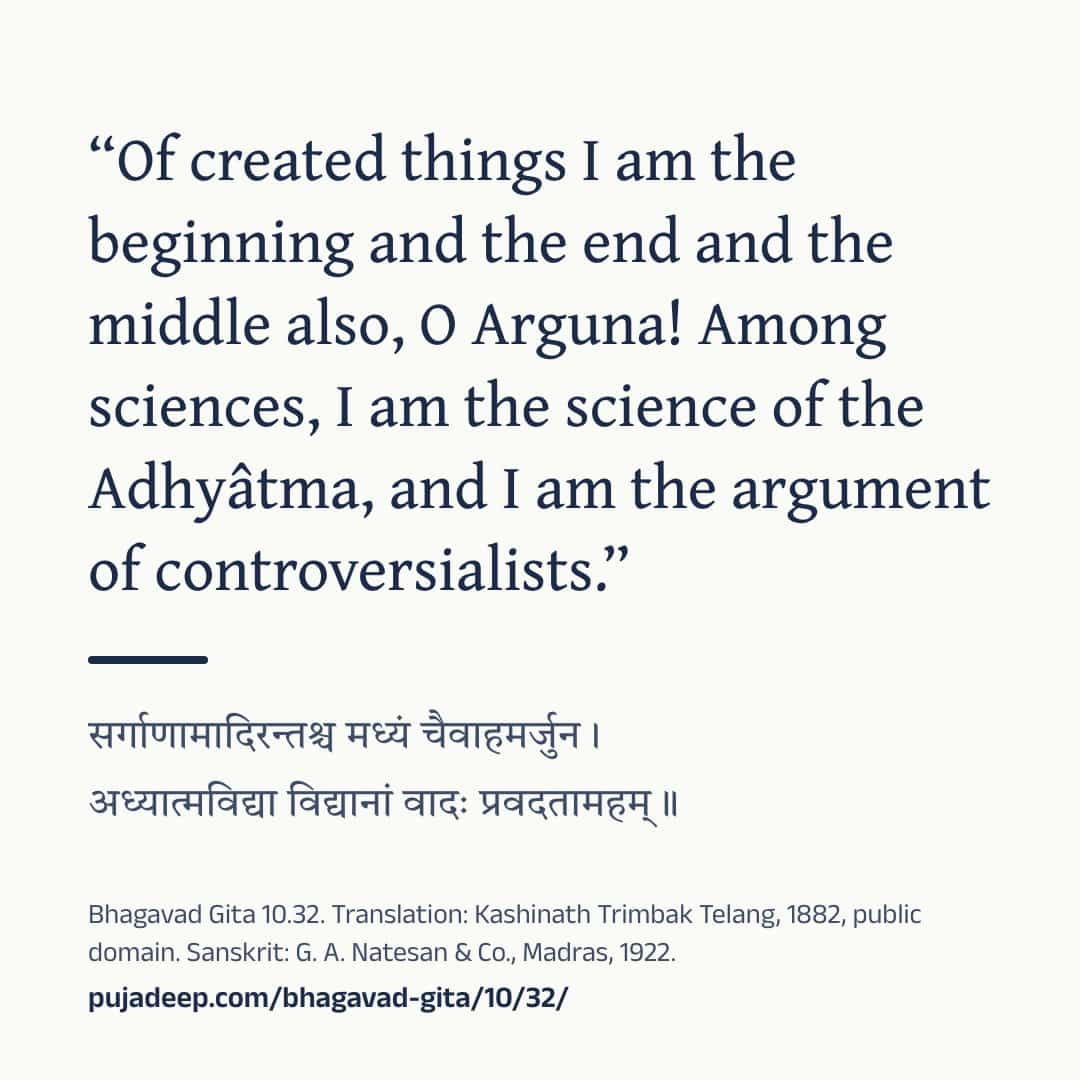
Drawing the picture
See the words
Bhagavad Gita 10.32

सर्गाणामादिरन्तश्च मध्यं चैवाहमर्जुन ।
अध्यात्मविद्या विद्यानां वादः प्रवदतामहम् ॥

“Of created things I am the beginning and the end and the middle also, O Arguna! Among sciences, I am the science of the Adhyâtma, and I am the argument of controversialists.”
(K. T. Telang, The Bhagavadgîtâ (The Sacred Books of the East, vol. VIII, Oxford: Clarendon Press, 1882), p. 90, public domain)

“Of creations the beginning and the ending, and also the middle am I, O Arjuna. Of sciences the science of Adhyâtmâ, the Speech of orators I.”
(Annie Besant, The Bhagavad Gîtâ, or The Lord's Song (London: Theosophical Publishing Society, 1895), p. 101, public domain)

“Of manifestations I am the beginning and the middle and also the end; of all knowledges I am the knowledge of the Self, and Vàda of disputants.”
(Swami Swarupananda, Srimad-Bhagavad-Gita (Mayavati: Prabuddha Bharata Press, 1909; first printed in Prabuddha Bharata, 1907–1909), pp. 206–207, public domain)

Sanskrit: G. A. Natesan & Co., Madras, 1922.
https://pujadeep.com/bhagavad-gita/10/32/ Nothing is sent from this site. Your own app sends it, to the chat you choose. The picture quotes the translation you chose on this page, with its name and year.
Sanskrit text: The Bhagavad-Gita, or The Lord's Song, with the text in Devanagari and an English translation, 1922. Meanings: written for Pujadeep and checked against the cited edition. Source and changes
Questions families ask
Who speaks Bhagavad Gita 10.32?
Krishna speaks this verse, in chapter 10 (Vibhuti Yoga).
Where does the Sanskrit text come from?
Sanskrit text: The Bhagavad-Gita, or The Lord's Song, with the text in Devanagari and an English translation, 1922. Meanings: written for Pujadeep and checked against the cited edition. See the source
Is the meaning on this page a translation?
Explanation written for this site from the sources listed here, and checked against the cited edition. It is not a translation and not the only way to read the text. Free to quote with credit.
Source and licence
- Sanskrit text
- The Bhagavad-Gita, or The Lord's Song, with the text in Devanagari and an English translation (Annie Besant, G. A. Natesan & Co., Madras, 1922). Public domain. The Sanskrit on these pages was read from this printing’s page images.
- Translation
- The Bhagavadgîtâ with the Sanatsugâtîya and the Anugîtâ, translated by Kâshinâth Trimbak Telang (The Sacred Books of the East, vol. VIII, ed. F. Max Müller) (Kashinath Trimbak Telang, F. Max Müller, Clarendon Press, Oxford, 1882). Public domain. Shown verbatim, as printed.
- Translation
- The Bhagavad Gîtâ, or The Lord's Song, translated by Annie Besant (Annie Besant, Theosophical Publishing Society, London, 1895). Public domain. Shown verbatim, as printed.
- Translation
- Srimad-Bhagavad-Gita, with Sanskrit Text; Paraphrase with Word-by-word Literal Translation; English Rendering and Comments, Index, &c., by the Swami Swarupananda (Himalayan Series, No. XX) (Swami Swarupananda, The Editors and Publishers, Advaita Ashrama, Mayavati, Prabuddha Bharata Press, Mayavati, Almora, Himalayas, 1909). Public domain. Shown verbatim, as printed.
- Common wording
- In this text, 32 words follow today's common wording, checked against sanskritdocuments.org; Sanskrit Wikisource; Gita Press, Gorakhpur; GRETIL, Göttingen and Bhaktivedanta Book Trust.
- Our explanation
- Explanation written for this site from the sources listed here, and checked against the cited edition. It is not a translation and not the only way to read the text. Free to quote with credit.
- Checked
- Checked against the cited edition, October 15, 2026.
- Updated
- October 25, 2026