Bhagavad Gita 10.31: meaning and translation
Chapter 10: Vibhuti Yoga. Krishna says
Among purifiers, Krishna says, he is the wind; among those who bear weapons, Rāma; among creatures of the water, the makara; among rivers, the Jāhnavī (the Ganga).
Click or tap a word for its meaning and its dictionary page.
Text and layers
Text and layers
These choices stay in this browser.
Bhagavad Gita 10.31
पवनः पवतामस्मि रामः शस्त्रभृतामहम् ।झषाणां मकरश्चास्मि स्रोतसामस्मि जाह्नवी ॥
Pavanah pavatamasmi ramah shastrabhritamahamJhashanam makarashchasmi srotasamasmi jahnavi
pavanaḥ pavatāmasmi rāmaḥ śastrabhṛtāmaham |jhaṣāṇāṃ makaraścāsmi srotasāmasmi jāhnavī ||
Our explanation Among purifiers, Krishna says, he is the wind; among those who bear weapons, Rāma; among creatures of the water, the makara; among rivers, the Jāhnavī (the Ganga). The makara is a sea creature; Telang calls it the dolphin, and Shankara the shark.
हिंदी अर्थ कृष्ण कहते हैं कि पवित्र करने वालों में वे वायु हैं; शस्त्रधारियों में राम; जलचरों में मकर; और नदियों में जाह्नवी (गंगा)। मकर एक जल-जीव है; तेलंग इसे डॉल्फ़िन कहते हैं और शंकराचार्य शार्क।
Word by word
Every word, with its dictionary page
Word by word
- पवनः pavanaḥ · the wind (noun (masculine), nominative singular) Dictionary: pavana, Monier-Williams 1899, p. 610, col. 3 “‘purifier,’ wind or the god of wind, breeze, air”
- पवताम् pavatām · among purifiers (present participle (masculine), genitive plural) Dictionary: 1. pū, Monier-Williams 1899, p. 640, col. 3 “to make clean or clear or pure or bright, cleanse, purify”
- अस्मि asmi · am (present, 1st person singular) Dictionary: 1. as, Monier-Williams 1899, p. 117, col. 2 “to be, live, exist, be present”
- रामः rāmaḥ · Rāma (noun (masculine), nominative singular) Dictionary: rāma, Monier-Williams 1899, p. 877, col. 1 “N. of various mythical personages”
- शस्त्रभृताम् śastrabhṛtām · among those who bear weapons (compound (masculine), genitive plural) Dictionary: śastra-bhṛt, Monier-Williams 1899, p. 1061, col. 1; śastra-dhara, Monier-Williams 1899, p. 1061, col. 1 “bearing w°s; m. a warrior”
- अहम् aham · "I" (Krishna) (pronoun, nominative singular) Dictionary: aham, Monier-Williams 1899, p. 124, col. 2 “nom. sg. ‘I,’”
- झषाणाम् jhaṣāṇām · among fishes (noun (masculine), genitive plural) Dictionary: jhaṣa, Monier-Williams 1899, p. 429, col. 1 “a large fish”
- मकरः makaraḥ · the makara (a sea creature) (noun (masculine), nominative singular) Dictionary: makara, Monier-Williams 1899, p. 771, col. 2 “a kind of sea-monster”
- च ca · and (indeclinable) Dictionary: 2. ca, Monier-Williams 1899, p. 380, col. 1 “and, both, also, moreover, as well as”
- अस्मि asmi · am (present, 1st person singular) Dictionary: 1. as, Monier-Williams 1899, p. 117, col. 2 “to be, live, exist, be present”
- स्रोतसाम् srotasām · among rivers (noun (neuter), genitive plural) Dictionary: srotas, Monier-Williams 1899, p. 1274, col. 3 “the current or bed of a river, a river, stream, torrent”
- अस्मि asmi · am (present, 1st person singular) Dictionary: 1. as, Monier-Williams 1899, p. 117, col. 2 “to be, live, exist, be present”
- जाह्नवी jāhnavī · Jāhnavī (the Ganga) (noun (feminine), nominative singular) Dictionary: jāhnava, Monier-Williams 1899, p. 420, col. 2 “the Gaṅgā”
Old translations
Kashinath Trimbak Telang, 1882. Public domain. Page 90.
I am the wind among those that blow1. I am Râma2 among those that wield weapons. Among fishes I am Makara3, and among streams the Gâhnavî4.
Footnotes (the translator’s own) Compare 3 translations
Kashinath Trimbak Telang, 1882. Public domain. Page 90.
I am the wind among those that blow1. I am Râma2 among those that wield weapons. Among fishes I am Makara3, and among streams the Gâhnavî4.
Footnotes (the translator’s own) You are reading this one
Annie Besant, 1895. Public domain. Page 100.
Of purifications I am the Wind, Râma of warriors I; and I am Makara of fishes, of streams the Ganges am I.
You are reading this one
Swami Swarupananda, 1909 (first printed 1907). Public domain. Page 206.
Of purifiers I am the wind, Ràma of warriors am I; of fishes I am the shark, of streams I am Jáhnavi (the Ganges).
You are reading this one
Cite this verse
The translation: K. T. Telang, The Bhagavadgîtâ (The Sacred Books of the East, vol. VIII, Oxford: Clarendon Press, 1882), p. 90. Bhagavad Gita 10.31.
The translation: Annie Besant, The Bhagavad Gîtâ, or The Lord's Song (London: Theosophical Publishing Society, 1895), p. 100. Bhagavad Gita 10.31.
The translation: Swami Swarupananda, Srimad-Bhagavad-Gita (Mayavati: Prabuddha Bharata Press, 1909; first printed in Prabuddha Bharata, 1907–1909), p. 206. Bhagavad Gita 10.31.
Our explanation: “Bhagavad Gita 10.31: meaning and translation.” Pujadeep. Updated October 25, 2026. https://pujadeep.com/bhagavad-gita/10/31/
Pujadeep’s explanations are free to quote with credit: name Pujadeep and link to the page. How to credit
Classical readings, by school
No readings by school on this verse yet.
Share
Show the ways to share
Send one picture or the text to one chat. The picture names its source and the address of this page.
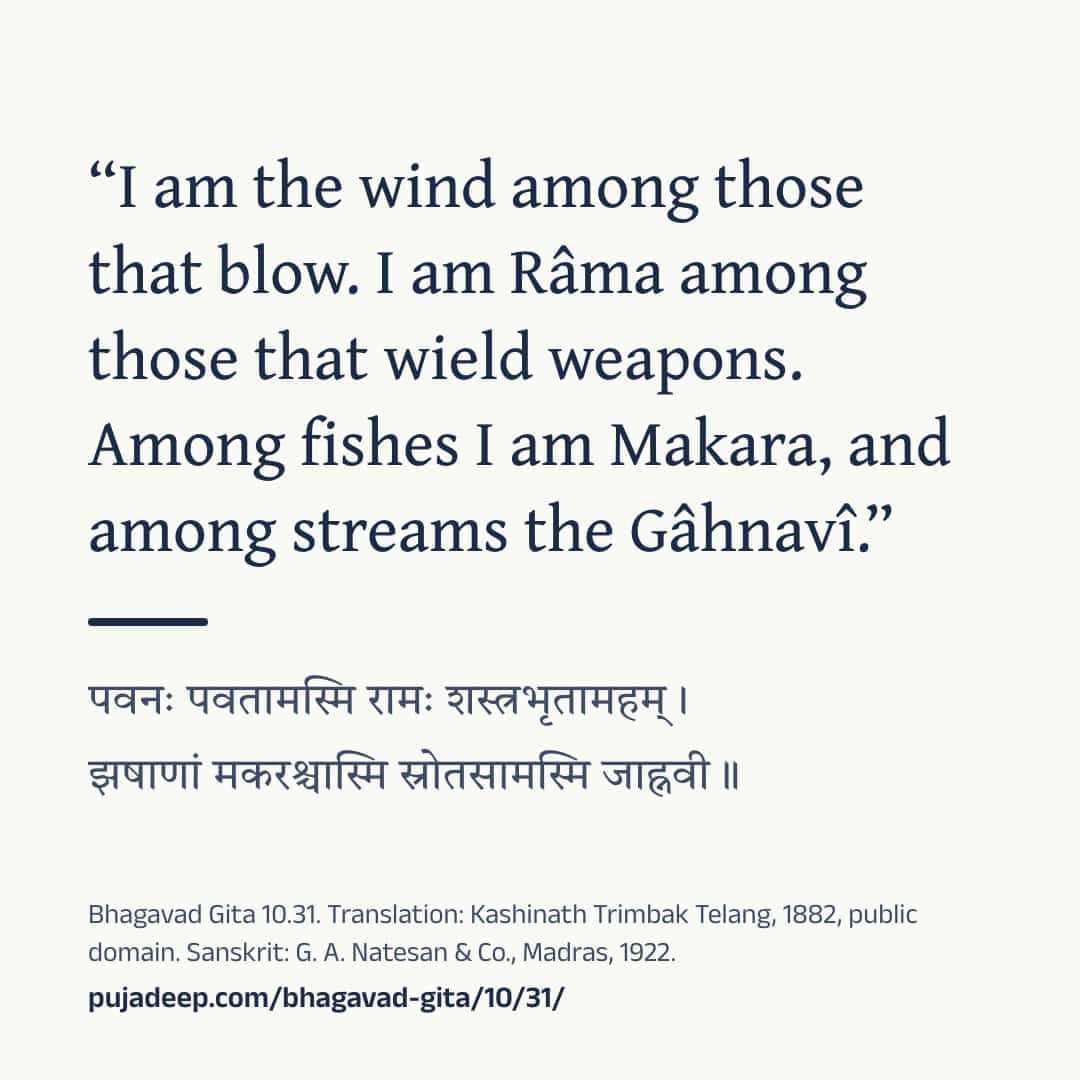
Drawing the picture
See the words
Bhagavad Gita 10.31

पवनः पवतामस्मि रामः शस्त्रभृतामहम् ।
झषाणां मकरश्चास्मि स्रोतसामस्मि जाह्नवी ॥

“I am the wind among those that blow. I am Râma among those that wield weapons. Among fishes I am Makara, and among streams the Gâhnavî.”
(K. T. Telang, The Bhagavadgîtâ (The Sacred Books of the East, vol. VIII, Oxford: Clarendon Press, 1882), p. 90, public domain)

“Of purifications I am the Wind, Râma of warriors I; and I am Makara of fishes, of streams the Ganges am I.”
(Annie Besant, The Bhagavad Gîtâ, or The Lord's Song (London: Theosophical Publishing Society, 1895), p. 100, public domain)

“Of purifiers I am the wind, Ràma of warriors am I; of fishes I am the shark, of streams I am Jáhnavi (the Ganges).”
(Swami Swarupananda, Srimad-Bhagavad-Gita (Mayavati: Prabuddha Bharata Press, 1909; first printed in Prabuddha Bharata, 1907–1909), p. 206, public domain)

Sanskrit: G. A. Natesan & Co., Madras, 1922.
https://pujadeep.com/bhagavad-gita/10/31/ Nothing is sent from this site. Your own app sends it, to the chat you choose. The picture quotes the translation you chose on this page, with its name and year.
Sanskrit text: The Bhagavad-Gita, or The Lord's Song, with the text in Devanagari and an English translation, 1922. Meanings: written for Pujadeep and checked against the cited edition. Source and changes
Questions families ask
Who speaks Bhagavad Gita 10.31?
Krishna speaks this verse, in chapter 10 (Vibhuti Yoga).
Where does the Sanskrit text come from?
Sanskrit text: The Bhagavad-Gita, or The Lord's Song, with the text in Devanagari and an English translation, 1922. Meanings: written for Pujadeep and checked against the cited edition. See the source
Is the meaning on this page a translation?
Explanation written for this site from the sources listed here, and checked against the cited edition. It is not a translation and not the only way to read the text. Free to quote with credit.
Source and licence
- Sanskrit text
- The Bhagavad-Gita, or The Lord's Song, with the text in Devanagari and an English translation (Annie Besant, G. A. Natesan & Co., Madras, 1922). Public domain. The Sanskrit on these pages was read from this printing’s page images.
- Translation
- The Bhagavadgîtâ with the Sanatsugâtîya and the Anugîtâ, translated by Kâshinâth Trimbak Telang (The Sacred Books of the East, vol. VIII, ed. F. Max Müller) (Kashinath Trimbak Telang, F. Max Müller, Clarendon Press, Oxford, 1882). Public domain. Shown verbatim, as printed.
- Translation
- The Bhagavad Gîtâ, or The Lord's Song, translated by Annie Besant (Annie Besant, Theosophical Publishing Society, London, 1895). Public domain. Shown verbatim, as printed.
- Translation
- Srimad-Bhagavad-Gita, with Sanskrit Text; Paraphrase with Word-by-word Literal Translation; English Rendering and Comments, Index, &c., by the Swami Swarupananda (Himalayan Series, No. XX) (Swami Swarupananda, The Editors and Publishers, Advaita Ashrama, Mayavati, Prabuddha Bharata Press, Mayavati, Almora, Himalayas, 1909). Public domain. Shown verbatim, as printed.
- Common wording
- In this text, 32 words follow today's common wording, checked against sanskritdocuments.org; Sanskrit Wikisource; Gita Press, Gorakhpur; GRETIL, Göttingen and Bhaktivedanta Book Trust.
- Our explanation
- Explanation written for this site from the sources listed here, and checked against the cited edition. It is not a translation and not the only way to read the text. Free to quote with credit.
- Checked
- Checked against the cited edition, October 15, 2026.
- Updated
- October 25, 2026