Bhagavad Gita 10.21: meaning and translation
Chapter 10: Vibhuti Yoga. Krishna says
Krishna begins the list.
Click or tap a word for its meaning and its dictionary page.
Text and layers
Text and layers
These choices stay in this browser.
Bhagavad Gita 10.21
आदित्यानामहं विष्णुर्ज्योतिषां रविरंशुमान् ।मरीचिर्मरुतामस्मि नक्षत्राणामहं शशी ॥
Adityanamaham vishnurjyotisham raviranshumanMarichirmarutamasmi nakshatranamaham shashi
ādityānāmahaṃ viṣṇurjyotiṣāṃ raviraṃśumān |marīcirmarutāmasmi nakṣatrāṇāmahaṃ śaśī ||
Our explanation Krishna begins the list. Among the Ādityas (the sons of Aditi) he is Vishnu; among lights, the radiant sun; among the Maruts (the storm gods), Marīci; among the stars (nakṣatras), the moon.
हिंदी अर्थ कृष्ण सूची शुरू करते हैं। आदित्यों (अदिति के पुत्रों) में वे विष्णु हैं; ज्योतियों में तेजस्वी सूर्य; मरुतों (वायु देवताओं) में मरीचि; और नक्षत्रों में चंद्रमा।
Word by word
Every word, with its dictionary page
Word by word
- आदित्यानाम् ādityānām · among the Ādityas (noun (masculine), genitive plural) Dictionary: āditya, Monier-Williams 1899, p. 137, col. 2 “N. of seven deities of the heavenly sphere”
- अहम् aham · "I" (Krishna) (pronoun, nominative singular) Dictionary: aham, Monier-Williams 1899, p. 124, col. 2 “nom. sg. ‘I,’”
- विष्णुः viṣṇuḥ · Vishnu (noun (masculine), nominative singular) Dictionary: viṣṇu, Monier-Williams 1899, p. 999, col. 1 “N. of one of the principal Hindū deities”
- ज्योतिषाम् jyotiṣām · among lights (noun (neuter), genitive plural) Dictionary: jyotis, Monier-Williams 1899, p. 427, col. 3 “pl. the heavenly bodies, planets and stars”
- रविः raviḥ · the sun (noun (masculine), nominative singular) Dictionary: ravi, Monier-Williams 1899, p. 869, col. 1 “the sun (in general) or the sun-god”
- अंशुमान् aṃśumān · radiant (adjective (masculine), nominative singular) Dictionary: aṃśu-mat, Monier-Williams 1899, p. 1, col. 2 “radiant, luminous”
- मरीचिः marīciḥ · Marīci (noun (masculine), nominative singular) Dictionary: marīci, Monier-Williams 1899, p. 790, col. 1 “N. of a Prajā-pati or 'lord of created beings'”
- मरुताम् marutām · among the Maruts (noun (masculine), genitive plural) Dictionary: marut, Monier-Williams 1899, p. 790, col. 2 “the storm-gods”
- अस्मि asmi · am (present, 1st person singular) Dictionary: 1. as, Monier-Williams 1899, p. 117, col. 2 “to be, live, exist, be present”
- नक्षत्राणाम् nakṣatrāṇām · among the stars (nakṣatras) (noun (neuter), genitive plural) Dictionary: nakṣatra, Monier-Williams 1899, p. 524, col. 2 “a star or any heavenly body”
- अहम् aham · "I" (Krishna) (pronoun, nominative singular) Dictionary: aham, Monier-Williams 1899, p. 124, col. 2 “nom. sg. ‘I,’”
- शशी śaśī · the moon (noun (masculine), nominative singular) Dictionary: śaśin, Monier-Williams 1899, p. 1060, col. 2 “'containing a hare,' the moon”
Old translations
Kashinath Trimbak Telang, 1882. Public domain. Page 88.
I am Vishnu among the Âdityas1, the beaming sun among the shining (bodies); I am Marîki among the Maruts2, and the moon among the lunar mansions3.
Footnotes (the translator’s own) Compare 3 translations
Kashinath Trimbak Telang, 1882. Public domain. Page 88.
I am Vishnu among the Âdityas1, the beaming sun among the shining (bodies); I am Marîki among the Maruts2, and the moon among the lunar mansions3.
Footnotes (the translator’s own) You are reading this one
Annie Besant, 1895. Public domain. Page 99.
Of the Âdityas I am Vishnu; of radiances the glorious Sun; I am Marîchi of the Maruts, of the asterisms the Moon am I.
You are reading this one
Swami Swarupananda, 1909 (first printed 1907). Public domain. Page 202.
Of the Adityas I am Vishnu; of luminaries, the radiant Sun; of the winds, I am Marichi; of the asterisms, the Moon.
You are reading this one
Cite this verse
The translation: K. T. Telang, The Bhagavadgîtâ (The Sacred Books of the East, vol. VIII, Oxford: Clarendon Press, 1882), p. 88. Bhagavad Gita 10.21.
The translation: Annie Besant, The Bhagavad Gîtâ, or The Lord's Song (London: Theosophical Publishing Society, 1895), p. 99. Bhagavad Gita 10.21.
The translation: Swami Swarupananda, Srimad-Bhagavad-Gita (Mayavati: Prabuddha Bharata Press, 1909; first printed in Prabuddha Bharata, 1907–1909), p. 202. Bhagavad Gita 10.21.
Our explanation: “Bhagavad Gita 10.21: meaning and translation.” Pujadeep. Updated October 25, 2026. https://pujadeep.com/bhagavad-gita/10/21/
Pujadeep’s explanations are free to quote with credit: name Pujadeep and link to the page. How to credit
Classical readings, by school
No readings by school on this verse yet.
Share
Show the ways to share
Send one picture or the text to one chat. The picture names its source and the address of this page.
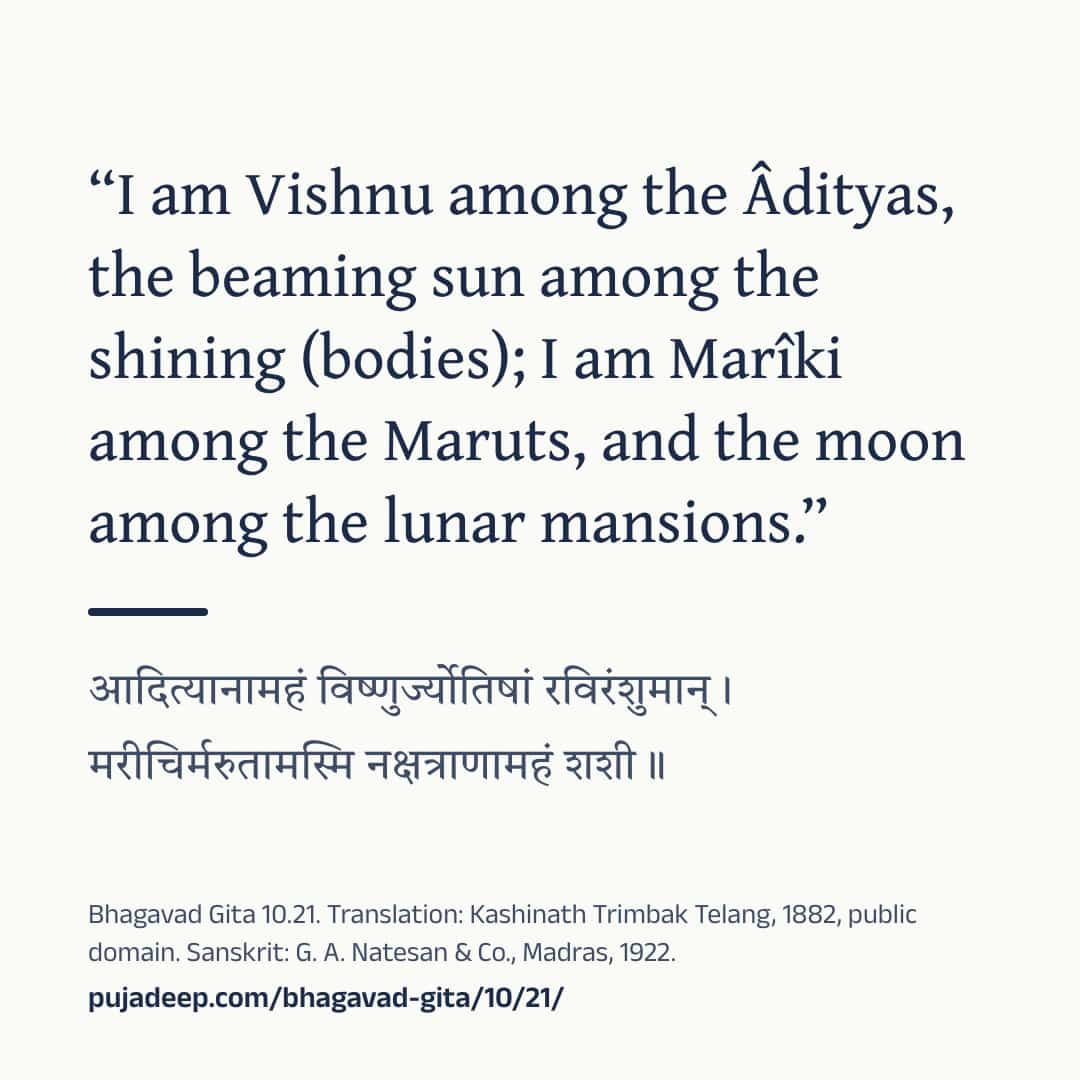
Drawing the picture
See the words
Bhagavad Gita 10.21

आदित्यानामहं विष्णुर्ज्योतिषां रविरंशुमान् ।
मरीचिर्मरुतामस्मि नक्षत्राणामहं शशी ॥

“I am Vishnu among the Âdityas, the beaming sun among the shining (bodies); I am Marîki among the Maruts, and the moon among the lunar mansions.”
(K. T. Telang, The Bhagavadgîtâ (The Sacred Books of the East, vol. VIII, Oxford: Clarendon Press, 1882), p. 88, public domain)

“Of the Âdityas I am Vishnu; of radiances the glorious Sun; I am Marîchi of the Maruts, of the asterisms the Moon am I.”
(Annie Besant, The Bhagavad Gîtâ, or The Lord's Song (London: Theosophical Publishing Society, 1895), p. 99, public domain)

“Of the Adityas I am Vishnu; of luminaries, the radiant Sun; of the winds, I am Marichi; of the asterisms, the Moon.”
(Swami Swarupananda, Srimad-Bhagavad-Gita (Mayavati: Prabuddha Bharata Press, 1909; first printed in Prabuddha Bharata, 1907–1909), p. 202, public domain)

Sanskrit: G. A. Natesan & Co., Madras, 1922.
https://pujadeep.com/bhagavad-gita/10/21/ Nothing is sent from this site. Your own app sends it, to the chat you choose. The picture quotes the translation you chose on this page, with its name and year.
Sanskrit text: The Bhagavad-Gita, or The Lord's Song, with the text in Devanagari and an English translation, 1922. Meanings: written for Pujadeep and checked against the cited edition. Source and changes
Questions families ask
Who speaks Bhagavad Gita 10.21?
Krishna speaks this verse, in chapter 10 (Vibhuti Yoga).
Where does the Sanskrit text come from?
Sanskrit text: The Bhagavad-Gita, or The Lord's Song, with the text in Devanagari and an English translation, 1922. Meanings: written for Pujadeep and checked against the cited edition. See the source
Is the meaning on this page a translation?
Explanation written for this site from the sources listed here, and checked against the cited edition. It is not a translation and not the only way to read the text. Free to quote with credit.
Source and licence
- Sanskrit text
- The Bhagavad-Gita, or The Lord's Song, with the text in Devanagari and an English translation (Annie Besant, G. A. Natesan & Co., Madras, 1922). Public domain. The Sanskrit on these pages was read from this printing’s page images.
- Translation
- The Bhagavadgîtâ with the Sanatsugâtîya and the Anugîtâ, translated by Kâshinâth Trimbak Telang (The Sacred Books of the East, vol. VIII, ed. F. Max Müller) (Kashinath Trimbak Telang, F. Max Müller, Clarendon Press, Oxford, 1882). Public domain. Shown verbatim, as printed.
- Translation
- The Bhagavad Gîtâ, or The Lord's Song, translated by Annie Besant (Annie Besant, Theosophical Publishing Society, London, 1895). Public domain. Shown verbatim, as printed.
- Translation
- Srimad-Bhagavad-Gita, with Sanskrit Text; Paraphrase with Word-by-word Literal Translation; English Rendering and Comments, Index, &c., by the Swami Swarupananda (Himalayan Series, No. XX) (Swami Swarupananda, The Editors and Publishers, Advaita Ashrama, Mayavati, Prabuddha Bharata Press, Mayavati, Almora, Himalayas, 1909). Public domain. Shown verbatim, as printed.
- Common wording
- In this text, 32 words follow today's common wording, checked against sanskritdocuments.org; Sanskrit Wikisource; Gita Press, Gorakhpur; GRETIL, Göttingen and Bhaktivedanta Book Trust.
- Our explanation
- Explanation written for this site from the sources listed here, and checked against the cited edition. It is not a translation and not the only way to read the text. Free to quote with credit.
- Checked
- Checked against the cited edition, October 15, 2026.
- Updated
- October 25, 2026