Bhagavad Gita 10.18: meaning and translation
Chapter 10: Vibhuti Yoga. Arjuna says
Arjuna asks Krishna, Janardana, to tell again in detail of his power (yoga) and glory (vibhūti), for he never tires of hearing these life-giving words.
Click or tap a word for its meaning and its dictionary page.
Text and layers
Text and layers
These choices stay in this browser.
Bhagavad Gita 10.18
विस्तरेणात्मनो योगं विभूतिं च जनार्दन ।भूयः कथय तृप्तिर्हि शृण्वतो नास्ति मेऽमृतम् ॥
Vistarenatmano yogam vibhutim cha janardanaBhuyah kathaya triptirhi shrinvato nasti memritam
vistareṇātmano yogaṃ vibhūtiṃ ca janārdana |bhūyaḥ kathaya tṛptirhi śṛṇvato nāsti me’mṛtam ||
Our explanation Arjuna asks Krishna, Janardana, to tell again in detail of his power (yoga) and glory (vibhūti), for he never tires of hearing these life-giving words.
हिंदी अर्थ अर्जुन कृष्ण (जनार्दन) से कहते हैं कि वे अपने योग और विभूति का फिर विस्तार से वर्णन करें, क्योंकि ये अमृत जैसे वचन सुनकर उनकी तृप्ति नहीं होती।
Word by word
Every word, with its dictionary page
Word by word
- विस्तरेण vistareṇa · in detail (noun (masculine), instrumental singular) Dictionary: vi-stara, Monier-Williams 1899, p. 1001, col. 3 “detail, particulars, full or detailed description”
- आत्मनः ātmanaḥ · your own (noun (masculine), genitive singular) Dictionary: ātman, Monier-Williams 1899, p. 135, col. 1 “is used as reflexive pronoun for all three persons and all three genders”
- योगम् yogam · power, yoga (noun (masculine), accusative singular) Dictionary: yoga, Monier-Williams 1899, p. 856, col. 2 “any junction, union, combination”
- विभूतिम् vibhūtim · glory (noun (feminine), accusative singular) Dictionary: vi-bhūti, Monier-Williams 1899, p. 979, col. 1 “splendour, glory, magnificence”
- च ca · and (indeclinable) Dictionary: 2. ca, Monier-Williams 1899, p. 380, col. 1 “and, both, also, moreover, as well as”
- जनार्दन janārdana · O Janardana (Krishna) (noun (masculine), vocative singular) Dictionary: janārdana, Monier-Williams 1899, p. 410, col. 3 “‘exciting or agitating men,’ Vishṇu or Kṛishṇa”
- भूयः bhūyaḥ · again (indeclinable) Dictionary: bhūyas, Monier-Williams 1899, p. 763, col. 3 “once more, again, anew”
- कथय kathaya · tell (imperative, 2nd person singular) Dictionary: kath, Monier-Williams 1899, p. 247, col. 1 “to tell, relate, narrate, report, inform, speak about, declare”
- तृप्तिः tṛptiḥ · satisfaction, having enough (noun (feminine), nominative singular) Dictionary: tṛpti, Monier-Williams 1899, p. 454, col. 1 “satisfaction, contentment”
- हि hi · for (indeclinable) Dictionary: 2. hi, Monier-Williams 1899, p. 1297, col. 3 “for, because, on account of”
- शृण्वतः śṛṇvataḥ · while hearing (present participle (masculine), genitive singular) Dictionary: 1. śru, Monier-Williams 1899, p. 1100, col. 3 “to hear, listen or attend to anything”
- न na · not (indeclinable) Dictionary: 2. na, Monier-Williams 1899, p. 523, col. 1 “not, no, nor, neither”
- अस्ति asti · is (present, 3rd person singular) Dictionary: 1. as, Monier-Williams 1899, p. 117, col. 2 “to be, live, exist, be present”
- मे me · for "me" (Arjuna) (pronoun, genitive singular) Dictionary: 1. mad, Monier-Williams 1899, p. 777, col. 2 “base of the first pers. pron. in the sg. number (esp. in comp.)”
- अमृतम् amṛtam · nectar (these words) (noun (neuter), accusative singular) Dictionary: a-mṛta, Monier-Williams 1899, p. 82, col. 2 “the nectar (conferring immortality, produced at the churning of the ocean), ambrosia”
Old translations
Kashinath Trimbak Telang, 1882. Public domain. Page 88.
Again, O Ganârdana! do you yourself declare your powers and emanations; because hearing this nectar, I (still) feel no satiety.
Compare 3 translations
Kashinath Trimbak Telang, 1882. Public domain. Page 88.
Again, O Ganârdana! do you yourself declare your powers and emanations; because hearing this nectar, I (still) feel no satiety.
You are reading this one
Annie Besant, 1895. Public domain. Page 98.
In minute detail tell me again of Thyself, Thy Yoga and sovereignty, O Janârdana; there is for me never satiety in hearing Thy life-giving words.
You are reading this one
Swami Swarupananda, 1909 (first printed 1907). Public domain. Page 201.
Speak to me again in detail, O Janârdana, of Thy Yoga-powers and attributes; for I am never satiated in hearing the ambrosia (of Thy speech).
You are reading this one
Cite this verse
The translation: K. T. Telang, The Bhagavadgîtâ (The Sacred Books of the East, vol. VIII, Oxford: Clarendon Press, 1882), p. 88. Bhagavad Gita 10.18.
The translation: Annie Besant, The Bhagavad Gîtâ, or The Lord's Song (London: Theosophical Publishing Society, 1895), p. 98. Bhagavad Gita 10.18.
The translation: Swami Swarupananda, Srimad-Bhagavad-Gita (Mayavati: Prabuddha Bharata Press, 1909; first printed in Prabuddha Bharata, 1907–1909), p. 201. Bhagavad Gita 10.18.
Our explanation: “Bhagavad Gita 10.18: meaning and translation.” Pujadeep. Updated October 25, 2026. https://pujadeep.com/bhagavad-gita/10/18/
Pujadeep’s explanations are free to quote with credit: name Pujadeep and link to the page. How to credit
Classical readings, by school
No readings by school on this verse yet.
Share
Show the ways to share
Send one picture or the text to one chat. The picture names its source and the address of this page.
Drawing the picture
See the words
Bhagavad Gita 10.18

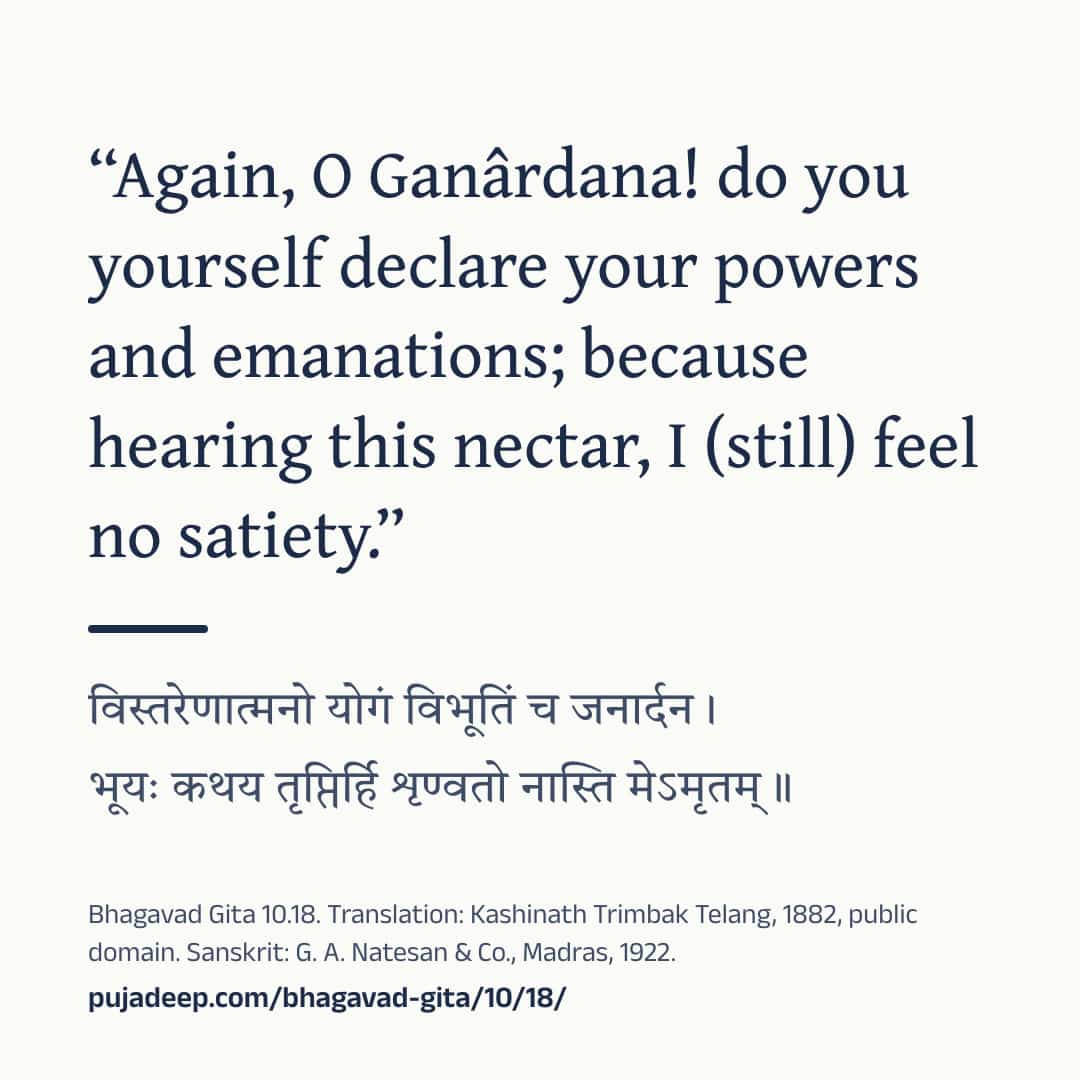
विस्तरेणात्मनो योगं विभूतिं च जनार्दन ।
भूयः कथय तृप्तिर्हि शृण्वतो नास्ति मेऽमृतम् ॥

“Again, O Ganârdana! do you yourself declare your powers and emanations; because hearing this nectar, I (still) feel no satiety.”
(K. T. Telang, The Bhagavadgîtâ (The Sacred Books of the East, vol. VIII, Oxford: Clarendon Press, 1882), p. 88, public domain)

“In minute detail tell me again of Thyself, Thy Yoga and sovereignty, O Janârdana; there is for me never satiety in hearing Thy life-giving words.”
(Annie Besant, The Bhagavad Gîtâ, or The Lord's Song (London: Theosophical Publishing Society, 1895), p. 98, public domain)

“Speak to me again in detail, O Janârdana, of Thy Yoga-powers and attributes; for I am never satiated in hearing the ambrosia (of Thy speech).”
(Swami Swarupananda, Srimad-Bhagavad-Gita (Mayavati: Prabuddha Bharata Press, 1909; first printed in Prabuddha Bharata, 1907–1909), p. 201, public domain)

Sanskrit: G. A. Natesan & Co., Madras, 1922.
https://pujadeep.com/bhagavad-gita/10/18/ Nothing is sent from this site. Your own app sends it, to the chat you choose. The picture quotes the translation you chose on this page, with its name and year.
Sanskrit text: The Bhagavad-Gita, or The Lord's Song, with the text in Devanagari and an English translation, 1922. Meanings: written for Pujadeep and checked against the cited edition. Source and changes
Questions families ask
Who speaks Bhagavad Gita 10.18?
Arjuna speaks this verse, in chapter 10 (Vibhuti Yoga).
Where does the Sanskrit text come from?
Sanskrit text: The Bhagavad-Gita, or The Lord's Song, with the text in Devanagari and an English translation, 1922. Meanings: written for Pujadeep and checked against the cited edition. See the source
Is the meaning on this page a translation?
Explanation written for this site from the sources listed here, and checked against the cited edition. It is not a translation and not the only way to read the text. Free to quote with credit.
Source and licence
- Sanskrit text
- The Bhagavad-Gita, or The Lord's Song, with the text in Devanagari and an English translation (Annie Besant, G. A. Natesan & Co., Madras, 1922). Public domain. The Sanskrit on these pages was read from this printing’s page images.
- Translation
- The Bhagavadgîtâ with the Sanatsugâtîya and the Anugîtâ, translated by Kâshinâth Trimbak Telang (The Sacred Books of the East, vol. VIII, ed. F. Max Müller) (Kashinath Trimbak Telang, F. Max Müller, Clarendon Press, Oxford, 1882). Public domain. Shown verbatim, as printed.
- Translation
- The Bhagavad Gîtâ, or The Lord's Song, translated by Annie Besant (Annie Besant, Theosophical Publishing Society, London, 1895). Public domain. Shown verbatim, as printed.
- Translation
- Srimad-Bhagavad-Gita, with Sanskrit Text; Paraphrase with Word-by-word Literal Translation; English Rendering and Comments, Index, &c., by the Swami Swarupananda (Himalayan Series, No. XX) (Swami Swarupananda, The Editors and Publishers, Advaita Ashrama, Mayavati, Prabuddha Bharata Press, Mayavati, Almora, Himalayas, 1909). Public domain. Shown verbatim, as printed.
- Common wording
- In this text, 32 words follow today's common wording, checked against sanskritdocuments.org; Sanskrit Wikisource; Gita Press, Gorakhpur; GRETIL, Göttingen and Bhaktivedanta Book Trust.
- Our explanation
- Explanation written for this site from the sources listed here, and checked against the cited edition. It is not a translation and not the only way to read the text. Free to quote with credit.
- Checked
- Checked against the cited edition, October 15, 2026.
- Updated
- October 25, 2026