Bhagavad Gita 10.9: meaning and translation
Chapter 10: Vibhuti Yoga. Krishna says
With their minds on Krishna and their lives given to him, such people teach one another, always speak of him, and are content and full of joy, Krishna says.
Click or tap a word for its meaning and its dictionary page.
Text and layers
Text and layers
These choices stay in this browser.
Bhagavad Gita 10.9
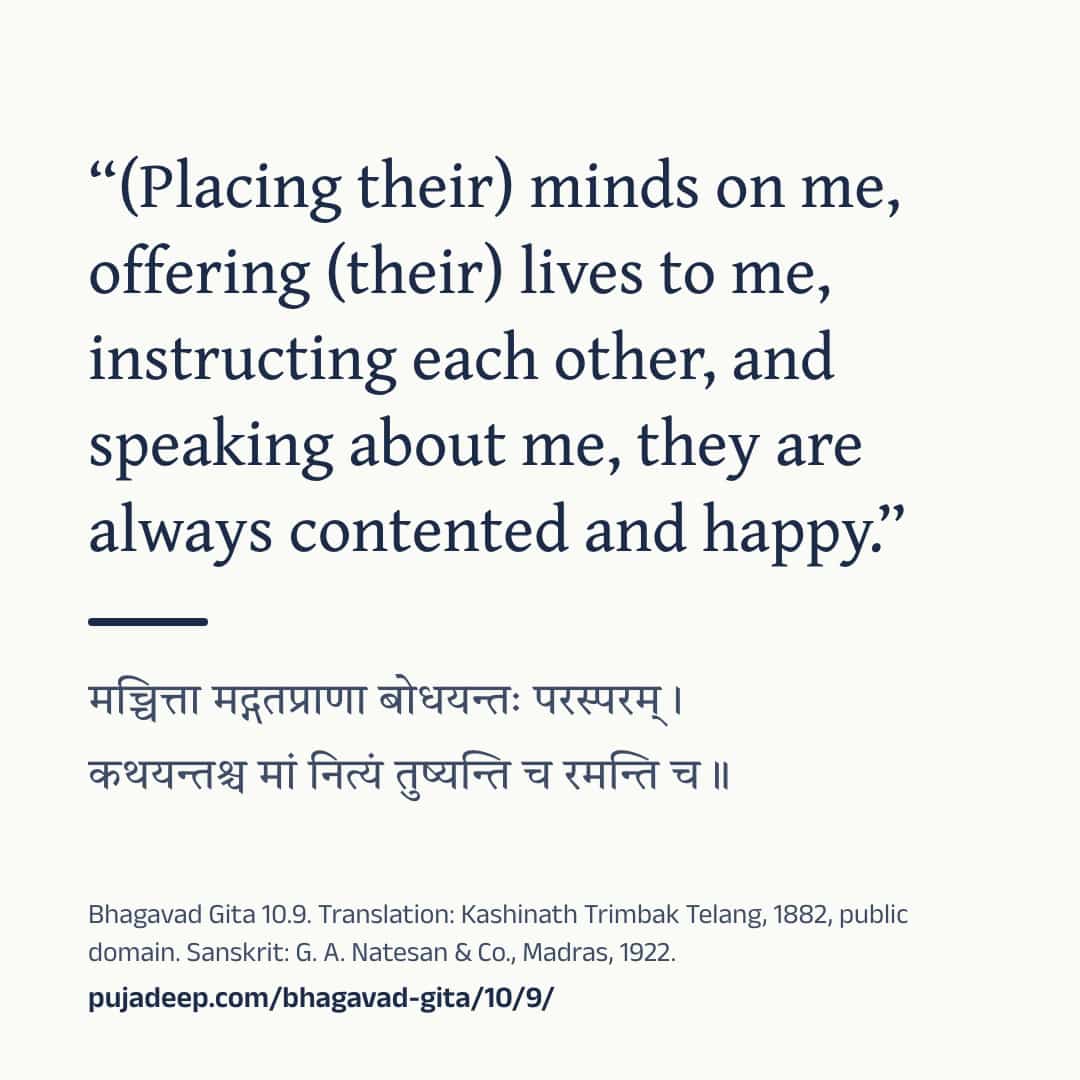
मच्चित्ता मद्गतप्राणा बोधयन्तः परस्परम् ।कथयन्तश्च मां नित्यं तुष्यन्ति च रमन्ति च ॥
Machchitta madgataprana bodhayantah parasparamKathayantashcha mam nityam tushyanti cha ramanti cha
maccittā madgataprāṇā bodhayantaḥ parasparam |kathayantaśca māṃ nityaṃ tuṣyanti ca ramanti ca ||
Our explanation With their minds on Krishna and their lives given to him, such people teach one another, always speak of him, and are content and full of joy, Krishna says.
हिंदी अर्थ कृष्ण कहते हैं कि ऐसे लोग अपना चित्त उनमें लगाकर, अपने प्राण उन्हें अर्पित करके, एक-दूसरे को समझाते हुए और सदा उनकी चर्चा करते हुए संतुष्ट और आनंदित रहते हैं।
Word by word
Every word, with its dictionary page
Word by word
- मच्चित्ताः maccittāḥ · with minds fixed on "me" (Krishna) (compound (masculine), nominative plural) Dictionary: 1. mad, Monier-Williams 1899, p. 777, col. 2 “base of the first pers. pron. in the sg. number (esp. in comp.)”; citta, Monier-Williams 1899, p. 395, col. 3 “the heart, mind”
- मद्गतप्राणाः madgataprāṇāḥ · with lives given to "me" (Krishna) (compound (masculine), nominative plural) Dictionary: 1. mad, Monier-Williams 1899, p. 777, col. 2 “base of the first pers. pron. in the sg. number (esp. in comp.)”; gata, Monier-Williams 1899, p. 347, col. 1 “gone, gone away; … come to, approached, arrived at, being in, situated in”; 2. prāṇa, Monier-Williams 1899, p. 705, col. 1 “the breath of life, breath, respiration, spirit, vitality”
- बोधयन्तः bodhayantaḥ · teaching, enlightening (present participle (masculine), nominative plural) Dictionary: 1. budh, Monier-Williams 1899, p. 733, col. 2 “to make a person acquainted with, remind or inform of, impart or communicate”
- परस्परम् parasparam · one another (indeclinable) Dictionary: paras-para, Monier-Williams 1899, p. 589, col. 1 “one another's, mutually, reciprocally”
- कथयन्तः kathayantaḥ · speaking of (present participle (masculine), nominative plural) Dictionary: kath, Monier-Williams 1899, p. 247, col. 1 “to tell, relate, narrate, report, inform, speak about, declare”
- च ca · and (indeclinable) Dictionary: 2. ca, Monier-Williams 1899, p. 380, col. 1 “and, both, also, moreover, as well as”
- माम् mām · of "me" (Krishna) (pronoun, accusative singular) Dictionary: 1. mad, Monier-Williams 1899, p. 777, col. 2 “base of the first pers. pron. in the sg. number (esp. in comp.)”
- नित्यम् nityam · always (adverb) Dictionary: nitya, Monier-Williams 1899, p. 547, col. 2 “(am), ind. always, constantly, regularly”
- तुष्यन्ति tuṣyanti · are content (present, 3rd person plural) Dictionary: tuṣ, Monier-Williams 1899, p. 452, col. 1 “to become calm, be satisfied or pleased”
- च ca · and (indeclinable) Dictionary: 2. ca, Monier-Williams 1899, p. 380, col. 1 “and, both, also, moreover, as well as”
- रमन्ति ramanti · rejoice (present, 3rd person plural) Dictionary: ram, Monier-Williams 1899, p. 867, col. 2 “to be glad or pleased, rejoice at, delight in”
- च ca · and (indeclinable) Dictionary: 2. ca, Monier-Williams 1899, p. 380, col. 1 “and, both, also, moreover, as well as”
Old translations
Kashinath Trimbak Telang, 1882. Public domain. Page 87.
(Placing their) minds on me, offering (their) lives to me, instructing each other, and speaking about me, they are always contented and happy.
Compare 3 translations
Kashinath Trimbak Telang, 1882. Public domain. Page 87.
(Placing their) minds on me, offering (their) lives to me, instructing each other, and speaking about me, they are always contented and happy.
You are reading this one
Annie Besant, 1895. Public domain. Page 96.
Mindful of Me, their life hidden in Me, teaching each other grade by grade, ever conversing about Me, they are content and joyful.
You are reading this one
Swami Swarupananda, 1909 (first printed 1907). Public domain. Page 197.
With their minds wholly in Me, with their senses absorbed in Me, mutually enlightening, and always speaking of Me, they are satisfied and delighted.
You are reading this one
Cite this verse
The translation: K. T. Telang, The Bhagavadgîtâ (The Sacred Books of the East, vol. VIII, Oxford: Clarendon Press, 1882), p. 87. Bhagavad Gita 10.9.
The translation: Annie Besant, The Bhagavad Gîtâ, or The Lord's Song (London: Theosophical Publishing Society, 1895), p. 96. Bhagavad Gita 10.9.
The translation: Swami Swarupananda, Srimad-Bhagavad-Gita (Mayavati: Prabuddha Bharata Press, 1909; first printed in Prabuddha Bharata, 1907–1909), p. 197. Bhagavad Gita 10.9.
Our explanation: “Bhagavad Gita 10.9: meaning and translation.” Pujadeep. Updated October 25, 2026. https://pujadeep.com/bhagavad-gita/10/9/
Pujadeep’s explanations are free to quote with credit: name Pujadeep and link to the page. How to credit
Classical readings, by school
No readings by school on this verse yet.
Share
Show the ways to share
Send one picture or the text to one chat. The picture names its source and the address of this page.
Drawing the picture
See the words
Bhagavad Gita 10.9

मच्चित्ता मद्गतप्राणा बोधयन्तः परस्परम् ।
कथयन्तश्च मां नित्यं तुष्यन्ति च रमन्ति च ॥

“(Placing their) minds on me, offering (their) lives to me, instructing each other, and speaking about me, they are always contented and happy.”
(K. T. Telang, The Bhagavadgîtâ (The Sacred Books of the East, vol. VIII, Oxford: Clarendon Press, 1882), p. 87, public domain)

“Mindful of Me, their life hidden in Me, teaching each other grade by grade, ever conversing about Me, they are content and joyful.”
(Annie Besant, The Bhagavad Gîtâ, or The Lord's Song (London: Theosophical Publishing Society, 1895), p. 96, public domain)

“With their minds wholly in Me, with their senses absorbed in Me, mutually enlightening, and always speaking of Me, they are satisfied and delighted.”
(Swami Swarupananda, Srimad-Bhagavad-Gita (Mayavati: Prabuddha Bharata Press, 1909; first printed in Prabuddha Bharata, 1907–1909), p. 197, public domain)

Sanskrit: G. A. Natesan & Co., Madras, 1922.
https://pujadeep.com/bhagavad-gita/10/9/ Nothing is sent from this site. Your own app sends it, to the chat you choose. The picture quotes the translation you chose on this page, with its name and year.
Sanskrit text: The Bhagavad-Gita, or The Lord's Song, with the text in Devanagari and an English translation, 1922. Meanings: written for Pujadeep and checked against the cited edition. Source and changes
Questions families ask
Who speaks Bhagavad Gita 10.9?
Krishna speaks this verse, in chapter 10 (Vibhuti Yoga).
Where does the Sanskrit text come from?
Sanskrit text: The Bhagavad-Gita, or The Lord's Song, with the text in Devanagari and an English translation, 1922. Meanings: written for Pujadeep and checked against the cited edition. See the source
Is the meaning on this page a translation?
Explanation written for this site from the sources listed here, and checked against the cited edition. It is not a translation and not the only way to read the text. Free to quote with credit.
Source and licence
- Sanskrit text
- The Bhagavad-Gita, or The Lord's Song, with the text in Devanagari and an English translation (Annie Besant, G. A. Natesan & Co., Madras, 1922). Public domain. The Sanskrit on these pages was read from this printing’s page images.
- Translation
- The Bhagavadgîtâ with the Sanatsugâtîya and the Anugîtâ, translated by Kâshinâth Trimbak Telang (The Sacred Books of the East, vol. VIII, ed. F. Max Müller) (Kashinath Trimbak Telang, F. Max Müller, Clarendon Press, Oxford, 1882). Public domain. Shown verbatim, as printed.
- Translation
- The Bhagavad Gîtâ, or The Lord's Song, translated by Annie Besant (Annie Besant, Theosophical Publishing Society, London, 1895). Public domain. Shown verbatim, as printed.
- Translation
- Srimad-Bhagavad-Gita, with Sanskrit Text; Paraphrase with Word-by-word Literal Translation; English Rendering and Comments, Index, &c., by the Swami Swarupananda (Himalayan Series, No. XX) (Swami Swarupananda, The Editors and Publishers, Advaita Ashrama, Mayavati, Prabuddha Bharata Press, Mayavati, Almora, Himalayas, 1909). Public domain. Shown verbatim, as printed.
- Common wording
- In this text, 32 words follow today's common wording, checked against sanskritdocuments.org; Sanskrit Wikisource; Gita Press, Gorakhpur; GRETIL, Göttingen and Bhaktivedanta Book Trust.
- Our explanation
- Explanation written for this site from the sources listed here, and checked against the cited edition. It is not a translation and not the only way to read the text. Free to quote with credit.
- Checked
- Checked against the cited edition, October 15, 2026.
- Updated
- October 25, 2026