Bhagavad Gita 10.12: meaning and translation
Chapter 10: Vibhuti Yoga. Arjuna says
Arjuna speaks.
Click or tap a word for its meaning and its dictionary page.
Text and layers
Text and layers
These choices stay in this browser.
Bhagavad Gita 10.12
अर्जुन उवाच ।
परं ब्रह्म परं धाम पवित्रं परमं भवान् ।पुरुषं शाश्वतं दिव्यमादिदेवमजं विभुम् ॥
Param brahma param dhama pavitram paramam bhavanPurusham shashvatam divyamadidevamajam vibhum
paraṃ brahma paraṃ dhāma pavitraṃ paramaṃ bhavān |puruṣaṃ śāśvataṃ divyamādidevamajaṃ vibhum ||
Our explanation Arjuna speaks. He says that Krishna is the supreme Brahman, the supreme abode, the supreme purifier: the eternal, divine Person (puruṣa), the first of the gods, unborn and all-pervading. The sentence continues in the next verse.
हिंदी अर्थ अर्जुन बोलते हैं। वे कहते हैं कि कृष्ण परम ब्रह्म हैं, परम धाम हैं, परम पवित्र हैं: शाश्वत, दिव्य पुरुष, आदिदेव, अजन्मा और सर्वव्यापी। यह वाक्य अगले श्लोक में पूरा होता है।
Word by word
Every word, with its dictionary page
Word by word
- परम् param · supreme (adjective (neuter), nominative singular) Dictionary: 1. para, Monier-Williams 1899, p. 586, col. 1 “better or worse than, superior or inferior to, best or worst, highest, supreme, chief”
- ब्रह्म brahma · Brahman (noun (neuter), nominative singular) Dictionary: brahman, Monier-Williams 1899, p. 738, col. 1 “one self-existent impersonal Spirit, the one universal Soul”
- परम् param · supreme (adjective (neuter), nominative singular) Dictionary: 1. para, Monier-Williams 1899, p. 586, col. 1 “better or worse than, superior or inferior to, best or worst, highest, supreme, chief”
- धाम dhāma · abode (noun (neuter), nominative singular) Dictionary: dhāman, Monier-Williams 1899, p. 514, col. 3 “dwelling-place, house, abode, domain”
- पवित्रम् pavitram · purifier (adjective (neuter), nominative singular) Dictionary: pavitra, Monier-Williams 1899, p. 611, col. 1 “purifying, averting evil, pure, holy, sacred, sinless, beneficent”
- परमम् paramam · supreme (adjective (neuter), nominative singular) Dictionary: parama, Monier-Williams 1899, p. 588, col. 1 “chief, highest, primary, most prominent or conspicuous”
- भवान् bhavān · you (in respect) (pronoun (masculine), nominative singular) Dictionary: 1. bhavat, Monier-Williams 1899, p. 749, col. 2 “your honour, your worship, your lordship or ladyship, you”
- पुरुषम् puruṣam · the Person (puruṣa) (noun (masculine), accusative singular) Dictionary: puruṣa, Monier-Williams 1899, p. 637, col. 1 “the Supreme Being or Soul of the universe”
- शाश्वतम् śāśvatam · eternal (adjective (masculine), accusative singular) Dictionary: śāśvata, Monier-Williams 1899, p. 1068, col. 3 “eternal, constant, perpetual”
- दिव्यम् divyam · divine (adjective (masculine), accusative singular) Dictionary: 2. divya, Monier-Williams 1899, p. 479, col. 2 “divine, heavenly, celestial”
- आदिदेवम् ādidevam · the first god (compound (masculine), accusative singular) Dictionary: ādi-deva, Monier-Williams 1899, p. 137, col. 1 “‘the first god;’ N. of Brahman, Vishṇu, Śiva, Gaṇeśa, the sun”
- अजम् ajam · unborn (adjective (masculine), accusative singular) Dictionary: a-ja, Monier-Williams 1899, p. 9, col. 3 “not born, existing from all eternity”
- विभुम् vibhum · all-pervading (adjective (masculine), accusative singular) Dictionary: vi-bhu, Monier-Williams 1899, p. 978, col. 3 “being everywhere, far-extending, all-pervading, omnipresent, eternal”
Old translations
Kashinath Trimbak Telang, 1882. Public domain. Page 87.
Arguna said:
You are the supreme Brahman, the supreme goal, the holiest of the holy. All sages, as well as the divine sage Nârada, Asita1, Devala, and Vyâsa, call you the eternal being, divine, the first god, the unborn, the all-pervading. And so, too, you tell me yourself, O Kesava!
This sentence covers verses 10.12 to 10.13.
Footnotes (the translator’s own) - Ânandagiri calls Asita father of Devala. See also Davids' Buddhism, p. 185; Müller's Anc. Sansk. Lit., p. 463. ↩
Compare 3 translations
Kashinath Trimbak Telang, 1882. Public domain. Page 87.
Arguna said:
You are the supreme Brahman, the supreme goal, the holiest of the holy. All sages, as well as the divine sage Nârada, Asita1, Devala, and Vyâsa, call you the eternal being, divine, the first god, the unborn, the all-pervading. And so, too, you tell me yourself, O Kesava!
This sentence covers verses 10.12 to 10.13.
Footnotes (the translator’s own) - Ânandagiri calls Asita father of Devala. See also Davids' Buddhism, p. 185; Müller's Anc. Sansk. Lit., p. 463. ↩
You are reading this one
Annie Besant, 1895. Public domain. Page 97.
Arjuna said:
Thou art the supreme Brahman, the supreme Abode, the supreme Purifier; Purusha! Eternal, Divine, Primeval God, unborn, the Lord!
You are reading this one
Swami Swarupananda, 1909 (first printed 1907). Public domain. Page 199.
Arjuna said:
The Supreme Brahman, the Supreme Abode, the Supreme Purifier, art Thou. All the Rishis, the Deva-Rishi Nàrada as well as Asita, Devala and Vyâsa have declared Thee as the Eternal, the Self-luminous Purusha, the first Deva, birthless and All-pervading. So also Thou Thyself, sayest to me.
This sentence covers verses 10.12 to 10.13.
You are reading this one
Cite this verse
The translation: K. T. Telang, The Bhagavadgîtâ (The Sacred Books of the East, vol. VIII, Oxford: Clarendon Press, 1882), p. 87. Bhagavad Gita 10.12–13.
The translation: Annie Besant, The Bhagavad Gîtâ, or The Lord's Song (London: Theosophical Publishing Society, 1895), p. 97. Bhagavad Gita 10.12.
The translation: Swami Swarupananda, Srimad-Bhagavad-Gita (Mayavati: Prabuddha Bharata Press, 1909; first printed in Prabuddha Bharata, 1907–1909), p. 199. Bhagavad Gita 10.12–13.
Our explanation: “Bhagavad Gita 10.12: meaning and translation.” Pujadeep. Updated October 25, 2026. https://pujadeep.com/bhagavad-gita/10/12/
Pujadeep’s explanations are free to quote with credit: name Pujadeep and link to the page. How to credit
Classical readings, by school
No readings by school on this verse yet.
Share
Show the ways to share
Send one picture or the text to one chat. The picture names its source and the address of this page.
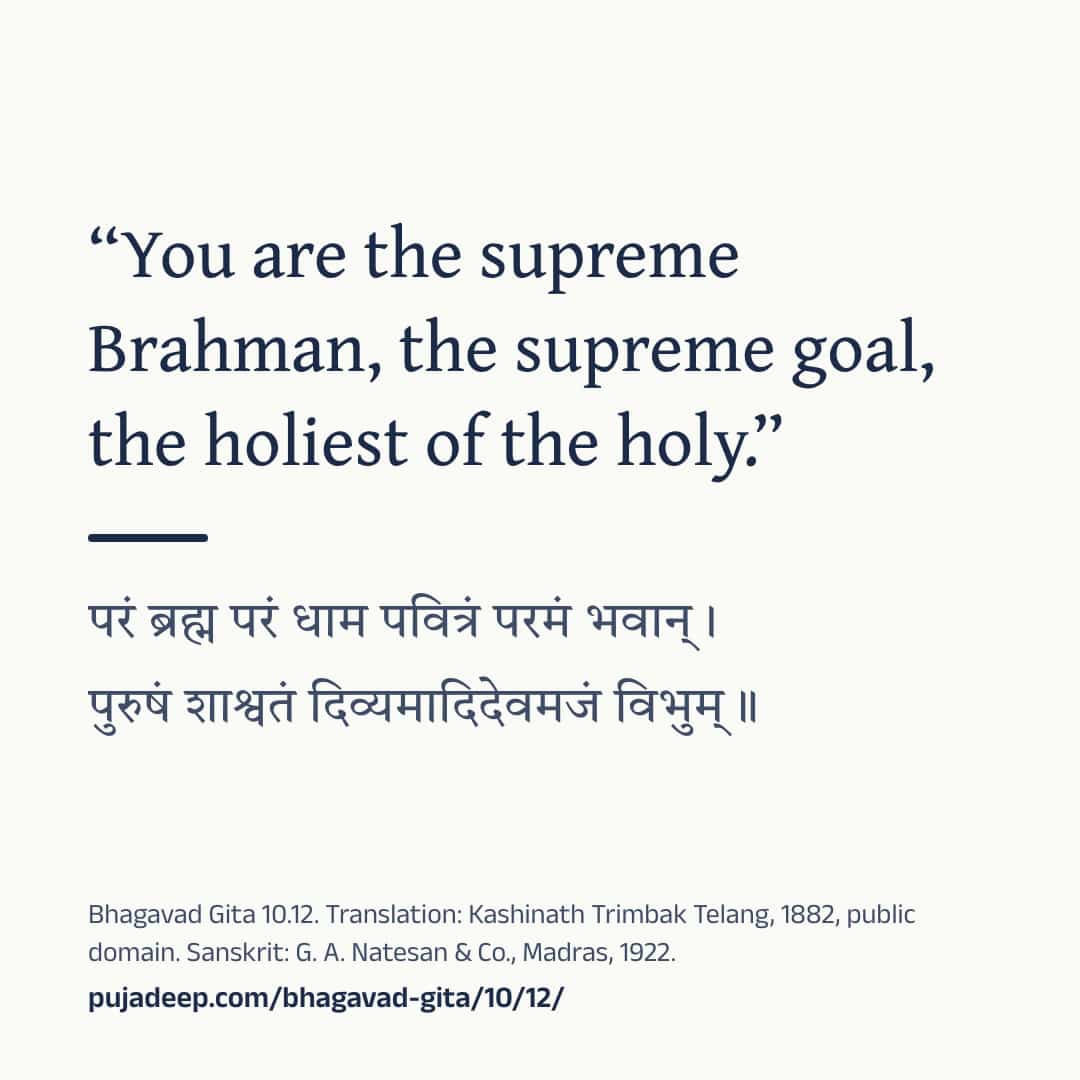
Drawing the picture
See the words
Bhagavad Gita 10.12

परं ब्रह्म परं धाम पवित्रं परमं भवान् ।
पुरुषं शाश्वतं दिव्यमादिदेवमजं विभुम् ॥

“You are the supreme Brahman, the supreme goal, the holiest of the holy. All sages, as well as the divine sage Nârada, Asita, Devala, and Vyâsa, call you the eternal being, divine, the first god, the unborn, the all-pervading. And so, too, you tell me yourself, O Kesava!”
(K. T. Telang, The Bhagavadgîtâ (The Sacred Books of the East, vol. VIII, Oxford: Clarendon Press, 1882), p. 87, public domain)
This sentence covers verses 10.12 to 10.13.

“Thou art the supreme Brahman, the supreme Abode, the supreme Purifier; Purusha! Eternal, Divine, Primeval God, unborn, the Lord!”
(Annie Besant, The Bhagavad Gîtâ, or The Lord's Song (London: Theosophical Publishing Society, 1895), p. 97, public domain)

“The Supreme Brahman, the Supreme Abode, the Supreme Purifier, art Thou. All the Rishis, the Deva-Rishi Nàrada as well as Asita, Devala and Vyâsa have declared Thee as the Eternal, the Self-luminous Purusha, the first Deva, birthless and All-pervading. So also Thou Thyself, sayest to me.”
(Swami Swarupananda, Srimad-Bhagavad-Gita (Mayavati: Prabuddha Bharata Press, 1909; first printed in Prabuddha Bharata, 1907–1909), p. 199, public domain)
This sentence covers verses 10.12 to 10.13.

Sanskrit: G. A. Natesan & Co., Madras, 1922.
https://pujadeep.com/bhagavad-gita/10/12/ Nothing is sent from this site. Your own app sends it, to the chat you choose. The picture quotes the translation you chose on this page, with its name and year.
Sanskrit text: The Bhagavad-Gita, or The Lord's Song, with the text in Devanagari and an English translation, 1922. Meanings: written for Pujadeep and checked against the cited edition. Source and changes
Questions families ask
Who speaks Bhagavad Gita 10.12?
Arjuna speaks this verse, in chapter 10 (Vibhuti Yoga).
Where does the Sanskrit text come from?
Sanskrit text: The Bhagavad-Gita, or The Lord's Song, with the text in Devanagari and an English translation, 1922. Meanings: written for Pujadeep and checked against the cited edition. See the source
Is the meaning on this page a translation?
Explanation written for this site from the sources listed here, and checked against the cited edition. It is not a translation and not the only way to read the text. Free to quote with credit.
Source and licence
- Sanskrit text
- The Bhagavad-Gita, or The Lord's Song, with the text in Devanagari and an English translation (Annie Besant, G. A. Natesan & Co., Madras, 1922). Public domain. The Sanskrit on these pages was read from this printing’s page images.
- Translation
- The Bhagavadgîtâ with the Sanatsugâtîya and the Anugîtâ, translated by Kâshinâth Trimbak Telang (The Sacred Books of the East, vol. VIII, ed. F. Max Müller) (Kashinath Trimbak Telang, F. Max Müller, Clarendon Press, Oxford, 1882). Public domain. Shown verbatim, as printed.
- Translation
- The Bhagavad Gîtâ, or The Lord's Song, translated by Annie Besant (Annie Besant, Theosophical Publishing Society, London, 1895). Public domain. Shown verbatim, as printed.
- Translation
- Srimad-Bhagavad-Gita, with Sanskrit Text; Paraphrase with Word-by-word Literal Translation; English Rendering and Comments, Index, &c., by the Swami Swarupananda (Himalayan Series, No. XX) (Swami Swarupananda, The Editors and Publishers, Advaita Ashrama, Mayavati, Prabuddha Bharata Press, Mayavati, Almora, Himalayas, 1909). Public domain. Shown verbatim, as printed.
- Common wording
- In this text, 32 words follow today's common wording, checked against sanskritdocuments.org; Sanskrit Wikisource; Gita Press, Gorakhpur; GRETIL, Göttingen and Bhaktivedanta Book Trust.
- Our explanation
- Explanation written for this site from the sources listed here, and checked against the cited edition. It is not a translation and not the only way to read the text. Free to quote with credit.
- Checked
- Checked against the cited edition, October 15, 2026.
- Updated
- October 25, 2026